Tate
About the Exhibition
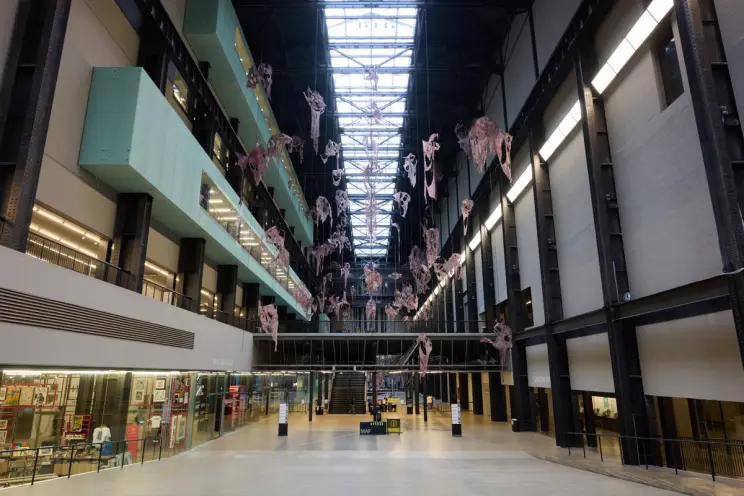
Mire Lee presents a large-scale sculptural installation for Tate Modern's Turbine Hall as the ninth Hyundai Commission artist. Lee reimagines the Turbine Hall as the inside of a body, transforming it into an eerie, fantastical factory. Blending her interest in rigid mechanical systems and soft organic forms with Tate Modern’s industrial architecture, the work reflects on the emotional and physical impact of living amid precarity and decline.
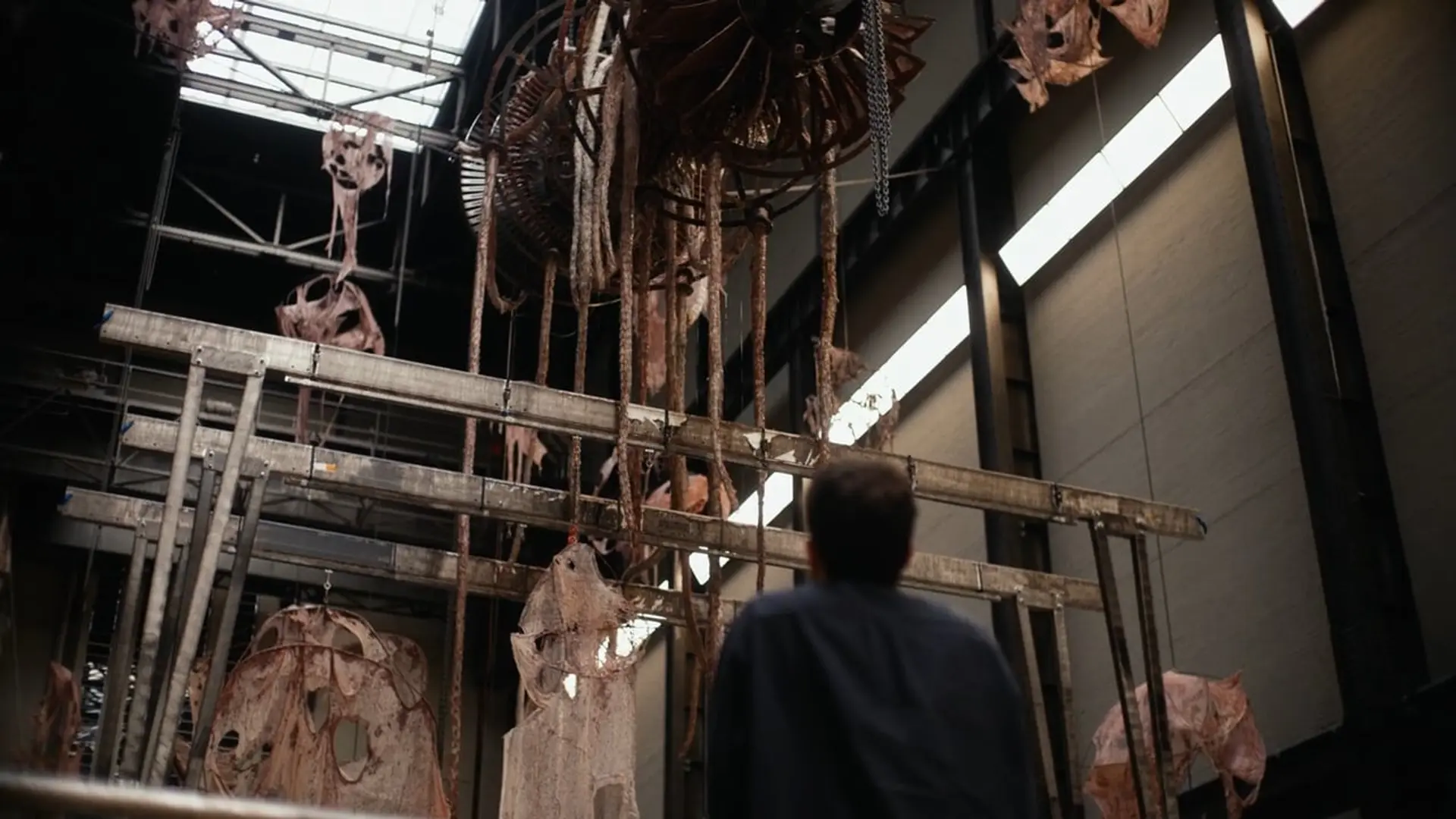
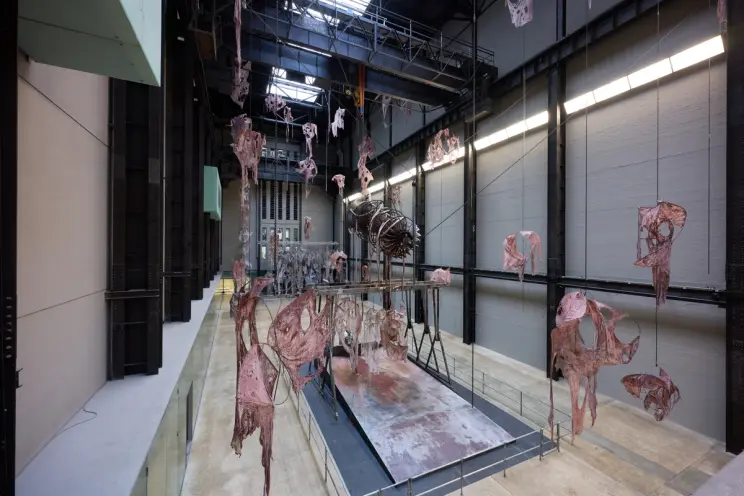
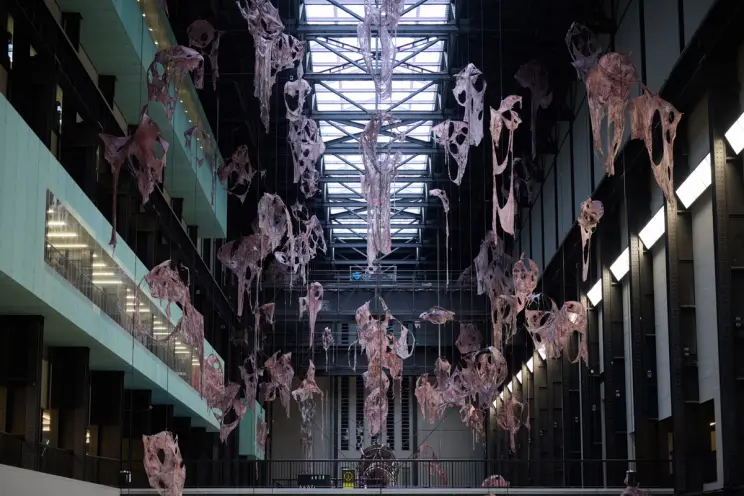
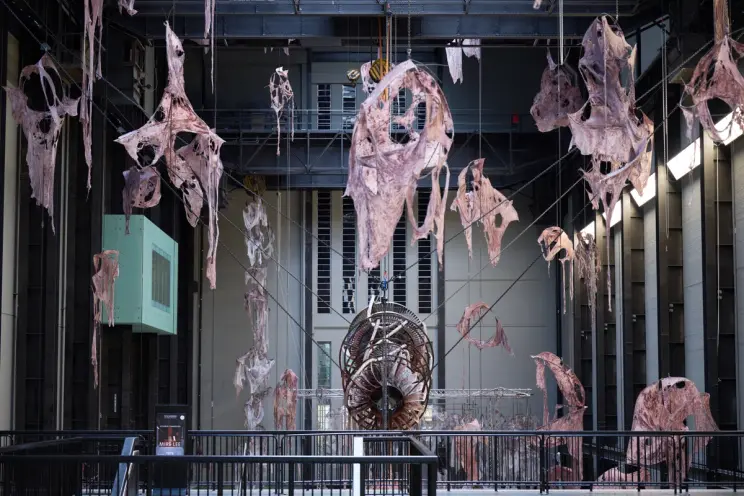
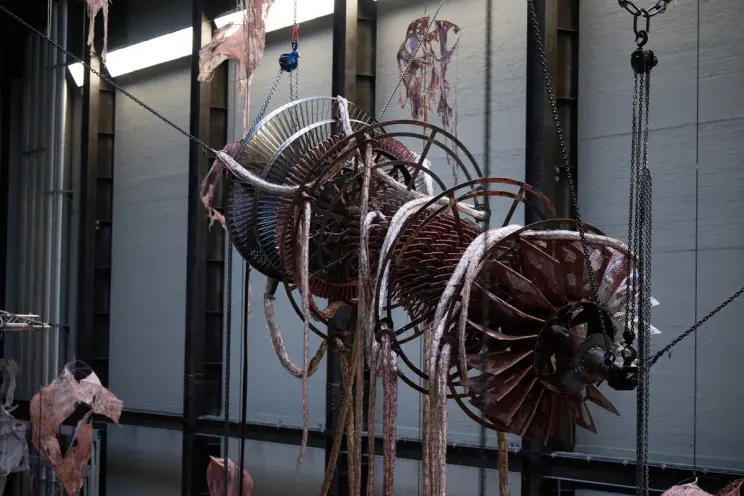
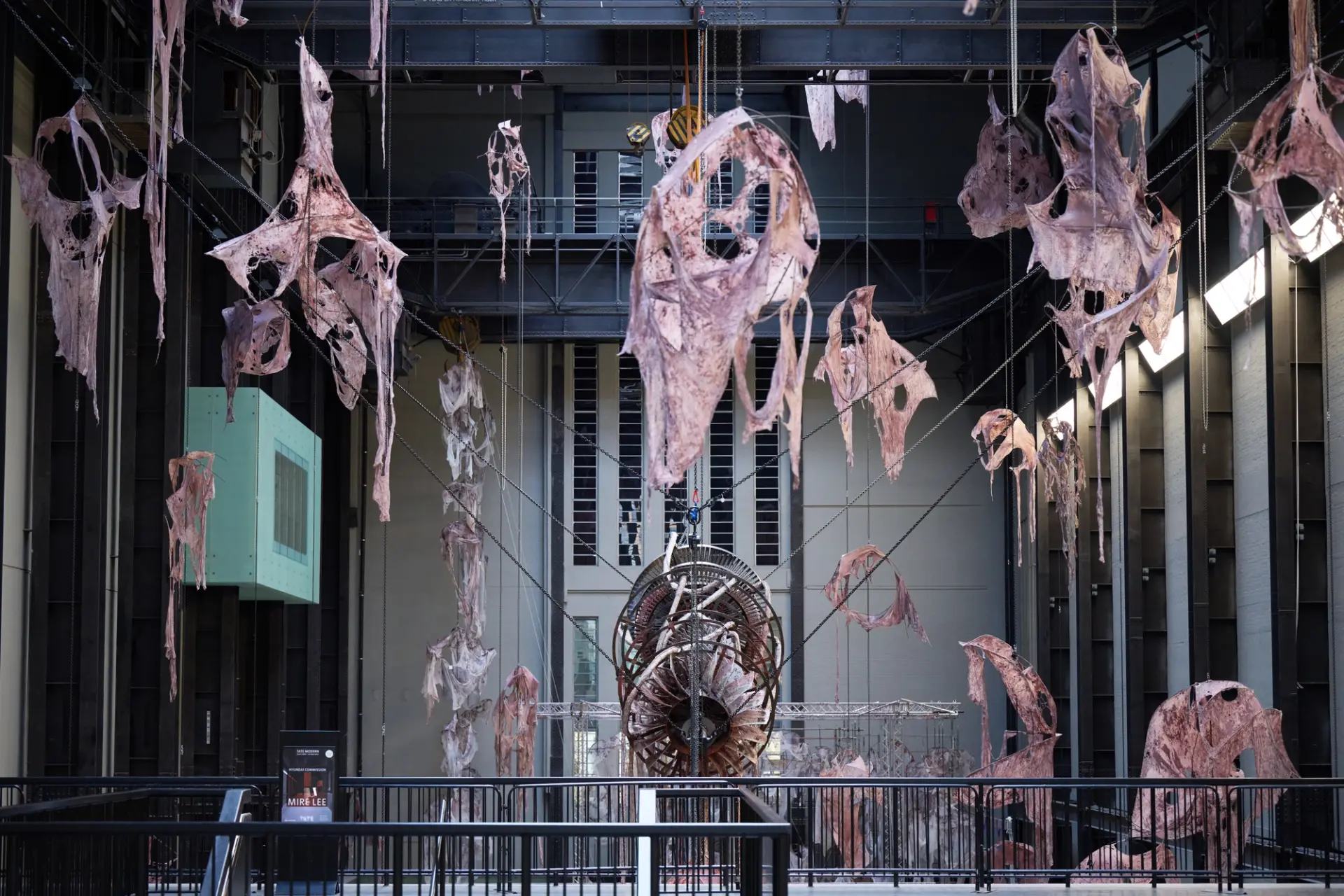
Hyundai Commission: Mire Lee: Open Wound transforms the Turbine Hall into a construction site filled with membranous fabric sculptures, or "skins," suspended from 49 metal chains. At the east end, a seven-meter-long turbine hangs from an original crane, recommissioned for this installation. This motorized piece references the turbines that once powered Bankside Power Station, the building’s former identity.
The slowly spinning turbine takes on human qualities, pumping dark pink liquid through vein-like silicone tubes, collecting in a large tray below. Fabric sculptures of construction mesh and steel rebar hang, absorbing the liquid and forming new 'skin' sculptures. These are carried by technicians to drying racks, in a process that feels artisanal yet industrial. Once dry, the skins are suspended from the ceiling. Throughout the commission, the number of hanging skins will increase, evoking a sense of the building "shedding" over time.
Materiality is central to Lee's practice, using visceral sculptures to provoke emotional responses. Employing her distinct visual language that merges organic forms with industrial materials, Hyundai Commission: Mire Lee: Open Wound explores contrasts: human and machine, soft and hard, inside and outside. The installation evokes a range of emotions—tenderness, empathy, melancholy, awe, and even disgust. Engaging the senses, Lee reflects on fears, vulnerabilities, hopes, and desires as we face an uncertain future together.
Hyundai Commission: Mire Lee: Open Wound is curated by Alvin Li, Curator, International Art, supported by Asymmetry Art Foundation, Tate Modern; and Bilal Akkouche, Assistant Curator, Tate Modern; and produced by Nancy Cooper, Production Manager, Tate Modern. It will be accompanied by a new book from Tate Publishing.
About the Artist
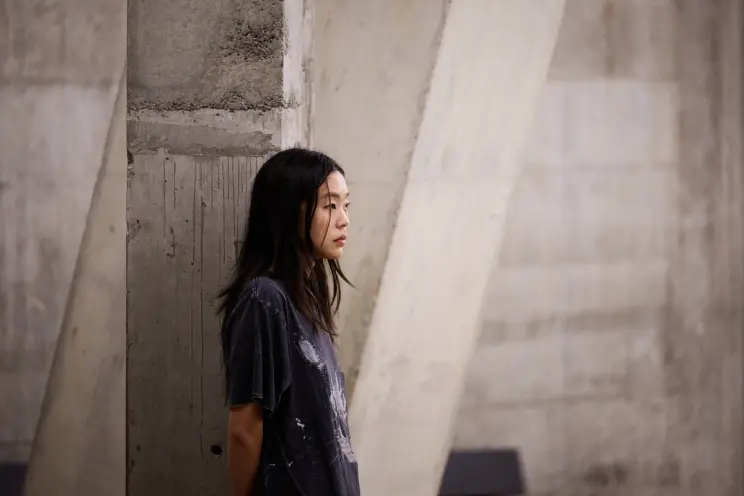
Mire Lee lives and works between Seoul, South Korea and Amsterdam, Netherlands. She has a bachelor’s degree from the Department of Sculpture (2012) and a bachelor's degree in Media Arts (2013) from the Seoul National University College of Fine Arts. Her recent solo exhibitions include Black Sun (2023) at the New Museum, New York; Look, I’m a fountain of filth raving mad with love (2022) at ZOLLAMTMMK, MMK Frankfurt; HR Giger & Mire Lee (2022) at Schinkel Pavillon, Berlin; and Carriers (2020) at Art Sonje Center, Seoul.
Lee’s work was also featured in several group exhibitions including presentations at the 59th Biennale di Venezia, Venice (2022), 11th Busan Biennale (2022), Kunstverein Freiburg, Freiburg (2021), Antenna Space, Shanghai (2020), the 15th Biennale de Lyon, Lyon (2019), Art Sonje, Seoul (2019), Sharjah Art Foundation (2019), and the 12th Gwangju Biennale Pavilion Project (2018). She has taken part in residencies at the Rijksakademie van beeldende kunsten, Amsterdam (2018); Seoul Museum of Art (SeMA Nanji Residency) (2017), and was the recipient of a Special Prize at the 2021 Future Generation Art Prize.
About the Program
Hyundai Commission
The annual Hyundai Commission is a series of new, site-specific installations by international artists in Tate Modern’s iconic Turbine Hall. It is made possible by the long-term partnership between Tate and Hyundai Motor, now confirmed until 2036. The partnership was founded in 2014 with the longest initial commitment from a corporate partner in Tate’s history and encompasses support of both the Hyundai Commission and the Hyundai Tate Research Centre: Transnational. Attracting over 21.6 million visitors since it began, the Hyundai Commission gives artists the chance to interpret the vast industrial space of Tate Modern’s Turbine Hall, producing some of the most bold and memorable artworks of the past decade.
Take a Closer Look
Editorial Article
Machine-Body Intimacies: Mire Lee’s Open Wound
Editorial Video
Hyundai Commission: Mire Lee: Open Wound, Curator Walkthrough