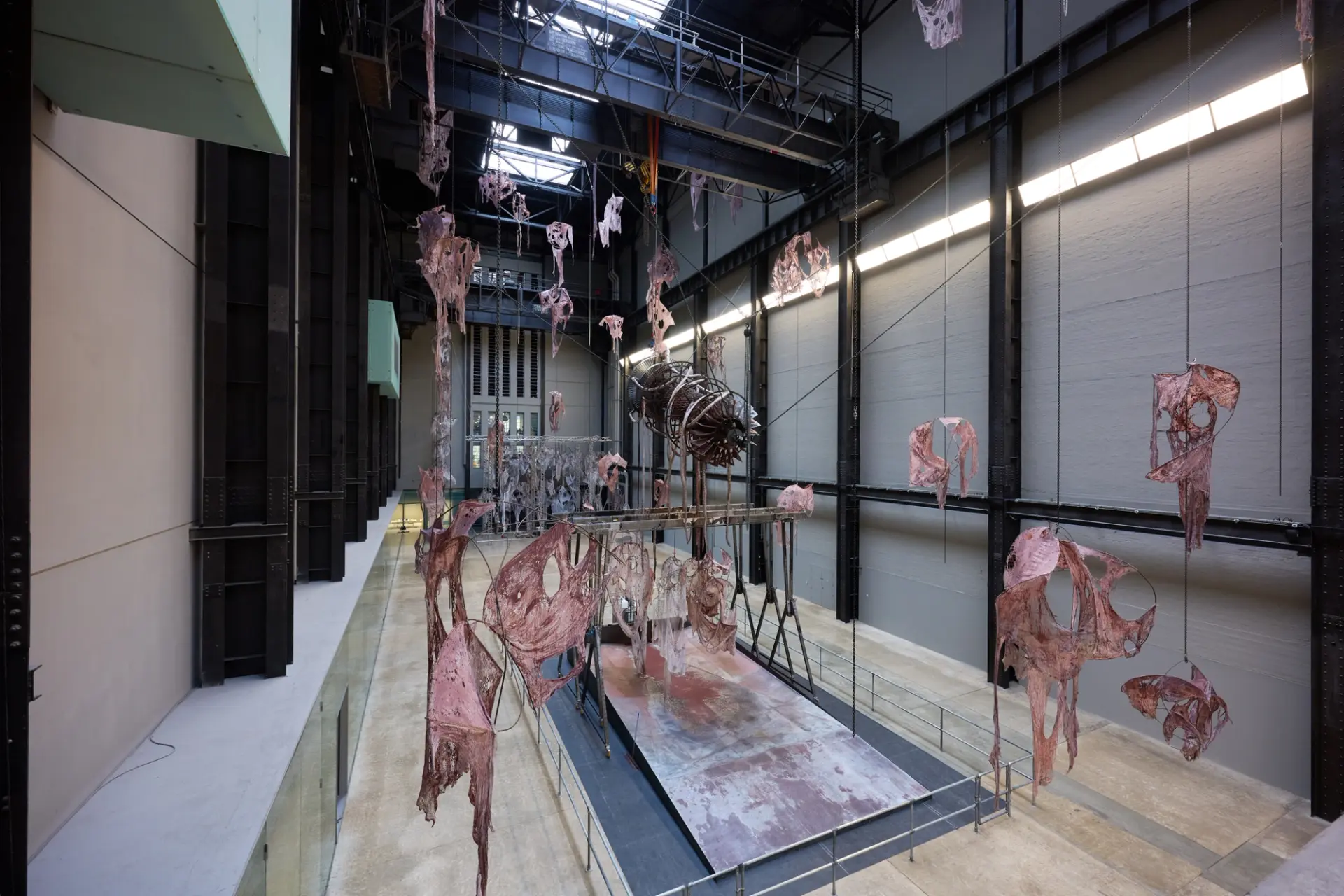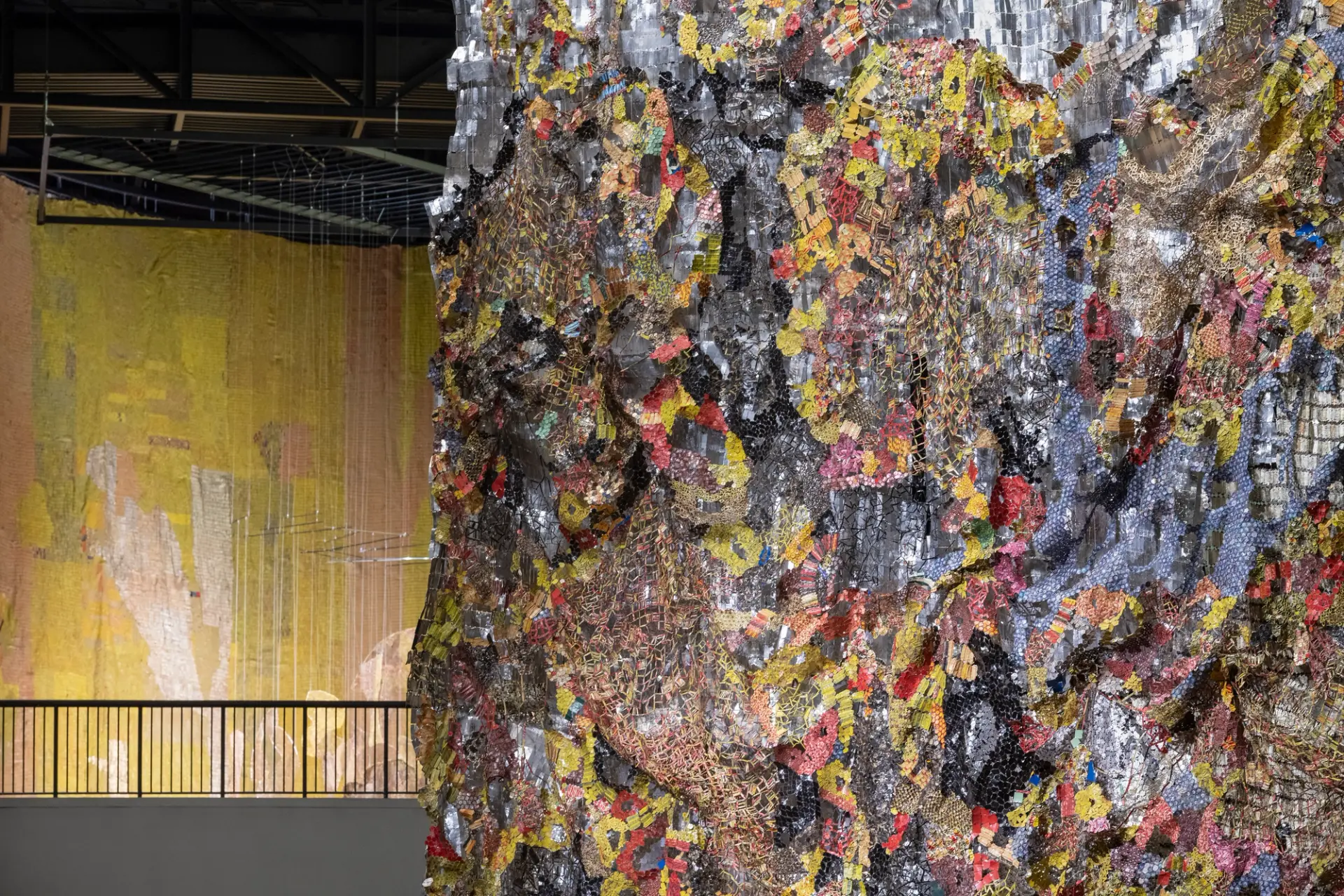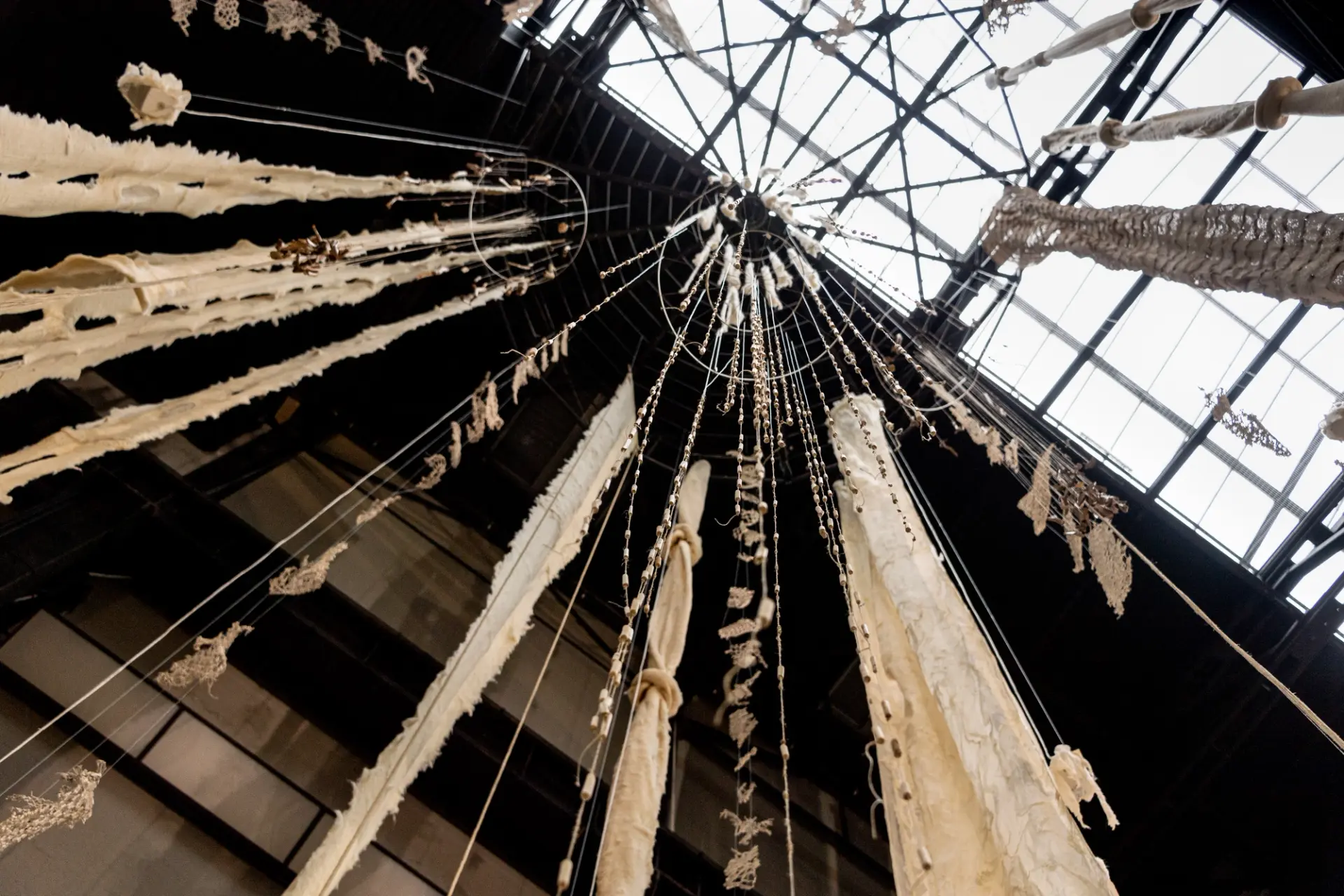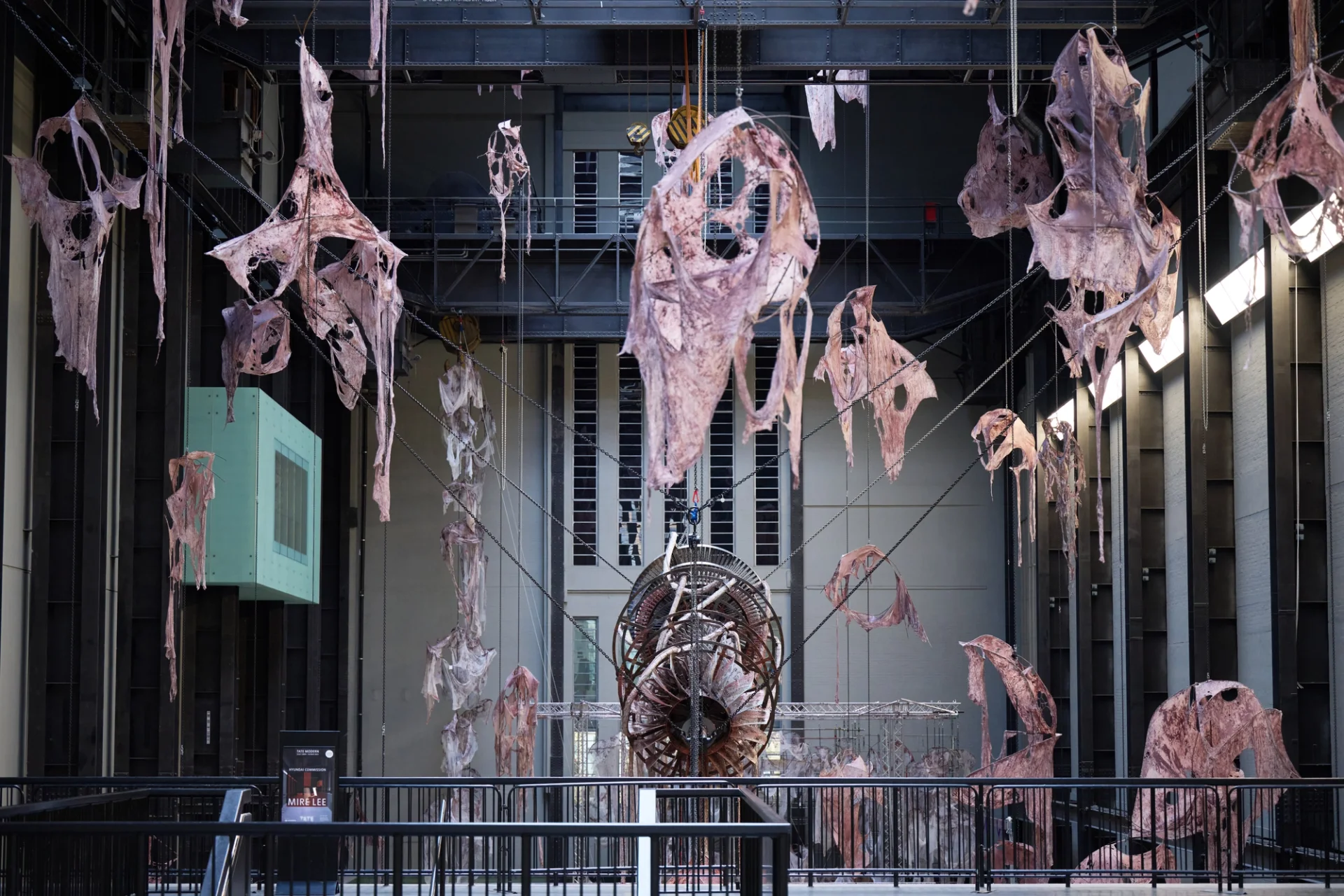
Hyundai Commission: Mire Lee: Open Wound, Installation View.
Photo © Tate (Ben Fisher Photography).
For her Hyundai Commission at Tate’s Turbine Hall, artist Mire Lee turned the former power station inside out, transforming the space into a site of shifting contrasts—combining grotesque elements with an unexpected beauty.
Artlab Editors: Writing about Hyundai Commission: Mire Lee: Open Wound, critic Cassie Packard unveils how the artist ripped open the seams of Tate’s Turbine Hall to upend the machinations of its industrial past. Hypnotically grotesque and simultaneously beautiful, Lee’s installation presents what is often deemed unseemly—the innards of labor, care, and production—and airs them out in the cavernous exhibition space.
It has been over four decades since the Bankside Power Station, a “cathedral to power” that once supplied electricity to greater London, was decommissioned. For the past quarter-century, the space has existed as Tate Modern, signifying and supplying power to the city in quite another sense. On the occasion of Hyundai Commission: Mire Lee: Open Wound, artist Mire Lee has invited this industrial past back to the present. Running on human and machine labor, her elaborate installation approximates a factory, the pièce de résistance of which is a hulking turbine that produces art in lieu of energy.
Lee rose to acclaim for motorized sculptures that annex their environments as they gush effluvia via peristaltic pumps, or else mash soft materials in spinning metal maws. On one hand, these abject machines engage with the real, relentless materiality of bodies—which persists, in banal and horrific ways, at the heart of industry and technology. On the other, her creations are also informed by fantasy images borne of and circulated via online fetish subcultures. Overtaking the museum’s 35,000 square foot Turbine Hall, Lee’s installation insists that we immerse ourselves in the grotesque: not merely to disavow it, but to feel it in its entirety, including the potential for tenderness, pleasure, or beauty inside of it.
The erotic desire to consume or be consumed by another—a fantasy shaped if not defined by the impediments to its consummation—is a fount of inspiration for Lee. Her installation likewise draws on Frederick Kiesler’s Endless House project (1950–60), which conceived of a corporeal architecture without beginning or end. The exhibition sees visitors traversing a spare, esophageal passage to find themselves “swallowed” (a past participle equally at home in niche NSFW subreddits and Julia Kristeva’s writings on abjection and melancholy) by the building, subsumed by its “innards.”
Hyundai Commission: Mire Lee: Open Wound, Installation View.
Photo © Tate (Ben Fisher Photography).
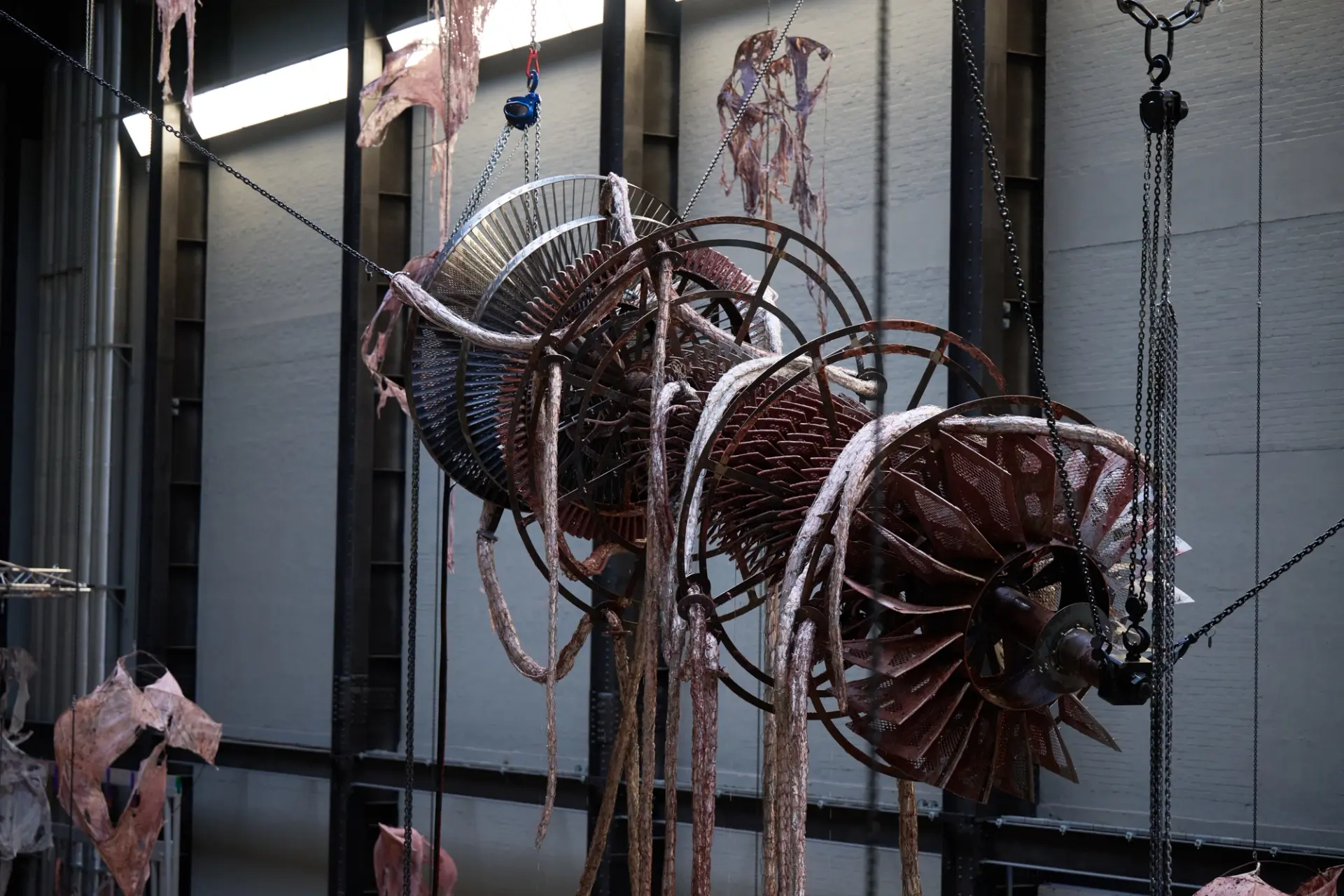
The artist stripped back the cladding of the Turbine Hall Bridge and recommissioned—reanimated—an old crane that formerly serviced the space. Suspended from the crane is the turbine, its rotors like the vertebrae of some enormous prehistoric skeleton. Thick silicone tubes are draped across its blades. This massive venous system-cum-tentacular cluster entangles the mechanical with the corporeal, blurring the distinctions between them. At predetermined intervals, the clunky machine groans clockwise or counterclockwise. Caught in its churn, the tubes spurt a viscous pink-brown liquid (a solution whose viscosity is attributable to a compound found in laxatives), which drips down into a sloped tray reminiscent of an abattoir floor. No longer content to generate electricity from coal and oil, Lee’s turbine has taken up the artist’s job of producing affect—literally grinding it out.
Hyundai Commission: Mire Lee: Open Wound, Installation View.
Photo: Cassie Packard.
Indeed, there’s an artistry to the machine’s work. Hanging from chains beneath the turbine are pieces of ragged construction mesh, stretched over steel armatures, that the liquid tinctures a delicate pink. Resembling flayed flesh or hides being brain-tanned, these “skins” conjure up such artistic touchstones as early 20th-century paintings of beef carcasses by Chaïm Soutine; Paul Thek’s 1960s-era meat cables; and Eva Hesse’s Contingent (1969), cut with body horror. The torn construction netting—a material that features in another monumental work by Lee, Landscape with Many Holes: Skins of Young-do Sea (2022)—nods to layered histories in rapidly changing cities; it also underscores that Lee’s sweeping installations take flux as a given, contrary to the prevailing logic of monuments. “Monumentality is essentially connected to stupidity or tragedy,” Lee told Tate Etc while reflecting on the show, adding that “there’s an underlying understanding of how much labor has gone into it.”
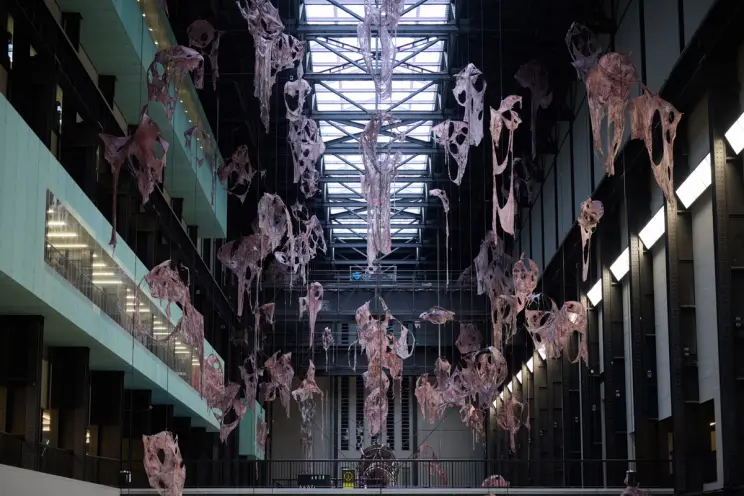
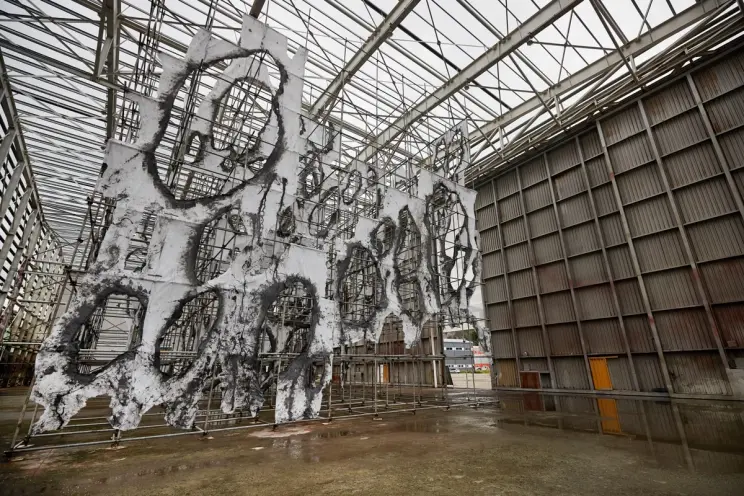
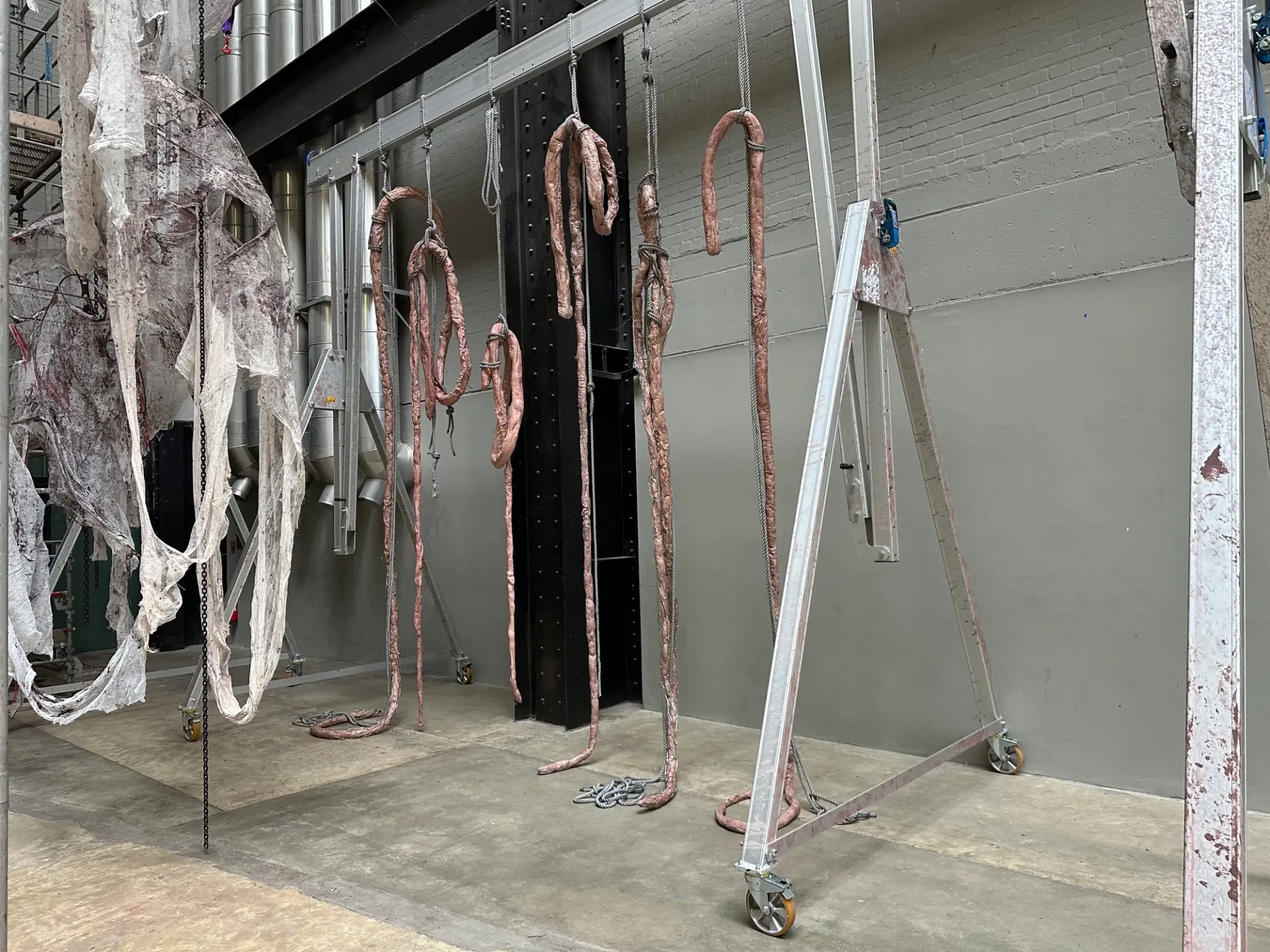
In Hyundai Commission: Mire Lee: Open Wound, Lee’s exploration of productive flows—fluids, sensations, and desires churned and circulated, and skins generated in the process—extends to human labor. This toil is made visible by an elaborate maintenance choreography: a playful riff, perhaps, on the artist’s own long-abandoned attempts to staunch her sculptures’ leakage. Technicians, like dutiful butcher’s assistants, periodically remove the sopping skins, relocate them to drying racks in the back of the space, replace them with fresh pieces, and suspend the dried skins from the ceiling with chains. Viewed as an analogy for the rote activities of slaughterhouse operators or the backbreaking work of coal miners, this durational performance may take on a brutal cast. At the same time, it also makes human touch central to the piece, and might even be read as an act of care.
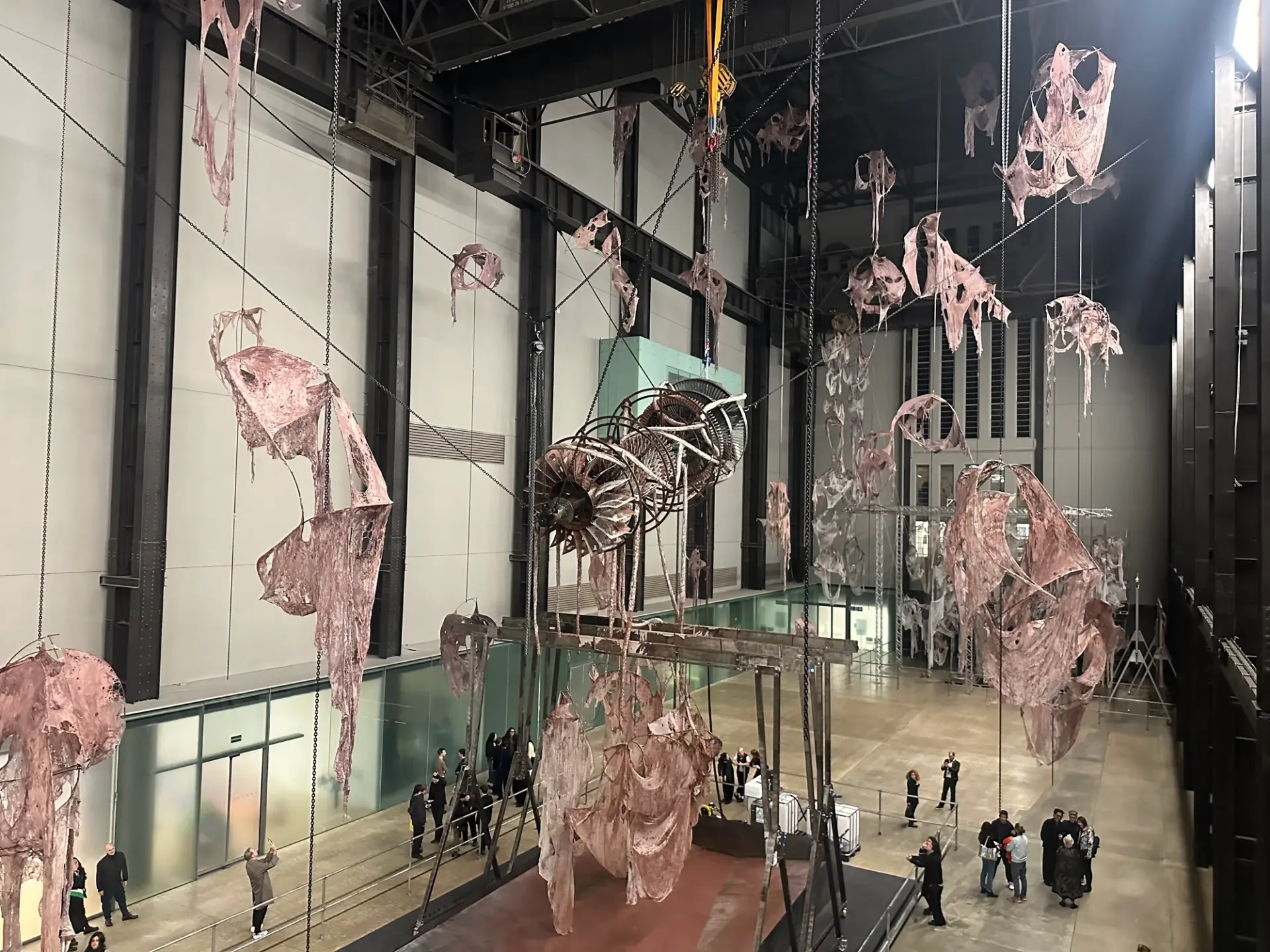
Hyundai Commission: Mire Lee: Open Wound, Installation View.
Photo: Cassie Packard.
The hanging method draws inspiration from a pulley system used in coal miners’ bathhouses, which multiplied in Britain amid 1930s-era welfare reforms but dwindled with the decline of coal. Miners, shuttling between “clean” and “dirty” sides of the baths, placed their garments in baskets to be raised aloft. Set to accumulate over the exhibition’s six-month run, the suspended skins and the machine-body intimacies that they reference fill the hall like ghosts.
With the self-aware sheen of camp, Lee’s grotesque creation gets to work scrambling the symbolic order, muddying not only the apparent dichotomies of subject/object, inside/outside, and repulsion/desire, but also human/machine, online/offline, one/many, and now/then. The impulse underlying the installation seems to stem less from a desire to shock viewers out of complacency or affirm marginal positions than from a drive to discover what forms of closeness, connection, and feeling might emerge in the throes of such a breakdown. After all, a wound is also an opportunity for renewal.