Tate
About the Exhibition
Sámi artist Máret Ánne Sara presents a monumental new sculptural installation in Tate Modern’s Turbine Hall as the tenth Hyundai Commission, an annual program made possible by the long-term partnership between Tate and Hyundai Motor, founded in 2014 and recently extended for another decade until 2036. For this year’s Hyundai Commission, Sara creates a sculptural installation from materials which surround and sustain her community in Sápmi—the territory of the Indigenous Sámi people, spanning parts of Norway, Sweden, Finland, and Russia.
For her first major work in the UK, Sara draws on her lived experience as a member of a Sámi reindeer-herding family to highlight ecological issues affecting her way of life, revealing their broader global significance. Combining hides and bones derived from traditional reindeer herding practices with wood, industrial materials, sound and scent, Hyundai Commission: Máret Ánne Sara: Goavve-Geabbil is an immersive work honouring the reciprocal relationship between the Sámi people, the reindeer, and the land.
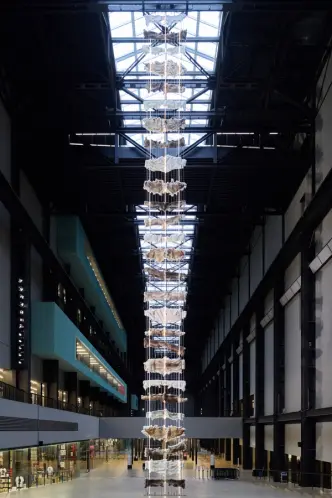
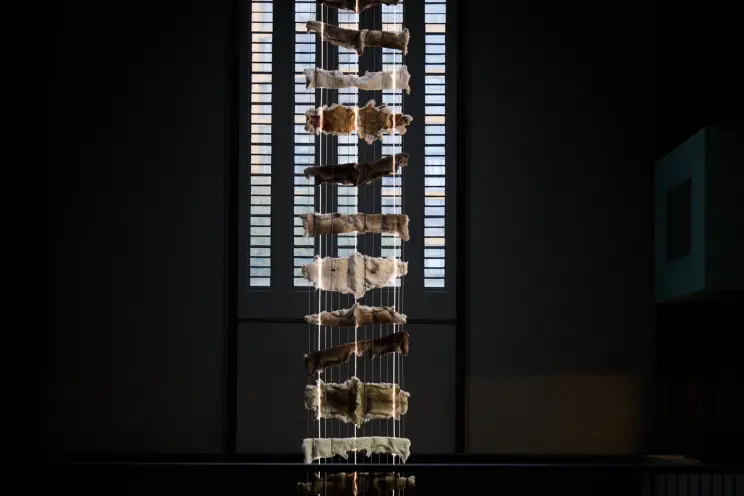
Goavve- is a multi-layered sculpture made of reindeer hides tightly bound by electrical power cables stretching 28-meter height of the Turbine Hall. The title Goavve- refers to a worsening environmental condition caused by extreme temperature fluctuations, in which rain and melted snow freeze into layers of ice on the land’s surface, preventing animals from accessing food sources below. The hides present in the installation symbolize the enduring power that flows from ancestral traditions, embodying the strength, knowledge and spiritual connections passed down through generations, while the cables evoke the continued extraction of resources from Sápmi through mining and energy developments, leading to the destruction of ecosystems, the displacement of animals and people, and the erosion of cultural practices. Goavve- serves as a powerful reminder of the interdependence of all living beings and the importance of fostering balance in our shared world.
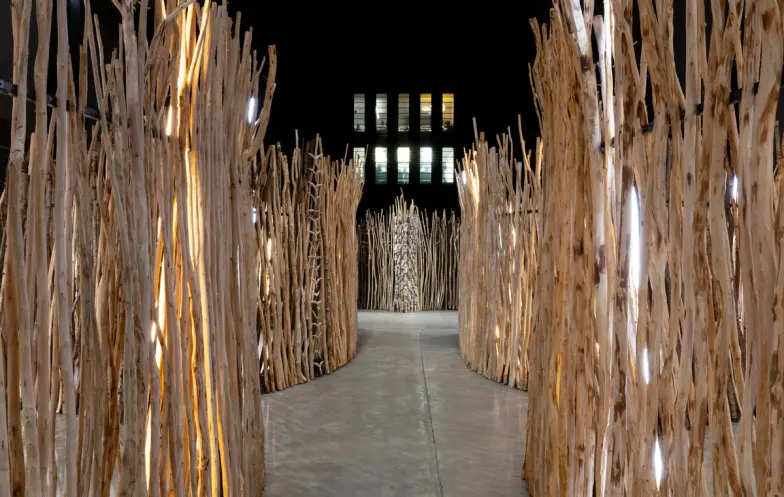
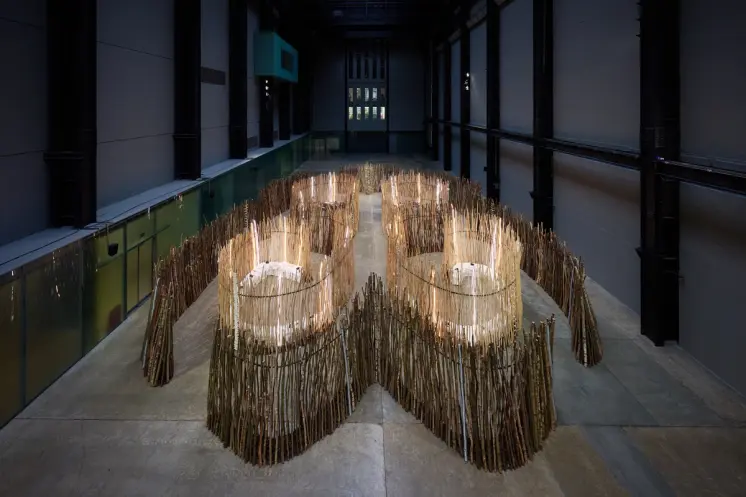
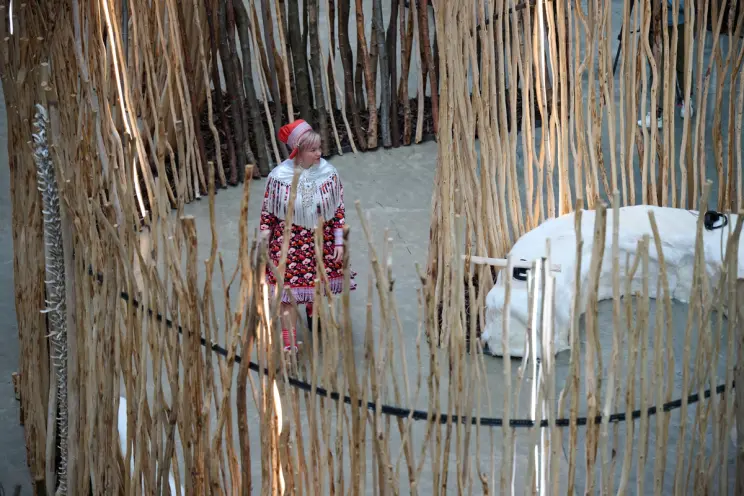
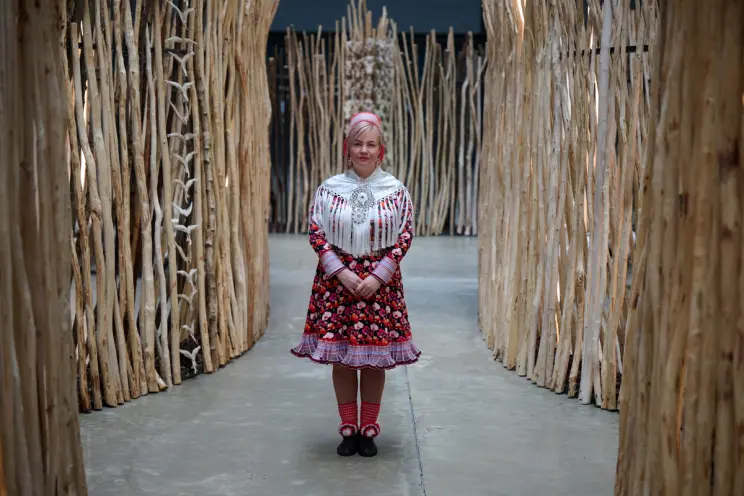
At the east end of the Turbine Hall, visitors are invited to move through a maze-like structure titled -Geabbil which means adaptability. The shape of the structure is based on the anatomy of the reindeer nose, an organ which can heat air by 80°C in a single second. Extraordinarily energy efficient visitors are invited to reflect on the intelligence of the reindeer nose, while also attuning themselves to the energy and ancestral knowledge that courses through the structures materials and winding passages. The walls are constructed from wooden poles carved with reindeer earmarks—distinct patterns passed down through generations of Sámi people to distinguish their herds and indicate their lifelong commitment to safeguarding the animals and their environment. As part of the traditional Sámi practice of duodji, hides and bones are integrated into the walls, giving new life to parts of the reindeer not used for food or clothing. This ensures that nothing is wasted, serving as a gesture of gratitude and respect to the reindeer.
Sara’s materials are infused with scent, a significant aspect of non-verbal communication between lifeforms. These range from the smell of ‘fear’ released by reindeer when they are in danger as a warning to the herd to the smell of ‘hope’ carried by native plants in Sápmi, such as lichen and shoegrass, evoking possibility and renewal. A soundscape of environmental recordings captured in Sápmi and Sámi musical practice, joik, alongside oral knowledge shared by elders from Sara’s community fills the hall.
Hyundai Commission: Máret Ánne Sara: Goavve-Geabbil offers a space to consider the possibilities offered by Sámi science and worldviews in the growing ecological crisis, deepening our connection to and protection of the living world for future generations.
About the Artist
Máret Ánne Sara is an artist and author based in Guovdageaidnu, Sápmi. Her work has featured in several solo and group exhibitions including presentations at the Northern Arts Festival, Harstad, Norway (2025); Norway Sámi Centre for Contemporary Art, Karasjok, Norway (2024); Emerson Dorsch, Miami, USA (2023); the 59th Biennale di Venezia, Venice (2022) and Documenta 14, Kassel (2017). Recent commissions include Háhčešeatni doali dádjadit and Čitna báffa (2025) for the Northern Arts Festival and Gapmu (2024), scene carpet for the Sámi National Theatre Beaivváš. She was nominated for the Nordic Council’s Children’s and Young Literature Prize for her debut book “Ilmmid gaskkas” in 2014. She is the founder of the Dáiddadállu Artist Collective, a network for Sámi artists in Guovdageaidnu.
About the Program
Hyundai Commission
The annual Hyundai Commission is a series of new, site-specific installations by international artists in Tate Modern’s iconic Turbine Hall. It is made possible by the long-term partnership between Tate and Hyundai Motor, now confirmed until 2036. The partnership was founded in 2014 with the longest initial commitment from a corporate partner in Tate’s history and encompasses support of both the Hyundai Commission and the Hyundai Tate Research Centre: Transnational. Attracting over 21.6 million visitors since it began, the Hyundai Commission gives artists the chance to interpret the vast industrial space of Tate Modern’s Turbine Hall, producing some of the most bold and memorable artworks of the past decade.
Take a Closer Look
Related Content
Project
Hyundai Commission: Mire Lee
Project
Hyundai Commission: El Anatsui
Project
Hyundai Commission: Anicka Yi