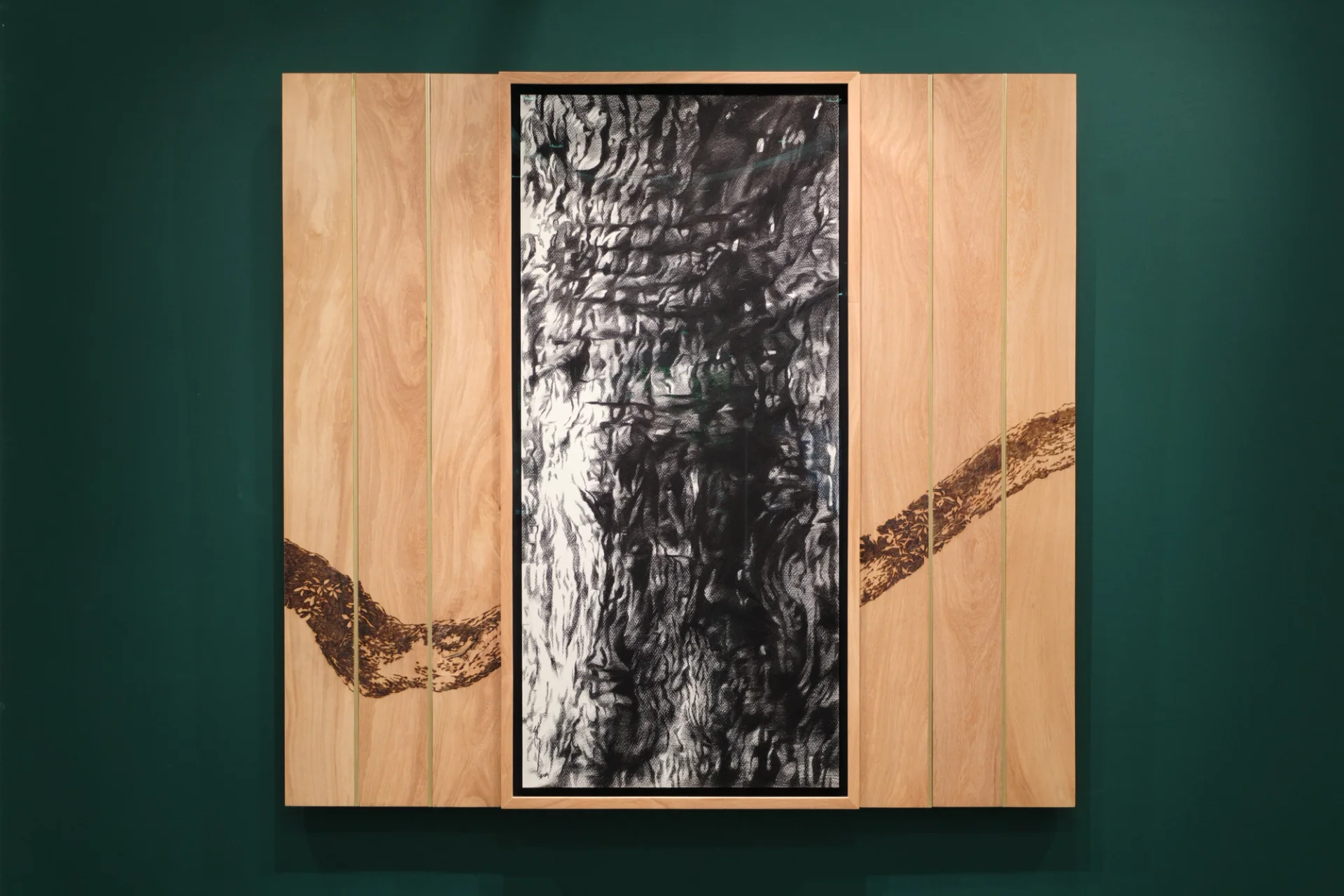
Yanyun Chen, Veins, Grains, and Striae, exhibited 2025, installation view in Bank of Singapore.
Courtesy of Art Outreach.
2025 Artlab Editorial Fellow Jiaying Sim considers seeing as a form of care in the work of Singaporean artist Yanyun Chen.
Artlab Editors: In her second Artlab Editorial Fellowship essay, Jiaying Sim presents a sprawling meditation on how Yanyun Chen’s charcoal work, Veins, Grains, and Striae (2025), offers an opportunity to reconsider and truly see one of Singapore’s most iconic trees on its own terms.
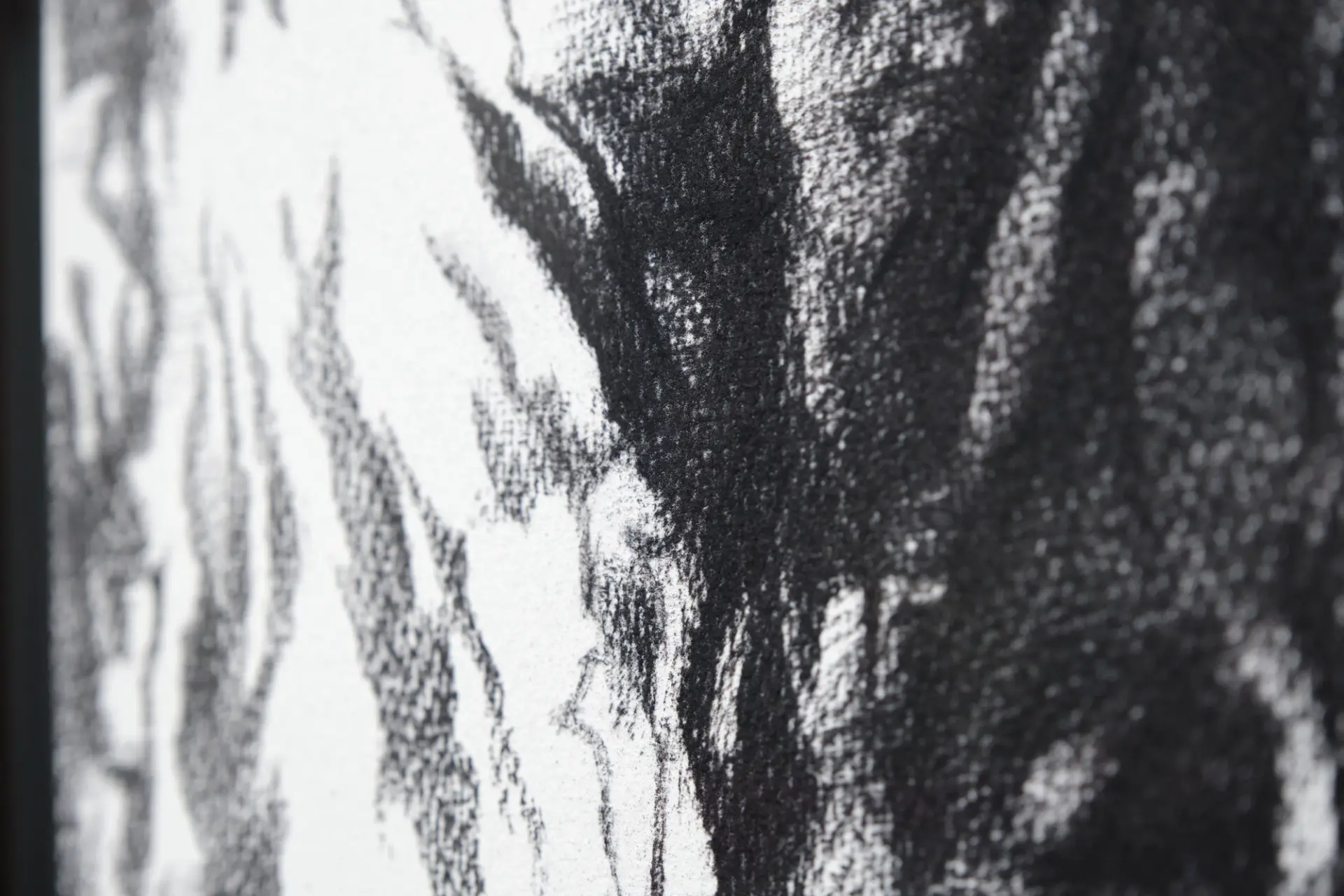
Rendered in dense, turbulent strokes, Singaporean visual artist Yanyun Chen’s Veins, Grains, and Striae (2025) surges with charged energy. Charcoal drags across the surface as its deep black collides with shocks of exposed paper. Horizontal striations break through layers, revealing palimpsests of grain and scarification. Gnarled grooves give way to fissures, hollows, and raised ridges. A low, sweeping branch, with a base scooped like a spoon, is depicted through delicate cross-hatches. Framed in polished wood, the drawing resists immediate recognition. Deconstructed, visceral, and disassembled, it does not show us a tree–it beckons.
Come closer.
Initially commissioned by S.E.A. Focus and STPI Creative Workshop and Gallery, and later presented with the support of Art Outreach at Bank of Singapore, Veins, Grains, and Striae takes as its starting point the tembusu tree—specifically, the well-known specimen in the Singapore Botanic Gardens. One of the oldest among the nation’s heritage trees, this 211-year-old tembusu’s sprawling form has become embedded in Singapore’s visual culture, iconized through its appearance on the five-dollar note in 1999 and the $1 postage stamp postage stamp in 2022, both designed by local artist Eng Siak Loy. The tree is thus rendered not just a tembusu but The Tembusu, distinct among its peers.
But while currency reproduces the tree into clean, legible silhouettes, Chen’s rendition defies easy identification and quick consumption. It calls for a different kind of looking.
For all its nationalized visibility, The Tembusu has little personal meaning to me. I must have handled enough five-dollar notes in my 38 years to have seen its image countless times. Still, would I recognise the tree in person?
Once upon a time, people sat on the low-lying branches of the Botanic Garden’s famed tembusu. That all ended in 2013 when a protective fence was installed to safeguard the tree’s roots from foot traffic. As it turns out, this measure might have also protected people—in 2017, a nearby 270-year-old tembusu collapsed in the gardens, killing one passerby and injuring four. News reports cited strong winds and heavy rain, but the deeper cause traced back to decades ago, when the tree’s roots were severed to build a nearby path. The coroner ultimately ruled the incident a “tragic misadventure.” Case closed, a gentle giant turned hazard. The tembusu’s sheer size, once offering comforting boughs to rest upon, was now a looming and deadly threat.
What would the tembusu say for itself, if it could speak?
The tembusu is a remarkably hardy tree found from southern Myanmar through Southeast Asia to New Guinea. Tall and slow-growing, these evergreens begin with a narrow conical crown in youth, becoming more irregular and wide-spreading with age. The tembusu’s bark, once smooth, gradually darkens from brown to black; cleft and cracked, a distinctive sign of maturity. It tolerates compacted, poorly aerated clay soils and generally resists pests and disease. Often cast as either ornamental or utilitarian, the tembusu is valued for its hard timber (though no longer commercially available), generous shade, and its ability to visually define public spaces. According to the Heritage Tree Register Heritage Tree Register , as of 2025, only seven heritage tembusu trees remain in Singapore.
More often than not, it appears as a static fixture, planted in curated gardens and civic landscapes, designed to be looked at rather than lived with. These roles risk flattening the tree into a symbolic placeholder or scenic accessory, its existence tethered to how much cultural or ecological value we assign to it.
Across the region, the tembusu is often featured in local writing as a spatial marker, signposting place, evoking familiarity, but seldom examined beyond its presence as a shade-giving landmark. Official narratives rely on metaphors of nation-building and endurance. According to the Monetary Authority of Singapore, the tree’s “highly branched canopy epitomizes the spirit of Singapore—strong, resilient, and continuously striving for progress.” A model citizen.
Botanical accounts throughout history echo this tone. In Singapore Trees (1989), A.N. Rao and Yeow Chin Wee praise the tembusu’s shapely branches, delicate green foliage, rare yellow flowers, and orange-scarlet berries as hallmarks of a decorative lawn tree. Chen’s Veins, Grains, and Striae departs from this fixed conception by stripping away iconography. Instead of visual cues, Chen offers points of contact. We are not expected to know The Tembusu, only to stay with it, in its flesh, up close, inside out, calloused, thick with memory.
Long before it became a heritage emblem of nationalistic strength and industrious resilience, the tembusu was once regarded for its slowness, embodying a kind of patient leisure. Consider British mycologist and botanist E.J.H. Corner’s mid-century account of the tree:
“The tembusu responds very slowly to the climatic stimulus, its flowers opening after an interval of nearly four months. But in all its activities the tree is leisurely. It grows slowly; it develops new leaves a pair at a time, never in flush like so many of our eager trees [....] Such sluggishness is remarkable in a tropical plant, the environment of which imposes no hindrance upon its growth, but it is not unparalleled for both Mangosteen and Nutmeg are almost, if not quite, as lethargic.”
– Wayside Trees of Malaya (1952)
Chen’s own process mirrors this temporal resistance. She worked on Veins, Grains, and Striae for a total of 62 hours over almost three months, allowing layers to accumulate slowly. In some areas, you can see where she returned repeatedly, patiently darkening and reworking until the surface holds memory of multiple encounters. There is discipline, too, in what is left untouched, in the restraint of preserving negative space, where absence becomes its own form of care.
Yanyun Chen, Veins, Grains, and Striae, exhibited 2025, installation view in Bank of Singapore.
Courtesy of Art Outreach.
Unbound by productivity or obligation, the tembusu’s temporality feels nonchalantly radical, refusing to flower on schedule or perform for the city. It embodies a vegetal resistance. It could not care less about our deadlines or routines. There’s almost humor in that: a tree simply being, while layers of meaning, metaphor, and usefulness are projected onto it.
Where scientific and national narratives organize knowledge into neat categories, poetry and art allow for ambiguity, feeling, and affect. In Wong Yoon Wah’s Metamorphosis: Temasek (2015), the poet dedicates two stanzas to The Tembusu. Translated into English by Jeremy Tiang, Wong’s poem shifts the tree from background to central figure. It is alive and observing:
A little tembusu tree
Aged 20
Suddenly shoots up 42 metres in the air
Occupying
The equatorial sky
Soaking up all the sunlight
(“iii. 林小小的登布树 / 二十岁 / 突然向上升高四十二米 / 占据了
赤道的天空 / 抢夺所有的阳光”)
The use of “occupying” (“占据了”) carries particular weight in this context. More than a physical claim to space, the word suggests a presence shaped by history. The “42 metres” invokes the year 1942, the year of the Japanese Occupation of Singapore. The Tembusu, then, is cast not as passive greenery, but as an active witness to colonial violence. Its vantage point, however, stretches beyond wartime trauma. Sentient and sovereign, it soaks in light and time.
Through the rest of Wong’s poem, The Tembusu becomes a shape-shifting figure of sentiment, first a crawling child, nurtured yet confined to the grounds of the Botanical Gardens, then an elderly presence on the back of a five-dollar note:
When tourists look upwards
The sky holds only sunlight and clouds
The tembusu tree, like a small child
Crawls on the ground of the Botanic Gardens.
(“当游客仰天眺望 / 天空只有阳光与白云 / 登布树像小孩 / 在植物园的草地上爬行”)
When tourists pull out five-dollar bills
To buy a bowl of bubur chacha
The tembusu, like an old person
On the back of the note
Walks along with crutches.
(“当游客掏出五元的钞票 / 买一碗波波查查 / 登布树像老人 / 在钞票背面 / 以拐杖走路”)
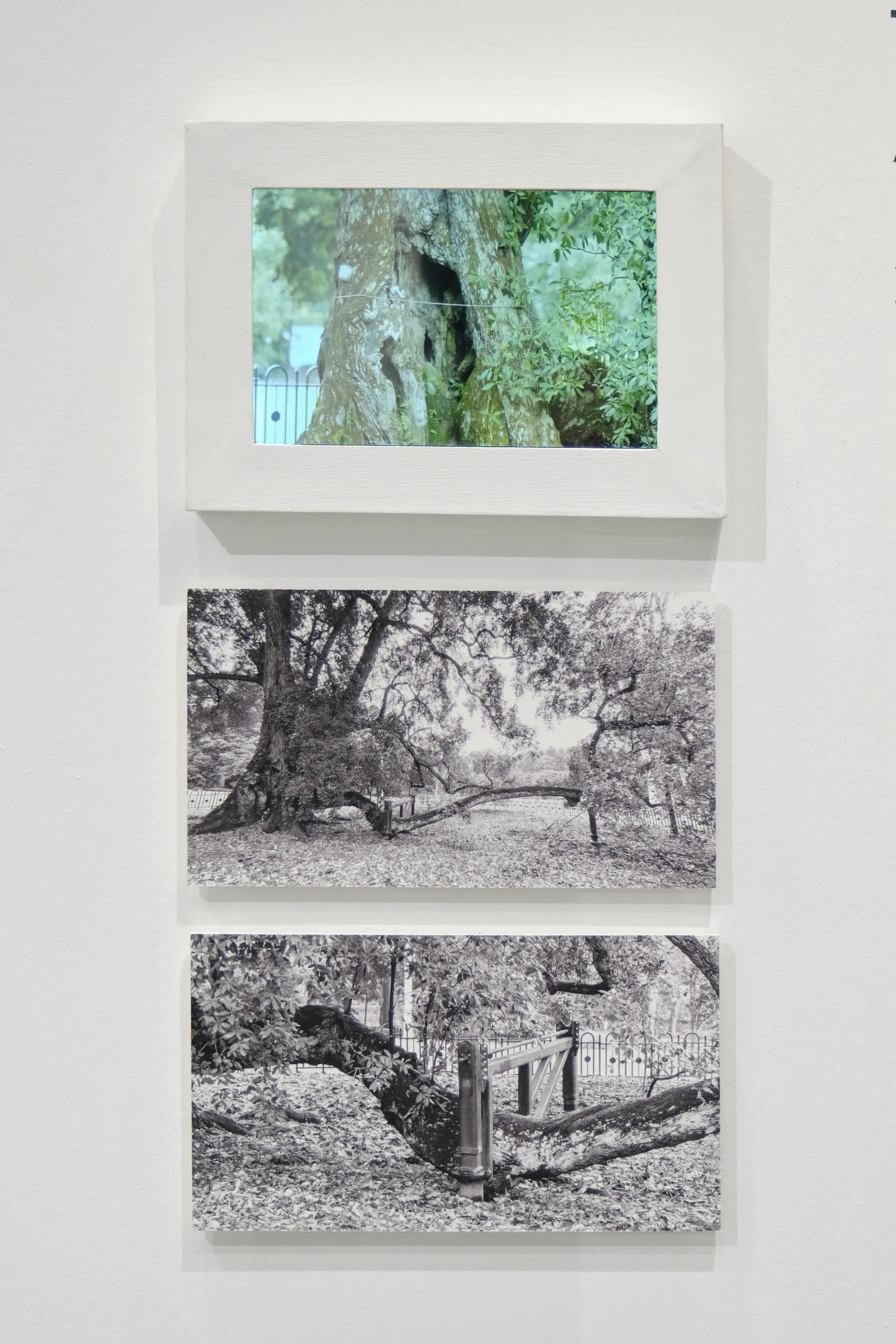
Since the 1990s, interventions to support The Tembusu’s sagging branch have evolved from simple wooden props to a flexible suspension system, engineered in 2014 to brace it at multiple points while still accommodating its natural movement and growth.
Yanyun Chen, Veins, Grains, and Striae, exhibited 2025, installation view in Bank of Singapore.
Courtesy of Art Outreach.
Under this scaffolded care, tension does not collapse into contradiction, only an ongoing calibration between vulnerability, acts of holding, and adaptation. By juxtaposing transactional consumerism through the aged Tembusu in crutches, Wong disrupts the cemented image of the tree, mobilizing it. The crutch, in this context, is more than metaphor; it reflects real-world interventions made to conserve the Tembusu’s low-hanging branch.
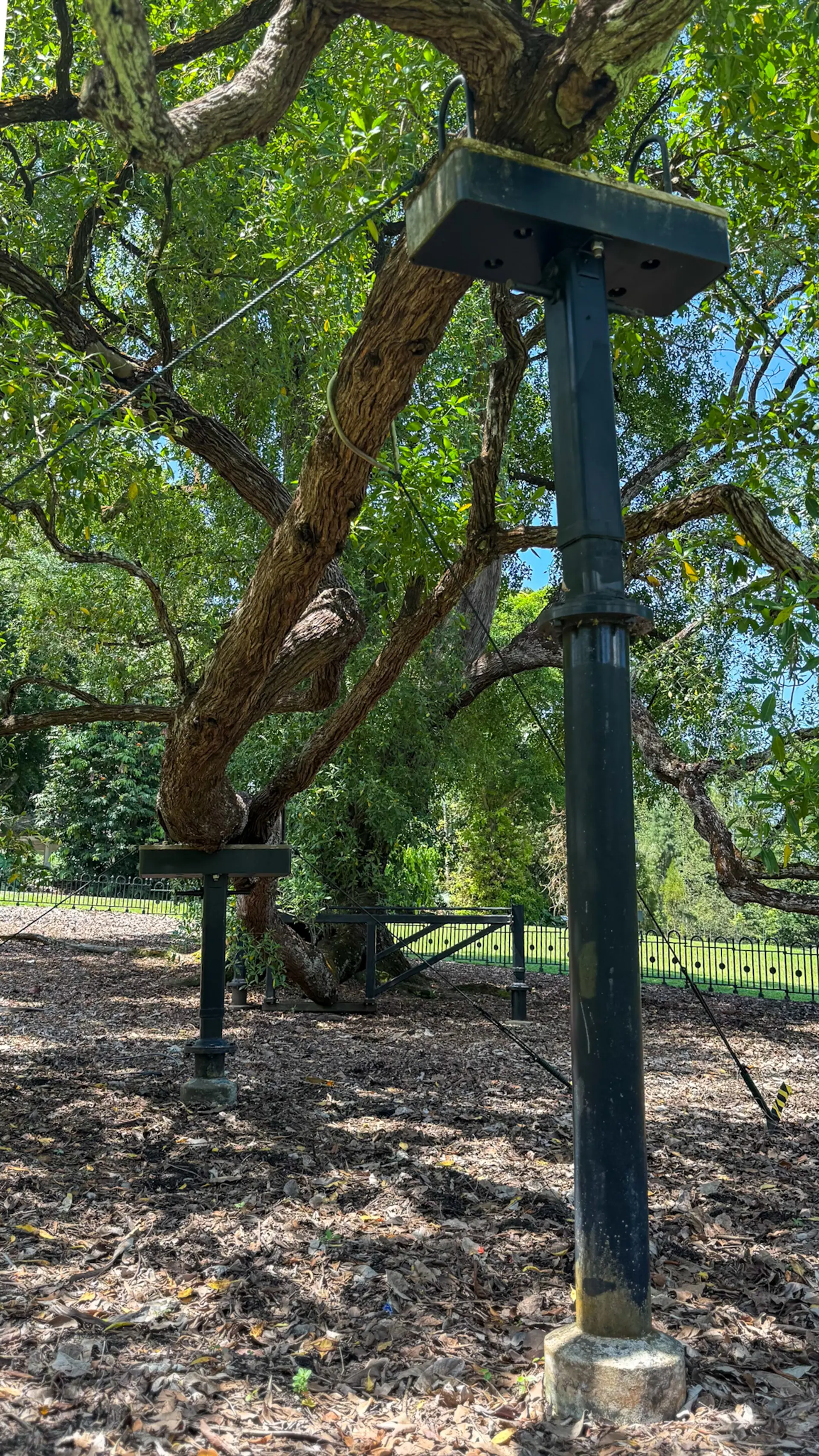
Tembusu tree suspension system at the Singapore Botanic Gardens.
Photo: Jiaying Sim
Chen picks up from this relationship of care, working in proximity to The Tembusu, neither locking the tree in form nor distancing it through abstraction. Instead, she attends to the often-unseen processes that unfold around the finished work, the labor behind the marks, the construction of the frame, and the afterimages beyond the frame–this echoes Chen’s early training as a digital animator. The result is not a definitive portrait of The Tembusu, even as the drawing evokes the textured, lifelike skin of a tree held just beyond physical reach. The encounter becomes experiential, even if ambiguous and open-ended. Staying close becomes another way of knowing.
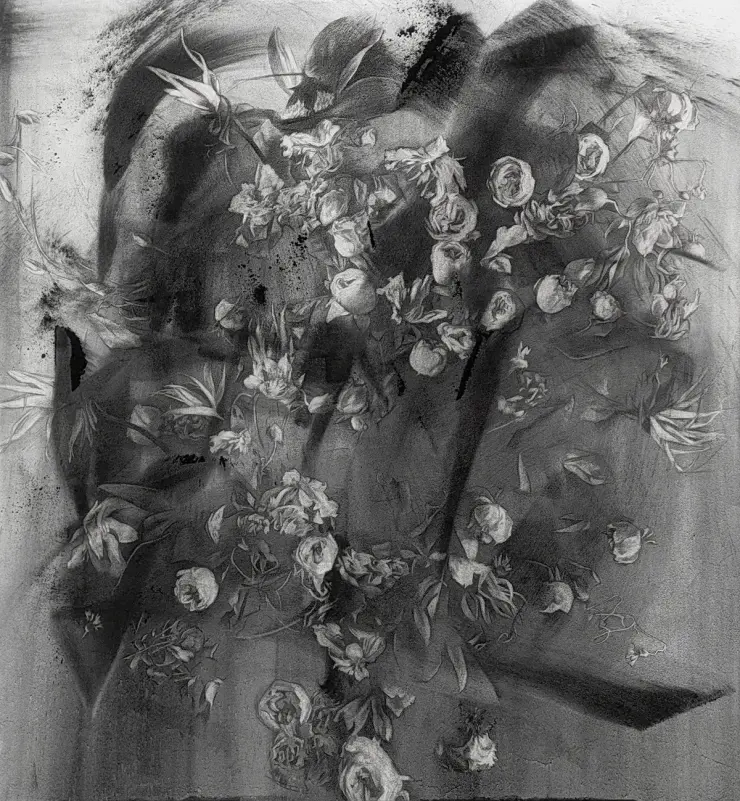
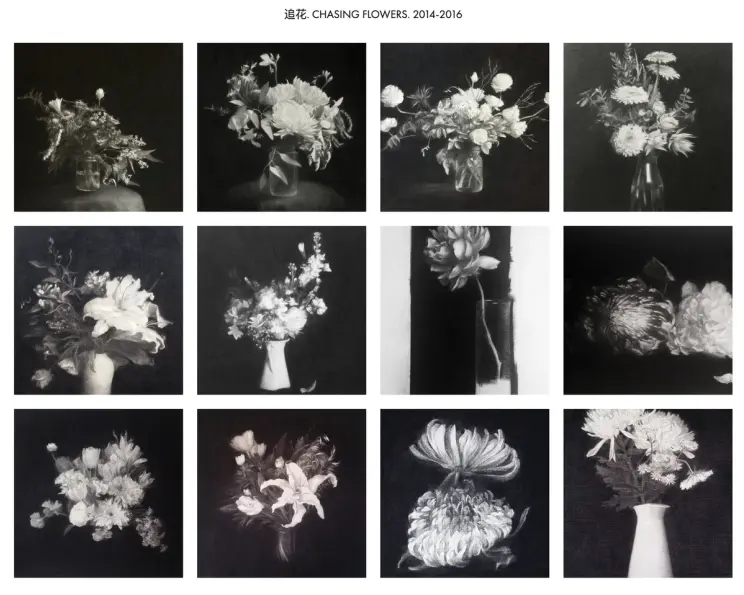
This commitment to remain near without fixing, to hold without possessing, runs through Chen’s wider practice. Underlying this refusal to pin a subject down is its own distinct ethic of care, a sustained regard for the complexity of a subject’s life amidst the fallibility of artistic mediation itself. This sensibility surfaces in Risks (2020–2022), where Chen worked with digitally dismantled flowers, recomposited with text and charcoal to trace processes of decay and erasure. Meanwhile, 追花 (Chasing Flowers) (2014-2016) saw her drawing directly from life as blooms wilted, observing without photographing, staying with what will inevitably fade. If Risks fragments and reassembles through digital mediation, Chasing Flowers tends closely to slow transformation with an existential awareness of the inability to fully capture.
Yanyun Chen, Veins, Grains, and Striae, exhibited 2025, installation view in Bank of Singapore.
Courtesy of Art Outreach.
Veins, Grains, and Striae deepens Chen’s long engagement with charcoal, one of the world's oldest tools for mark-making. The choice of charcoal becomes increasingly significant when we consider the material’s origin as compressed carbon, the burnt remains of trees. Each stroke bears the pressure, speed, and rhythm of the work’s making; its materiality inseparable from creative expression and experimentation. This accumulation of labor mirrors how the tembusu’s bark, whose scabbed layers thicken over time, bears traces of old wounds rather than heal clean, forming a topography of experiences. Chen presents the bark not as surface, but quintessential to the tree’s continuing life, facilitating a dialogue between states of being that conventional botanical illustrations rarely accommodate.
Yanyun Chen, Veins, Grains, and Striae, exhibited 2025, installation process. Bank of Singapore.
Image courtesy of Yanyun Chen.
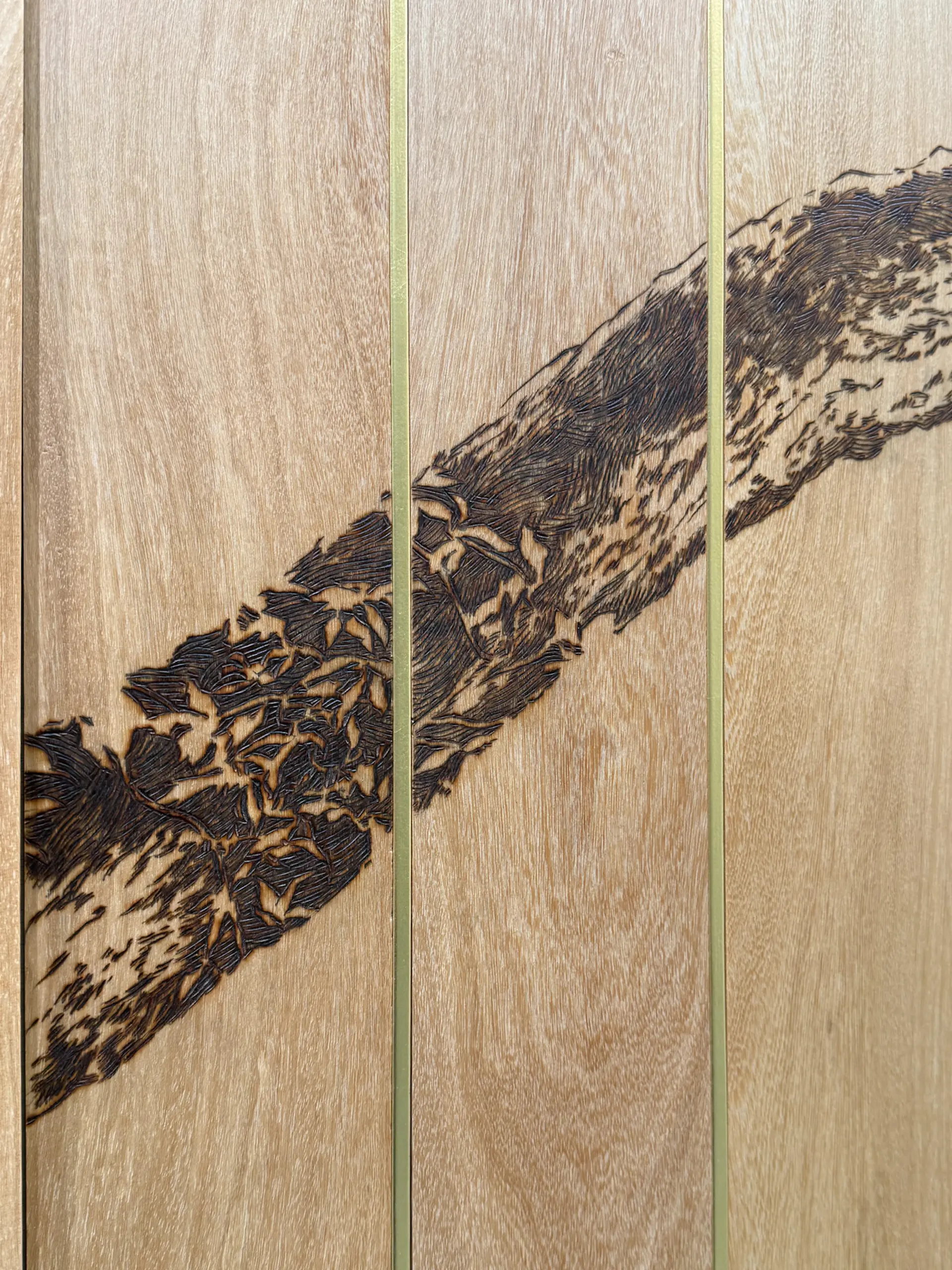
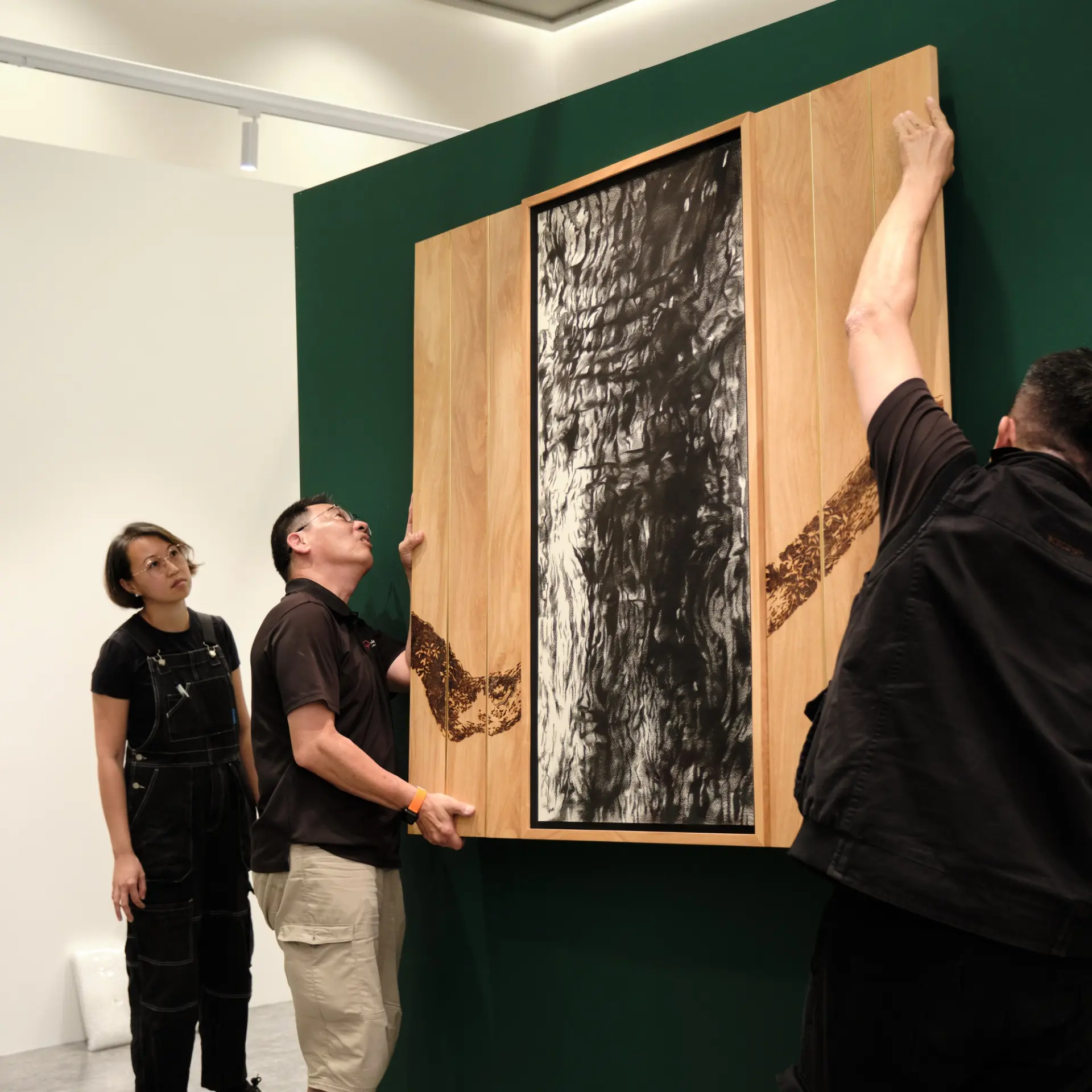
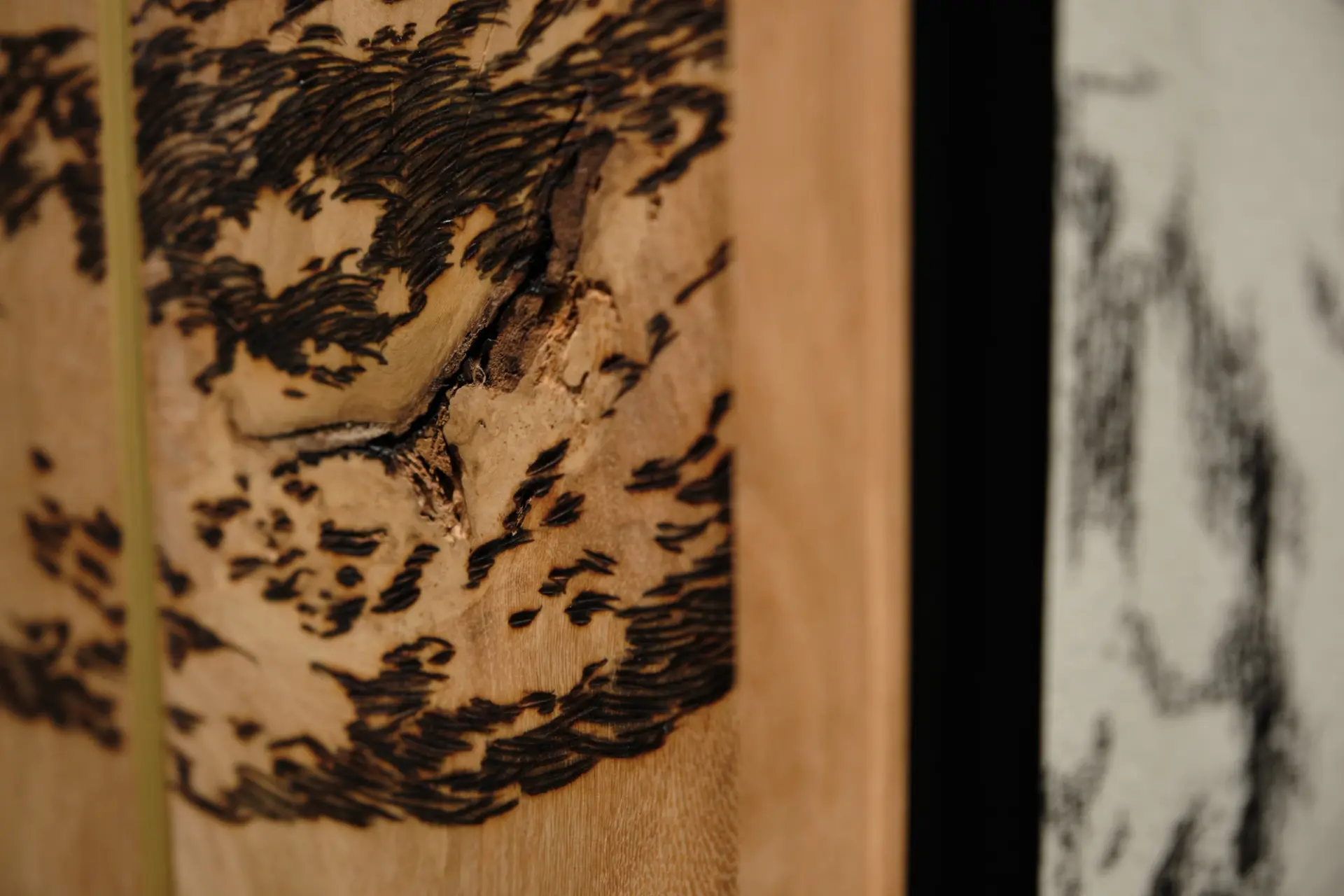
With the support of QFraming, the work’s frame, fashioned from reclaimed tembusu wood, enters into an uncanny exchange with the work it holds. Golden-grained and carefully finished, the wood recalls how we most often encounter the tree: as timber, as furniture, as product. Yet, scorched across the wooden panels are burned marks that echo the charcoal strokes within the drawing itself.
To stand before Veins, Grains, and Striae is to be enveloped both by The Tembusu’s presence and its unbearable physical absence, its carbon form rising before you with the wooden frame anchoring behind. Surrounded by its materiality, we find ourselves immersed in what remains, while contemplating what has been lost.
Yanyun Chen, Veins, Grains, and Striae, exhibited 2025, installation view in Bank of Singapore.
Courtesy of Art Outreach.
At the edges, where charcoal meets paper meets burned wood, boundaries begin to dissolve. The most delicate cross-hatches require you to lean in, bringing your breath near. Amidst the intricate lines, an exposed cavity interrupts the smoothness, like scarring that remembers The Tembusu’s own weathering. Here, the frame ceases to be a container. It becomes an extension of the work, a site of inscription, where touch, time, and process leave a trace. One forgets how precise Chen’s touch must be to create such depth without searing through the surface or subject.
Without instruction or demand, Chen’s craft shifts perception. Looking slows as other senses are heightened, folded into the act of seeing. Attention becomes physical, enacting a kind of time that moves unhurriedly with The Tembusu and tembusus, resistant and indifferent to urgency. There is no rush to interpret. Chen regards the Tembusu with reverence, and in turn, gently prompts us to do the same, expanding our gaze beyond the image to wonder, learn and care more deeply for the tree and all its kin.
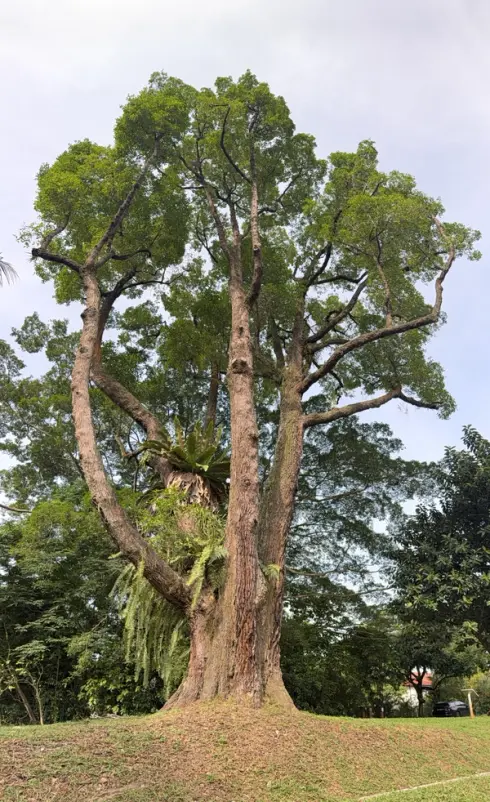
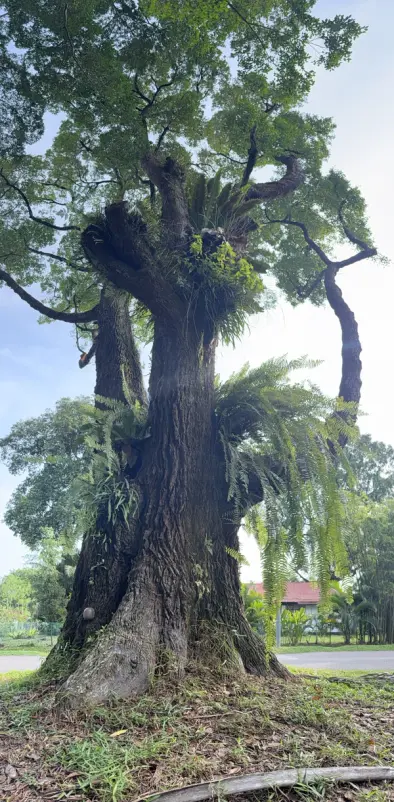
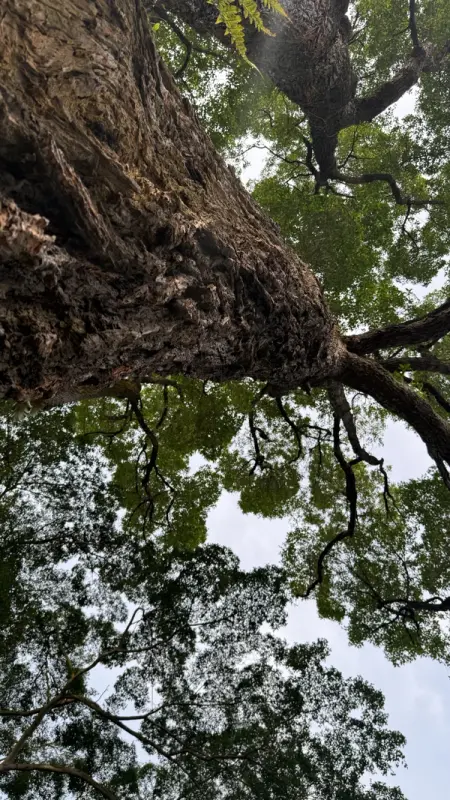
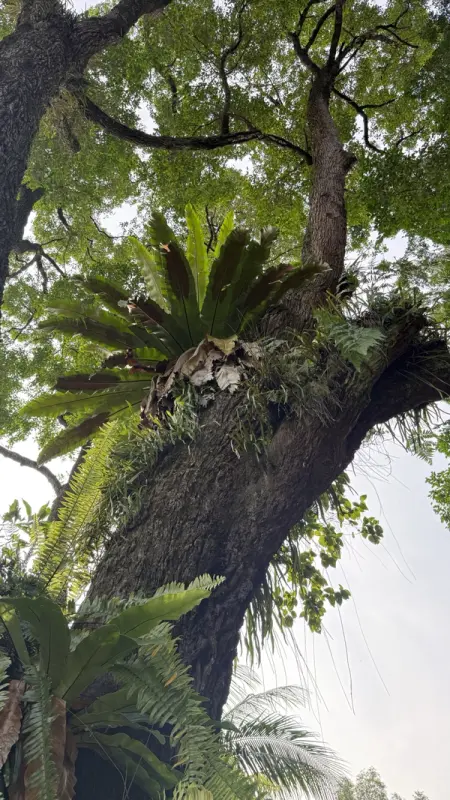
I find myself responding to this tempo, searching not for meaning but for closeness as I make my way to the nearest tembusu tree. Tucked beside a quiet road, it stands unmistakable. Towering, composed, and still. The tree’s trunk looms with assured power, broader and taller than expected, giving rise to its signature branch that curves outward with intent. Looking up, the canopy stretches wide, branches twisting and intertwining like arms mid-motion, frozen in an elegant sprawl. Unlike its more famous counterpart, this tembusu has been spared the burden of touristic spectacle and service. Where public memory reimagines The Tembusu as a fragile elder, this tree before me offers another kind of steadfast and grounded presence. Its limbs rise freely, untouched by the demands and conditions of human use or the weight of bodies perched for photographs. It grows on its own terms, full of grace. Ferns cluster in soft tufts along the trunk, catching light like green antennae. Alongside, a heritage sign—mottled with mildew and fading—keeps faithful company.
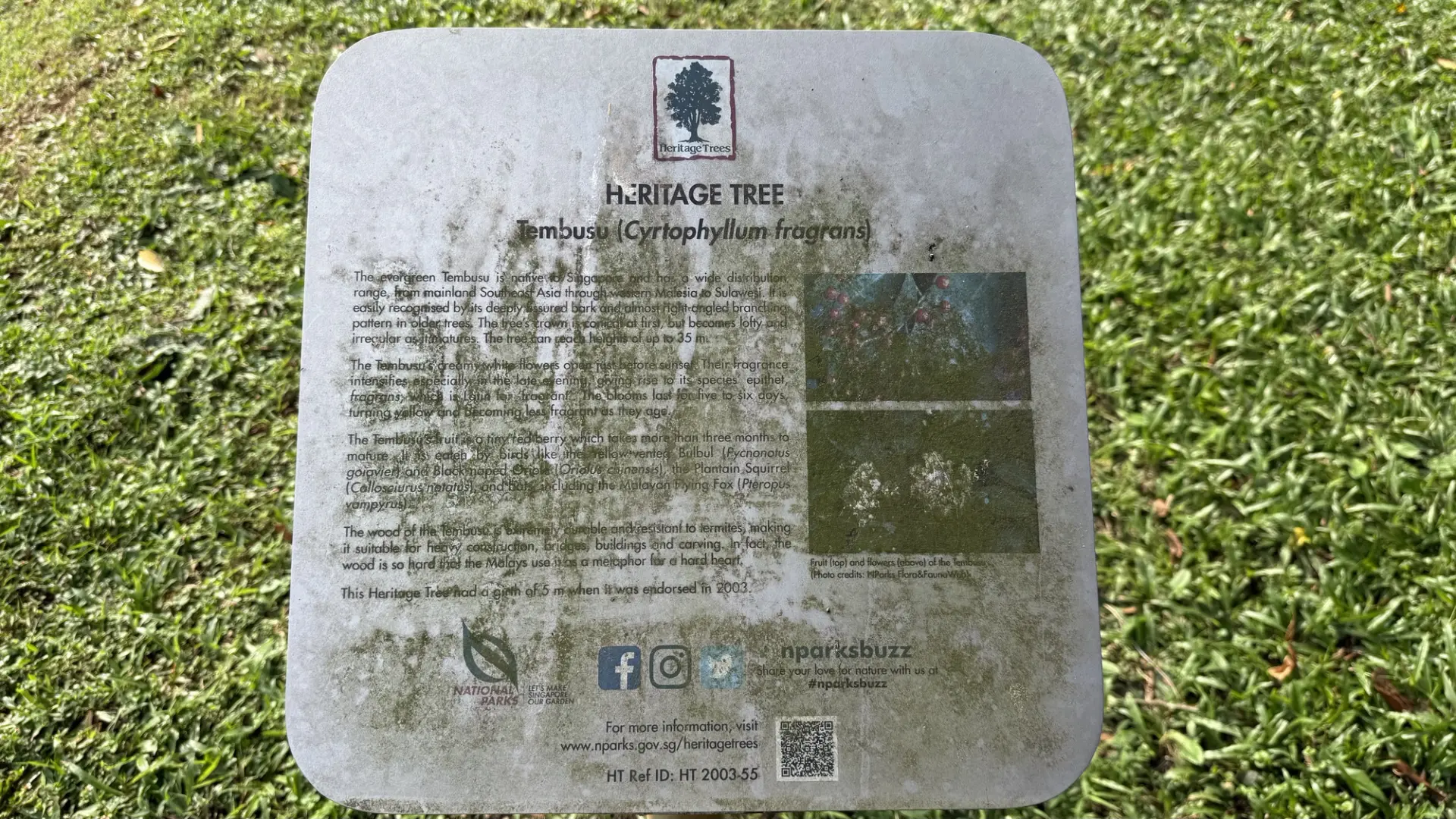
Heritage sign of tembusu tree at Maida Vale.
Photo: Jiaying Sim
With no fence between us, my face inches closer. The bark is magnificent and rugged, almost tectonic. Some surfaces rise like worn spines; others buckle and lift, revealing dense strata beneath, where shades of umber and rust stain the crevices like old weather. Chen’s work brought me here, not to the enshrined Tembusu of the Botanic Gardens, but to a beautiful roadside giant.
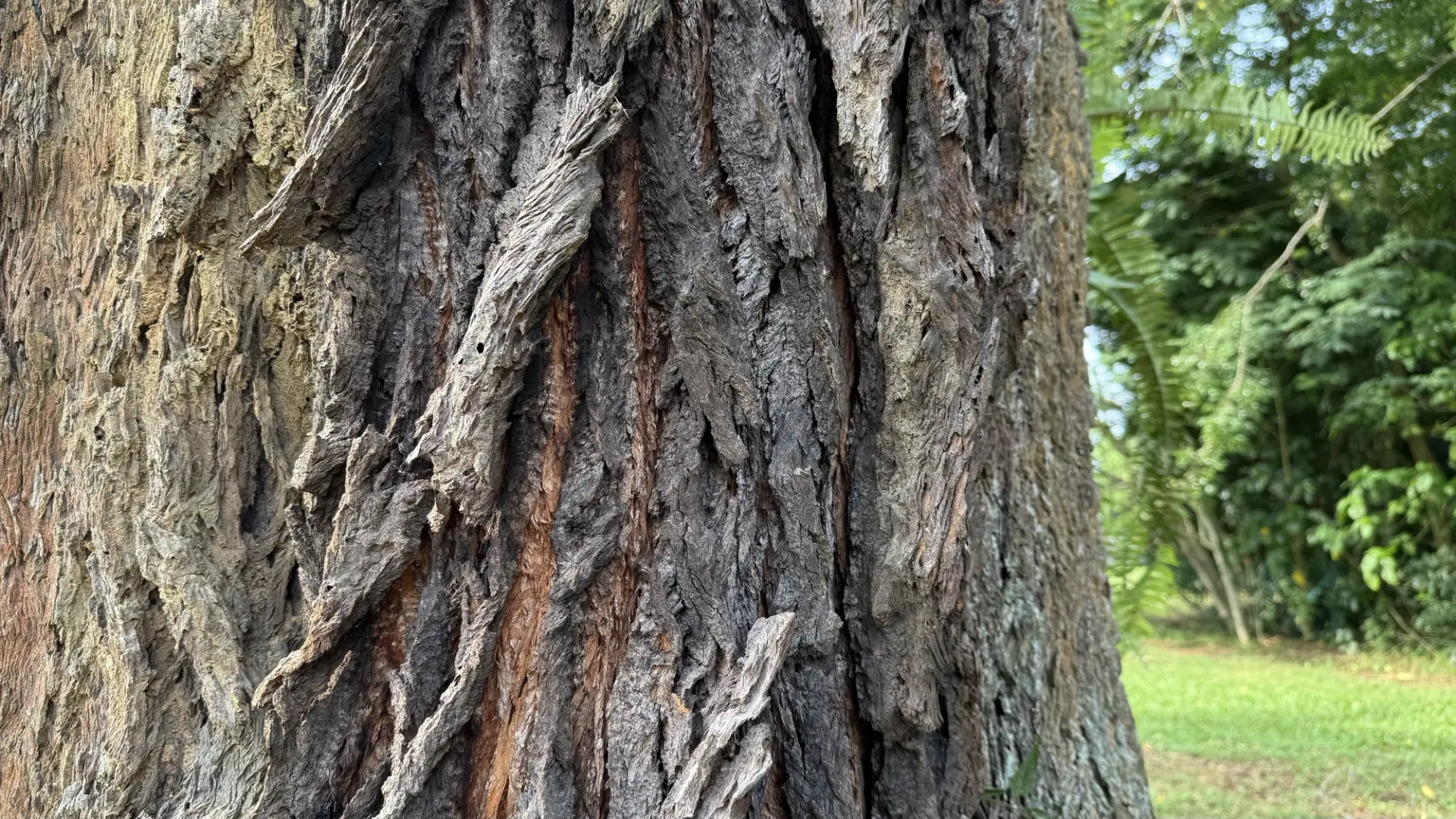
Tembusu tree bark at Maida Vale, Singapore.
Photo: Jiaying Sim
In defamiliarizing the tembusu, Chen awakens a different kind of register, one rooted in embodied attention and the impulse to stay close, even without the comfort of full comprehension. Veins, Grains, and Striae thus offers more than a portrait. This is not just about The Tembusu, but a way of seeing that expands beyond it. Such is the ethic of care etched into Chen’s artistry, where her work encourages our active attention, deepens regard, and guides us carefully toward what cannot always be fully represented on paper. From a single tree, a new orientation emerges as an open call to look again, to look anew and askew, and to begin witnessing others so often passed by or overlooked, those growing in car parks, near drains, at the fringe of fields.