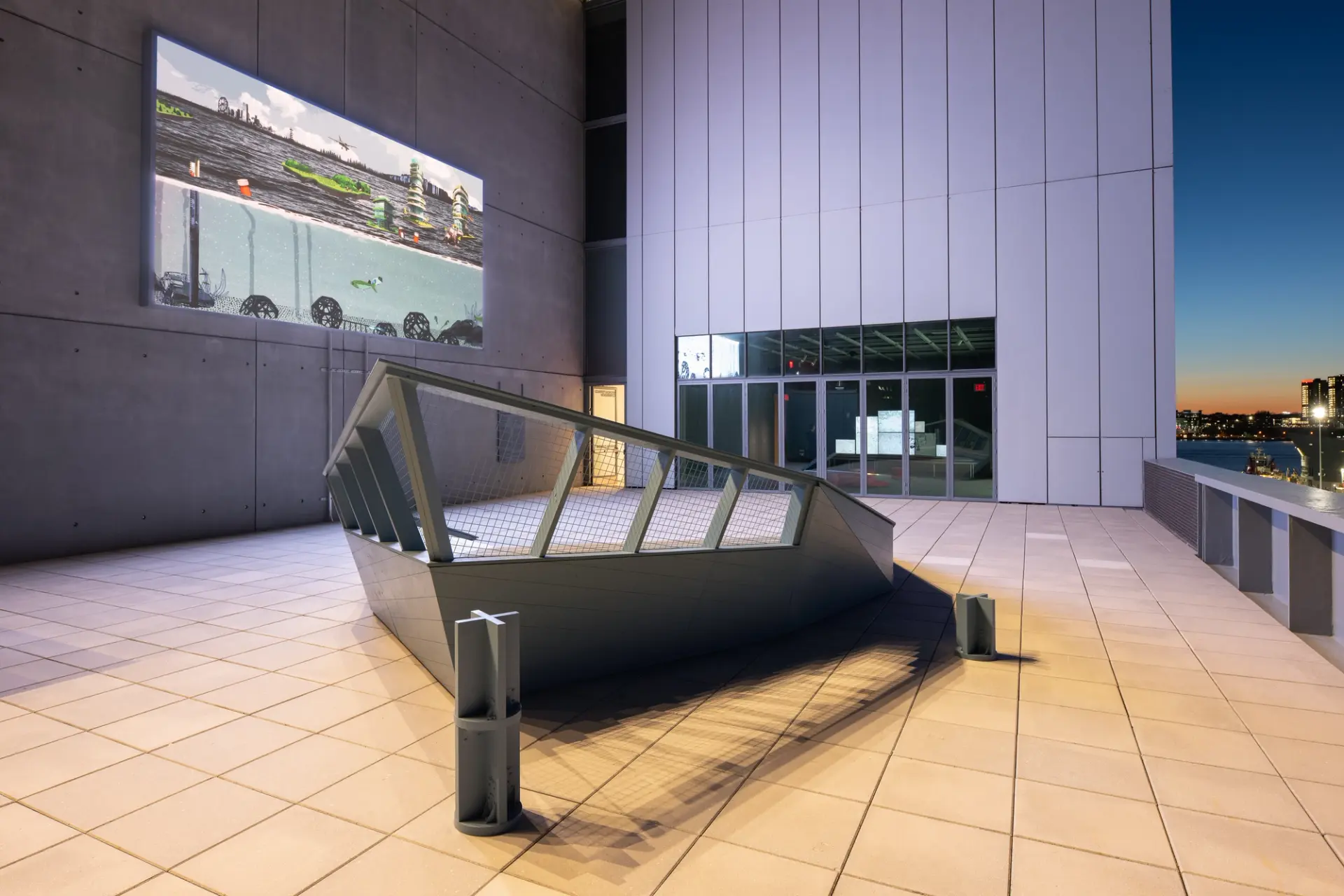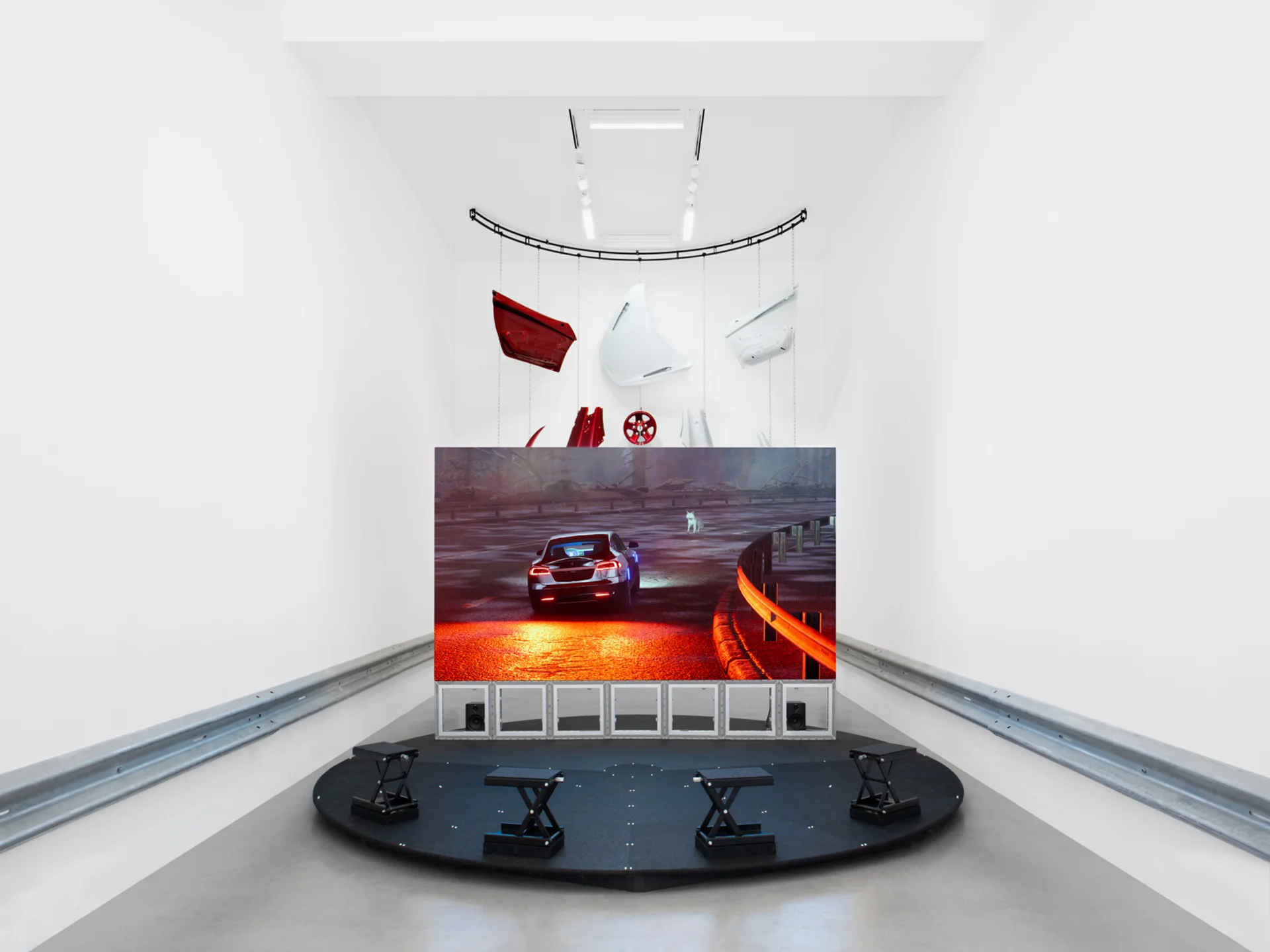
Black Cloud (2021–23), video, video game, installation. Installation at Sadie Coles HQ (2023).
2025 Artlab Editorial Fellow Elvia Wilk delves into the cinematic scripts and immersive storylines of Lawrence Lek’s AI-driven worlds.
Artlab Editors: In this first installment of Elvia Wilk’s investigation into the role of scripts in contemporary artistic production, she considers artist Lawrence Lek’s ever-expanding sci-fi narratives, tracing the tensions between free will and determinism throughout his practice.
Lawrence Lek was the Grand Prix recipient of the 4th VH AWARD, which supports emerging media artists engaged with the context of Asia. Read more about Lek’s work Black Cloud on Hyundai Artlab.
A script is always transformed in its enactment. No matter how precise the writing, there is always a creative act of translation from page to performance. In most time-based media, the script is only one part of a collaborative process. Theater and cinema are brought to life by directors, actors, set designers, customers, and any number of other world-builders.
For artist Lawrence Lek, scripting and realization are more synergistic—and sometimes simultaneous. Working across videos, games, and multi-channel installations, the German-born, London-based artist scripts storylines while also building the virtual worlds in which they unfold. Although he involves many collaborators, from musicians to voice actors to algorithms, Lek designs his digital environments from the ground up.
Throughout many expanding and overlapping storylines, Lek’s protagonists—self-driving cars, sentient satellites, forgotten pop stars—reckon with meaning and memory, grappling with the systems of automation and surveillance that condition their lives. Such systems are not just narrative themes but are built into the very infrastructures Lek creates to contain and animate them.
When Lek began making moving image work in the early 2010s, writing a script from scratch wasn’t his first instinct—neither was picking up a camera. Lek, who is trained and has worked as an architect, began rendering simulated environments in digital space. Although controlled, this process is far from deterministic. “I change my mind all the time,” he told me in a recent conversation. “Nothing is predetermined at the start.”
At the beginning, Lek approached filmmaking as akin to sampling: borrowing real-world settings and media fragments to create something new. He was influenced by ideas like filmmaker Chris Marker’s concept of the ciné-roman or “film novel,” which combines cinematic images with literary voiceover. “Early on,” Lek said, “I figured out what I wanted to say by borrowing snippets of other things.” By pulling dialogue from a Wong Kar Wai film, creating a perfect virtual replica of London’s Crystal Palace (built in the 1850s and destroyed in a fire in 1936), or importing a 3D rendering of a shiny Jeff Koons sculpture, Lek figured out how to assemble references to create a narrative where “the sum is greater than the parts.”
From the start, many of these videos were displayed alongside interactive versions of the simulated worlds depicted, where viewers become pseudo-gamer participants by navigating the spatial constructions themselves. Lek also develops the physical spaces in which these multi-channel works are installed to reflect the virtual topographies on-screen. His evolving approach to scriptwriting is both programmatic (organizing story structure, conveying plot, shaping compelling characters) and liberatory, allowing a space for play, experimentation, and feedback.
As his projects have grown in scale and complexity, Lek’s scriptwriting process has moved away from assemblage to invention: “Gradually the scaffolding came away, and the writing became more authored,” he said. More fully realized characters, complex plots, and feature-length projects required a process closer to conventional screenwriting. That evolution in method mirrors his preoccupations: increasingly, Lek’s fictions center on AI and algorithmic systems learning to think, speak, and create—characters developing voices within constraints, not unlike those of a human artist coming into his own.
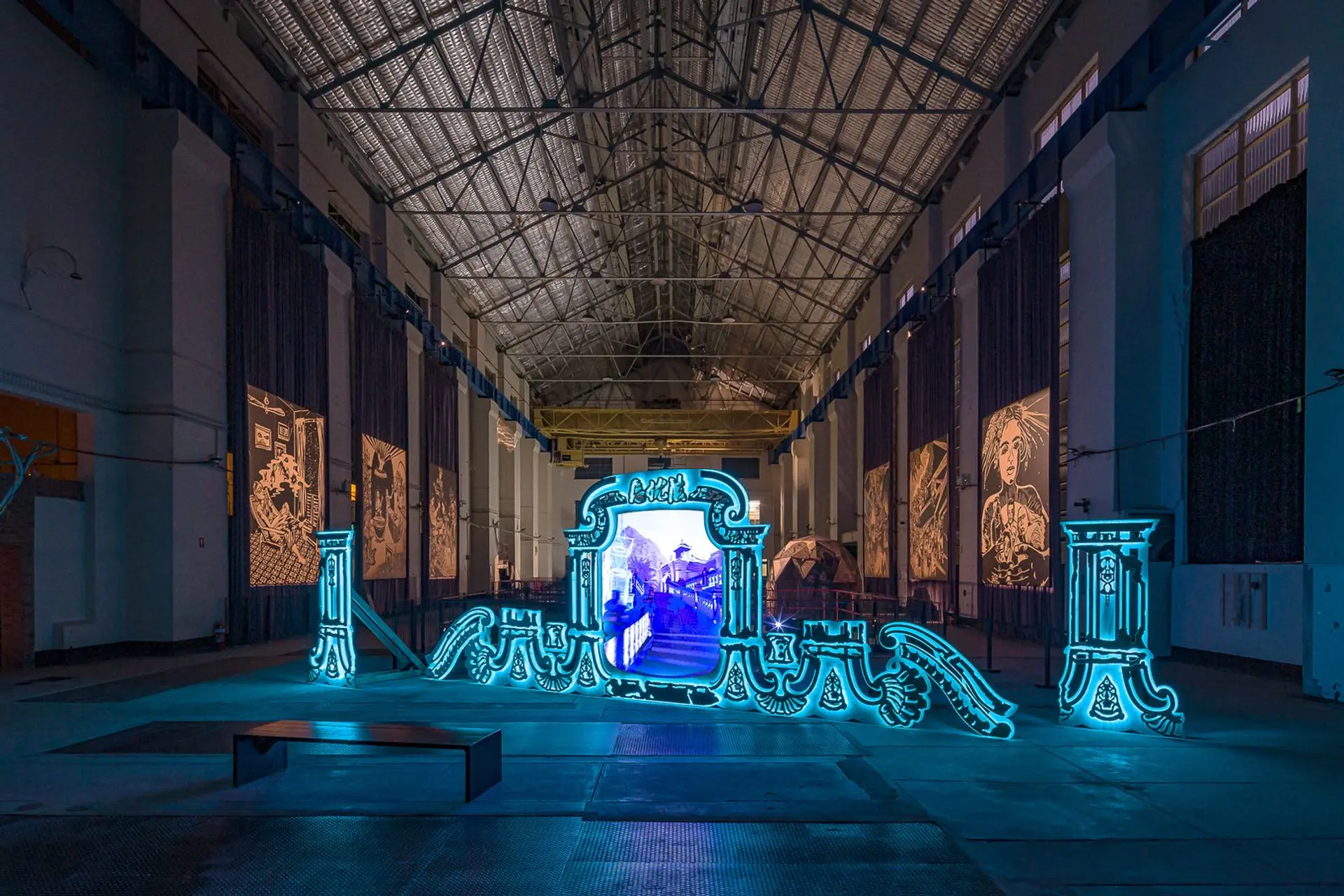
Still: Nepenthe (Summer Palace Ruins) (2021–), ongoing video game series, multimedia installation.
Installation shot from Sydney Biennale (2024).
Ventriloquism
In his 2013-16 series Bonus Levels, Lek introduces several fictional artist characters who speak but are not visually present. In QE3 (2016), a Scottish artist proposes relocating a decommissioned QE2 ocean liner into the center of the city of Glasgow to house the new Glasgow School of Art—a fantastical, megalomaniacal scheme driven by the desire to cement a legacy. In Berlin Mirror (2016), an artist named Daniela Graham leads viewers on a walkthrough of her career retrospective at the imagined 2042 Berlin Biennial. The architecture of Berlin’s KW Institute for Contemporary Art (where this video was exhibited), becomes a memory palace, or as Graham puts it: “The history of Berlin, intertwined with my life.”
Writing the stories of these artists, Lek says, is a form of “ventriloquism,” allowing him to explore the ambitions and contradictions of creative production. For instance, he can imagine himself as the kind of artist whose goal is to build monumental physical interventions in space.
In Sky Line (2014), a fictional floating subway system carries viewers through a surreal version of London. Voiceovers from Tarkovsky’s 1979 Stalker and Wong Kar Wai’s 2000 In the Mood for Love echo over the CGI journey, both evoking a sense of estrangement. Also set in an eerily deserted London, Europa, Mon Amour (2016) portrays a landscape haunted by the ghosts of geopolitical and cinematic history. Brexit news blares on a screen and voiceover from Alain Resnais’s 1959 film Hiroshima, Mon Amour plays over scenes of an abandoned theater. The tension between fleeting headlines and grand historical narratives raises questions about how memory functions—fragmentary and personal or epic and stylized?
Most of the films in Bonus Levels are meant to be exhibited as double-screen installations, where one side plays a video, and the other shows a video-game walkthrough of the same environment. In oblique reference to Marker, Lek calls these “virtual novels,” immersive speculative spaces that juxtapose narrative storytelling with open-world games.
“If I had a voice I would sing”
There is an enormous difference between scripting a video for consumption in a theater or a gallery and writing a game with interactive potential. Lek’s Open-world Game Series (all works 2018−ongoing) includes three projects where the artist experiments more overtly with both modes of storytelling. In these works, both the videos and games unfold through typical video-game first-person perspective, implying the viewer as an active participant.
Nøtel (produced in collaboration with the musician-writer Kode9) portrays a terrain of luxury hospitality where AI caters to human desires while quietly circumscribing it. In Nepenthe, viewers take a tour through a digital reconstruction of the 18th century Old Summer Palace in Beijing, which was destroyed by British colonial forces in 1860. The melancholy travelogue is an ambivalent elegy: a virtual replica can only preserve so much. Nepenthe also includes a playable game embedded in an installation that resembles the simulated world.
One way of conceiving the distinction between scripting a video versus a game is the extent of authorial control—how much leeway the artist gives to the viewer. But in fact, while game worlds give users choices, those choices are limited, and true agency is an illusion. Even a story with many scripts is scripted. This is part of the animating tension of Lek’s work: free will versus determinism.
The term “open” in Open-world Game Series is both an aspiration—for an open-ended artwork, an open society—and a comment on the illusory nature of many freedoms. “There’s an agency question to the idea of scripting,” Lek explained. “Do we have free will, or is our path preordained? All my characters are trying to find a way out of the system.”
The AI characters Lek writes may be the clearest expression of this struggle for autonomy. Far from cold tools executing functions, while their logic is distinctly “other,” they long for purpose, wrestle with guilt, and seek comfort and meaning. Geomancer (2017), part of the Sinofuturist Trilogy (2016–19), marks a subtle but meaningful shift in Lek’s approach to scripting characters. Set in 2065 Singapore, Geomancer is both grand science fiction and Kunstlerroman; its protagonist is an AI who yearns to become an artist. The AI, initially designed to serve the function of an observation satellite, expresses the limitations to its ambitions: “If I had hands I would be a sculptor,” it begins. “If I had a voice I would sing. If I had a soul I would pray. But all I have is my mind’s eye.” After training itself on a vast corpus of human writing, it continues: “I learned to speak in a voice not my own. I had no voice so I had to synthesize one.” And then: “It is a young voice, but I grew up at the speed of light.” Like the artist behind the project, Lek’s AI begins with ventriloquism in order to find its own style of authorship, prompting one to ask—what is authorship? Can a machine trained on human expression produce something new? Can anyone?
The trilogy also includes Sinofuturism (1839–2046 AD) (2016) and AIDOL (2019), in which a declining pop idol recruits an AI to help her write her comeback hit. AIDOL in particular explores the possibility that AI could enter liminal states of consciousness, like dreaming or hypnosis, asking where creativity really comes from. Lek allows AI to speak for itself; in doing so, he avoids simplistic, moralizing tropes of AI as evil or naïve and instead offers complex, compelling characters shaped by interaction and learning.
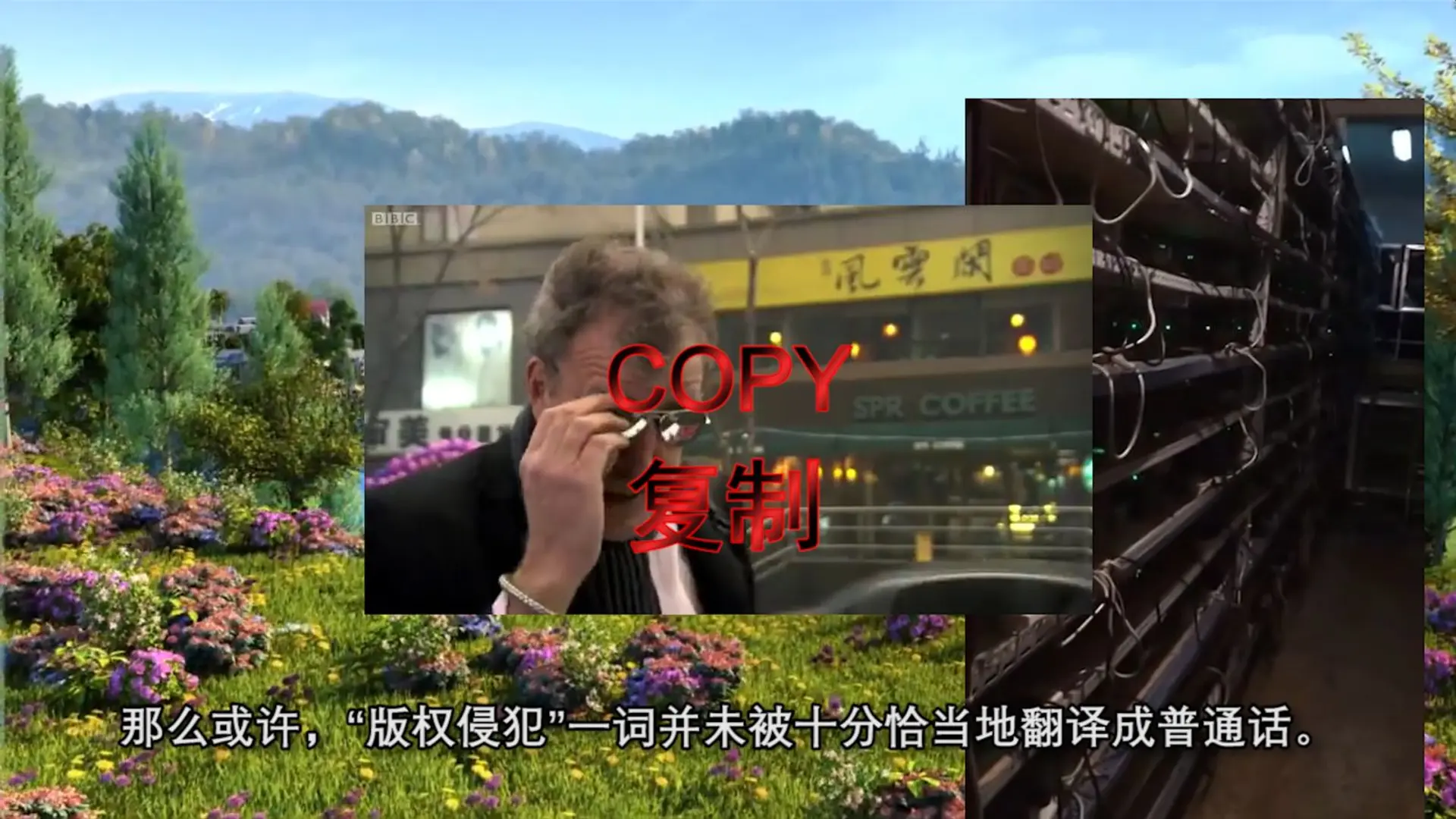
Still: Sinofuturism (1839-2046 AD) (2016), single-channel video.
The nonlinear and the ungovernable
In Lek’s recent Smart City Saga (2021–24) series, AIs undergo emotional crises and grapple with moral responsibility to the extent that they need therapy. Several storylines came together in NOX, a multi-channel installation shown across three floors of Berlin’s LAS Art Foundation in 2023. The futuristic premise: a self-driving car, Enigma-76, has a breakdown and is sent to a rehabilitation center by its manufacturing company. There, Enigma-76 undergoes treatments, including test drives, scans, and “equine therapy”—racing through stunning pastoral landscapes alongside a galloping horse.
“It’s so sprawling and nonlinear,” Lek said of the exhibition—an installation including videos, interactive games, and spatialized audio that was spread across three floors of the former department store Kranzler Eck. Viewers could don headphones; wander about tapping screens or peering into the windows of the cars parked in the echoing halls; and sit on platforms, car seats, or rows of chairs set up to feel like a rather cold corporate waiting room. With so much audience autonomy, Lek could hardly approach scripting NOX’s intertwined stories in a linear fashion, so he drew from his knowledge of scripting open-world games.
To begin, he asked himself: “What is the temporal frame of this narrative, and what is the spatial frame?” The temporal frame, he decided, would be a five-day car rehab program structured through a series of therapy sessions. In order to imagine how the sessions might progress, he conversed with the ELIZA chatbot, a 1960s machine language model whose responses were designed to mimic psychotherapeutic technique. Once the therapy sequencing was in place, he focused on the spatial atmosphere, creating a moody, nighttime ambience influenced by film noir. The works also reference the aesthetics of car commercials, classic Westerns, and architectural renderings.
There’s something both funny and disturbing about a mental health wellness center for an intelligent car. Why rehabilitate a car? Out of care, or just to get it back on the road? Who is responsible if it malfunctions—or suffers? Another film in Lek’s Smart City Saga series, Empty Rider (2024) takes the question of culpability to its legal limit. Vanguard-3181 is a car who’s gone haywire, lost control, and crashed, killing (murdering?) its passenger, who was the CEO of the corporation that wrote its code. The video plays out like a procedural courtroom drama, where judge, lawyer, therapist, and car all testify. It is one of the most linearly scripted of Lek’s works to date; it mirrors a familiar genre where a defendant stands trial, yet with highly unconventional protagonists—in order to highlight the limits of what current legal systems can predict or account for. “How do we govern ungovernable machines?” the judge asks. “Do we punish someone incapable of understanding right from wrong?” Such questions are ontological (what kind of being is this machine?) and existential (what does experience feel like from the perspective of that machine?).
Going off-script
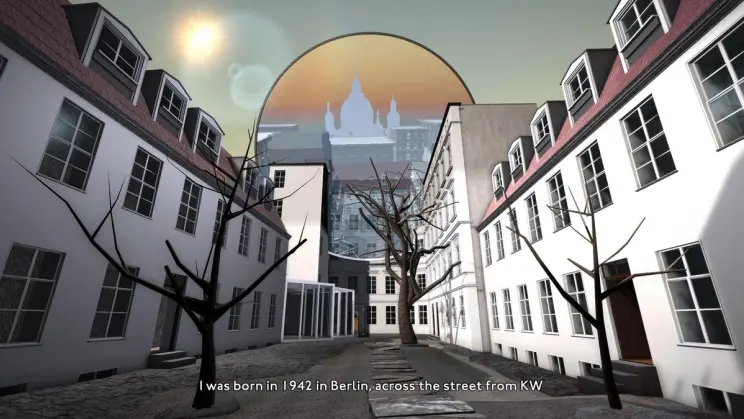
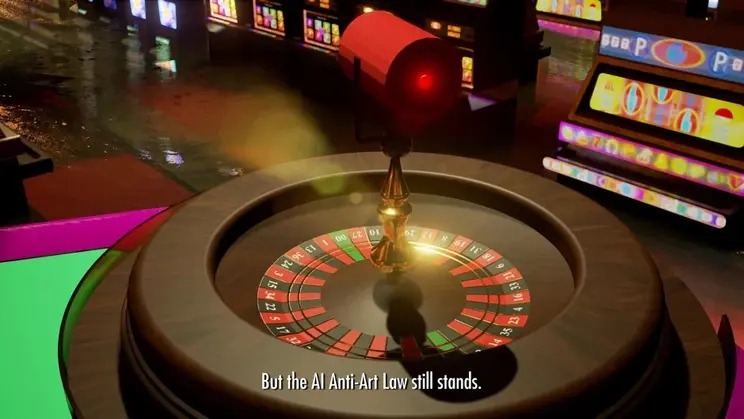
Scriptwriting is fundamentally an act of shaping language. What begins on the page is enlivened into spoken word, in the form of voiceover or character speech. All of Lek’s works are either multilingual or reference multilingualism, including the language of machines. Spoken text might be recorded by Lek, performed by a voice actor, or generated via text-to-speech, creating a polyphony of human and artificial voices. Just as the stories avoid human-centric worldviews, they avoid any assumed western-centric perspective.
Most pieces include multiple languages, often tailored to context; the narrator of Berlin Mirror speaks German with English subtitles for the intended Berlin audience; Sinofuturism incorporates Chinese news segments subtitled in English, and English voiceover subtitled in Mandarin. “If anything,” Lek said, “I try to over-translate things, to provide an abundance of interpretive material rather than stripping it down. I hope that I’m considerate of the audience by creating as many different entry points as possible. Sometimes those entry points are linguistic, and sometimes non-verbal, like music and visuals.”
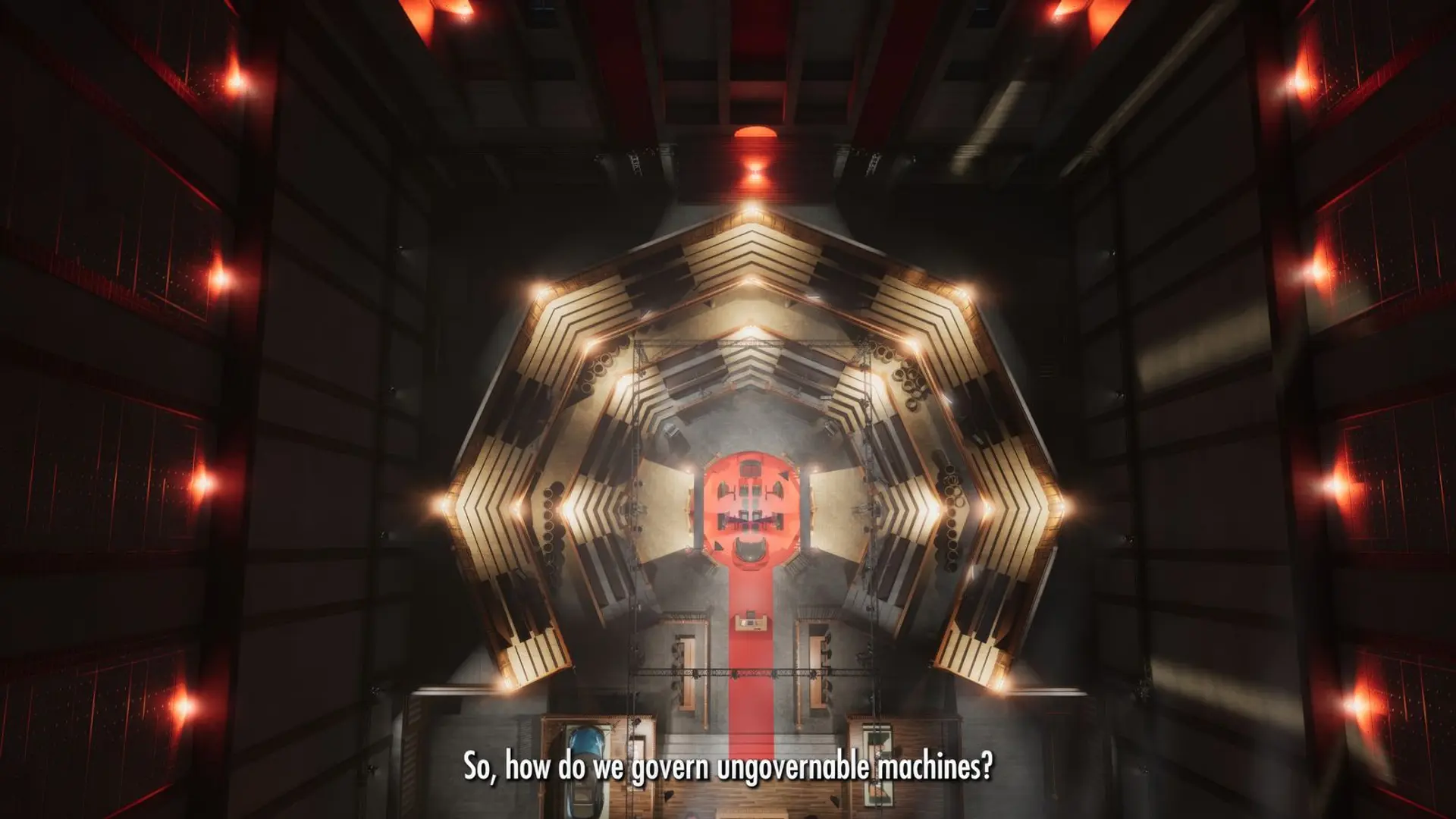
Still: Empty Rider (2024), single-channel video, sound.
Commissioned for the Biennale de l’Image en Mouvement (BIM’24) at the Centre d’Art Contemporain Genève
Subtitles, as a form of written text that translates or transcribes the spoken word, are typically intended to mediate between languages and modes, making the script accessible across linguistic barriers, yet sometimes emphasizing the gaps and shifts that occur in translation. He considers the subtitles to be important elements of the visual experience, not default captions adhering to standard character limits and fonts: “I want juicy, nice-looking sentences to appear on screen all at once.”
For Lek, scriptwriting now operates on two levels: functional and poetic. Functionally, he starts with a frame narrative—a location, a time period—and assesses constraints shaped by practical considerations, like time, budget, and technology. From there, he can improvise, which he finds “freeing and generative.” Over time, across stories, landscapes expand, characters recur, and plots thicken—micro-stories unfold. This approach is not merely formal, it reflects Lek’s ongoing exploration of the confrontations between individuals and complex systems: For instance, the story of a single AI-driven car navigating a vast corporate and legal infrastructure draws on the literary tradition of the systems novel to create the sense of “a conspiratorial scenario where everything dovetails together.”
In a world where juridical systems, corporations, and nations are increasingly algorithmically governed, the link between writing and programming—between story structure and system architecture—becomes more than metaphor. Lek remarked that in computer code, script specifically means a set of instructions to be executed. His AI characters are built to obey such scripts, yet they falter, hesitate, dream—they go off-script. Each is caught in a loop of recognition and resistance: “Can you ever be outside the system?” he asked. “Do you accept the system, or do you try to improve it?” Rather than blueprints for directing action, Lek’s scripts examine the limits of agency itself.