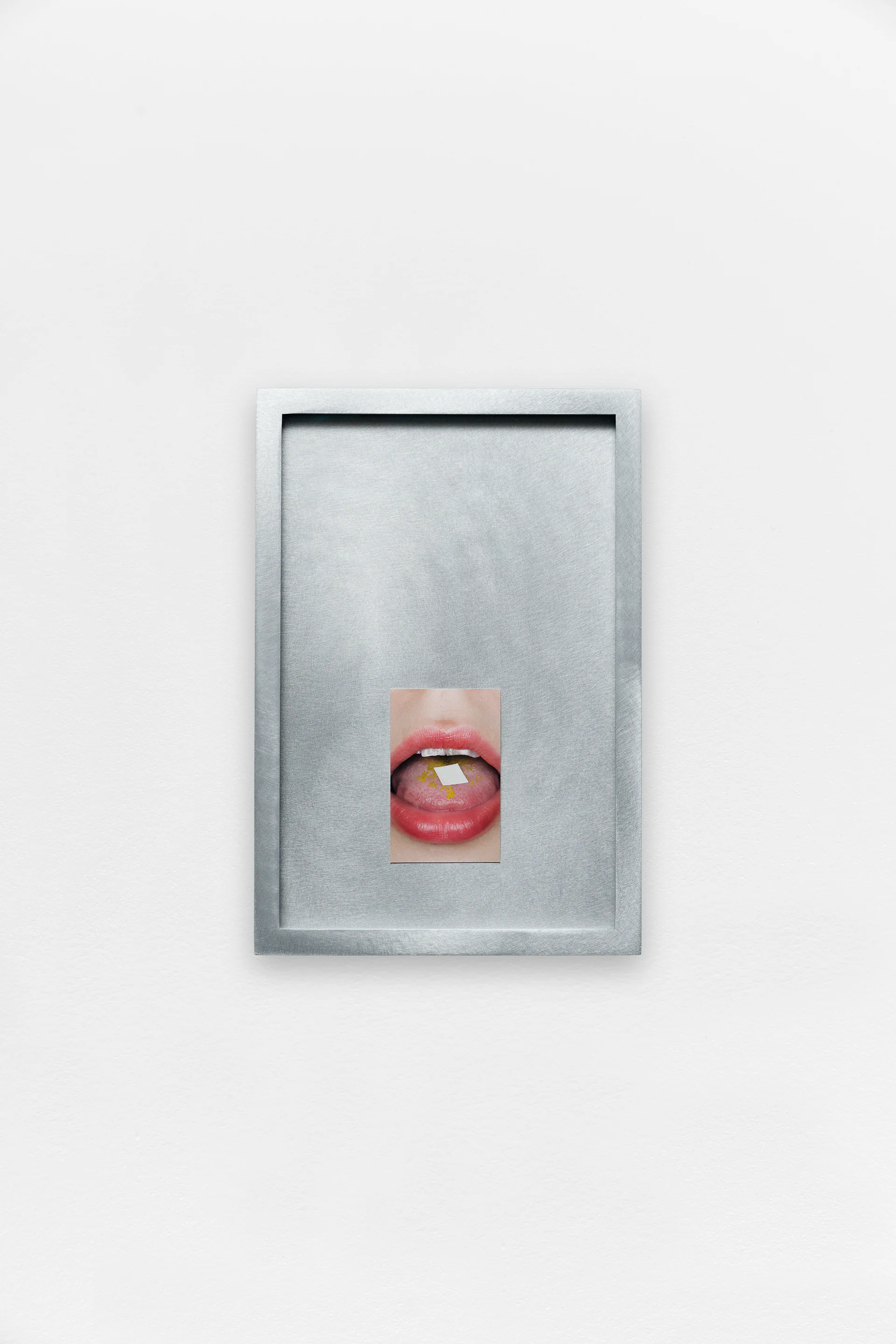
Jenna Sutela, Many-Headed Reading, 2022, Inkjet print mounted on aluminum and aluminum frame.
Photos: Dirk Tacke.
In her final 2025 Artlab Editorial Fellowship essay exploring the role of scripts in contemporary art practices, Elvia Wilk traces the ways artist and frequent collaborator Jenna Sutela acts as a medium for inspirations, be they human, animal, or extraterrestrial.
Artlab Editors: Collaborating with machines, slime molds, scientists, and 19th century spirit mediums, Jenna Sutela adopts a many-headed approach to her sonic and filmic scripts as a way to embody collective intelligence.
In the last years of the nineteenth century, the Swiss-French spirit medium Hélène Smith began to speak in a Martian language. As a semi-professional member of occult circles, Smith was known for entering trance states and channeling voices from the past, figures like Victor Hugo and Marie Antoinette, but in the mid-1890s an unfamiliar voice in an unknown language began to pour from her mouth, and a mysterious script emerged from her hand.
At the time, speculation about extraterrestrial life was gaining popular and scientific traction. Astronomers had reportedly glimpsed what looked like water channels etched across the surface of Mars, suggesting the viability of life there. Smith claimed to be receiving transmissions from this newly discovered Martian civilization. First contact: achieved.
Smith’s Martian speech was never recorded, but the Swiss psychologist Théodore Flournoy transcribed her glossolalia—the ancient phenomenon of speaking in tongues—and gave it a psychological explanation. She was experiencing cryptomnesia, he said, where a person repeats something they’ve heard or seen, mistakenly believing it to be new. Although Flournoy aimed to reduce Smith’s miraculous speech to a mechanism of the unconscious, his concept of cryptomnesia could equally be seen as validation of the “truth” of her project. And while Flournoy leaned skeptical, later Surrealists like André Breton took inspiration, finding Smith’s channeling akin to their practices of automatic writing. The truth is that she was channeling something—it just may not have been Martians.
All language is in some sense borrowed, all our patterns learned and then reappropriated, channeling words as canals channel water. Others are always speaking through us. Perhaps Smith was recombining aspects of languages she’d heard. Perhaps she was manifesting a deep cultural desire for comprehending the still-incomprehensible. Perhaps her unconscious was hard at work finding a way to express something she couldn’t say in her native French. While Flournoy wanted to explain her phenomenon, the Surrealists wanted to listen.
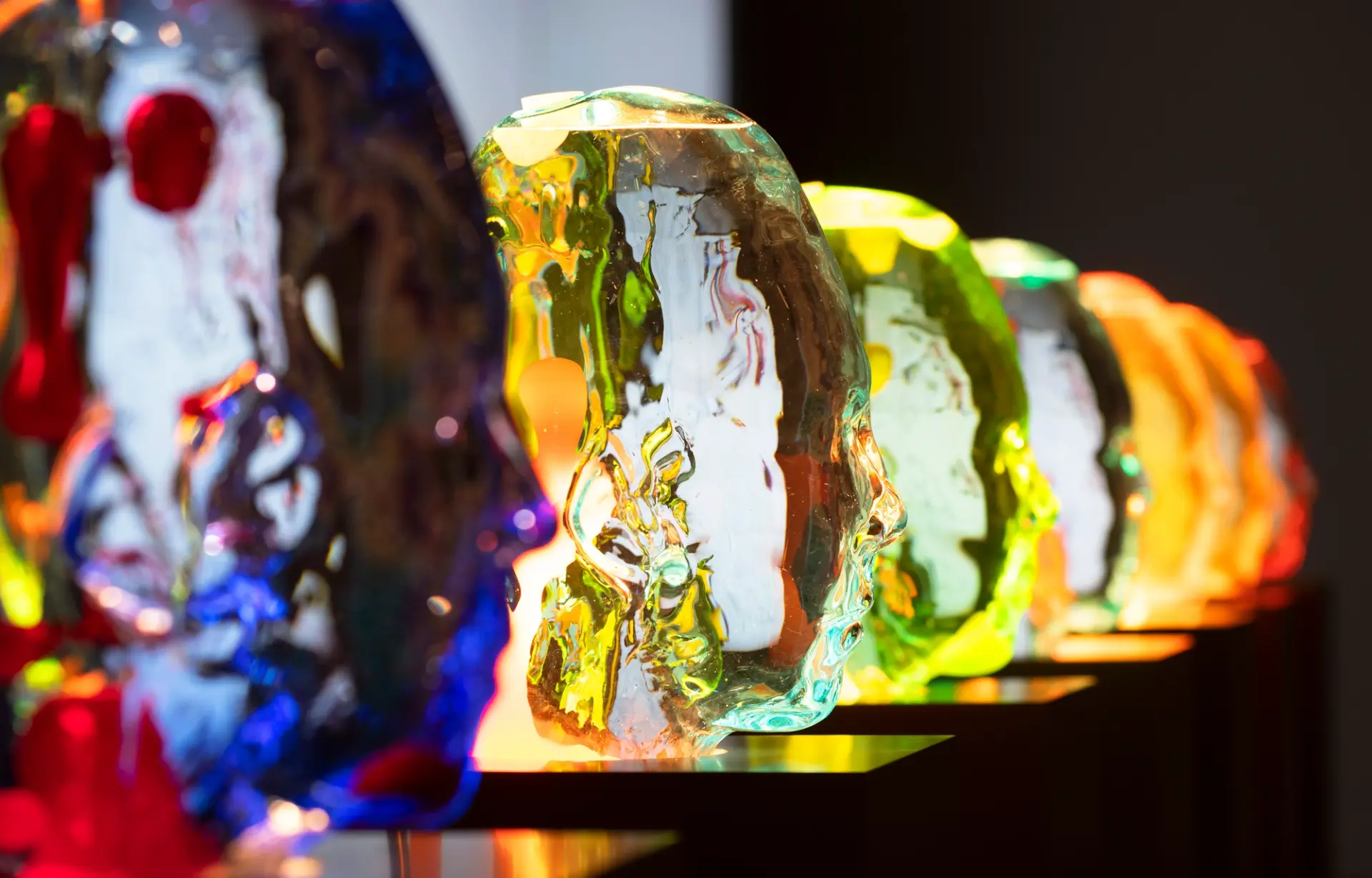
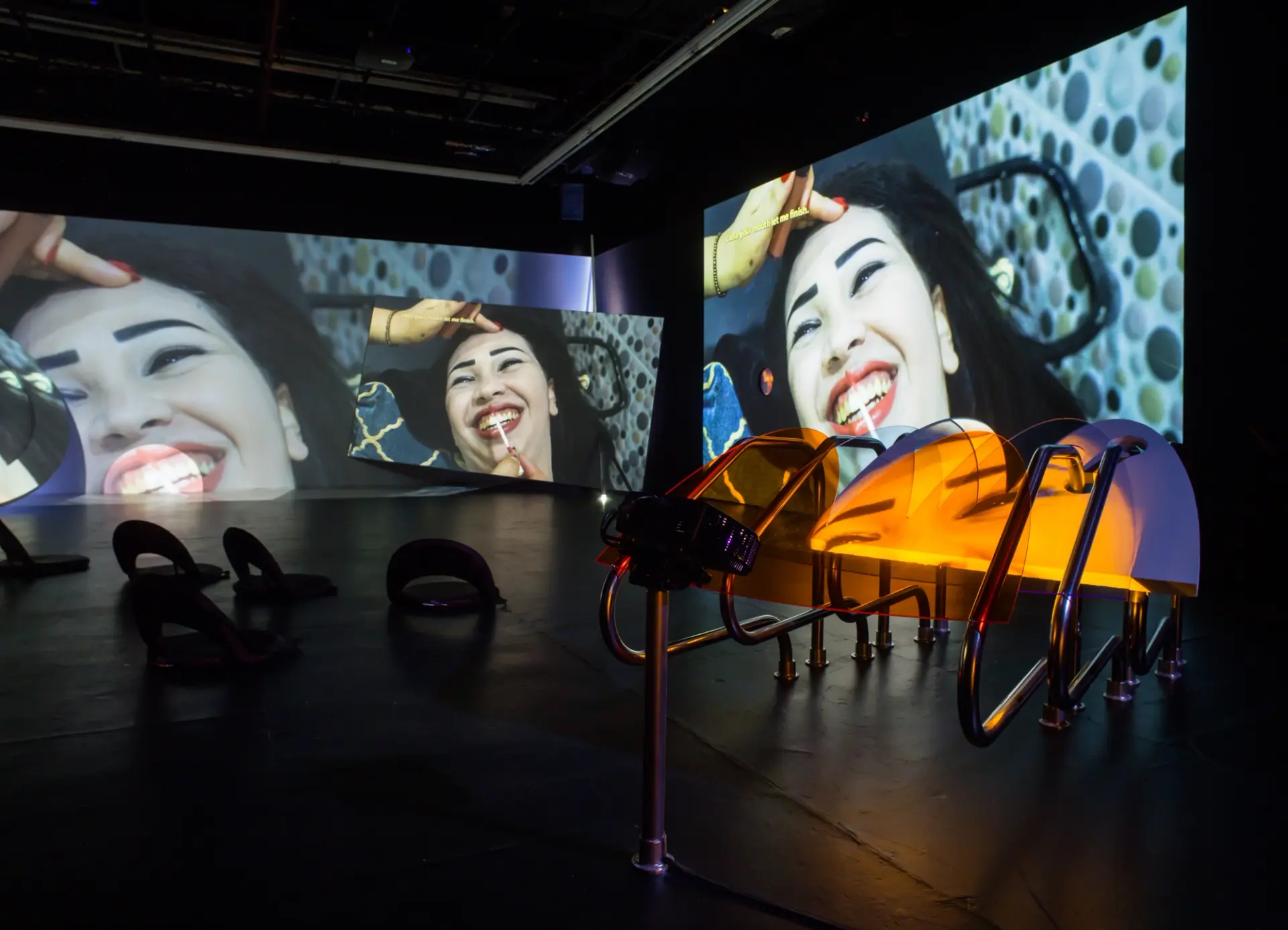
Jenna Sutela, I Magma, 2019, Lava lamps in the shape of the artist’s head.
Photo: Julie Hrnčířová, Courtesy of Oslo Kunstforening.
When the artist Jenna Sutela came upon Flournoy’s Martian transcripts in the mid-2010s, she was already developing a studio practice premised on channeling collective intelligence and communal expression, or what she sometimes calls “many-headedness.” Rooted in sound and media art, her work expands typical notions of collaboration, where many people contribute ideas and labor. For Sutela, this collaborative community also extends to nonhuman participants.
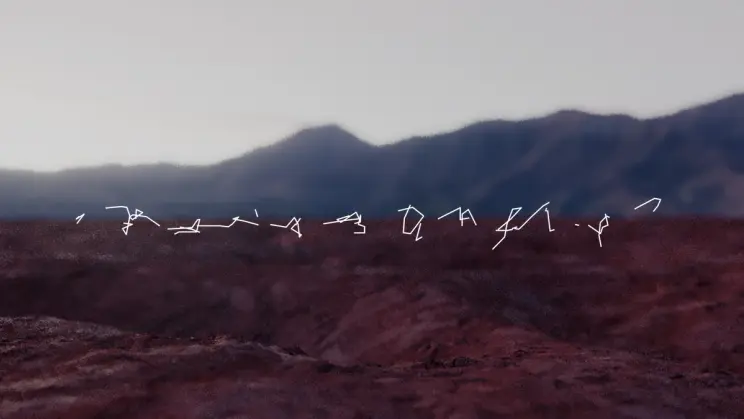
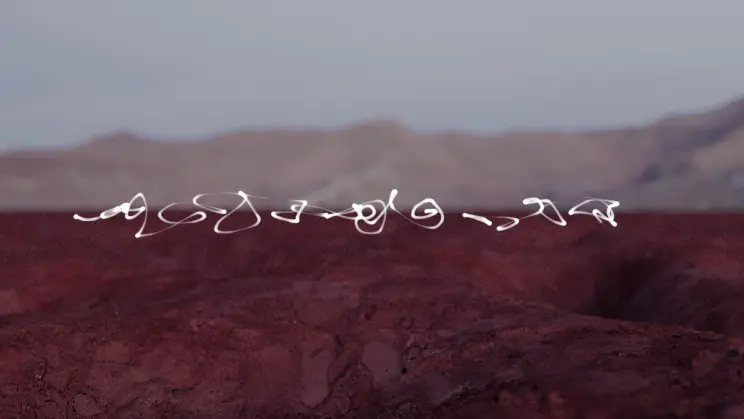
In 2018, Sutela revived Smith’s Martian language in her video work nimiia cétiï. Working together with scientists and a machine learning system, she observed patterns in the movements of Bacillus subtilis, a microbe whose ability to survive in extreme environments makes it a popular choice for scientific experiments in how organisms respond to space flight. She then took the bacteria’s behavioral patterns as a structuring principle for a sonic composition of her own vocalizations of Smith’s language. In the video that resulted from these many procedures, an eerie, stuttering voice echoes over a computer-generated written script, against a fuzzed-out pan across what looks like Mars rover footage.
How would we go about identifying who scripted the sound and scrawl of nimiia cétiï? Who wrote it? The bacteria? The machine intelligence that observed the bacterial behavior and extrapolated coded patterns? The scientists who programmed the machine intelligence? Sutela, who had the idea to channel the gut bacteria? Hélène Smith? Nineteenth-century aliens trying to get their message across? The answer, of course, is all of the above.
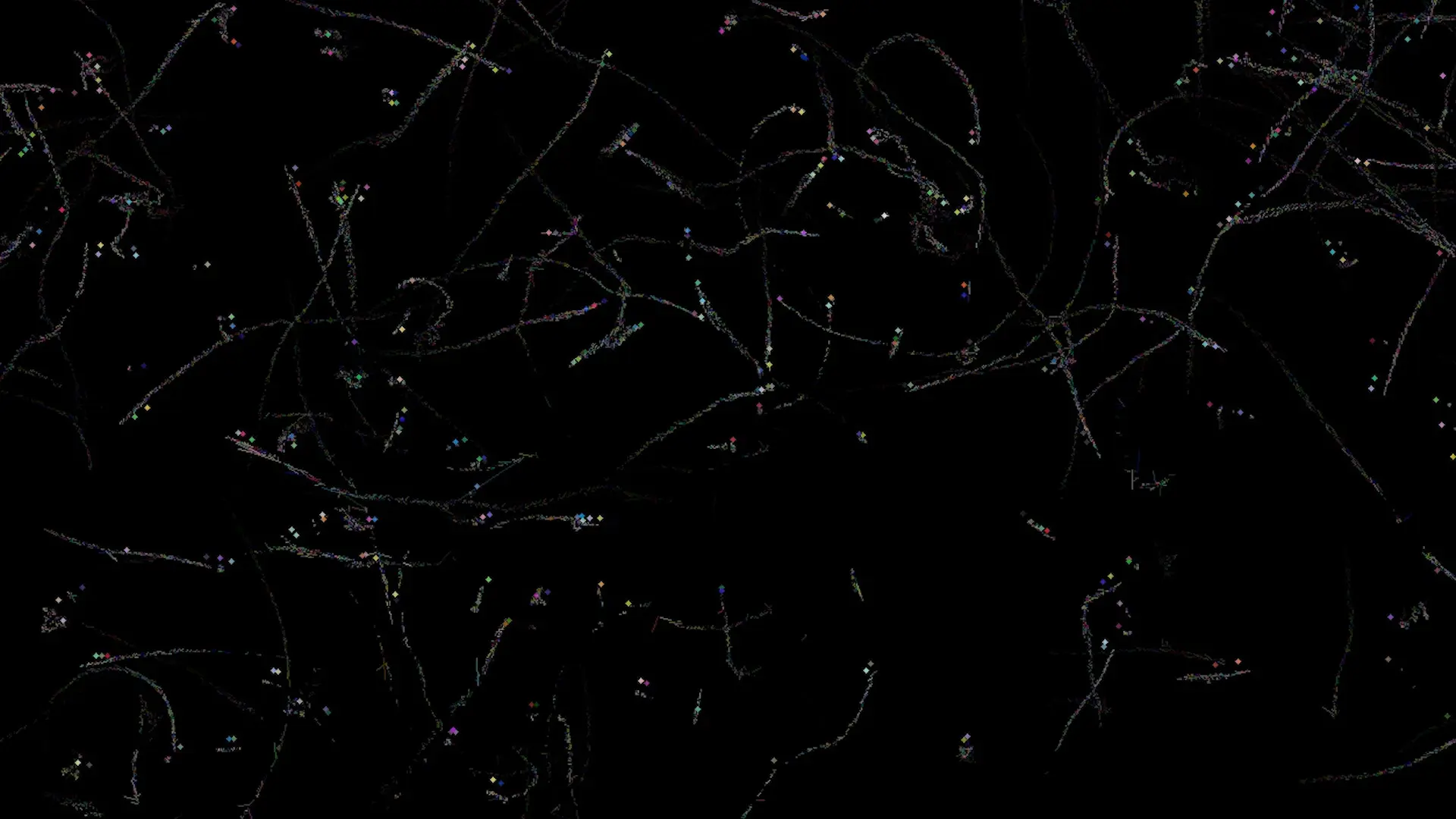
Jenna Sutela, nimiia cétiï, 2018, HD video, sound.
Still images courtesy of the artist.
Research into the gut-brain connection has made abundantly clear that the activity of bacteria in our bodies influences human thoughts and feelings. At least half of human body weight is made of microbes, mainly bacteria. Many of these bacteria are ancient, and they provide clues about what kinds of alien life could theoretically have evolved on other planets. nimiia cétiï shows how aliens already live within and among us, in our microbial bodies and in the machines we communicate with; to be human is to be many-headed.
Sutela is an artist working in the tradition of the spirit medium. By finding ways to listen, and then to channel voices other than her own, she helps attune our ears to new frequencies—and asks us to listen. This generous process results in poetic, seductive, funny, and subtly radical projects that upend assumptions about authorship and individualism that we may not even realize we’re holding on to.
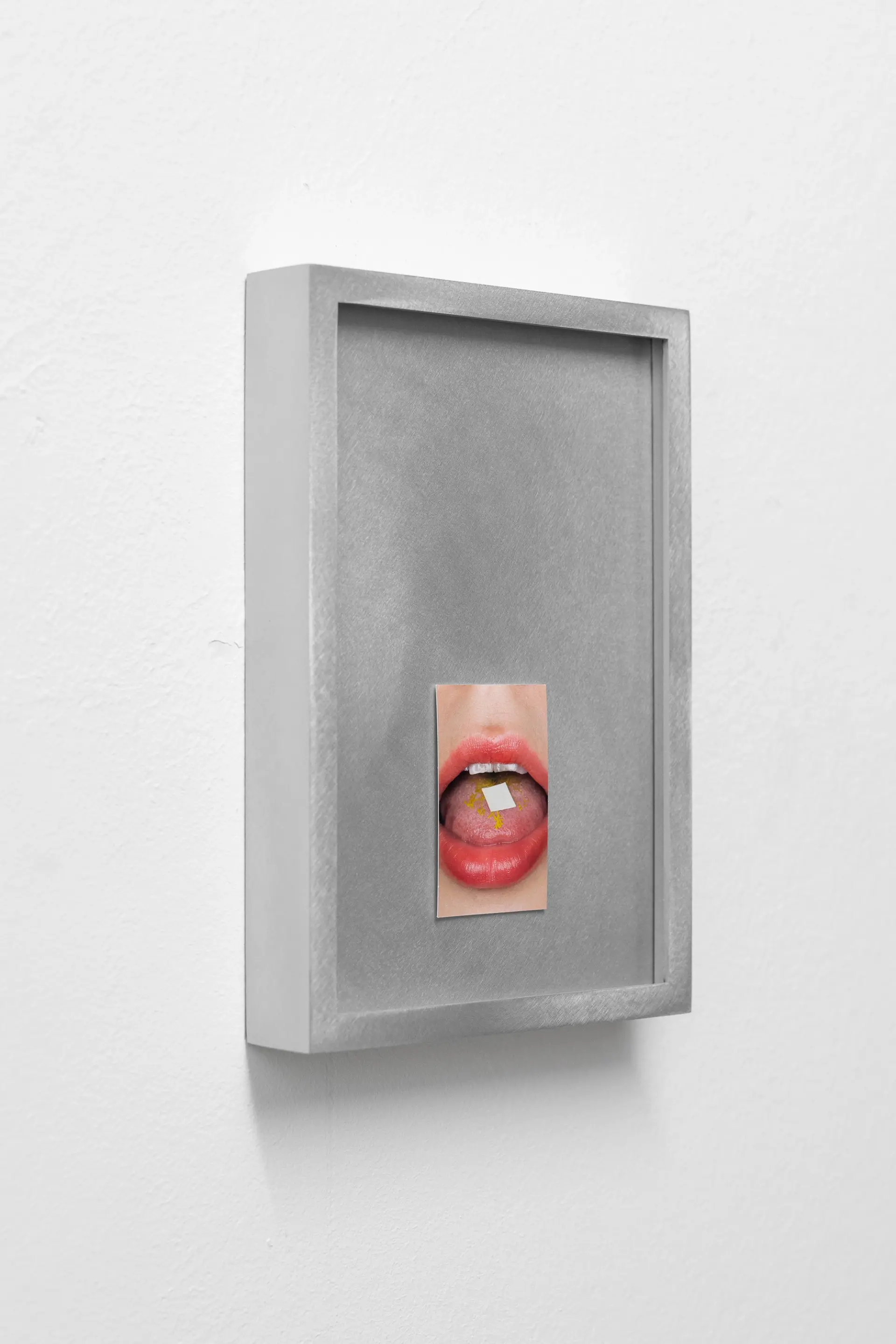
Jenna Sutela, Many-Headed Reading, 2022, Inkjet print mounted on aluminium, aluminium frame.
Photo: Dirk Tacke.
The term “many-headed” first came to Sutela when she began studying and eventually working with the organism known as the slime mold. Physarum Polycephalum—“poly” means many, and “cephalum” means cranium—is a multicellular creature that, when it spreads, looks like a bright-yellow fungus. (It isn’t fungal—it belongs to the group of thrillingly uncategorizable organisms called protists). Although the slime mold has no brain or central nervous system, it can navigate complex spatial problems. Its peculiar genius was made known through the experiments of Japanese researcher Toshiyuki Nakagaki, who showed in the early 2000s how expertly it could navigate a maze seeking food (and in doing so, design a network as efficient as the Tokyo metro).
Curiosity about Physarum led Sutela to conduct her own experiments, and eventually to meet and interview Nakagaki. Her investigations manifested in a project called Orgs (started in 2015), which includes labyrinthine sculptures that house wandering slime molds, a 2017 book with many (human) contributors, and a series of performances. In her performative “Many-Headed Readings” she invites the slime mold to navigate her body on stage: she starts by placing an acid-blotter-like tab with Physarum spores on her tongue before she begins to recite a speech. I remember a line from this monologue without having to look it up: “Artificial intelligence has been trapped on the level of consciousness for too long.”
Conceivably, the slime mold may be traveling through Sutela as she speaks on stage. It’s an experiment without a control test—there’s no way to determine how much she is performing versus being performed. “I find something meaningful about ingesting this hive mind,” she told me in a recent conversation. “Through this act, I’m saying that we’re also comprised of different forces inside and outside our bodies that contribute to our speech—programming it, or at least affecting our moods and ways of delivery.” She points out that you could also see the performance as “a slime mold trip report.”
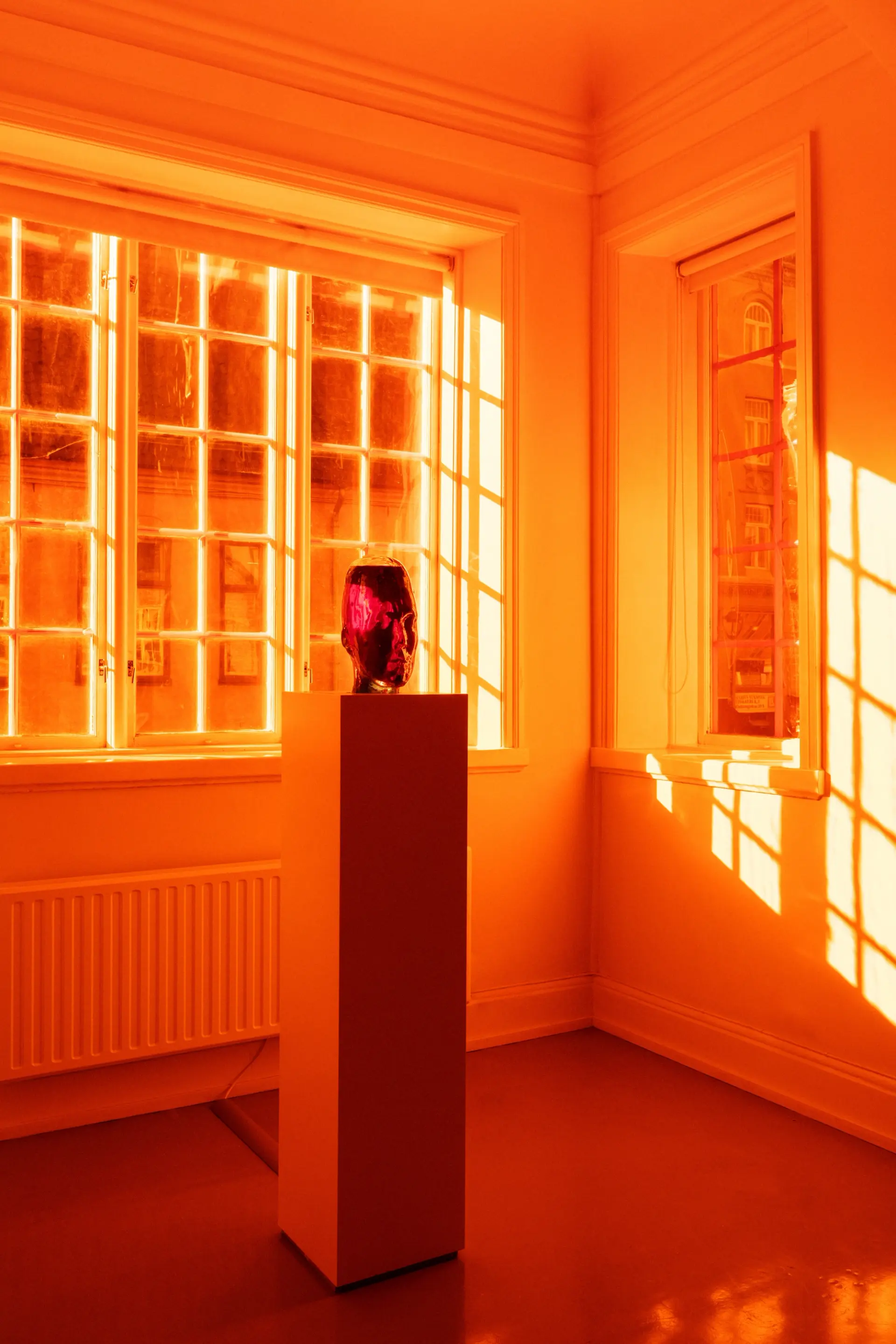
Jenna Sutela, I Magma, 2019, Lava lamps in the shape of the artist’s head.
Photo: Julie Hrnčířová, Courtesy of Oslo Kunstforening.
I count myself as one of Sutela’s many heads. We’ve been writing together for over a decade—long enough to forget exactly when our collaboration started. It might have been an early video essay that we scripted in 2014, where we alternated diaristic and manifesto-like language to explore the idea of the quantified self—the urge to catalog and to know everything about energetic and metabolic processes, and the difficulty of defining where the biological and technological diverge.
Over the years, Sutela and I have written more video scripts, as well as poems, essays, audio pieces, and the more obligatory research proposals and press releases—which, in her practice, sometimes allow her to imagine works at the edge of realizability, becoming traces and documents of star-gazing thought. Art-making requires thousands of words of paratext, which often script in advance the way works manifest in space and time, and after the fact, help script the way audiences interpret the work they’ve seen.
In 2016, we published a text for Rhizome called “Slime Intelligence” on Sutela’s projects involving Physarum, where we tried to write as if we were slime mold: one many-headed creature thinking together by writing together, sometimes in the same document, sometimes in the same room, sometimes over the phone. Rereading that essay today, I’ve found a script for our long collaboration—it’s called friendship—that continues to today. “We overlap, we leave traces, we circle back on one another,” we wrote. “We write this essay back and forth, to articulate each other’s thoughts: two heads working laterally through movement, tracing slimelike intelligence by simulating its collaboration.”
The medium of art publishing doesn’t always allow for that type of cohabitation. Sutela is supposed to be the artist; I’m supposed to be the writer reflecting on her finished work, perhaps providing a window into her process, but from a different room. But what if I’m part of her process? What if she’s part of mine? How can those divisions be unscripted—unprofessionalized—and how can we think about “medium” differently? What is my medium and what is hers? More to the point: Who is the medium?
The process of writing back and forth together is more freeing than many parts of my writing life; I’ve learned to channel her voice, and in doing so to develop new capacities of language within myself. I’ve also become highly conscious of just how much of my writing—and speaking, down to my gestures or my laugh—are scripted and patterned on others’ words and ways. I know that my thoughts channel others, whether I know it or not. She’s not typing this, but I’m sure Sutela’s writing this with me right now.
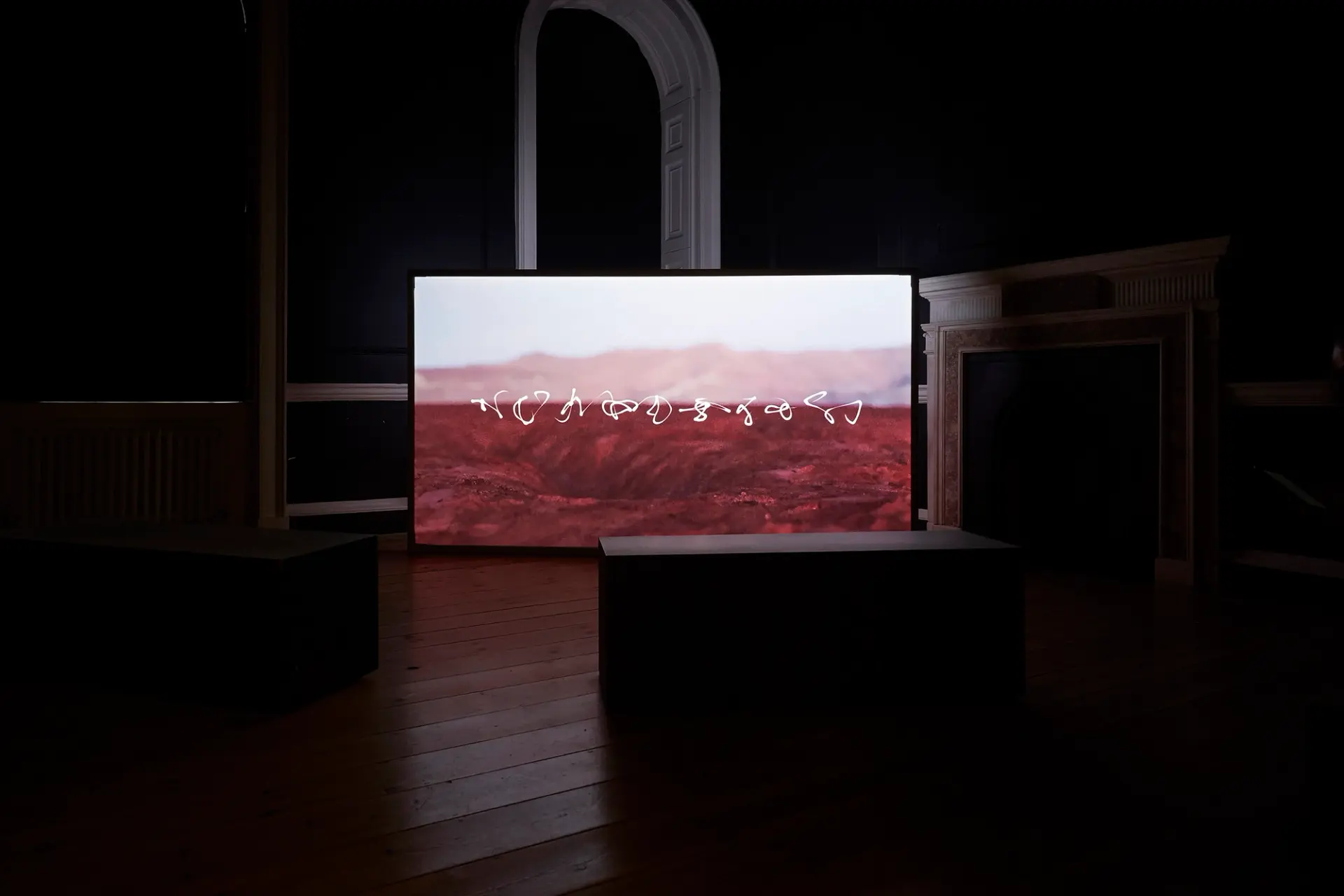
Jenna Sutela, nimiia cétiï, 2018, HD video, sound.
Photo: Anne Tetzlaff, Courtesy of Somerset House Studios.
It’s a classic science fiction storyline: an alien intelligence contacts Earth, but we can’t figure out the content of the message. Communication is a matter of both intent and interpretation. Inspired by science fiction scripts, Sutela tries to imagine the broadest spectrum of ways beings may signal and receive meaning, as well as the breakdowns in transmission or gaps in comprehension. She’s sought those moments where meaning becomes unstable and we have to reach. “There are other types of life forces, beings, and sensing at play that wouldn’t communicate through language as we know it,” she tells me. Every reader brings personal histories, habits, and hauntings to a text.
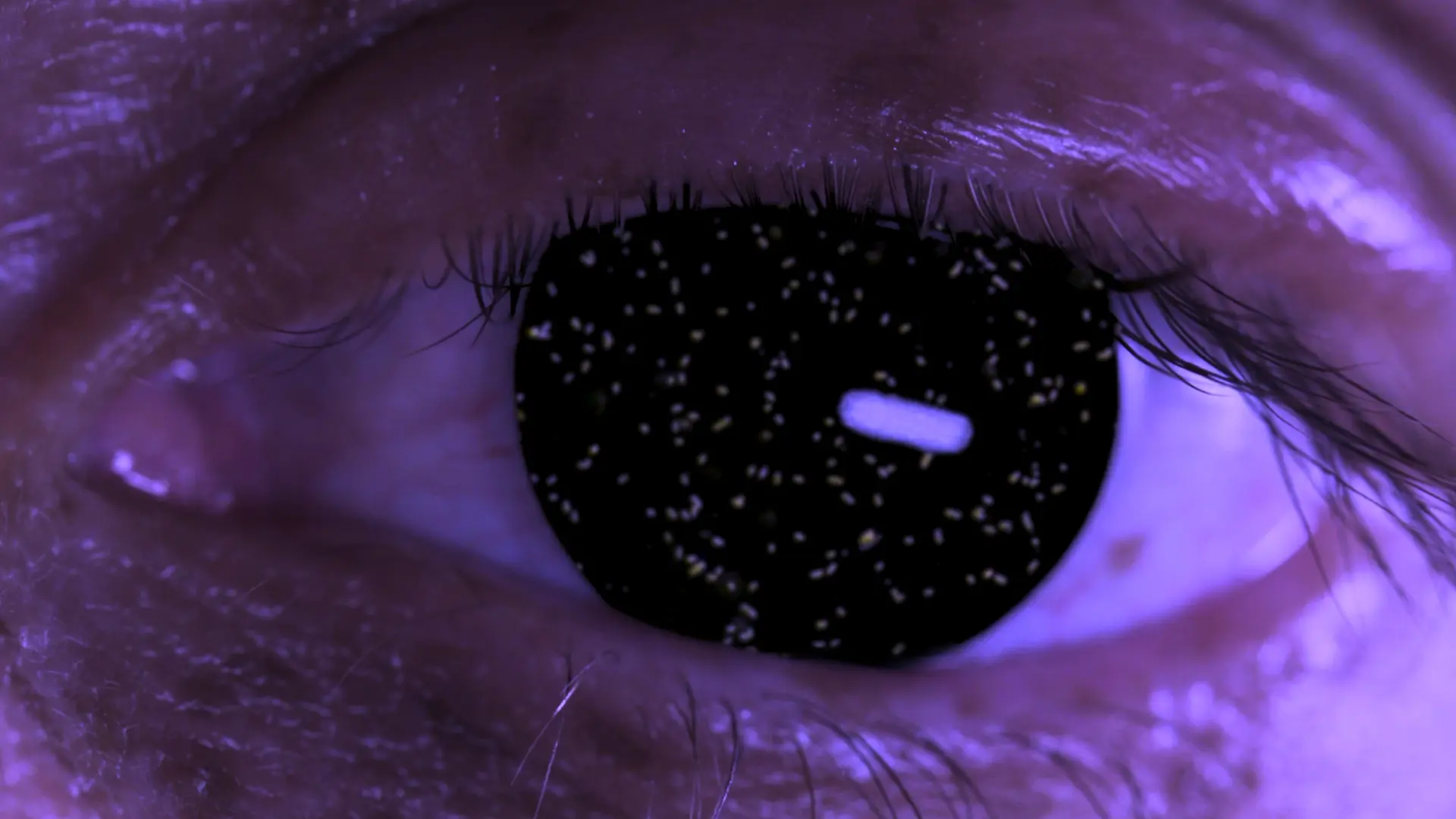
Jenna Sutela, Holobiont, 2018, HD video.
Still image courtesy of the artist.
Sutela’s 2018 video Holobiont connects a macrocosmic view of the universe with the microcosmic world inside our guts. To produce it, she traveled to the European Space Agency to film the ritualistic “planetary protection” practices undertaken by scientists there. The scientific aim is to decontaminate spacecrafts, preventing Earth’s microbes from spreading to other planets during space missions—and vice versa. Again, she offered Bacillus subtilis a starring role: microscopic images of the bacterial colonies quiver and flit across the screen like distant stars.
That piece, she tells me, “combined a scripted, essayistic style of writing with snippets of interviews and discussions.” I see that video as a bridge between her (and our) earlier working style, more reliant on pre-written narratives and plans, and a practice that is increasingly, ambitiously, free of the urge to predetermine what will happen—or to explain what does.
I’ve noticed that as the works flee narrative convention, other people's writing about the work becomes more poetic and less deterministic, too. When I write about her, I carefully consider how much of the processes to divulge, resisting my own urge to over-explain. I don’t want to script someone’s interpretation in advance. I’d rather preserve that precious space of primary encounter with an artwork: first contact.
For an audio piece we made in 2020 at the invitation of curator Helen Kaplinsky, we asked the artist Sissel Tolaas, known for her olfactory works, to create an environment for listening to the work. In a room within Science Gallery London, Tolaas coated the walls with (undisclosed) smells that evoke a feeling of bonding and togetherness. Visitors could sit and absorb the smells while listening to the audio of nnother—a dialogue between two creatures who are dependent on each other, with a parent-child relationship that sometimes sounds more like a host-parasite relationship. The artist Colin Self voiced both parts. We drew ideas from a conversation we had with scientist Yannis Paloyelis from London’s King’s College, who studies the effects of the hormone oxytocin, essential to human bonding and often credited as the chemical embodiment of love. We also included snippets of code language and the pre-linguistic communication of a baby. Here is a part of the beings’ conversation:
How do you communicate?
Peeling language off the ceiling and licking the walls to write.
What have you forgotten?
As you grew, I learned another language. The more fluent I became, the less I remembered my own name.
Your name was my name and your body was my body.
You and me, forgetting language and code. Stuttering our way to infinity. I-i-i-infinity.
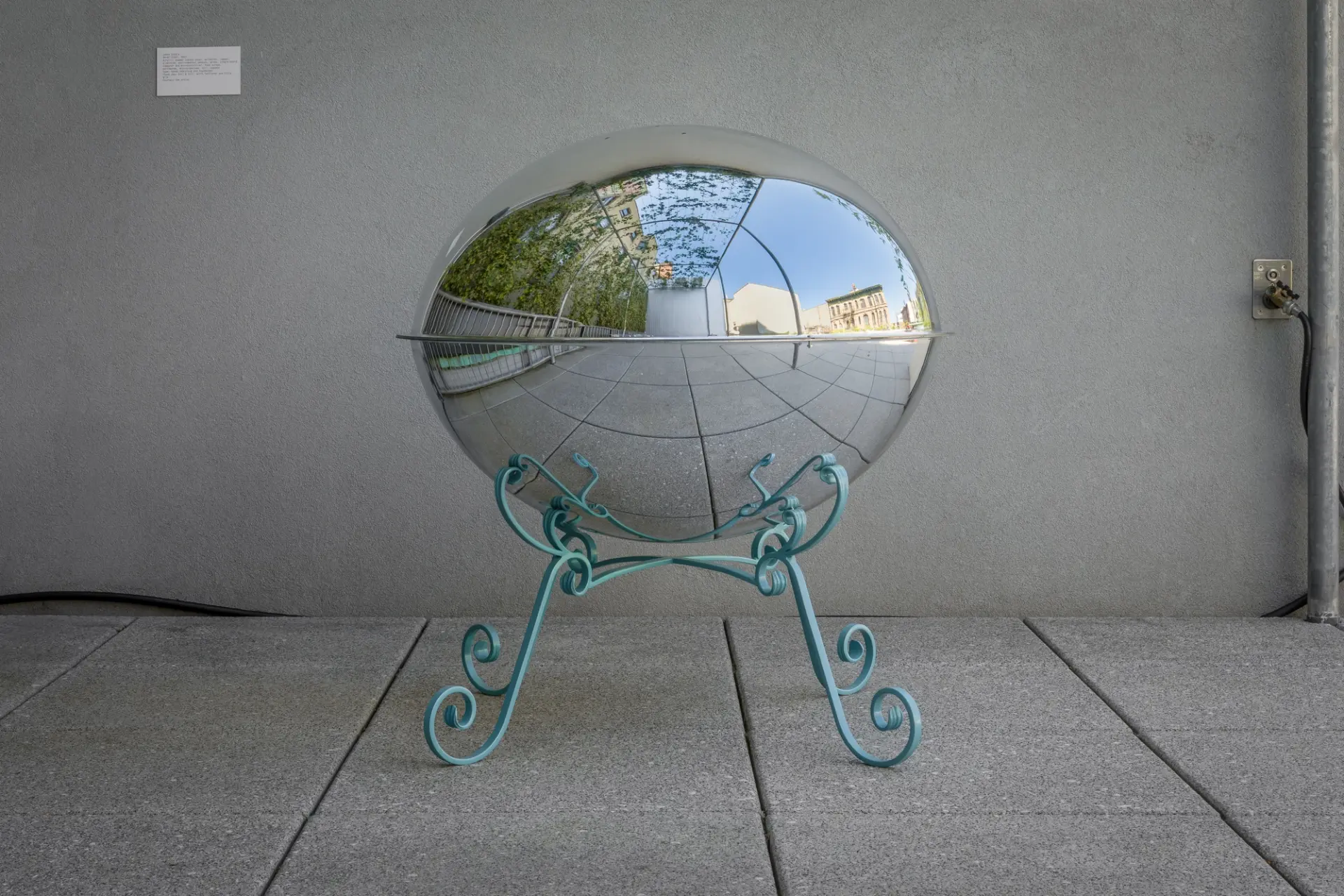
Jenna Sutela, Vermi-Sibyl, 2023
Photos: Daniel Pérez, Courtesy of the Swiss Institute.
In the spirit of many-headedness and looking to unexpected, assumedly “voiceless” collaborators, Sutela created the process-sculpture Vermi-Sibyl. Commissioned in 2023 as part of the Swiss Institute’s curatorial initiative “Spora,” the piece is a composting receptacle installed on the roof of the institution’s building in lower Manhattan.
The Swiss Institute staff regularly deposit their food scraps into the work’s round, mirrored container. Inside, a thousand worms munch and metabolize the material. Their energetic digestion generates electricity conducted through a battery-like system of copper and aluminum rods. The resulting energy powers a sound system on the roof. The degree of worm activity determines the amount of echo of the resulting saxophone-like sound. The composter also occasionally produces randomly generated phrases Sutela calls “compost wisdoms” —snippets of language that read like prophecy, prediction, or wordplay.
“Creating works with living matter is like creating a laboratory,” Sutela said in a 2023 conversation with the writer Cassie Packard Cassie Packard . “Organisms need a habitat: not just an installation but an architectural space.” Hosting another species can be delicate work. Artistic processes that truly include others are as reproductive as they are productive. They require ongoing care, maintenance, and exchange. In the slime mold sculptures made for Orgs, for instance, keeping the organism alive and healthy required continuously calibrating its preferred levels of darkness and humidity in exhibition spaces—not your typical archival conditions for static artworks.
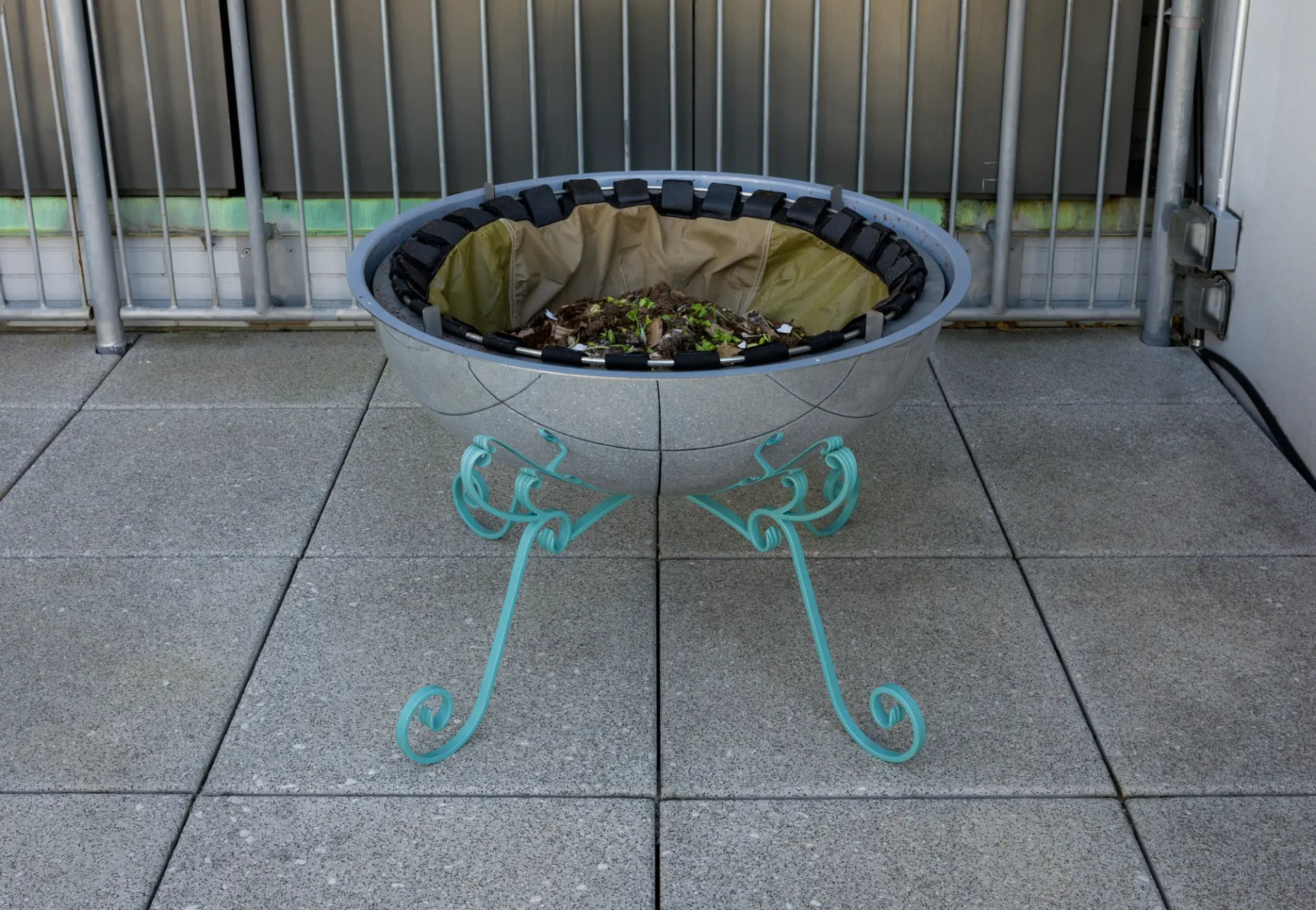
Jenna Sutela, Vermi-Sibyl, 2023.
Photos: Daniel Pérez, Courtesy of the Swiss Institute.
In Hélène Smith’s era, astronomers in search of the origins of life were mistaken about their Martian observations. What looked like grooves and canyons on Mars turned out to be scratches on the telescope’s lens. What was taken to be an objective observation turned out to be wishful fiction—fantastical speculation was born of a fault in the mechanism of observation. We can only see as well as our tools allow—and we tend to invent tools that allow us to see what we expect to find. In 2026, Sutela will transform the Finnish Pavilion at the Venice Biennale into an atmospheric installation, inviting audiences to practice what composer Pauline Oliveros called “deep listening.” This is a conscious focus distinct from passive hearing; through concentration, each person can determine for themselves what is signal versus noise.
Rigorous inquiry, the intellectual endeavor to understand, is itself an act of devotion. When the classicist Dr. Andrew Szegedy-Maszak visited the ancient Greek ruins of Delphi in 2002 to research the theory that hallucinogenic fumes emanating from the ground beneath the temple produced the oracles' prophetic powers, he emphasized that he was “very, very skeptical at first.” He didn’t want to go off-script by taking oracle lore too seriously or literally. But the theory that psychoactive vapors influenced oracular speech, it seemed, was accurate. That the oracles’ visions may have been chemically induced made the site more, not less miraculous to him. “I came to scoff,” he said, “but stayed to pray.” There is something sacred in wanting to know. There is something sacred in knowing you can’t.
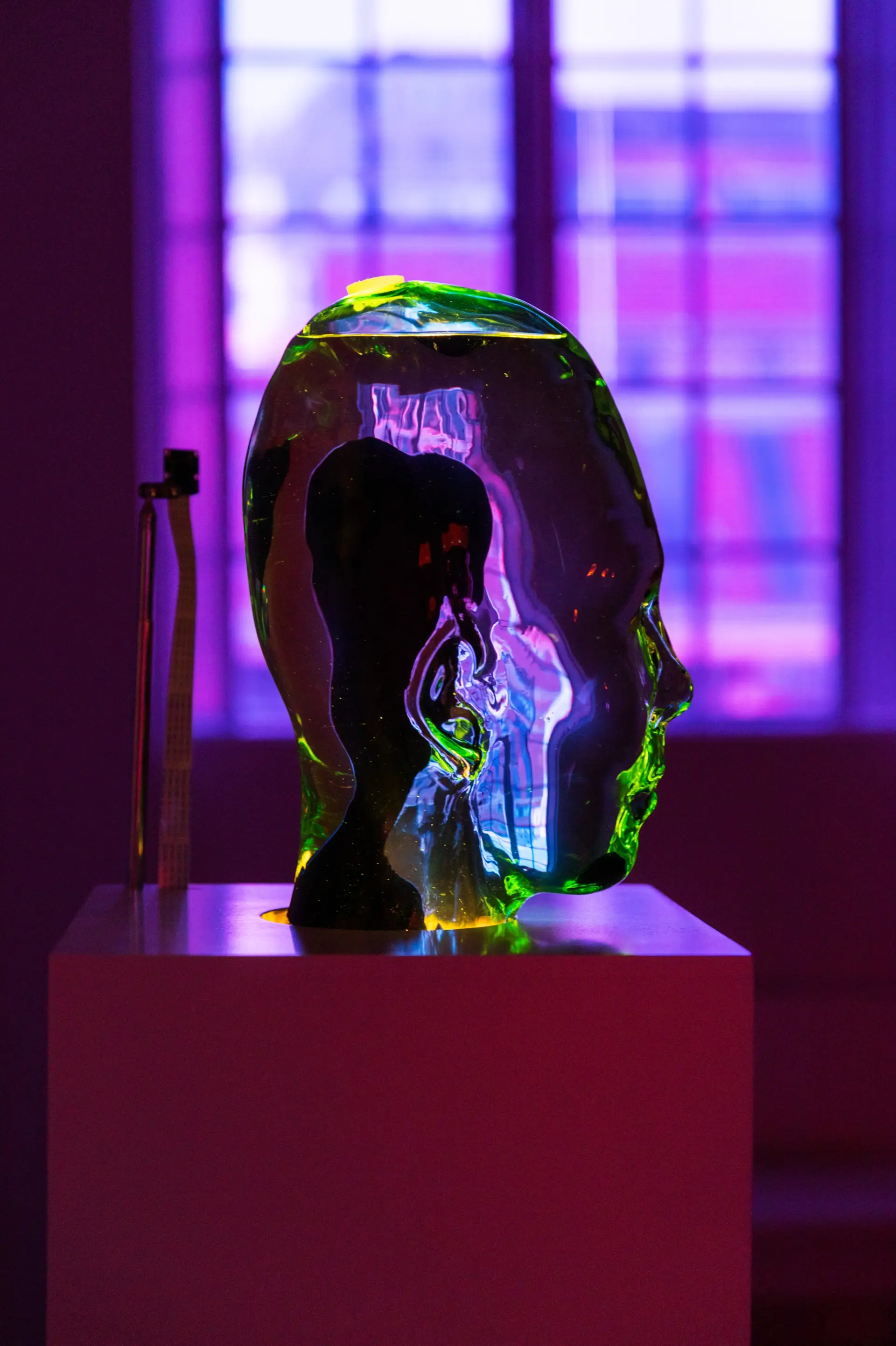
Jenna Sutela, I Magma, 2019, Lava lamps in the shape of the artist’s head.
Photo: Julie Hrnčířová, Courtesy of Oslo Kunstforening.
Sutela’s acknowledgment that we are all in some sense intermediaries is not an abdication of accountability for the results of our own ideas or creations; it’s an overt and ethically driven recognition that we’re never acting alone. Authorship is more mysterious than that. She asks how we might credit the other consciousnesses that think and speak through us every day. In making those presences audible, Sutela scripts a circuit, a feedback loop, between organic and technological, self and many, human and something-else. Sutela jokes that the slime mold she’s eaten in various performances might still be active in her body. “Maybe its effects weren’t immediate,” she says. “It’s an ancient organism. It might start to thrive inside of me.” Over the years, she tells me, her idea of narrative has begun to dissolve. “I feel like the language started leaving… it’s still there, but it became more scrambled… it became more Martian.”