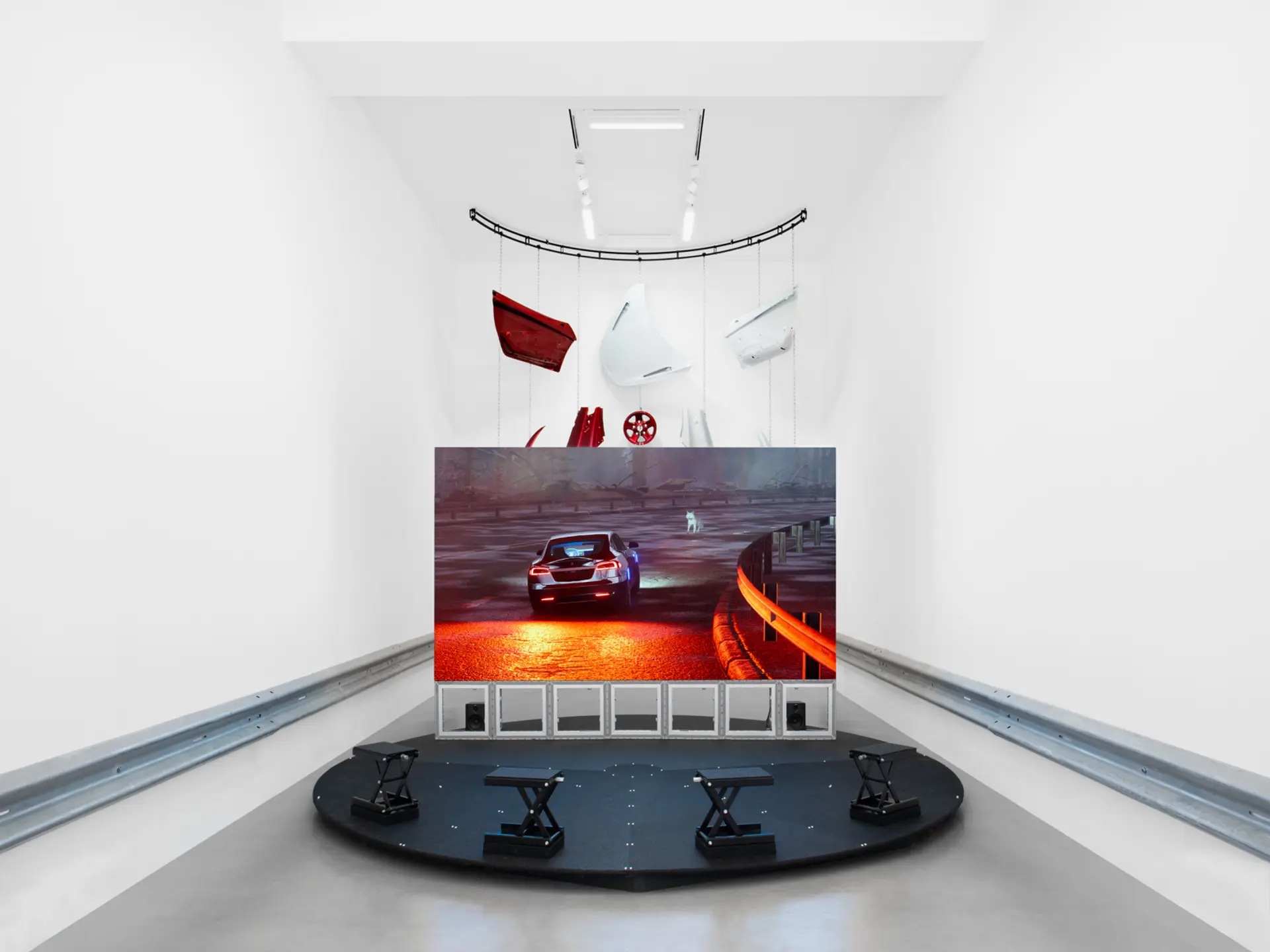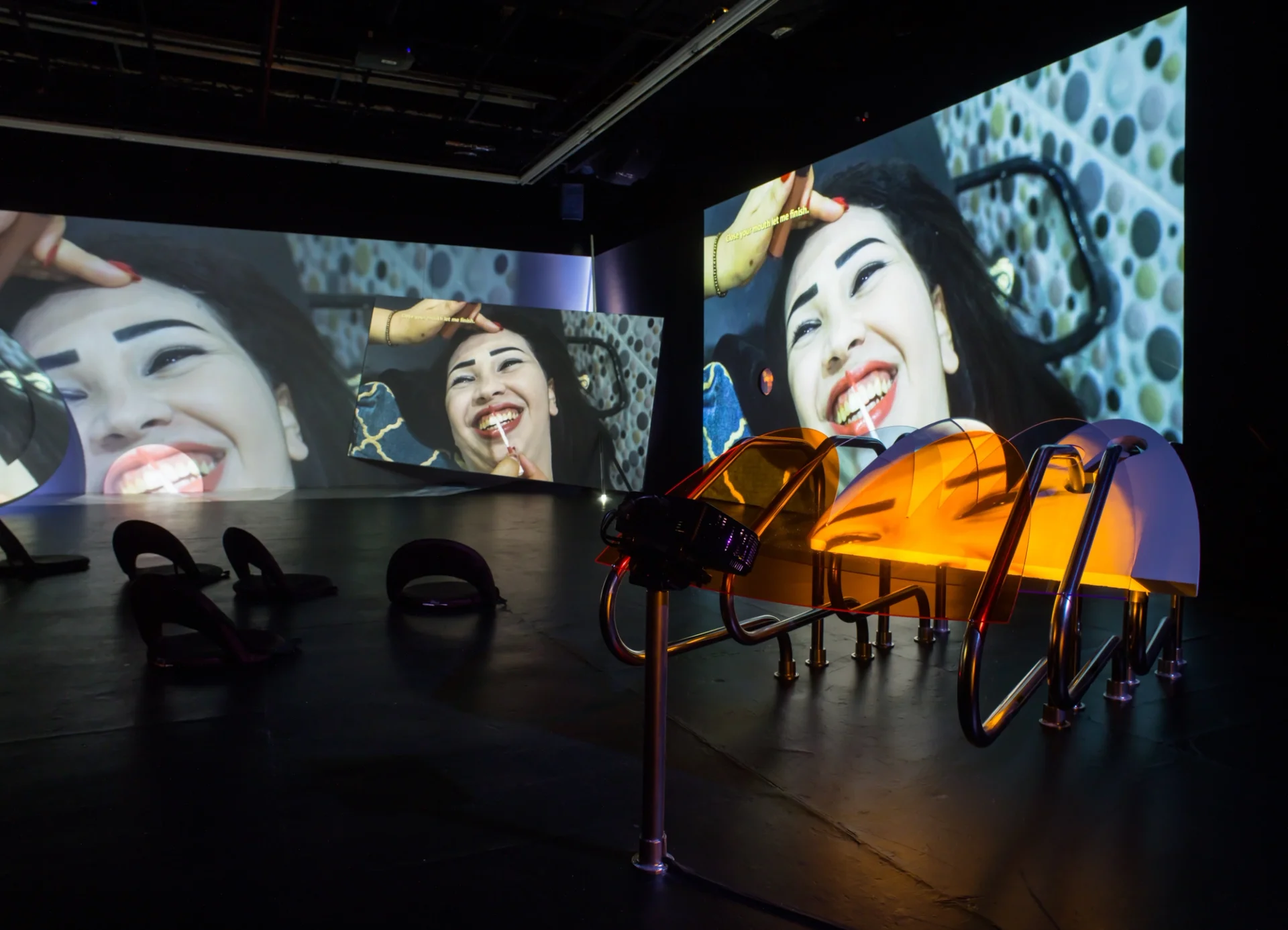
Meriem Bennani Siham & Hafida, 2017. Exhibition view of Siham and Hafida by Meriem Bennani at The Kitchen, 2017.
Courtesy of the artist; François Ghebaly, Los Angeles/New York; Lodovico Corsini, Brussels; and Sadie Coles HQ, London. Photo by Jason Mandella.
2025 Artlab Editorial Fellow Elvia Wilk discusses the candid approach to scriptwriting that has made artist Meriem Bennani’s work so distinct.
Artlab Editors: In her second Artlab Editorial Fellowship essay, Elvia Wilk continues her exploration of the role of the script in contemporary art practices. Here, she takes us behind-the-scenes on how the Moroccan, New York City-based artist Meriem Bennani captures the nuanced rhythms of relationships.
“Okay, this is the story now.”
When Meriem Bennani landed in Safi, Morocco to shoot her 2017 video Siham & Hafida, she had a loose plan to film two singers. Safi is a cultural center for the music genre Aita, a centuries-old form with soaring, propulsive vocals that can be both mournful and electric. Bennani wanted to explore how the women who sing it, known as chikhas, keep the tradition alive and pass it down to the next generation.
As soon as Bennani reached Hafida’s house, the older singer confessed she was upset that Bennani would also be visiting Siham, the younger singer Bennani planned to film. Siham, Hafida complained, wasn’t a real Aita singer yet. Plus, she’d recently run into Siham and felt ignored. “That was the main thing she wanted to talk about,” Bennani told me in a recent conversation. “I was like, oh, there’s drama? Okay, this is the story now.”
Hafida was skeptical of the way women today are learning Aita by watching, say, YouTube, rather than receiving instruction directly from those carrying the tradition. Aita was once an art of subterfuge: over decades of French colonial rule, the songs smuggled messages of resistance through their poetry, often in regional dialects. When Siham giggles while doing her makeup or clacking away on her phone in Bennani’s film, you can imagine that this might not be how Hafida envisions female defiance.
The fraught relationship that Bennani encountered upon meeting the singers forms the basis for the half-hour movie that reflects broadly on generational divides based on perceived authenticity. In exploring the relationship between the two singers, Siham & Hafida asks: To what extent does the social context of an art form determine its meaning and its continued relevance? If you’re learning Aita from YouTube tutorials and singing for TikTok, is the sound sapped of its subversive potential—authenticity reduced to #nofilter?
After spending two days with each singer, Bennani arranged for them to meet at a café in a semi-awkward encounter. “People in the past went through a lot of trouble,” Hafida explains, garnering little reaction from Siham. At the end, Siham pulls Hafida in close to take a selfie together.
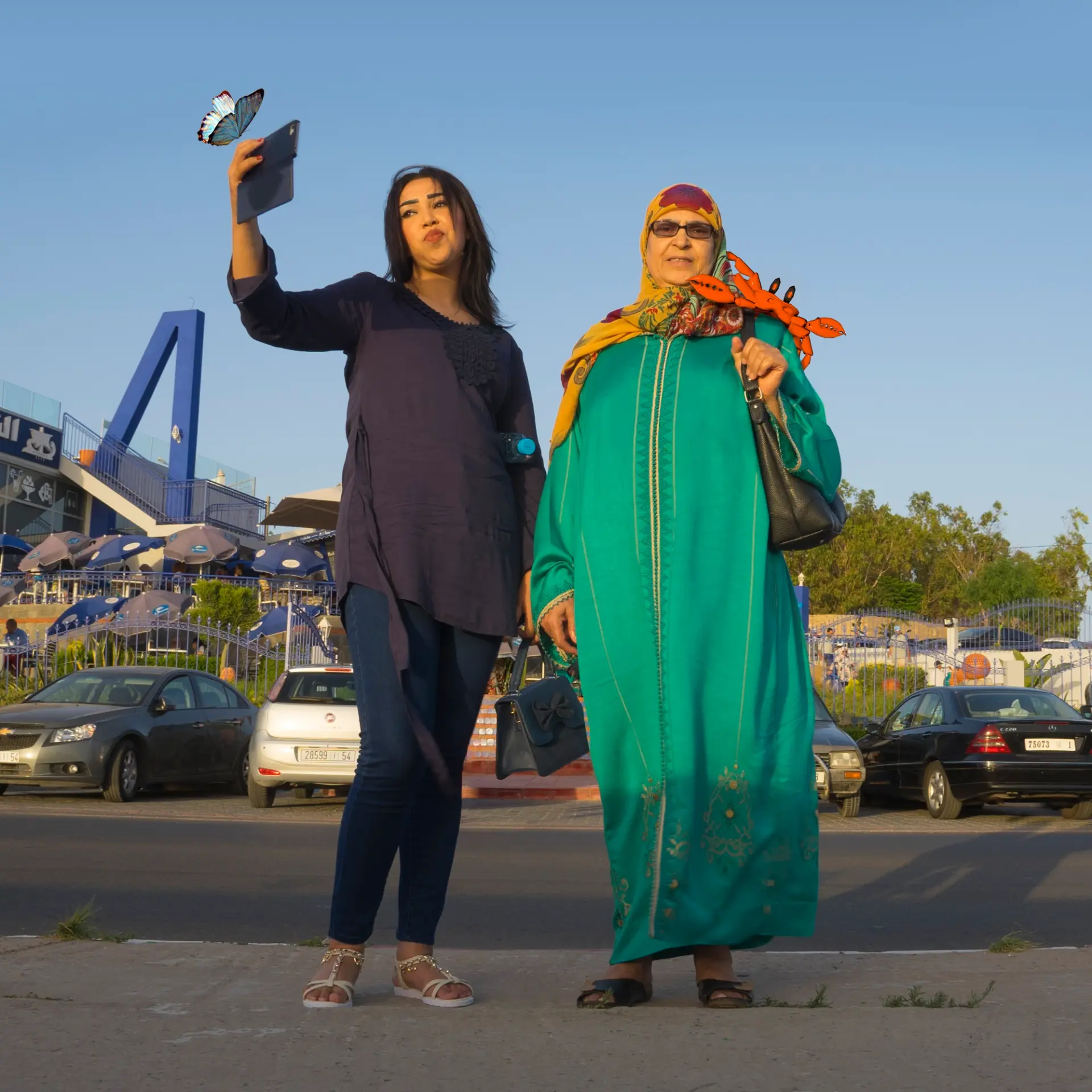
Stills from Meriem Bennani, Siham & Hafida, 2017.
Courtesy of the artist; François Ghebaly, Los Angeles/New York; Lodovico Corsini, Brussels; and Sadie Coles HQ, London.
In post-production, Bennani overlaid these scenes with animated butterflies and crabs, which act as avatars for the main characters—one crab drowns in spilled cappuccino foam while the women avoid each other’s glances at the café. Many other visual distortions and sound effects alternately goof up scenes or heighten the tension. People’s faces pixelate into bloopy dots. Baseline reality feels wonky. Bennani’s added manipulations in post-production, by now a signature style, exacerbate the real-world absurdity and the real-world stakes of daily lives and relationships. Even what seems like the pettiest drama, she says, can become a way of “conveying something deeper.” The all-around effect destabilizes any sense of a single takeaway message. The story feels both documented and constructed, like any story is.
This process—arriving on-site to meet someone based on an idea, a fascination, a curiosity; discovering a story there; then molding and playing with the documentary footage after the fact—is the basis for much of Bennani’s work. Each project has a different entry point, a different way of calibrating the scripted concept with the unpredictable encounter. “I write as I’m filming, telling people: Can you try this differently? The real story really happens after, in the edit.”
Siham & Hafida was the first work by Bennani I saw, when it was shown at The Kitchen in New York in 2017. The video was projected across slanty walls and distorted surfaces in a dizzying installation, which the critic Annie Godfrey Larmon called a “Stan VanDerBeek–like exercise in expanded cinema,” that is “as divergent and distracting as it is immersive.” It reminded me of the experience of having 30 browser tabs open to different videos. Not quite a cacophony—not exactly a narrative either.
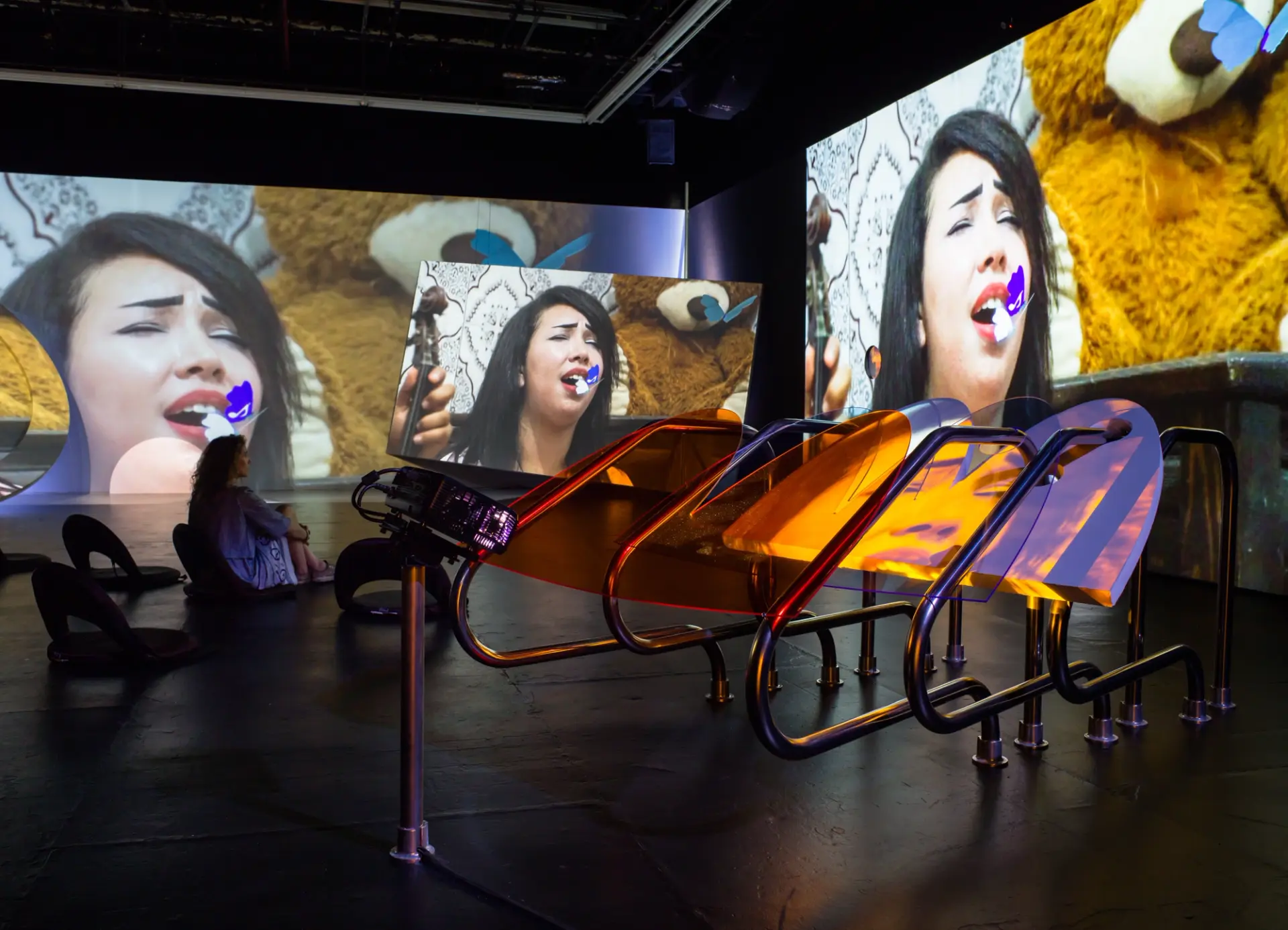
Meriem Bennani Siham & Hafida, 2017. Exhibition view of Siham and Hafida by Meriem Bennani at The Kitchen, 2017.
Courtesy of the artist; François Ghebaly, Los Angeles/New York; Lodovico Corsini, Brussels; and Sadie Coles HQ, London. Photo by Jason Mandella.
“I just touched my nose!”
Many fans will have first discovered Bennani through 2 Lizards, a video series she made with her longtime collaborator, the documentary filmmaker Orian Barki, in the surreal days of the 2020 pandemic lockdown in New York City. Like everyone else living that particular dystopia, I first saw the 2 Lizards videos on Instagram, where the artists released the eight shorts over several weeks (it was later acquired by The Whitney and MoMA). The bite-sized videos felt like they could have been about me, so perfectly did they capture my experience. A still from the first video of the two lizards dancing on a Brooklyn rooftop to a jazz song has hung framed in my kitchen since that summer: a memento of the most harrowing, disorienting season of my life.
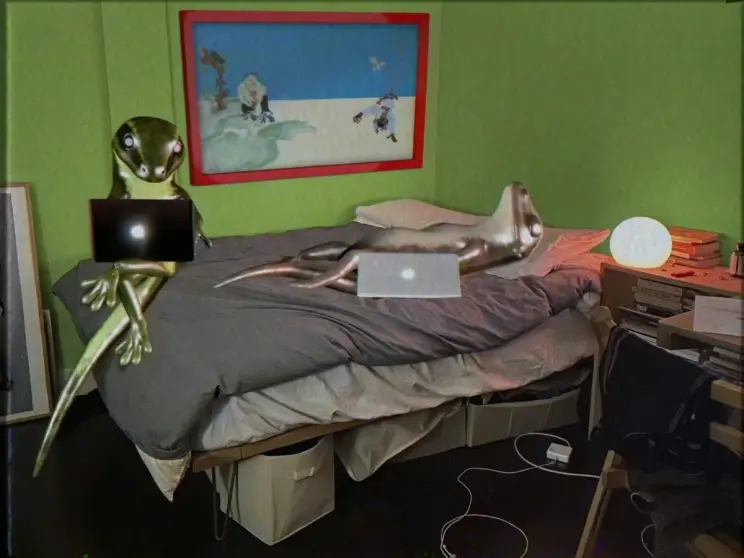
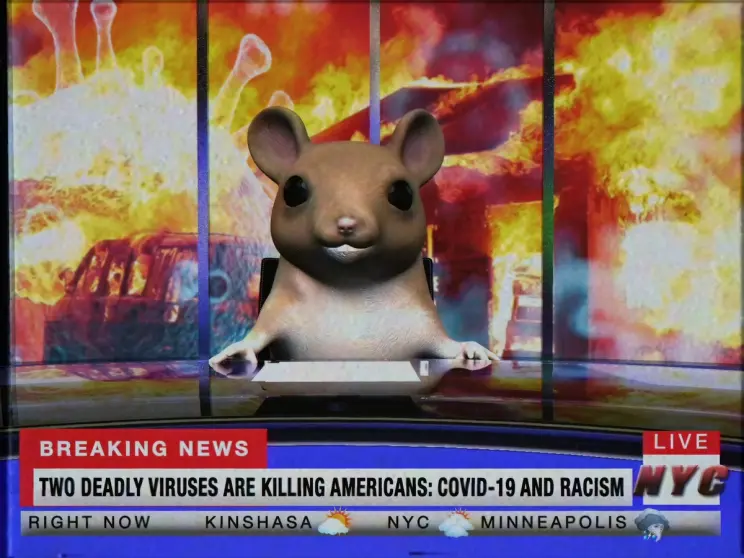
The two endearing, appropriately neurotic, shiny-skinned lizard-pals are voiced by Bennani and Barki. They traverse the vacant streets of New York City, chatting, watching a (mouse) news anchor deliver dire statistics. “I just touched my nose!” the masked lizard voiced by Bennani says in the first episode. “Your nose???” The Barki-voiced lizard freaks out, just as I would have at the time. By the summer, as the George Floyd uprising comes into focus, the lizards march in protest and watch a statue fall. In the final scene of the series, they’re viewing the fireworks explosions that notoriously and somewhat mysteriously dominated the city’s night sky at the time.
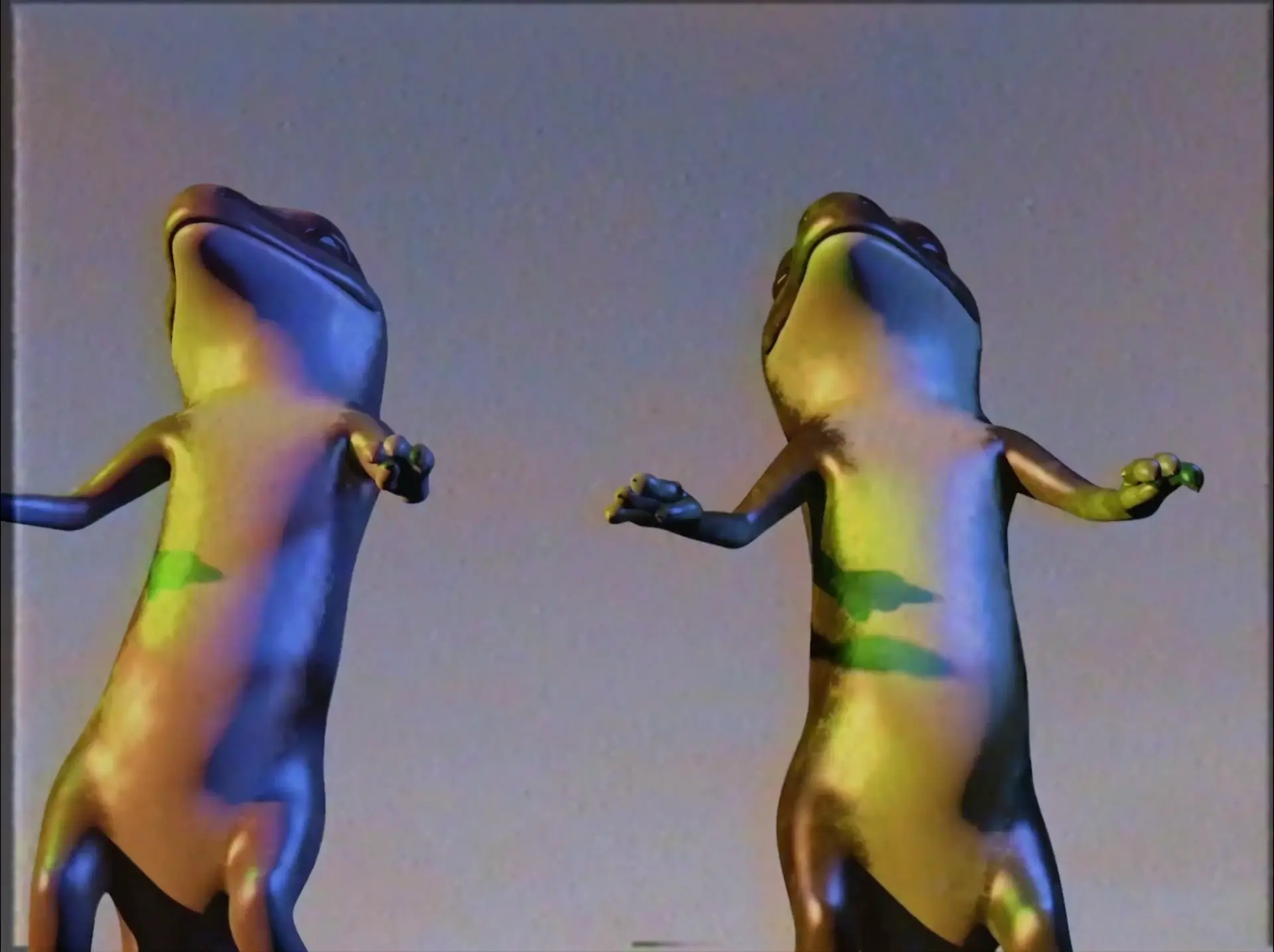
Stills from Meriem Bennani and Orian Barki, 2 Lizards, 2020.
Courtesy of the artist; François Ghebaly, Los Angeles/New York; Lodovico Corsini, Brussels; and Sadie Coles HQ, London.
2 Lizards was created for the feed, made to be seen under a thumb pressed hard on a phone screen. In 2020, practically everything I watched, I also touched. I think about this when watching Bennani’s work: it’s as if her thumb has always touched the image, through her added animations and soundtracks. The animations are evidence of the artist’s hand, the most clearly authored parts of the work. “I am an animator,” Bennani told me. “My comfort zone is alone in front of a computer.” But her curiosity compels her to work with other people—as collaborators, subjects, or both.
The lizards’ stories were scripted to some extent. But also, it’s just Bennani and Barki talking. They sound like friends. That quality of familiarity is impossible to script; you can only find it and capture it. I realized this after many years of reading my friends’ writing—I can hear their voices speaking the words in my head. Once, I listened to an audiobook of a friend’s novel voiced by an actor, and found it so uncanny I had to stop. It was my friend’s words, but not her voice. Truth here is not about whether a text is scripted versus unscripted; it’s about the believability of the rhythm. Rhythm, the rhythm of the voice, of the hand, of the edit: Bennani is an artist who deftly and brilliantly captures the rhythms of relationships.
“When something sounds really scripted, it doesn’t feel true.”
Bennani’s three-part series Life on the CAPS (2018−2022) is a fully realized alternate universe. In this science fiction, travel by teleportation is the norm but the technological marvel hasn’t changed the geopolitical landscape, which is still defined by strict national borders. Anyone who tries to transnationally teleport without permission can be arrested in transit and deported to the CAPS, a (fictional) island owned by the US government in the middle of the Atlantic.
The CAPS (short for “capsule”), like many liminal places where migrants are held, is purported to be a temporary holding zone, but by now three generations of detainees live there. In this proverbial melting pot, neighborhood enclaves have sprung up, languages have started to cross-hatch, and new music genres are burgeoning, as are recipes, hairstyles—and new types of resistance.
Viewers are introduced to the CAPS by a tour guide, an animated crocodile called Fiona. Bennani wrote Fiona’s voiceover before she began filming (although, she reminded me, everything changes in edits). As in Siham & Hafida, Bennani traveled to Morocco to film. The cast includes her family, friends, and people she met on-site or online. While she had ideas for storylines in mind, she didn’t hand anyone scripted lines. Instead, she gave her actors prompts. “Here’s the gist of it,” she would tell the actors, one of whom was her mother, who plays the island pharmacist. “I let them say it in their own words,” said Bennani. “I don’t know how to write the specific way they would speak. When something sounds really scripted, it doesn’t feel true.”
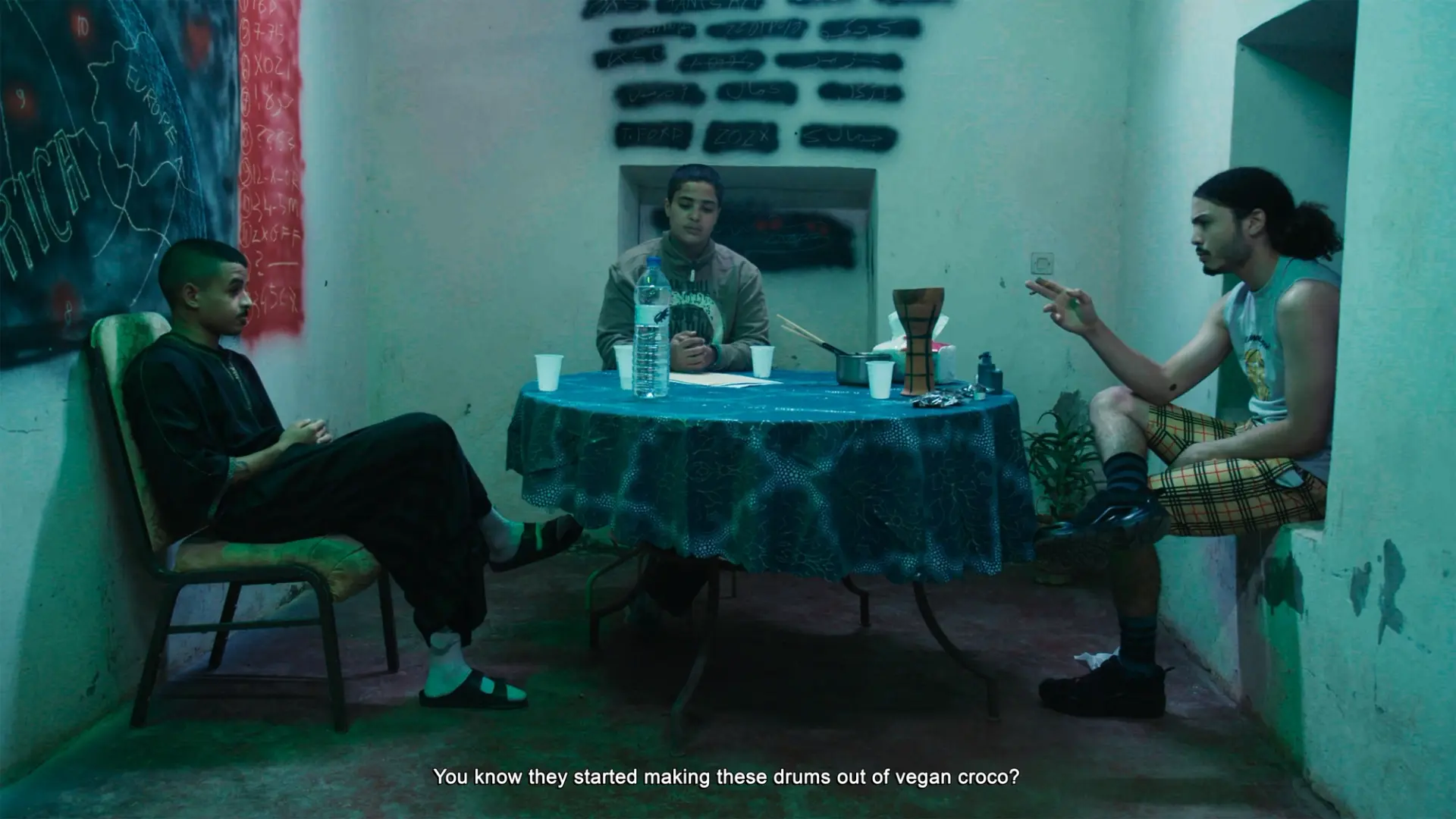
Meriem Bennani. Life on the CAPS, 2018-2022, single-channel video, 76 min.
Courtesy of the artist; François Ghebaly, Los Angeles/New York; Lodovico Corsini, Brussels; and Sadie Coles HQ, London. Commissioned by the Renaissance Society/Chicago and Nottingham Contemporary/UK.
The main character of Life on the CAPS is Kamal, a man in his sixties who, in another technological marvel, was able to “upgrade” his body to stay young and fit. The way she worked with Kamal (played by actor Kamal El Jadid) epitomizes the way she experiments with linguistic give-and-take, exploring the way dialects form, mutate, and mix—both online and off.
Kamal narrates the final chapter of Life on the CAPS in a voiceover that Bennani originally wrote in English with Darija slang interspersed. Then Kamal translated it into his own version of Darija slang, resulting in a language that’s deliberately intermixed—makeshift, playful, at the edge of legibility, at least for someone who doesn’t live on the CAPS. “We’re imagining the CAPS being a place where things like that happen with language,” said Bennani. This is not to say that the plot of the CAPS is linear, that the scenario is “plausible,” or that it is anything like a documentary. There are plenty of slippery logistics: I don’t know how, for example, “the ocean became an internet soup” after a crocodile chomped an undersea cable, but I totally get Bennani’s gist.
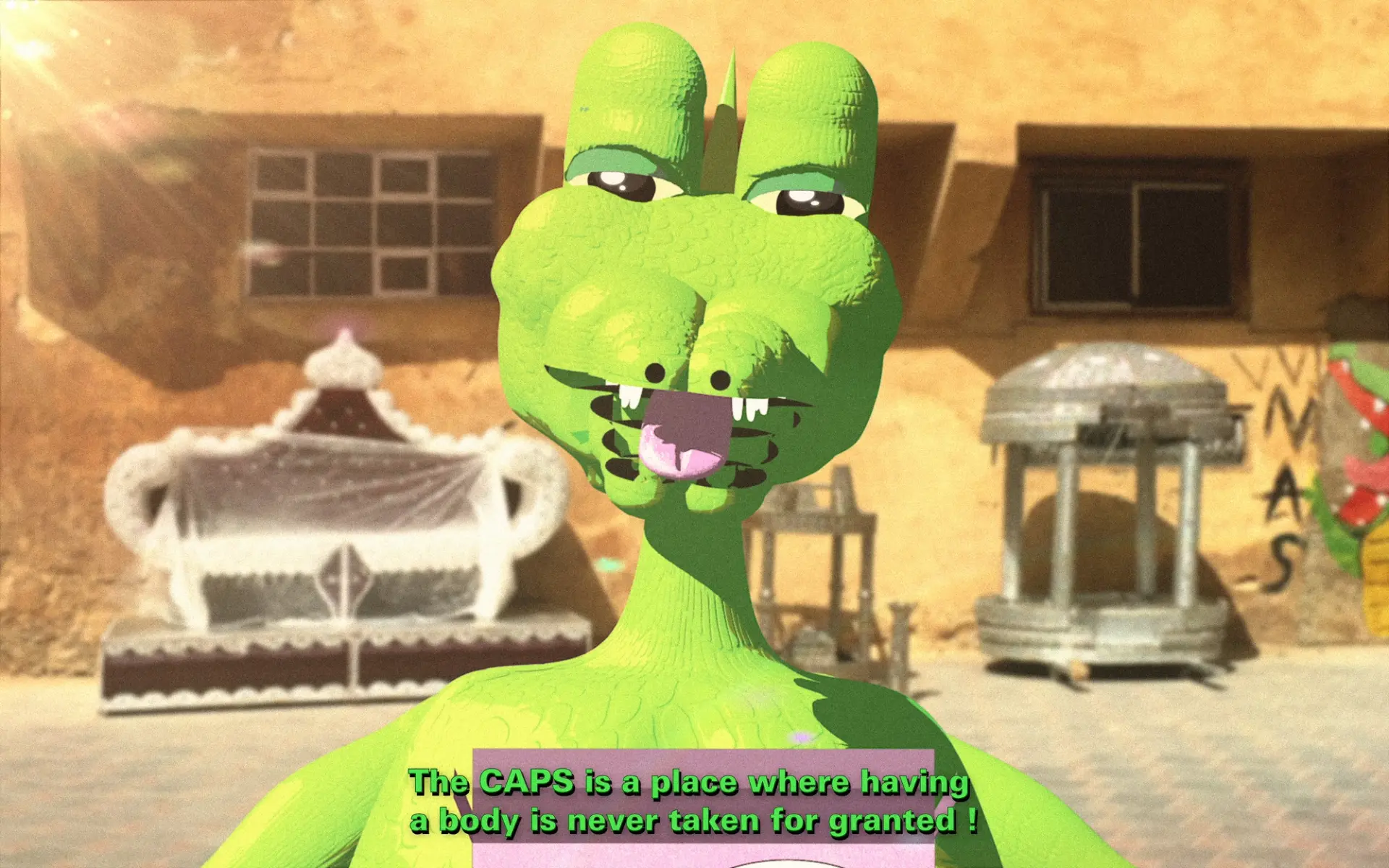
Meriem Bennani. Life on the CAPS, 2018-2022, single-channel video, 76 min.
Courtesy of the artist; François Ghebaly, Los Angeles/New York; Lodovico Corsini, Brussels; and Sadie Coles HQ, London. Commissioned by the Renaissance Society/Chicago and Nottingham Contemporary/UK.
I often find myself talking about CAPS when I teach fiction. It’s an ideal way of describing what the novelist Omar El Akkad calls “dislocative fiction”—rather than try to imagine a dystopian future, Bennani shifts the gaze to what’s already going on. Look here, she says. Listen to what that sounds like. The most effective way to construct the fantastical is through the quotidian. And in this way, dystopia and utopia are nested. Even trapped on an island, even with bodies mutated through teleportation, people will sample and invent music, pirate torrents, improvise jokes across languages, argue about which restaurant has the best fries—people just figure it out.

Meriem Bennani. Life on the CAPS, 2018-2022, single-channel video, 76 min.
Courtesy of the artist; François Ghebaly, Los Angeles/New York; Lodovico Corsini, Brussels; and Sadie Coles HQ, London. Commissioned by the Renaissance Society/Chicago and Nottingham Contemporary/UK.
“Do I want a look of tenderness?”
Each of Bennani’s projects has a time signature. A signature tempo, beat, syncopation, which she says she aims to get right before anything else. Finding the rhythm—of speech, of music, of cuts between scenes—is what guides the process. It encompasses the attitude Bennani wants to take toward the source material. “The CAPS is hyperactive in the rhythm and the genre. [There’s] so much happening at the same time, so many references—it’s like a big high-BPM music mix.” 2 Lizards, on the other hand, proceeds in the warped time of lockdown isolation, at the pace of intermittent conversations and melancholy strolls punctuated by freakouts and news flashes. “The tone is about the gaze,” she explained. “Do I want a look of tenderness? Do I want to look at it in a sharp way?”
In Bennani’s newest film, Bouchra (2025), it was crucial to calibrate the attitude with seismographic sensitivity, because she was looking toward her own life and family. Bouchra is her first feature-length movie, made again with Barki, and its dominant palette is neo-noir: silhouettes, jazz, and lone wolves (well, coyotes) stalking the city streets under lamplight.
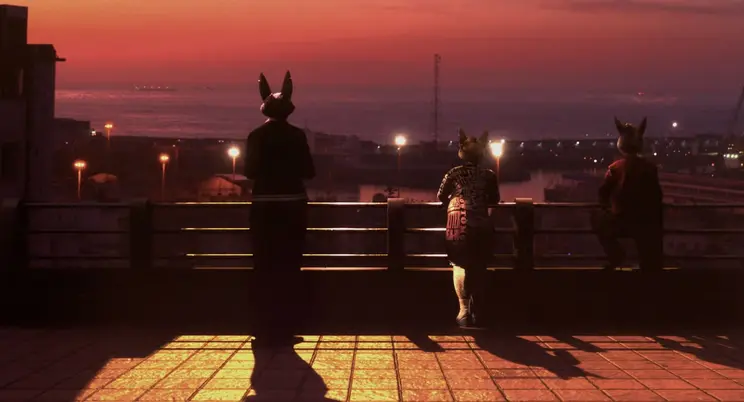
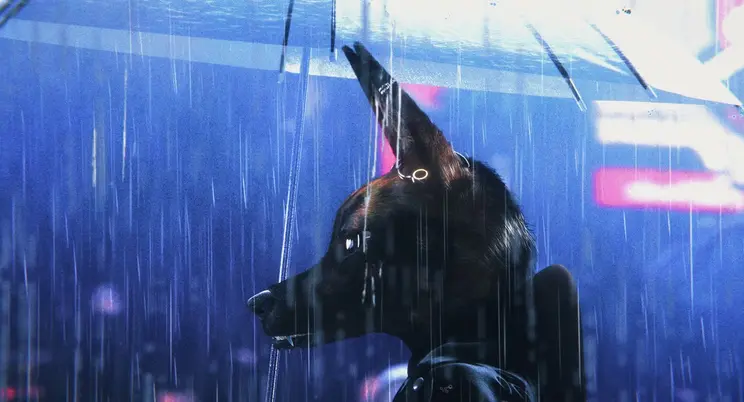
Bouchra is a Moroccan coyote living in a melancholy New York high-rise apartment. The terrain is an everyday obstacle: she’s afraid of elevators but needs an inhaler when she climbs the stairs. She just split with her girlfriend of nine years (minus a steamy, post-breakup hookup) and has long felt alienated from her family in Casablanca, the miles between them compounding the divide opened years earlier by a letter she sent to them about being queer. Their silence has finally become insurmountable, a set of stairs she can’t bear to keep climbing.
Barki and Bennani intended to write a story centered on Bouchra’s uneasy homecoming trip. “We fully wrote a script,” Bennani said, “and then we recorded actors reading the script and made a radio edit.” Typically for an animated feature, you record all the dialogue first, then add the images afterward. “But after finishing the radio edit,” said Bennani, “we realized it wasn’t that good. We were missing a lot, because we’re not writers—meaning we’re not at our best when we just work with a piece of paper and pen. We’re more like writers who react to reality, or like editors of reality.” In this case, they wanted to deviate from overdetermined “coming out” storylines relying on predictable identity tropes. “The idea of queerness and coming-out have been exported to be very Western,” said Bennani, describing the difficulty of telling a non-formulaic story.
But after they rewrote the script drawing from Bennani’s life, they realized that it still didn’t feel like the whole truth—it was missing perspectives. “We didn’t have enough information on how the mom felt.” So she had a phone conversation with her own mother about their relationship, and recorded it “as research” (I share this habit of calling everything I do research, hedging against the likelihood I’ll eventually fold it directly into my writing). But in speaking with her mother, she quickly realized that “the two things she said were already better than the whole script we wrote; they were so poetic.
As a result, she and Barki rewrote the script, adding some of the recorded dialogue and changing the storyline accordingly: the coyote became a film director who decides to talk frankly to her mother about being gay so she can write an honest film. These conversations between the coyote and her mom are now the spine of the film, holding together dual storylines. At times we’re in the coyote’s life, at times in her film, until the two come together. In Bennani and Barki’s tightly plotted autofiction, filmmaker becomes character becomes filmmaker—and somewhere between documentation and construction emerges a truth.
Driven by rhythm and tone, Bennani borrows the term “desire scenes” from the filmmaker Céline Sciamma, who has said she starts a script by writing what she most desires to see. Barki, on the other hand, operates on a more holistic level, considering how scenes connect to one another.
“It wasn’t about making a feature.”
Bennani and Barki have now spent three years making the final cut of Bouchra. A shorter version was shown as For Aicha (2024) in the two-floor exhibition “For My Best Family” in 2025 at Fondazione Prada in Milan—on the ground floor, an orchestra of 192 slippers and flip-flops smacked and thwacked out a resounding rhythm. The full hour-and-20-minute version premiered at TIFF in Toronto in September 2025, and it will continue to tour the festival circuit. As a feature film meant for a single-channel cinema, it demands a certain rhythm and pacing that shorter works don’t.
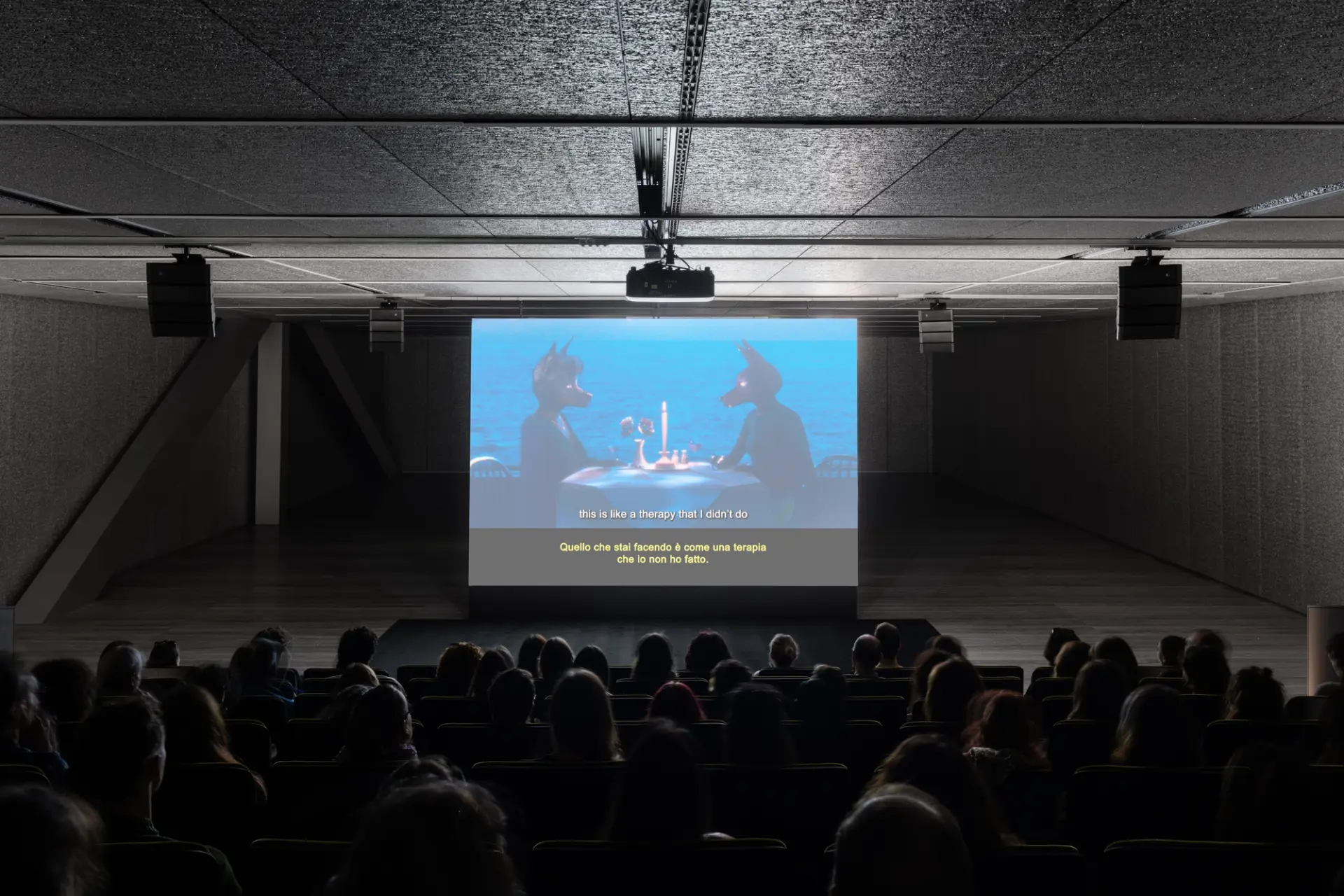
Meriem Bennani and Orian Barki, For Aicha, 2024.
Exhibition view of “For My Best Family” by Meriem Bennani at Fondazione Prada, 2025. Photo: Delfino Sisto Legnani – DSL Studio. Courtesy Fondazione Prada.
I wanted to know why Bennani was drawn to make a long movie that circulates outside the world of art exhibitions. Her shorter films, she explained, have largely been constrained by the time and budget of institutional art-making. She was exhausted from making multiple projects a year and traveling to openings. “I really wanted to know what would happen if I could spend years on something,” she said. “That was my dream. It wasn’t about making a feature.”
Another consideration for Bennani was her audience. “Everyone I film is in Morocco, and they’re never at the exhibitions,” she told me. “I value the people who go see my exhibitions, but the art world is so limiting for me. By fitting within the film format, maybe more people will see my work.”
This reminded me of something the critic Laura MacLean-Ferris wrote of the Fondazione Prada show: that across their collaborations, Bennani and Barki have conjured “a curious realism in which communion is more possible.” Communion sometimes sounds like 192 feet stomping in unison. Sometimes it sounds like a young Aita singer trying to match the notes in a video clip. Sometimes it’s a hundred pairs of hands clapping in a cinema. Sometimes it’s mom’s voice on speakerphone.
Bennani told me she loves finding her videos on pirate streaming platforms: “That means more kids went and tried to look for my work.” Once the work is in the world—leaked into the internet soup—the carefully crafted rhythm is picked up in unexpected ways. Its timing, its comedic cadences, its narrative leaps, feel lived-in, immediate, and alive. Last year I heard someone call 2 Lizards a “documentary.” I wanted to ask him which magical swamp he knew about, but I let it go. I knew what he meant.