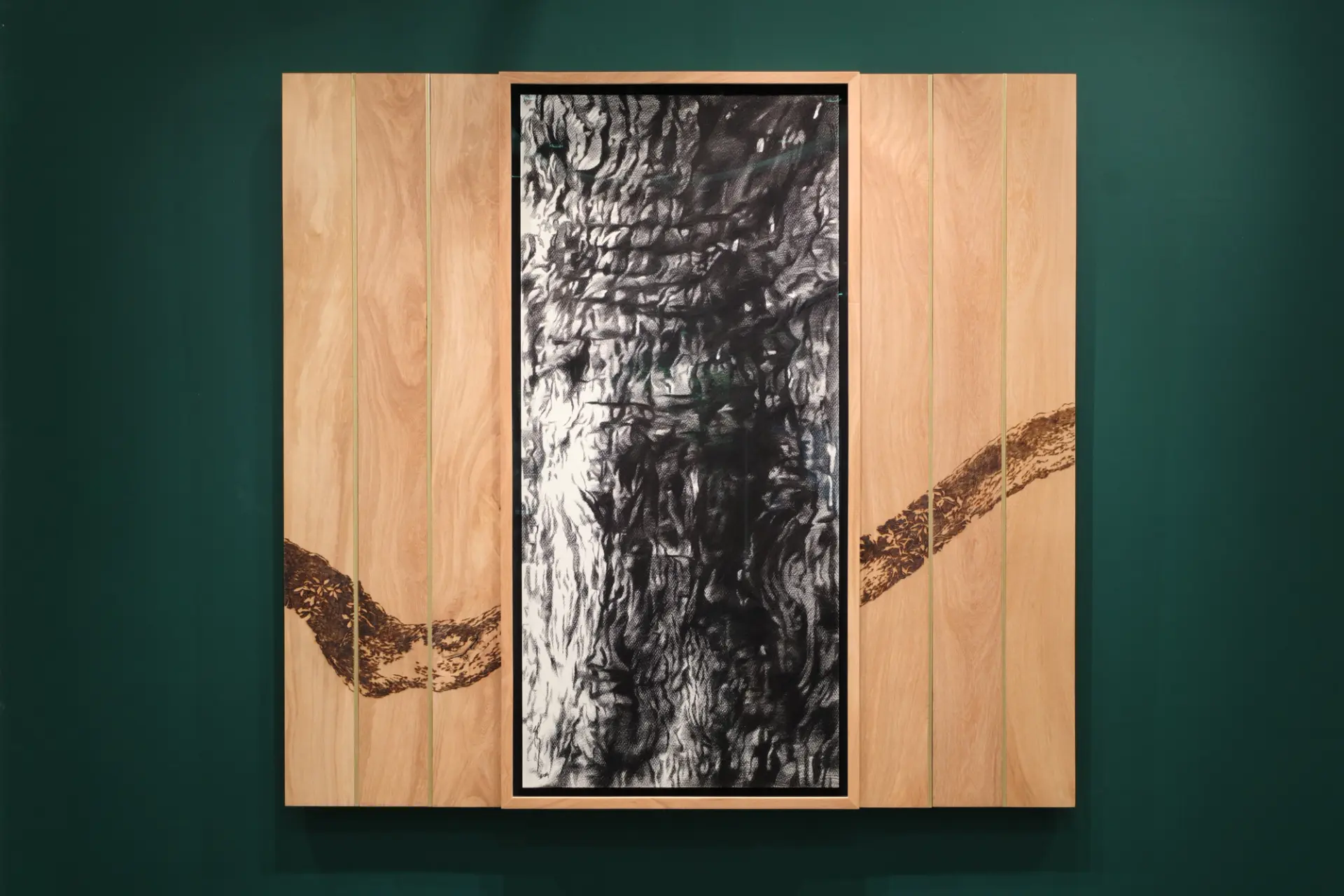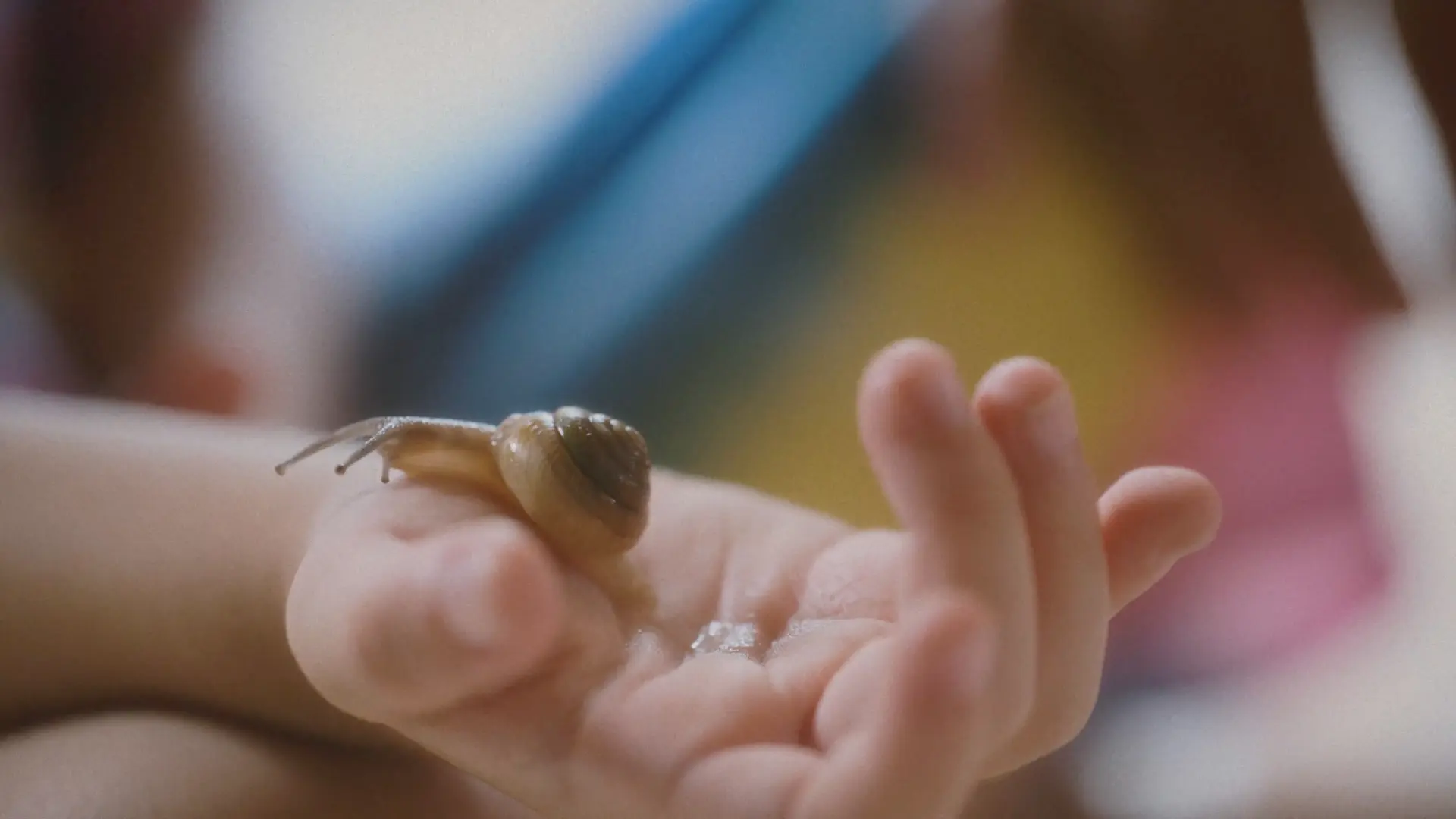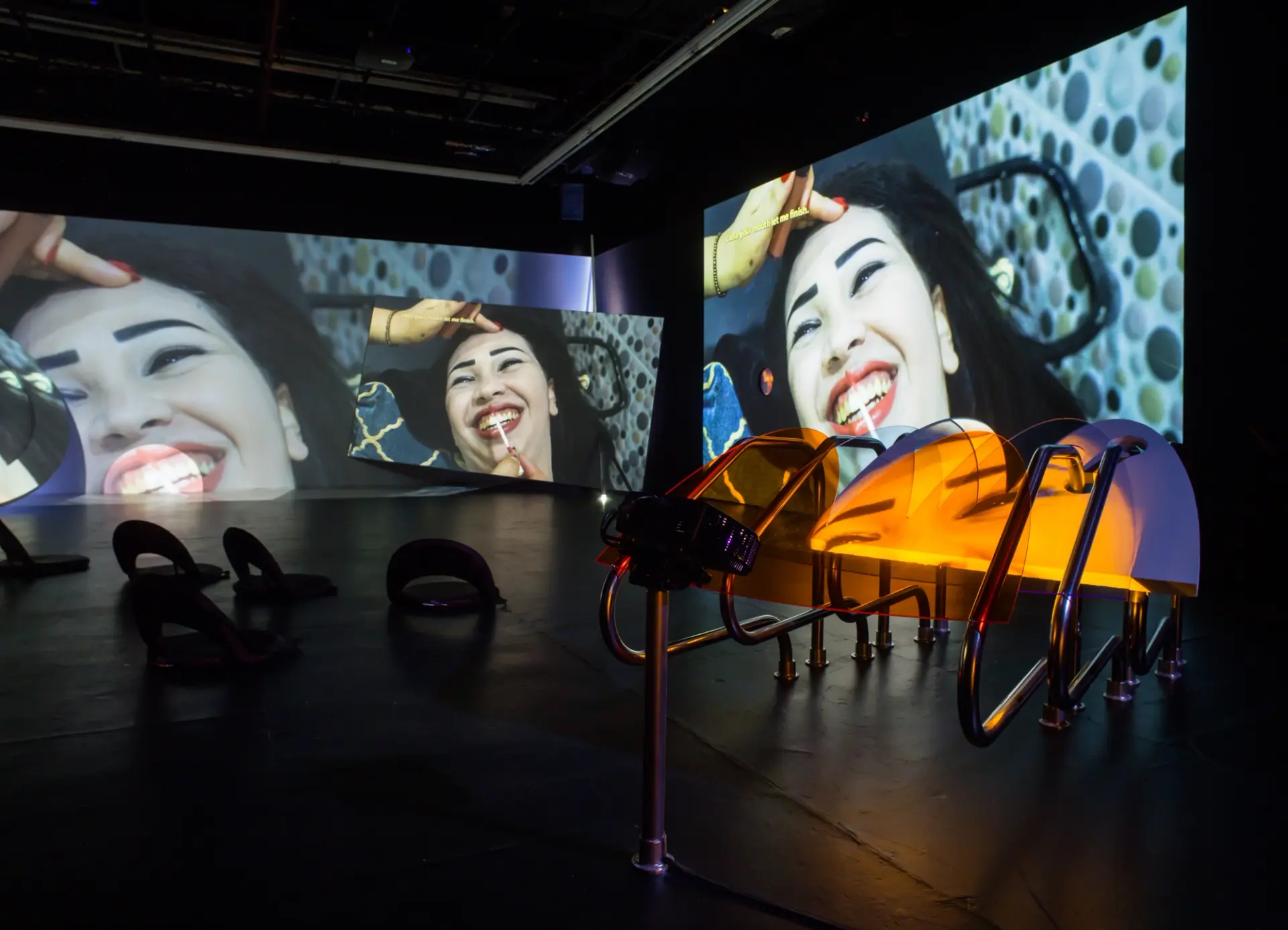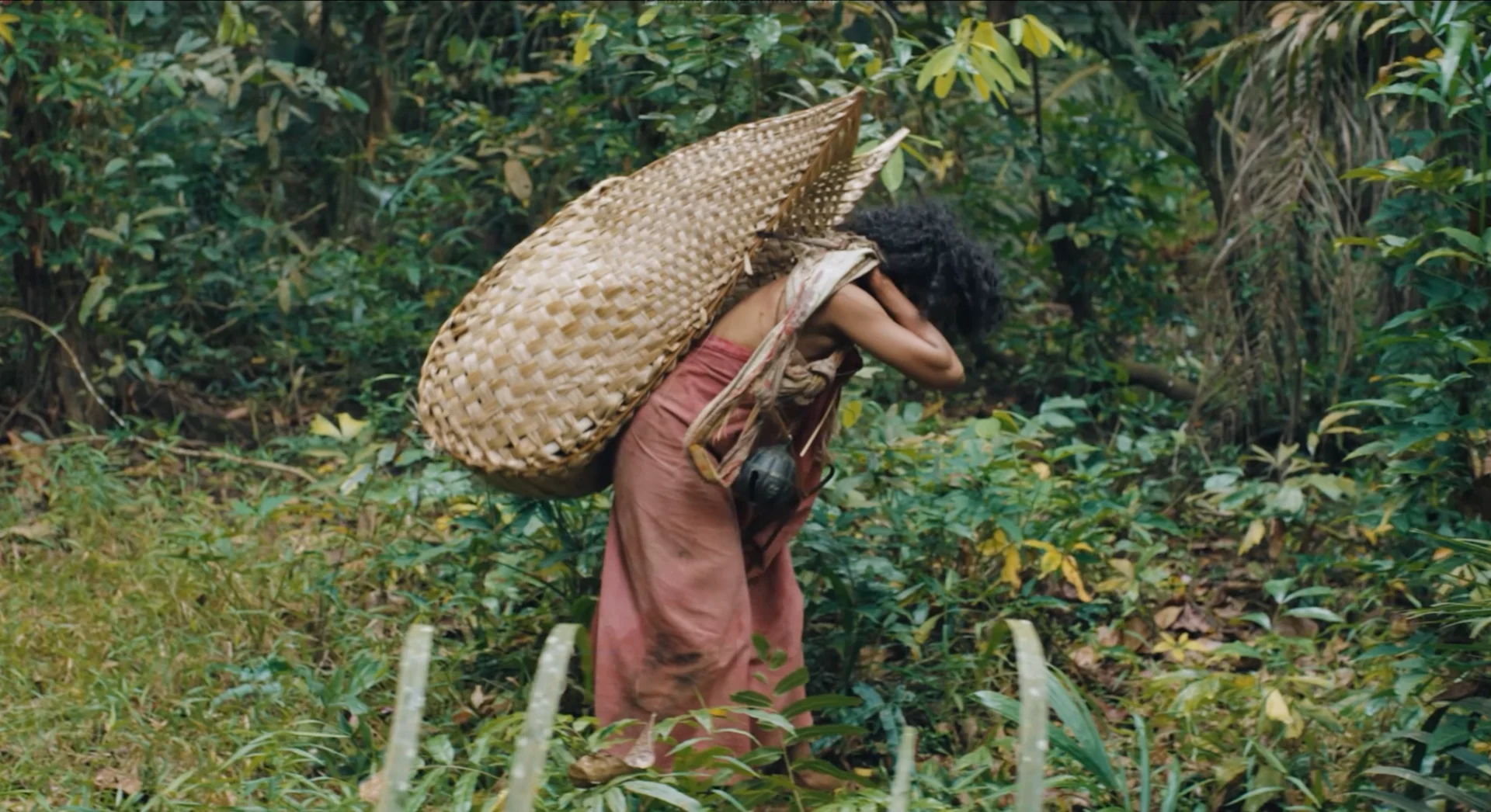
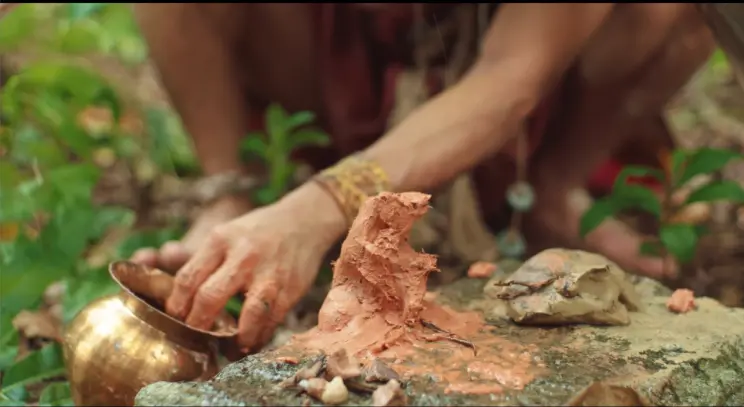
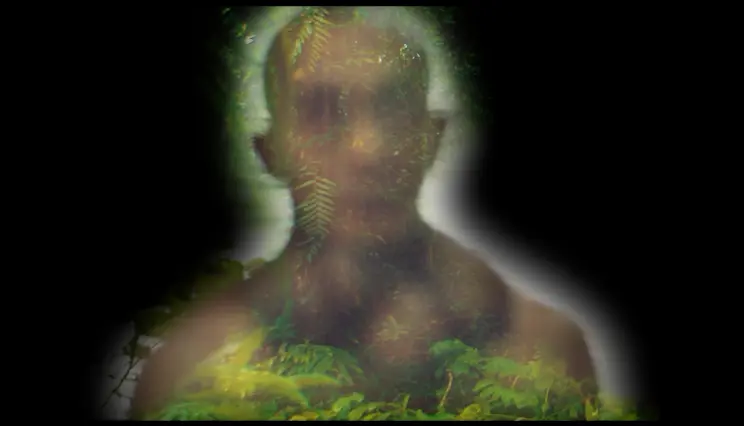
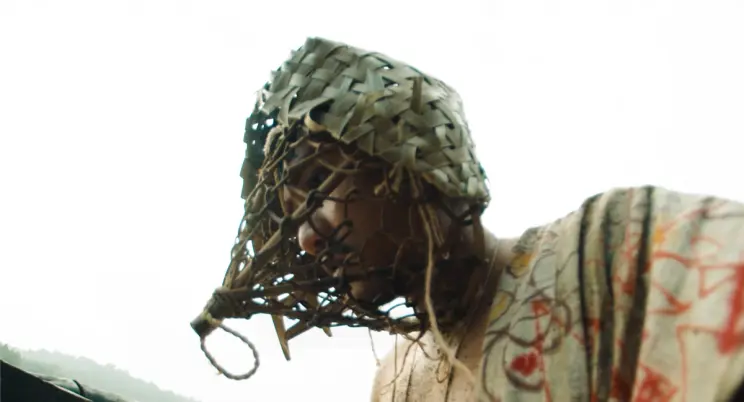
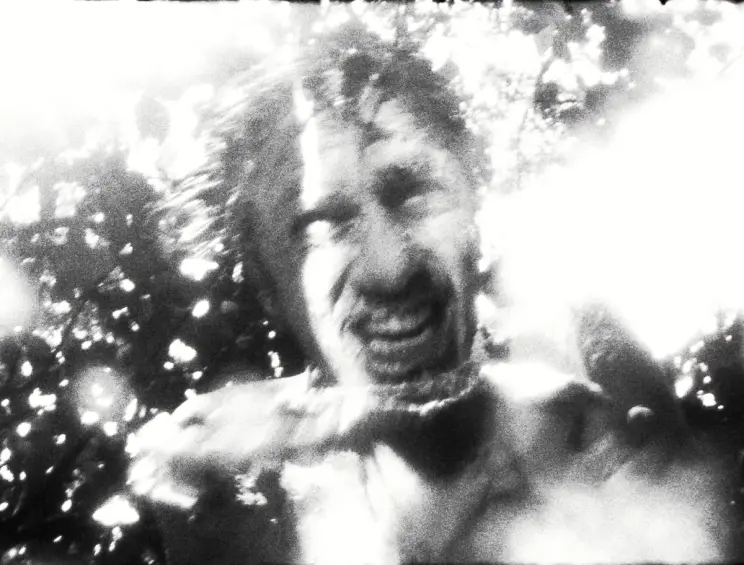
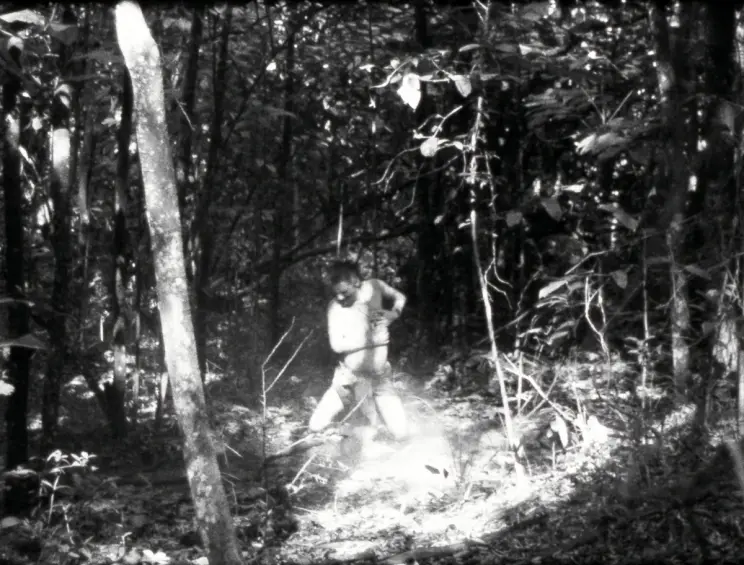
Film stills of Inhabitants, screened as part of Before and After the Unknown (2025).
Courtesy of Mark Chua and Lam Li Shuen.
2025 Artlab Editorial Fellow Jiaying Sim considers how Singaporean artist-filmmakers Mark Chua and Lam Li Shuen’s experiments in expanded cinema employ failure, repetition, and abjection to expand our understanding of care.
Artlab Editors: For her final Artlab Editorial Fellowship Essay investigating embodied care in contemporary Singaporean art practices, Jiaying Sim explores how yams, ear wax, and film form the material basis for Mark Chua and Lam Li Shuen’s surreal narratives.
As you hear the drone of crickets and the distant calls of birds, an island shimmers into view. From there, one vignette dissolves into the next: Dry leaves carpet the jungle floor, a cylindrical vessel glows faintly in the undergrowth, and a colossal, mud-like statue, half torso, half monument, looms by the shoreline.
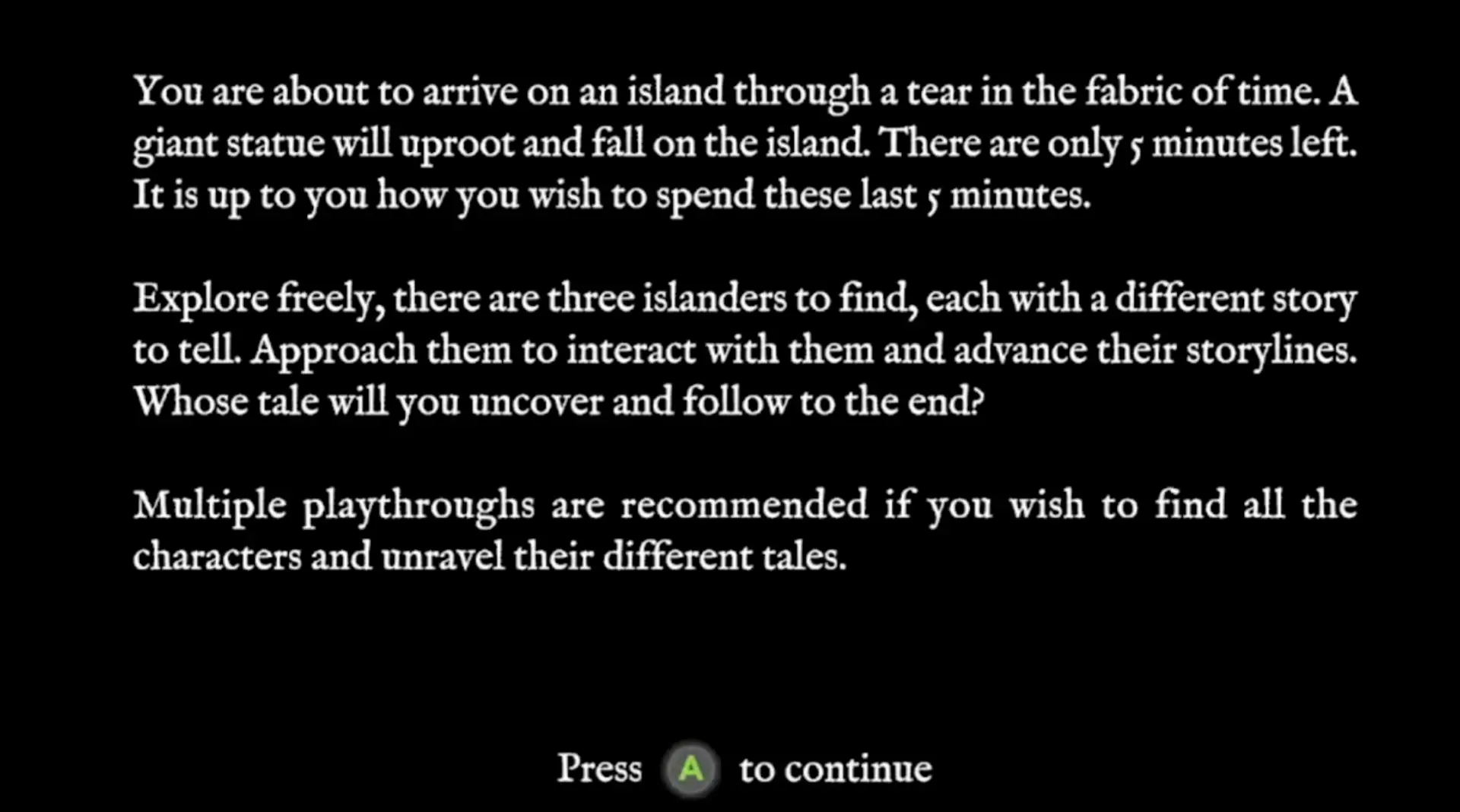
Press ‘A’ to start.
Designed in the manner of a walking simulation, Singaporean artist-filmmakers Mark Chua and Lam Li Shuen’s Keladi Figments (2025) places you in the first person. The premise is simple: On this island await three islanders, each carrying a fragmentary story. A man born a yam declares, “When the animals disappeared from the island, it was I who fed the people.” Another in office attire, lanyard hanging from his neck, asks, “You are the public, right? Not just in my private mind?” A crouching woman insists, “They mock me…Must’ve told you some nasty things, hm?” and extends a pot of water toward you when you approach her again, asking, “Will you stay with her until it all ends?”
Still of gameplay, Keladi Figments (2025).
Image courtesy of Mark Chua and Lam Li Shuen.
To follow one character is to abandon the others. Speech comes in scrambled captions, asynchronously translated into cryptic fragments. Meanwhile, the giant statue stands on borrowed time, destined to collapse within five minutes, indicated by a countdown clock.
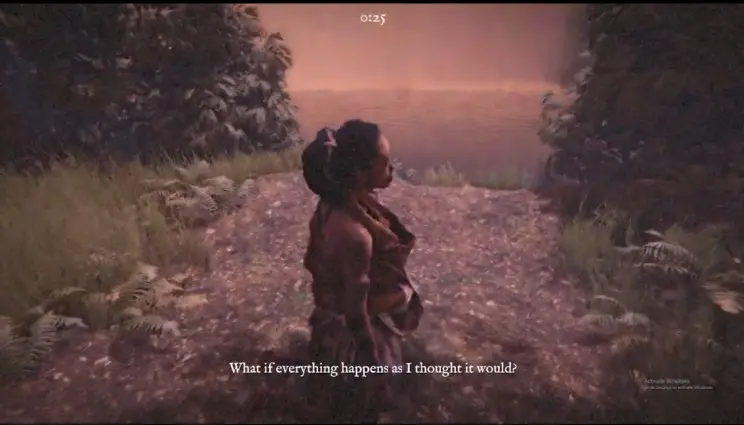
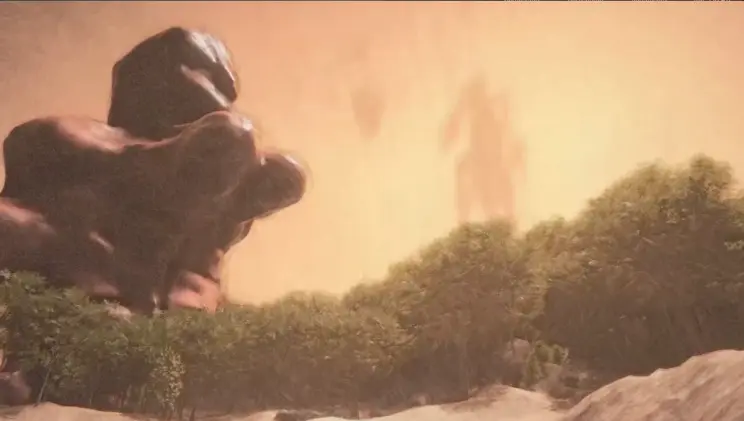
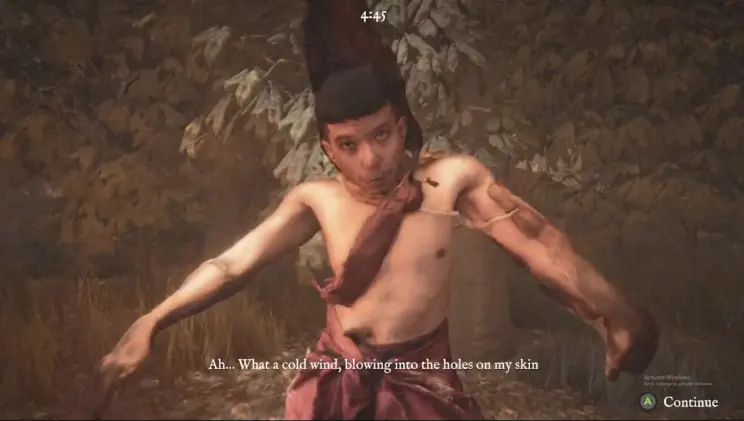
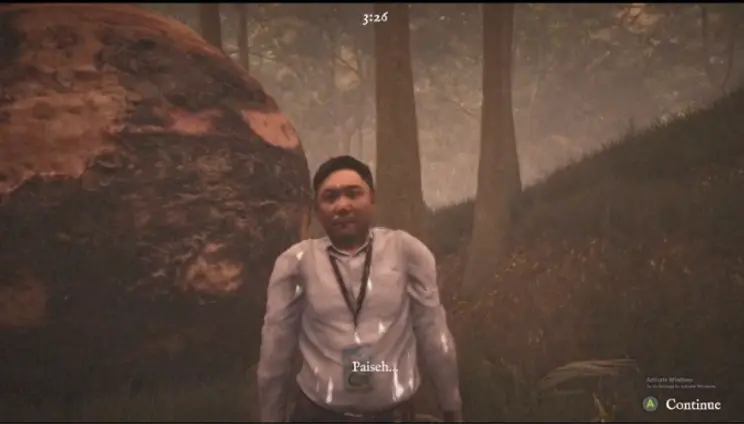
Unlike other adventure games, which hinge on puzzles, meaningful choices, and branching narratives, Keladi Figments pares such mechanics away, privileging orientation, immersion, and trying to make sense of a world. “You are not from here…,” you are told, quickly identifying your position as an outsider. Bound by the inevitability of the statue’s demise, exploration is marked by urgency, foreshadowed by an inescapable end. Replays may accrue, but the endings remain predetermined. The game insists that agency lies not in overcoming but in deciding how to spend your time before the fall.
You find yourself back at the start screen.
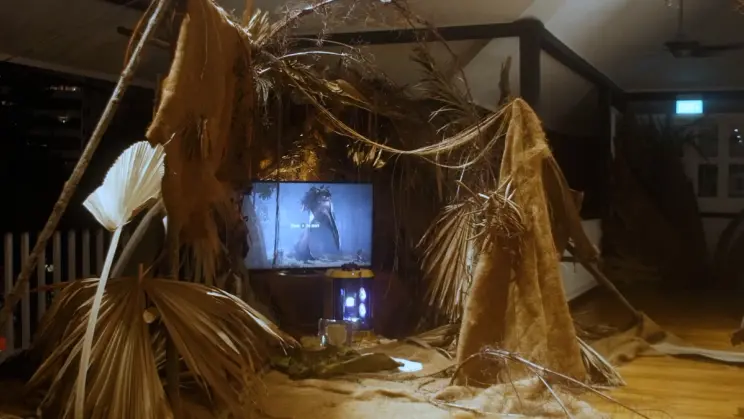
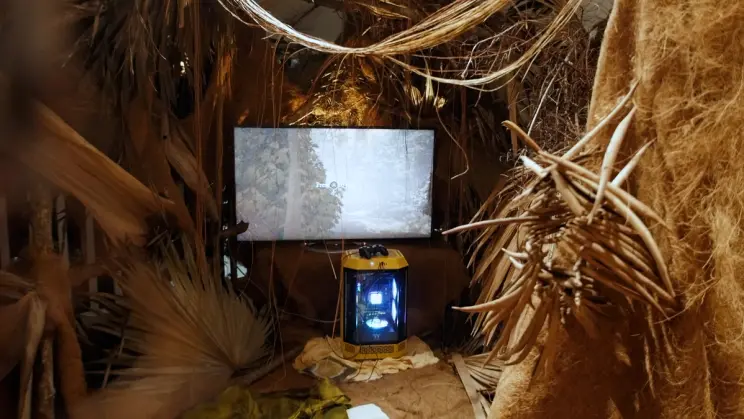
Keladi Figments debuted at Lewin Terrace in Singapore’s Fort Canning Park as part of Chua and Lam’s solo exhibition, Before and After the Unknown (2025). Across multi-channel videos, 16mm film, sculpture, and gameplay, the show reworked fragments of history and fiction into a deconstructed mythology centered around the humble yam.
The show responded directly to the unveiling of a public statue of Sir Stamford Raffles in May 2024—one of many monuments honoring the British colonial administrator credited as Singapore’s “founder.” Raffles remains an enduring emblem of how the nation’s commemorative culture continues to orbit colonial figures and rehearse the myth of a single founding event. Against this repetition, Chua and Lam turned instead to the island of Pulau Ubin.
Situated between the border of Singapore and Malaysia, the island was claimed by the British in 1825 to harvest rubber. In the 1840s, Chinese mining companies arrived to meet the colony’s demand for granite. In the 1850s, Malay communities moved there as a refuge against piracy. By the 1980s, rubber and quarrying industries had ceased, leaving the ground barren and the population dwindling from some 4,000 residents in the 1970s to fewer than 200. As one of Singapore’s last kampungs—traditional Malay village settlements made out of wooden houses and close-knit communities—Pulau Ubin carries the scars of such resource use. Keladi Figments is inspired by these sedimented histories, setting colonial nostalgia against the island marked by occupation.
On first encounter, Keladi Figments might seem to replicate the essentialist tropes of colonial ethnography. In-game characters mostly dressed in sarongs remain fixed in place like static tableaux, speaking through broken captions that grant only fragmentary access to meaning. All of this might suggest a racialised staging of timeless indigeneity undisturbed by colonialism but by tying these illegible speech patterns to the mechanics of the game loop, the fantasy of the colonial origin story is interrupted and dismantled. With each cycle, the figures appear less as bearers of a single truth and more as witnesses of histories whose stories may never be fully heard.
Straying off the mapped paths occasionally reveals a fourth figure, a hidden presence that hints at other possibilities. Still, the player is caught within the game loop. This mechanical system produces a reflexive awareness, underscoring how even decolonial attempts risk circling back to scripts of origin and primitivism, and why charting new narratives beyond them remains urgent albeit challenging.
These repetitive game loops open up an aporia, where even if each choice fails to prevent the fall of the statue, the world enables interactions with characters that may reveal just enough to pique our curiosity to find out more about these silenced voices. Game coding rests on binaries—one and zero, on and off, success and failure—while Keladi Figments demonstrates how even these dichotomous foundations can produce multiplicity and plurality in ways of knowing.
The logic of repetition extends into Inhabitants (2025), a three-channel video that immerses viewers in scenes of scavenging, dwelling, and ritual. Also set on Palau Ubin, in this work, characters forage across the island: Faces dissolve into foliage; a shelter is coaxed out of the forest; dancers twist at daybreak in movements that oscillate between rite and play. The yam-born man appears again, lifting his staff to test the shore breeze; another figure wearing a basket-woven helmet bows in reverence; clay is repeatedly reshaped against a rock. These gestures move through the interstices between categories of work, performance, and ritual. Like the looping mechanics of Keladi Figments, they unsettle the authority of inherited scripts and instead appear as rehearsals, open to improvisation.
Life on Pulau Ubin has long been structured by unequal economies that extract resources as much as they sustain them. In this light, Before and After the Unknown shifts our preoccupation away from what inheritances the island might reveal and towards how humans inhabit spaces through uneven forms of dependence. The exhibition reframes relationality as an economy of taking and giving, where care and consumption remain inseparable and unequal, each shaping the island’s present condition. Our presence, the work insists, is already caught within these asymmetries.
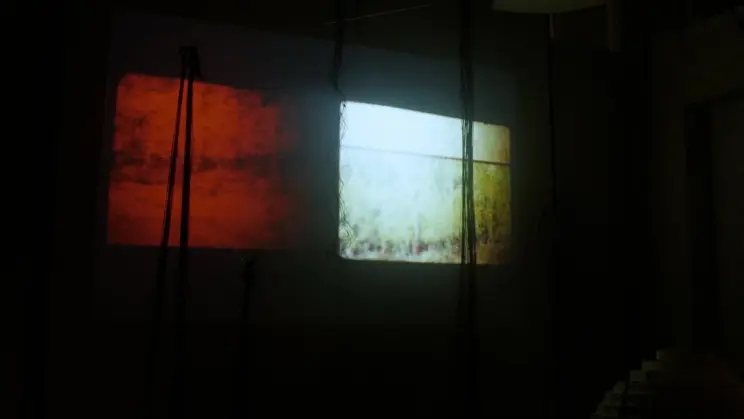
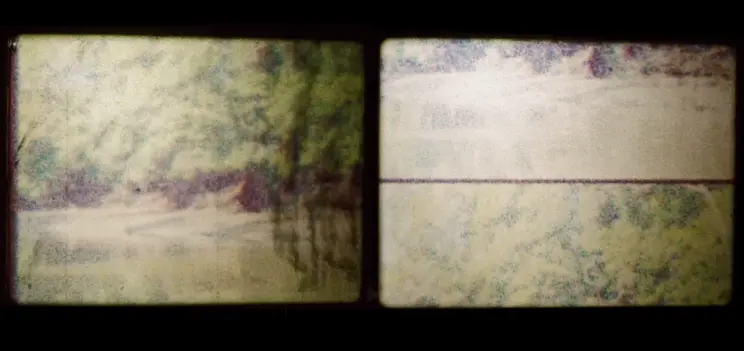
Representation itself, for Chua and Lam, is never neutral. A Yam as I Am (2025), a two-channel silent video produced as handmade film loops, makes this explicit. Shot on 16mm along the mangrove coast of Pulau Ubin, the footage was later subjected to tactile reworking. One loop was layered with printed fragments that stiffened the reel, leaving it rigid and serrated as it passed through the projector. The other was coated with yam starch that clouded the emulsion with streaks and residues, bending light into unpredictable distortions. These interventions build failure directly into the image, transforming the mangroves and island coast into faded impressions, grainy one moment, flaring into reds the next, before dissolving into pale washes of green. In this way, representation shifts from capturing the coast as a composited scene to revealing image-making as iterations of failed mediation, where each frame offers a contingent, open-ended way of regarding the island.
The silence of the playback is broken by the sounds of the 16mm projector, where crackles and stalls punctuate the rhythm as the loop stutters, caught in the friction of machinery. The projector’s motion both drives and disrupts the image, drawing our attention to the cinematic apparatus. In this way, A Yam as I Am extends its critique beyond film technology toward the larger systems of society that demand seamless, endless reproduction of the image. Against these expectations, Chua and Lam value moments of interruption and inaccuracy as potentialities for imagining otherwise.
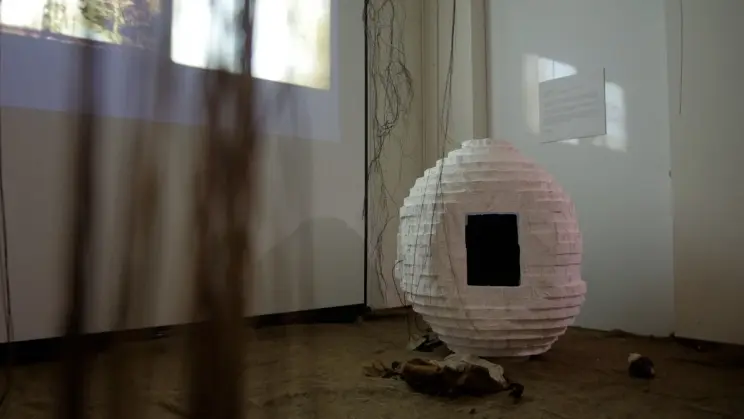
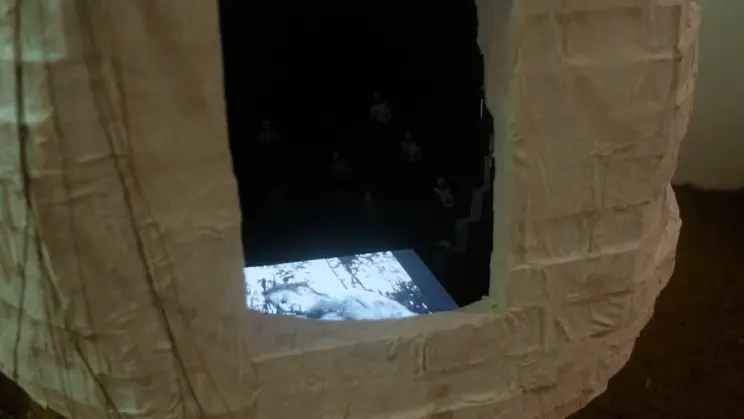
Failure takes different forms across Before and After the Unknown, shifting from the game-world of Keladi Figments, to film materiality in A Yam as I am, and finally into the thresholds of the body in Yam Over Body (2025). Screened within a 3D-printed yam sculpture, the film depicts yam paste being pressed onto skin, provoking a rash that is at once unbearable and strangely luminous. The yam acts directly on flesh, forcing an encounter that is neither voluntary nor comfortable. Here, Chua and Lam extend the logic of failure from cinematic apparatus into skin and substance, courting abjection as psychoanalytic theorist Julia Kristeva defines it, as an unsettling of boundaries. Relations spill and resist containment.
In Yam Over Body, abjection surfaces as starch inflaming skin, paste seeping into pores, residue clinging to film stock. These intrusions refuse neat separations between human and non-human substances. The abject names not only the difficulty of how relations are assembled but also the inevitability of what resists integration. Through Chua and Lam’s practice, the body becomes permeable to vegetal affects. Without permission, celluloid thickens in response, and performance is destabilised by noise. Such scenes compel us to think of relation as assemblages of human, plant, and apparatus rather than the binaries on which both colonial and decolonial narratives too easily rely.
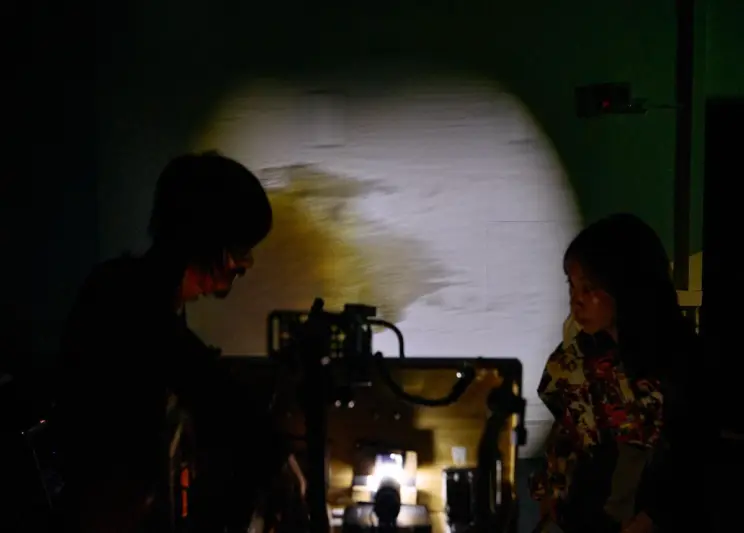
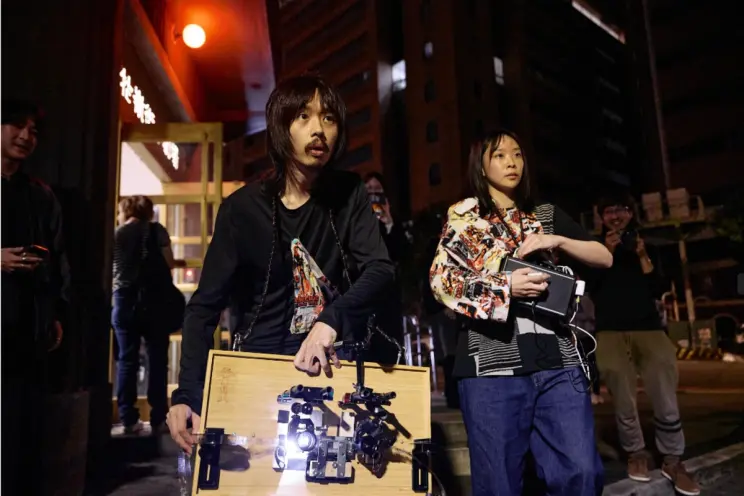
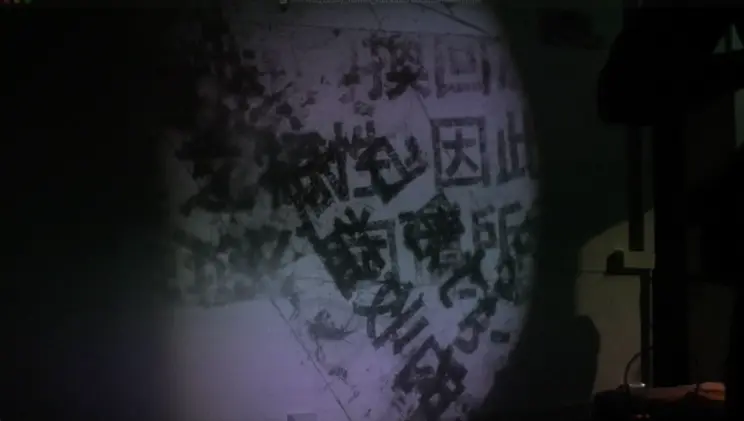
If Yam Over Body approaches permeable vulnerability through skin, Year Wax: Hear No Bullshit (2024) channels it through the fragile infrastructures of projection. Presented at Guling Street Avant-Garde Theatre as part of EX!T 14 Experimental Media Art Festival in Taipei, Year Wax excavates earwax, one of the body’s most intimate secretions, into a barrier against the constant hum of modern noise, from media chatter to everyday distraction. Collected over months and extracted live, earwax was pressed onto strips of 16mm film already bearing transferred newspaper prints. The celluloid, no longer smooth or transparent due to the stickiness of wax, clung to fragments of text and dissolved into the film material.
Fed through a hand-built projector cobbled together from an assemblage of IKEA bed tray, metal hinges, carabiners, and a camping torch, these wax-covered loops ran through an apparatus never meant for cinematic precision. Without sprockets or calibrated rollers, the film slipped and snagged occasionally, while the torch beam misaligned with the makeshift gate. The process revealed cinema’s fallibility in literal form.
Live projection performances like Year Wax depend on careful, tactile maintenance, threading, adjusting, coaxing the projector into temporary alignment. The impossibility of reproducing the same image twice becomes integral to their rhythm, each run invites new calibrations and discoveries shaped by its specific projection surface and setting.
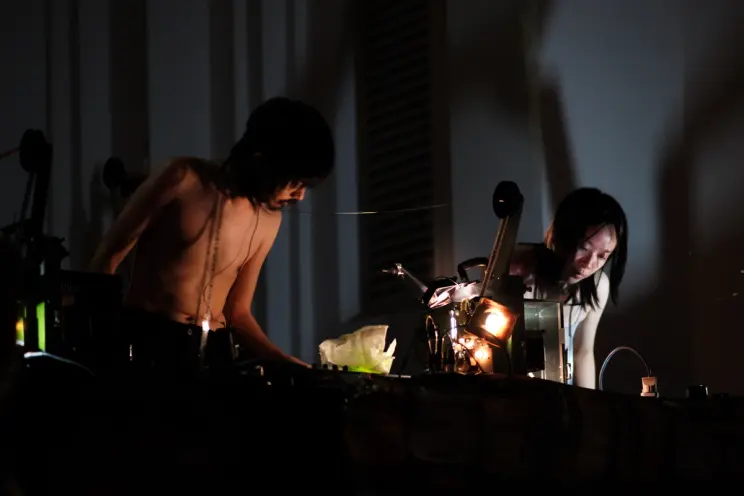
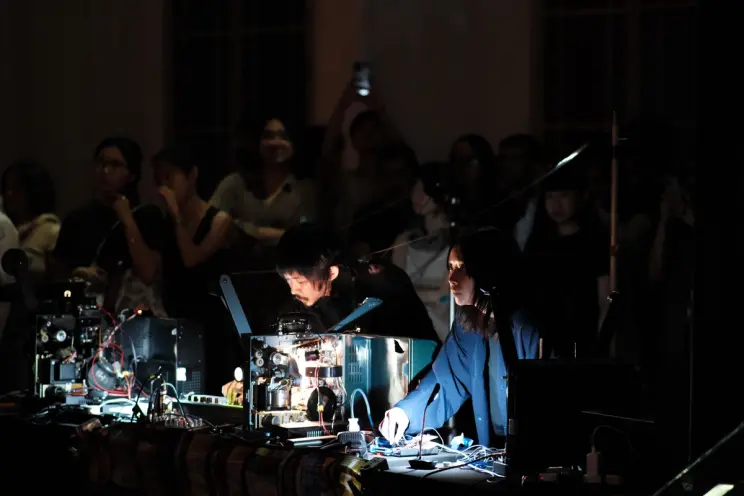
Keeping these fragile machines alive becomes integral to Chua and Lam’s craft, sustained through improvisation, repetition, and the generosity of shared expertise. The upkeep of these reels and projectors exposes the manual and affective labor that ensures cinema’s continuity, processes that often remain hidden behind the image. Unlike Gene Youngblood’s vision of expanded cinema as technological utopia, Chua and Lam’s practice does not fixate on trying to overcome the volatile, uncertain, complex, and ambiguous by chasing the latest cinematic tools. Rather, they intentionally resist the obsession with technological advancement, spectacle, and easy consumption. Defiantly, their expanded cinema becomes acts of world-making, where they work with what they already have to build infrastructures that allow diverse and unexpected images to emerge under inhospitable conditions.
This sensitivity to failure and fragility—and to the infrastructures that make an image im/possible—shapes how Chua and Lam think about cinema as apparatus. By foregrounding the material and mechanical conditions of image-making, they turn bodily waste into medium, subverting disgust as a reaction to the abject and reorienting it toward the possibility of making. Over the years, they have committed to this niche of 16mm analog practice by bringing it into the everyday commons: hand-developing reels in their bathroom, soaking celluloid in foods like kaya, coffee, pandan, and eggs, and rewiring projectors from spare parts. Abjection expands beyond theory into the intimacies of artistic labour and embodied acts of cinematic care.
Fragility here is systemic, bound to the conditions of art-making in Singapore where artistic resources are uneven, censorship persists, and independent cultural spaces continue to vanish. Chua and Lam do not mourn these instabilities, they work through them, choreographing uncertainty and working with variables that pose high risks of failure. Breakdowns are not obstacles or impasses but recurring grounds for making-new. At its core, turning their attention to maintaining the apparatus of cinema is less a wager on risk than an extended and necessary form of care for the longevity of other creative practices. If the sustainability of art practices depends only on endless new resources, art-making risks becoming available only to those who control access, reducing creativity to the weighing of measurable returns rather than reimagining what can be made from what is already here.
This careful attention to the economies of precarity and possibility runs through Keladi Figments, whose falling statue crystallises a state of perpetual reparation. Its cycle evokes the Sisyphean task of racing against institutions that can dismantle worlds as quickly as they enable them. Yet, Chua and Lam imagine the reverse: that art and artists may continue to negotiate, subvert, and repurpose existing systems, eventually unsettling the foundations of hostile worlds and toppling them altogether.
Fragile loops—whether in cycles of gameplay or the reels of 16mm film—are invitations to play again. Chua and Lam carefully cultivate conditions where the ongoing labor of tending to loops and cinematic apparatuses keeps images, machines, and collaborations alive. Their remaking expands cinema as an ongoing work-in-progress, producing creative intensities that our world should dare to hold, open to those willing to inhabit failure along the way. In doing so, they model how to create and imagine multiplicity through failure and limitation, reminding us that in a world obsessed with expansion, accumulating resources, and technological promise, creative artmaking begins by working with what already exists.