Hyundai Commission: Máret Ánne Sara: Goavve-Geabbil, Installation View at Tate Modern.
Photo © Tate (Ben Fisher)
For her Hyundai Commission at Tate’s Turbine Hall, Sámi artist Máret Ánne Sara transformed the former power station into a multi-sensory labyrinth where reindeer hides, scent, sound, and story braid ancestral knowledge with the stark realities of climate change.
Artlab Editors: Writer Jennifer Higgie explores the ways in which Hyundai Commission: Máret Ánne Sara: Goavve-Geabbil immerses us in the culture and worldview of the Sámi as a proposition for adaptation and resilience.
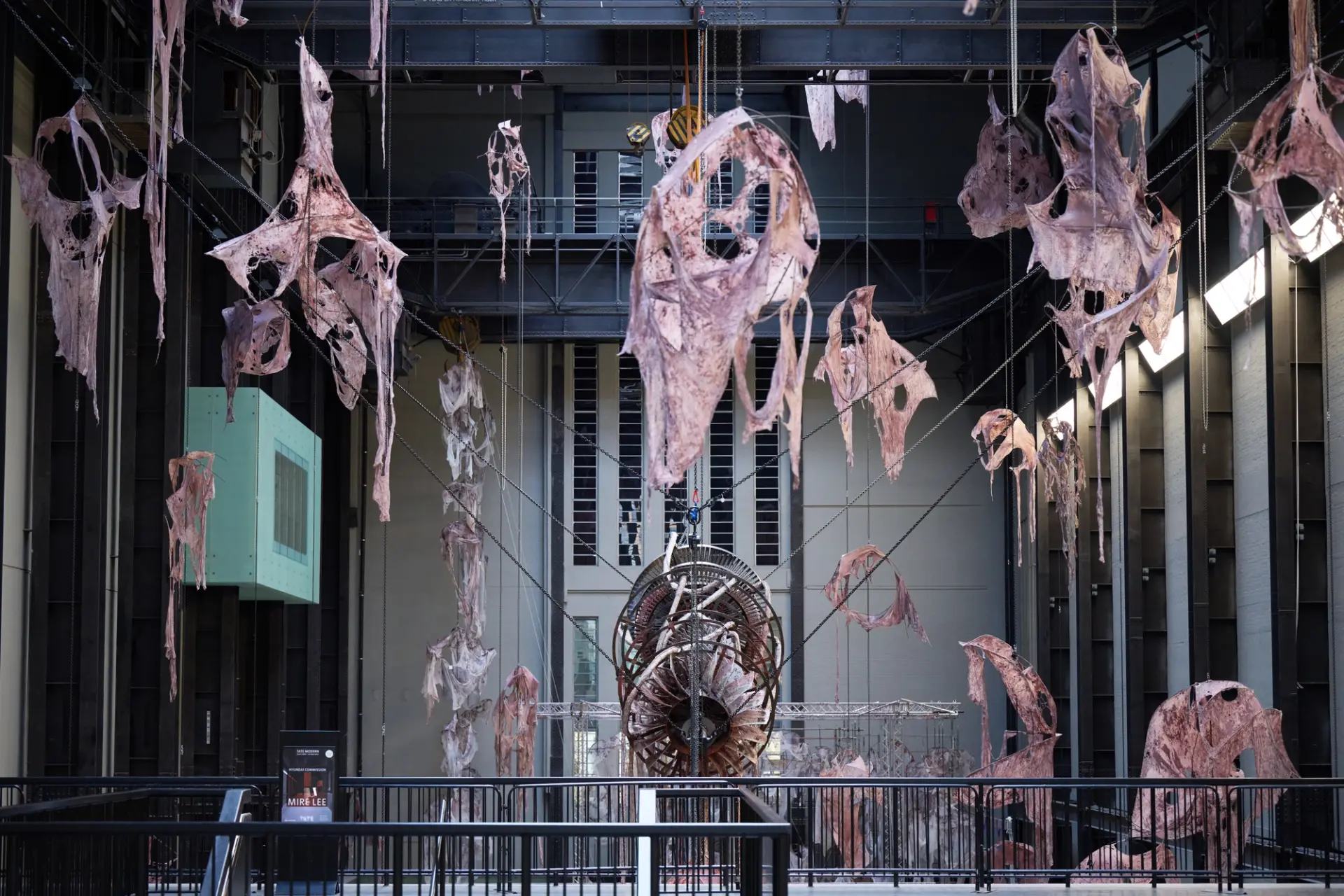
The soaring space of Tate’s Turbine Hall–so urban, so industrial, so grey–is not the obvious place to evoke the vast, wild, and largely subarctic regions known as Sápmi, the ancestral lands of the Sámi people spanning Norway, Sweden, Finland, and Russia. But by transplanting physical elements from her homelands–including trees, reindeer skulls, hides, and various industrial materials–into the heart of a former power station, Sámi artist and land defender Máret Ánne Sara has created something both nightmarish and educational, celebratory and elegiac.
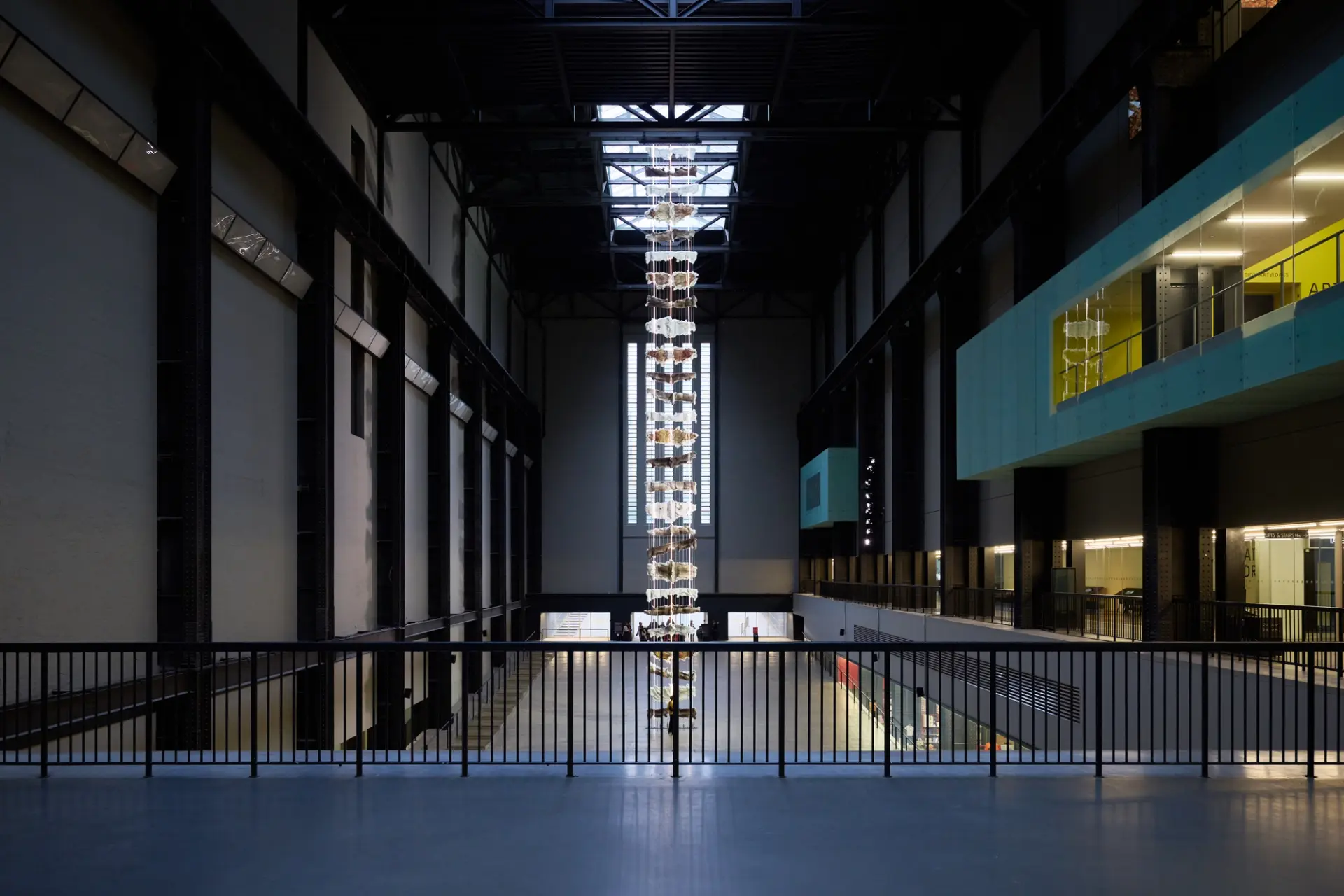
Hyundai Commission: Máret Ánne Sara: Goavve-Geabbil, Installation View at Tate Modern.
Photo © Tate (Ben Fisher).
The title of Sara’s multi-faceted installation Hyundai Commission: Máret Ánne Sara: Goavve-Geabbil embodies not only the complexities of the artist’s first major work in the UK but the complexities of her Sámi culture, whose beating heart is defined by reindeer herding, and the spiritual and physical interdependence of people, land, and animals. Goavve is a Sámi term that loosely translates as ‘locked pastures’–a snow condition caused by climate change, as a result of industrial development, that prevents animals from grazing. Meanwhile, in a recent interview with The Art Newspaper, Sara explained that geabbil is a “North Sámi word meaning flexible or smartly adaptable.” This term, she explained, reflects her “search for alternative strategies for a more sustainable global future, looking beyond the modern Western capitalist logic.” It’s a search that has resulted in a nuanced and immersive work that demands, for the uninitiated, an openness to learning not only about the historic riches of Sámi culture, but also its contemporary crises–from the impact of increasingly extreme weather conditions and the imposition of wind farms on migration pastures, to the Sámi’s forced displacement, and battles with mining companies.
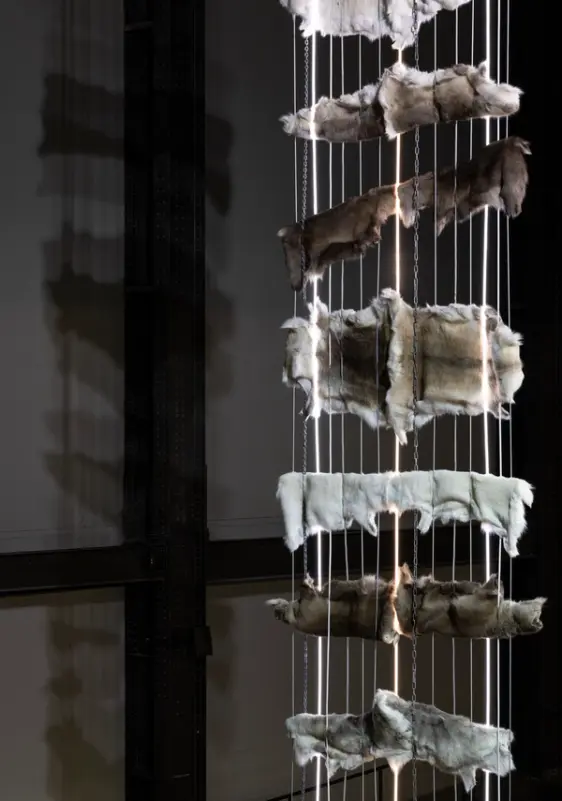
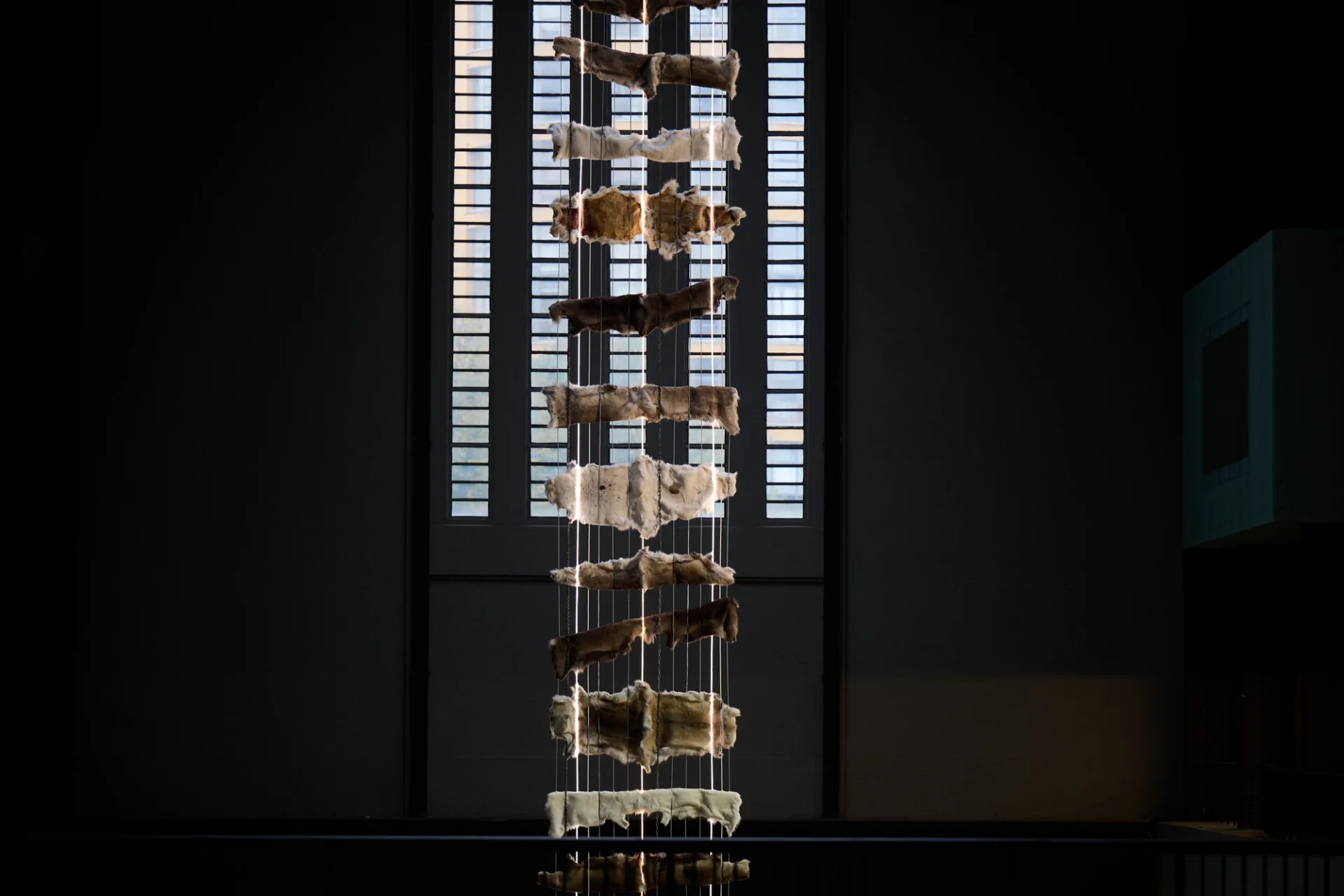
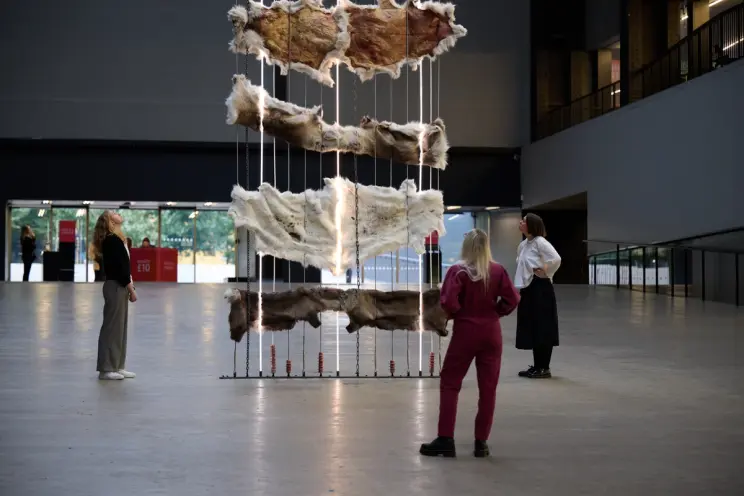
Walking down the ramp into Tate’s Turbine Hall, you’re confronted with a startling sight: Goavve-, a 28-meter high, two-and-a-half meter wide structure, suspended from the ceiling. Like a sci-fi mortuary, death abuts a cool eternity of metal in the form of 72 reindeer hides–some folded, others stitched together–which are draped across the structure’s 27 rungs. Interspersed among them are floor-to-ceiling LED lights that glow harshly against the fur. The work emits a curiously pungent smell, inspired by the scent released by frightened reindeer. (It was created by the artist in collaboration with scent-maker Nadjib Achaibou.) The combination of animal hides with power cables suggests the destructive entangling of the natural world with industry–what Sara, who was born into a reindeer herding family, describes as the “green colonisation” that is currently rampant on her lands.
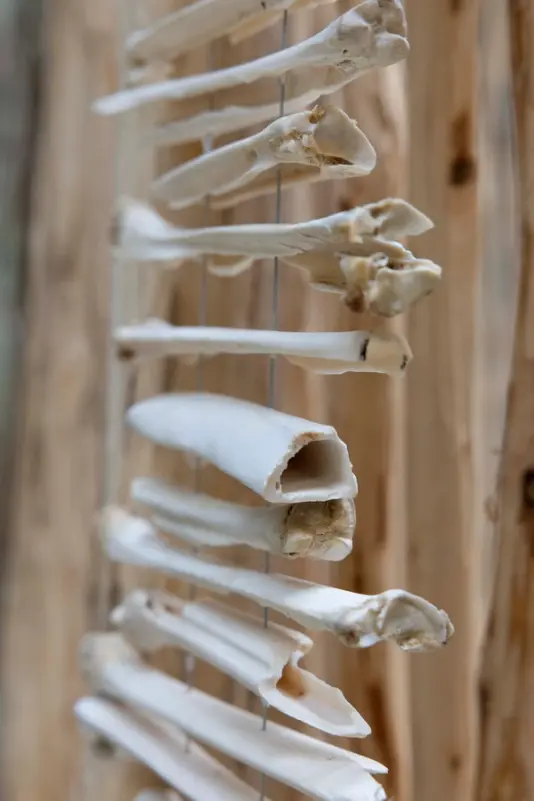
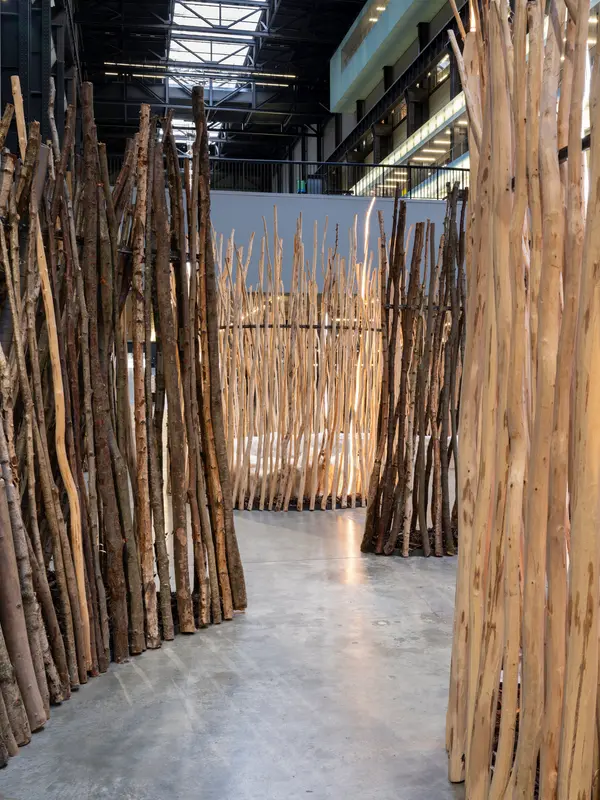
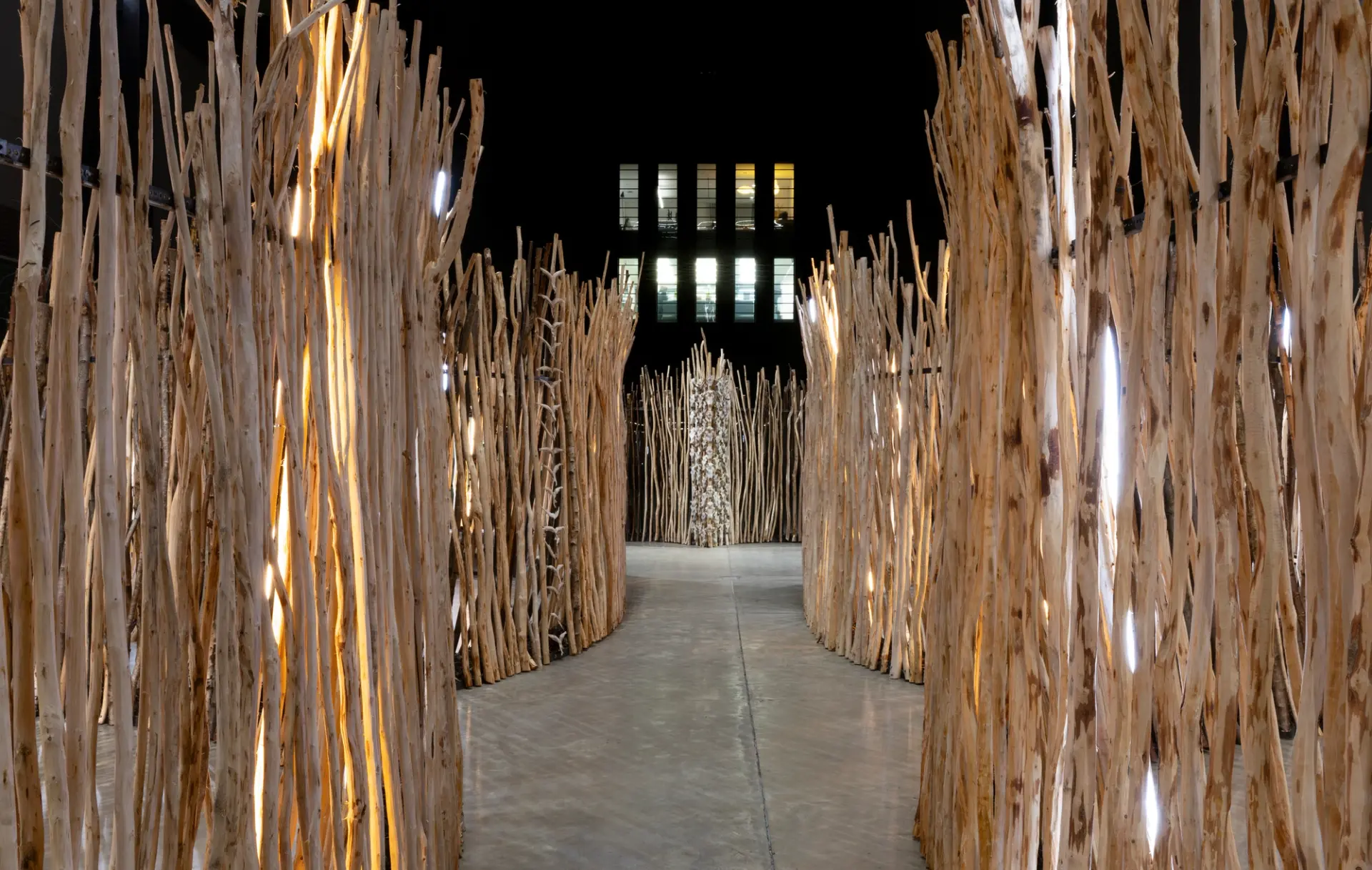
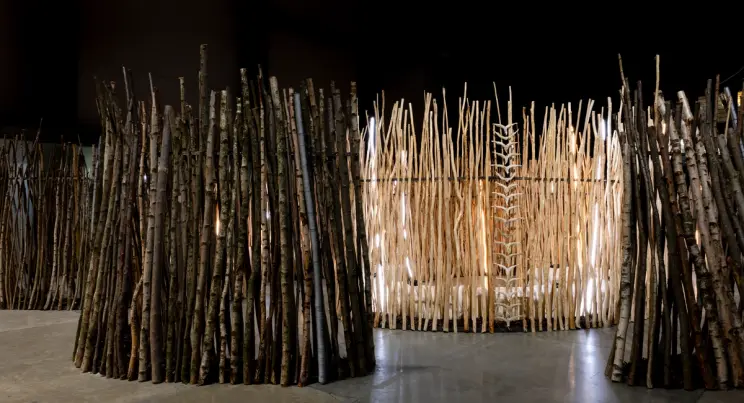
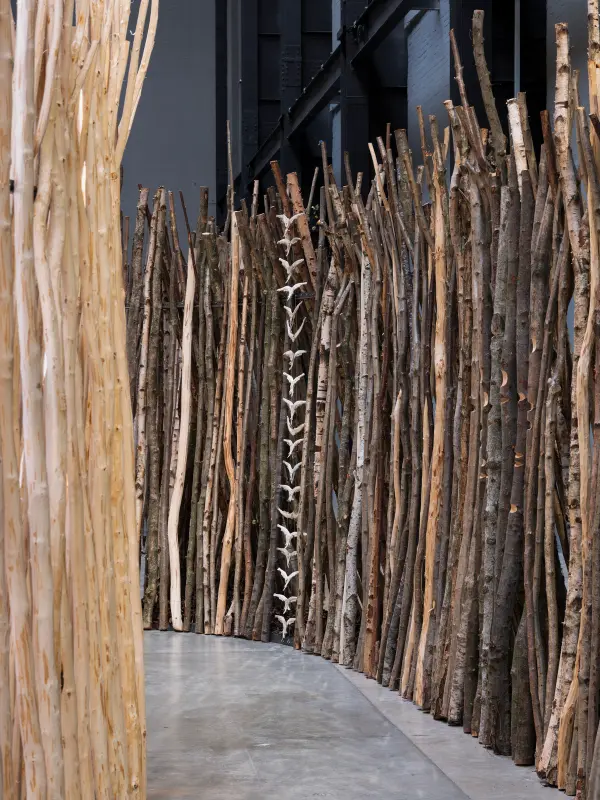
Beyond this mournful monument is a sinuous labyrinth, of sorts. Titled Geabbil-, its walls are created from poles carved from birch, hazel, and chestnut trees, some of which are carved with the geometric patterns traditionally used by the Sámi to mark a reindeer’s ears, indicating guardianship. The curve of the wall is occasionally broken up with arrangements of hides and bones—a reflection of the long-standing gesture of respect in Sámi culture that once an animal is killed, every part of its body is used, whether for food, ritual, clothing, or warmth.
The bustle of the crowd at Tate’s Turbine Hall is tempered with a soundscape which Sara designed in collaboration with Kristine Hansen; it includes recordings from the Sámi landscape, mosquitos buzzing, and the gurgles of the artist’s son, alongside juoigan or joik, a Sámi vocal tradition in which a singer evokes the essence of a person, animal, or place. Smell, too, is important here, but in this iteration, it’s not sourced from fear but from native Sápmi plants, reindeer milk, and the artist’s own breastmilk.
Hyundai Commission: Máret Ánne Sara: Goavve-Geabbil, Installation View at Tate Modern.
Photo © Tate (Ben Fisher).
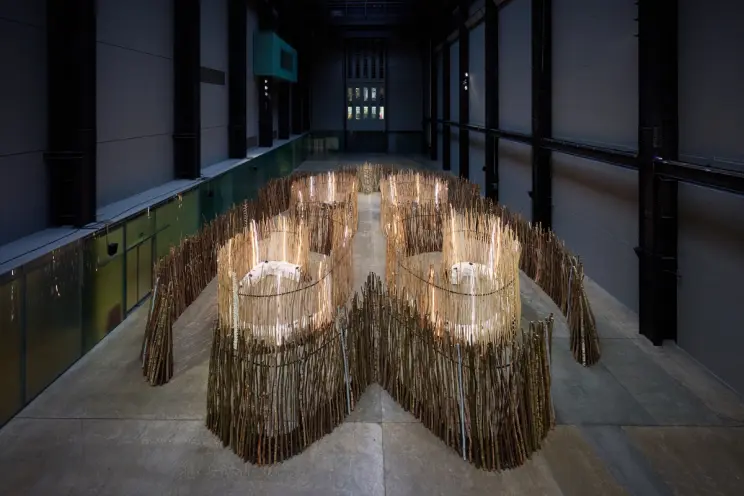
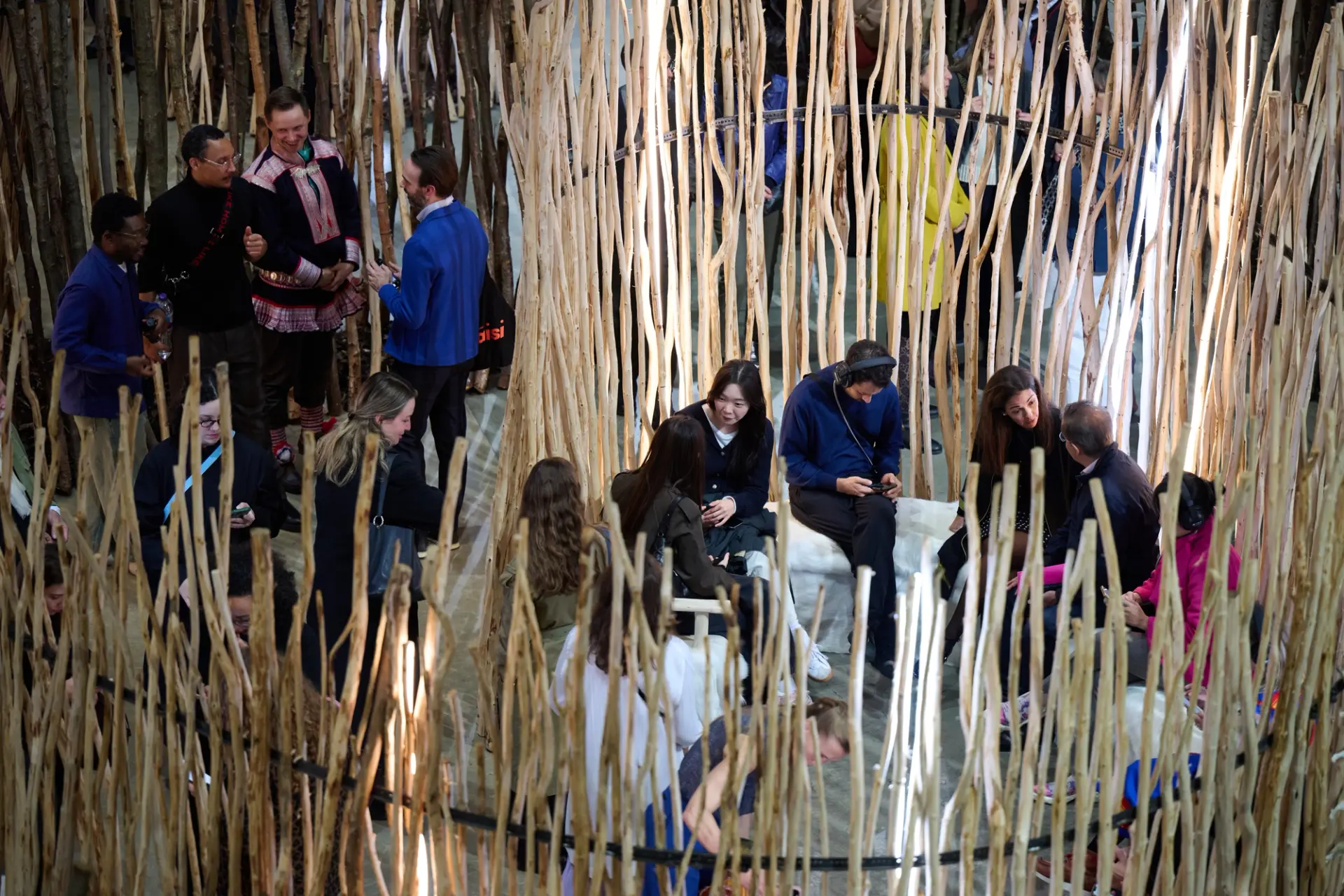
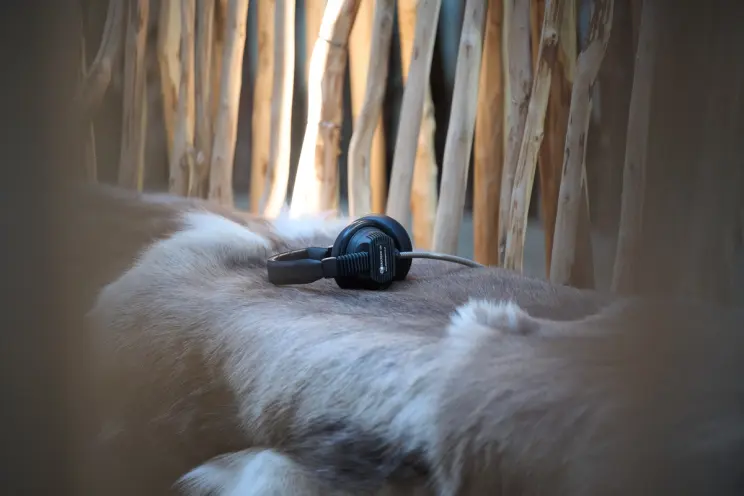
The design of the labyrinth is based on the shape of a reindeer’s nose, which, astonishingly, can heat air to 80 degrees Celsius in a second. It’s a clever way of reversing the conventional sapien-centric hierarchies between humans and animals: here, visitors are small enough to fit inside a reindeer’s nasal cavity. A series of snaking corridors lead to four enclosures, which contain long benches covered in reindeer hides. This is where the artwork moves from the sensory to storytelling, a form of oral communication which is central to Sámi culture. You can don headphones and listen to recordings of Sara’s conversations with family members, reindeer herders, and knowledge keepers. They cover the Sámi philosophy of exchange between humans, animals, and nature; the spiritual and practical partnership between humans and reindeers; and the importance of generational knowledge. A beautiful chapter explores the necessity of asking “permission” when travelling somewhere new–whether from the land, non-human creatures, or spirits. As the Sámi professor Mihkkal Niillas Sara observes:
In Sámi thinking, there are also spirits—beings that cannot be seen. The idea is that another realm exists. We don’t know in what shape or name but there is something in our surroundings. […] It is important always to communicate and come to an agreement with your surroundings when traveling, so that your journey may end well.
Art, for Máret Ánne Sara, is not a discrete object on a wall: it emerges from her deep cultural knowledge and her belief in the entangled connections between humans and animals, the earth and the air. Her resistance to colonial imposition is articulated not in rage or violence but in age-old methods of storytelling and symbolism. For her, ancient Indigenous philosophies are deeply alive and replete with wisdom. As she makes clear, given the many crises the world is currently facing, it’s essential to look back in order to discover new ways to move forward.