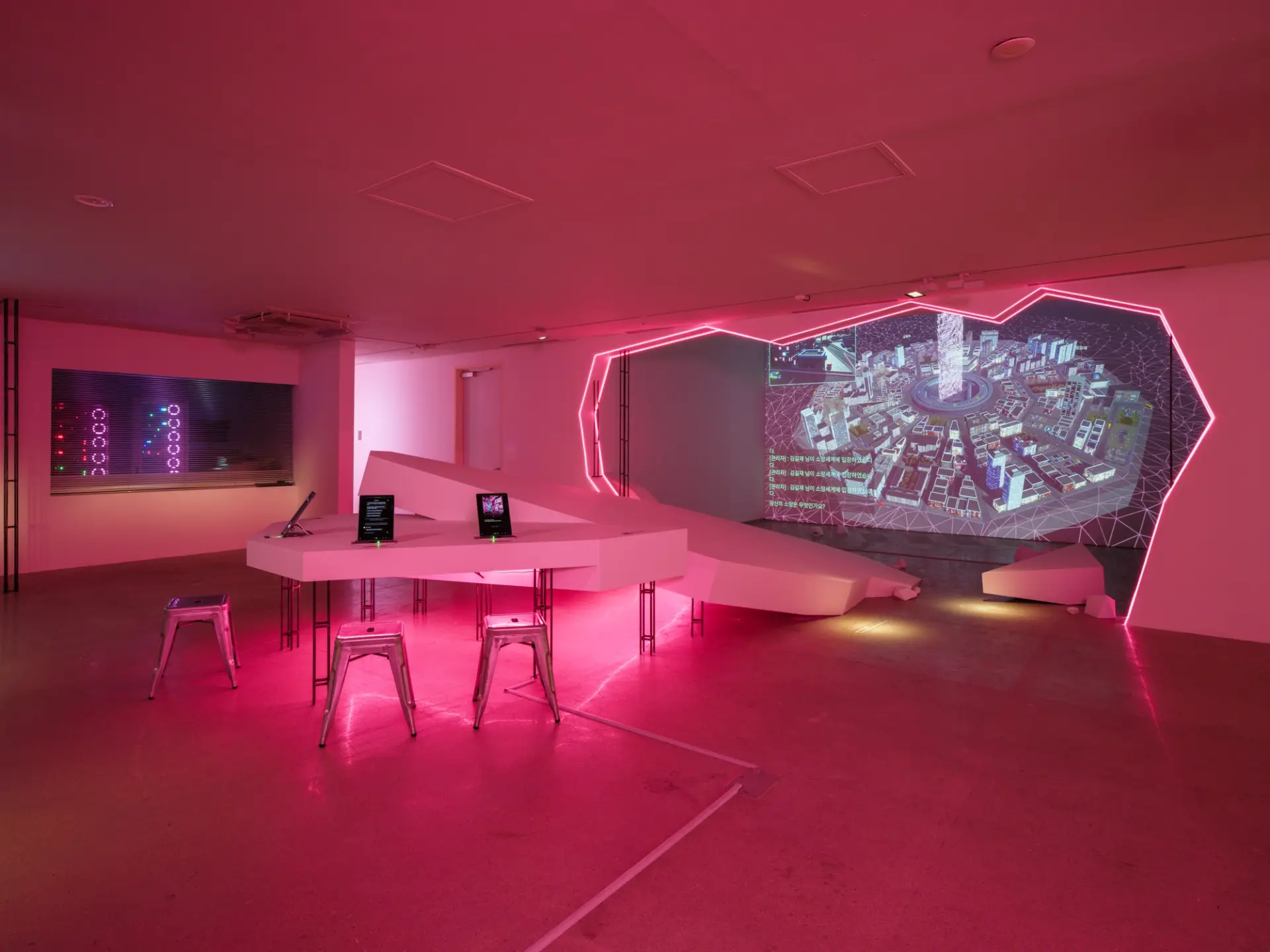
Christine Sun Kim, Up and Away, 2025. Commissioned by Hyundai Artlab, © Christine Sun Kim
In Up and Away, an Artlab Digital Commission by Christine Sun Kim, the artist reimagines the speech therapy games of her childhood, using her own voice to challenge prevailing assumptions and culture around speech and sound.
Artlab Editors: Games, in recent years, have often been used as conduits for empathy, placing us directly into experiences outside of our own. Exploring Christine Sun Kim’s new Artlab Digital Commission, Up and Away, writer and fellow Berliner Emily McDermott traces the different ways Kim has employed the game format in her decade-long conceptual art practice subverting the power dynamics of the hearing world.
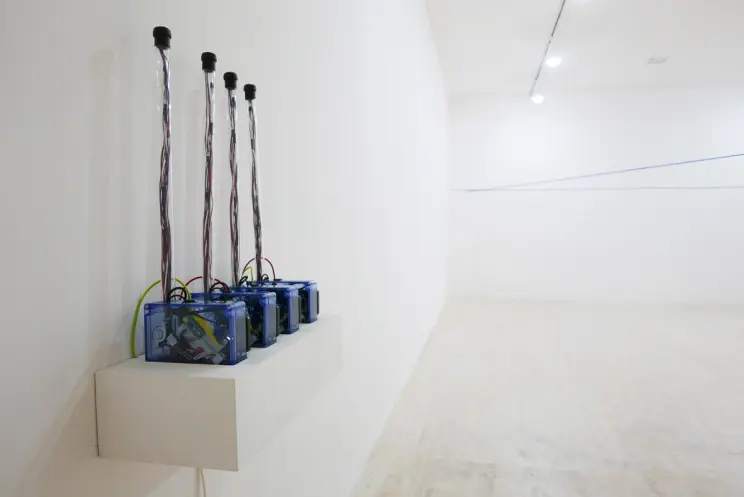
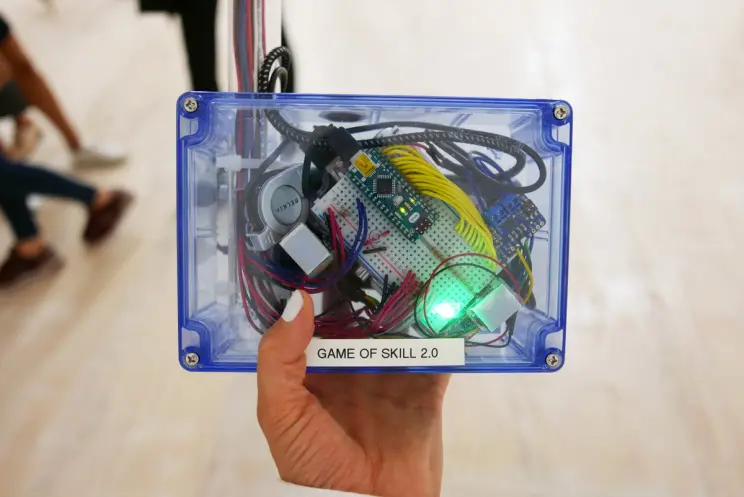
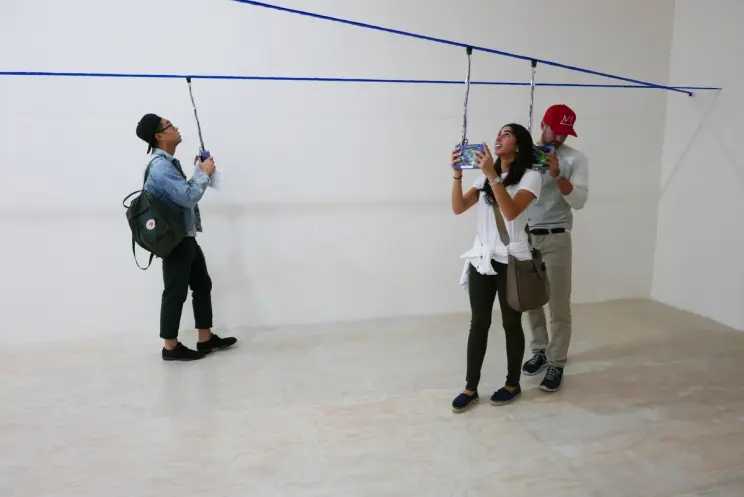
The first time I saw Christine Sun Kim’s work was at MoMA PS1’s 2015 exhibition “Greater New York.” Her piece, Game of Skill 2.0 (2015), had its own room; three wires covered in blue Velcro were strung tautly in a triangle between the space’s corners. Visitors were given a Lucite box crammed full of cords and circuit boards with a protruding two-foot-tall antenna. Affixed atop the antenna was a small piece of Velcro. The goal of Kim’s gamified installation was to walk while keeping the antenna attached to the Velcro overhead. As one moved, a slow-motion, garbled voice spoke through the device. The faster one moved, the faster the audio played. But Kim intentionally designed the experience so that it was impossible to keep the Velcro connected and walk fast enough to result in clear audio—and when contact was lost, the audio restarted. In me, the experience elicited frustration and, ultimately, defeat. In this, the work challenged my expectations of what the voice was meant to do.
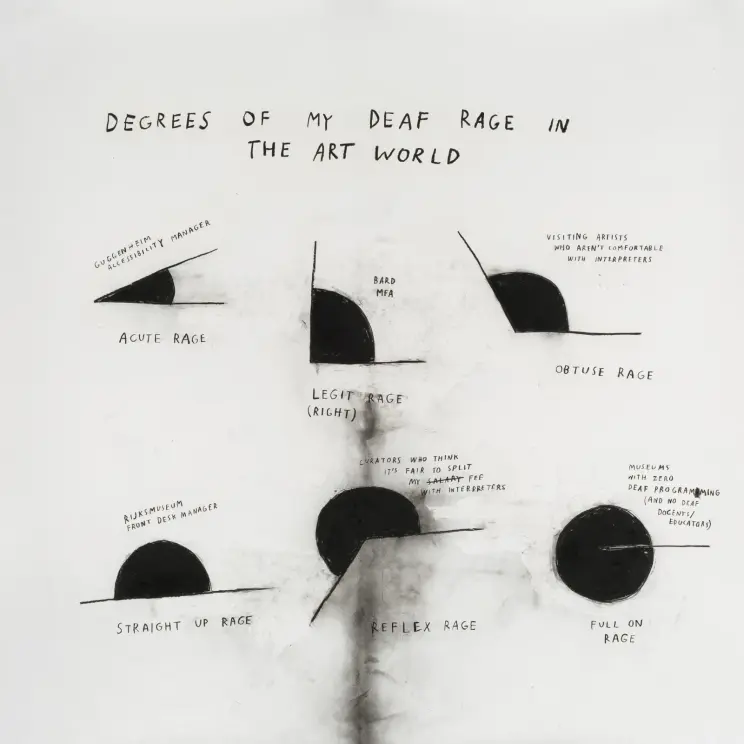
Since Game of Skill 2.0, Kim has continued to develop an expansive practice encompassing everything from drawings and murals to performances, videos, and ceramic works. She is most recognized for charcoal and oil pastel drawings that translate her lived experiences into notational scores and graphs as well as use the shapes of American Sign Language (ASL) signs to consider how sound and language operate—and often define—societies.

In Up and Away, her new Artlab Digital Commission, Kim merges this practice with childhood experiences and voice-correcting exercises in an animated, interactive game. Here, she incorporates her own voice and, for the first time, asks the audience to use theirs too.
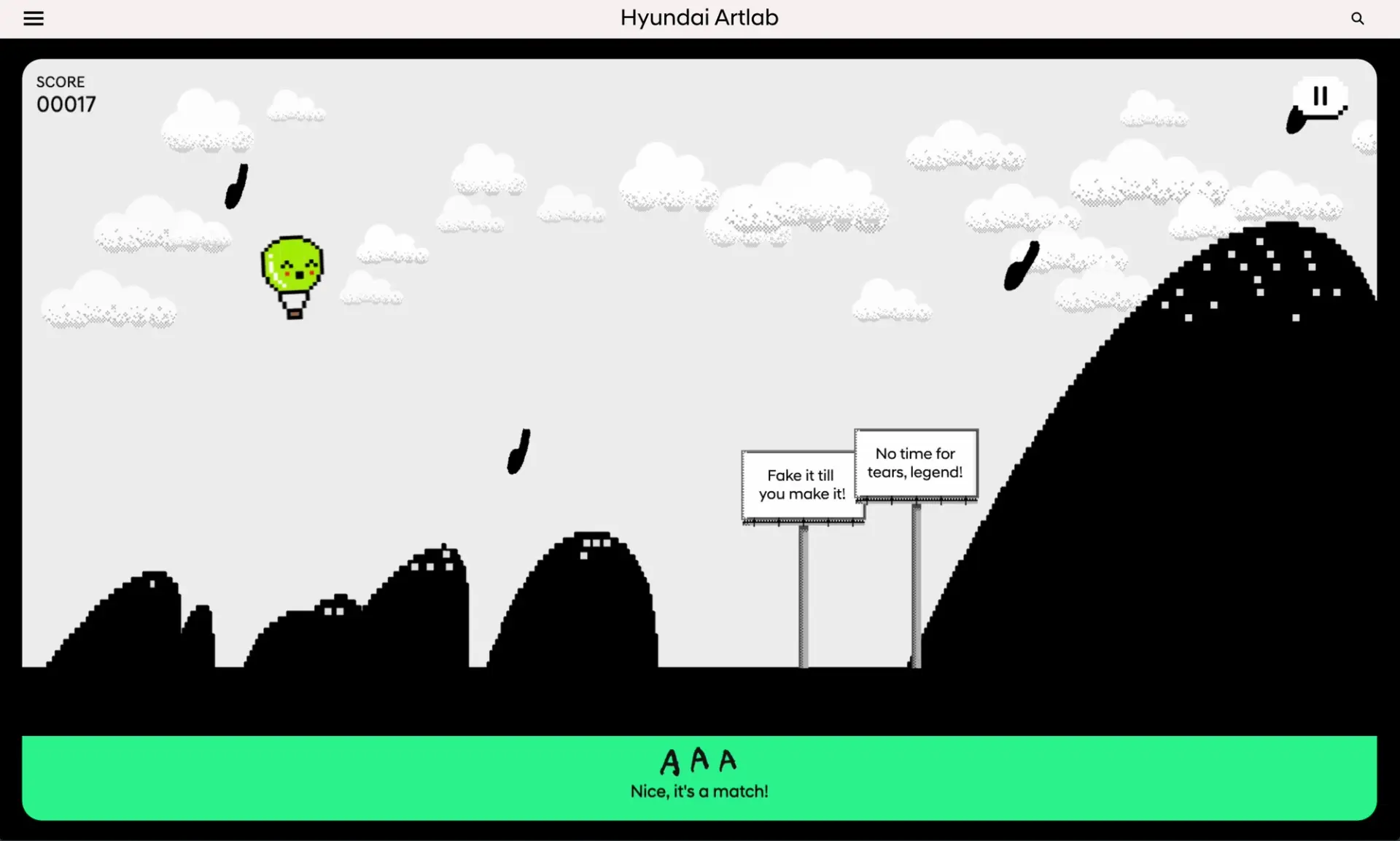
Christine Sun Kim, Up and Away, 2025.
Commissioned by Hyundai Artlab, © Christine Sun Kim.
“I have used my voice in previous works, but very sparingly,” the California-born, Berlin-based artist says. “It’s so vulnerable and uneasy for me to share my voice sounds with the public; I find it very disempowering.”
“But it doesn’t have to be that way, right?,” she continues. “Doing this game is one of many ways to put power into my voice sounds. It’s a small space where my voice does not get corrected.”
Up and Away was inspired by three primary experiences: Kim trying to hack Siri on her phone, a trending voice challenge she saw on TikTok, and a speech therapy game she played as a child. Recently, the artist has tried, in vain, to figure out how to have Siri perform actions based on her own choice of voice sounds: “Like if I grunt, it starts a new email, or hum and it FaceTimes my sister,” she says. In the viral “Pitch Perfect” challenge on TikTok, people record themselves playing a game in which they sing to make animated balls go through holes associated with specific notes; the ball only makes it through the hole if the player is on key. Similarly, in the early computer speech therapy game Up, Up, and Away, the player’s voice was used to guide a hot air balloon upwards along a mountain. This was an effort to teach deaf and hard of hearing children voice control. If they made a sound too loudly, the hot air balloon would be blown far away from the mountain, disappearing into the abyss. If they were too quiet, the balloon would crash to the ground. “It was fun and traumatizing at the same time,” Kim remembers.
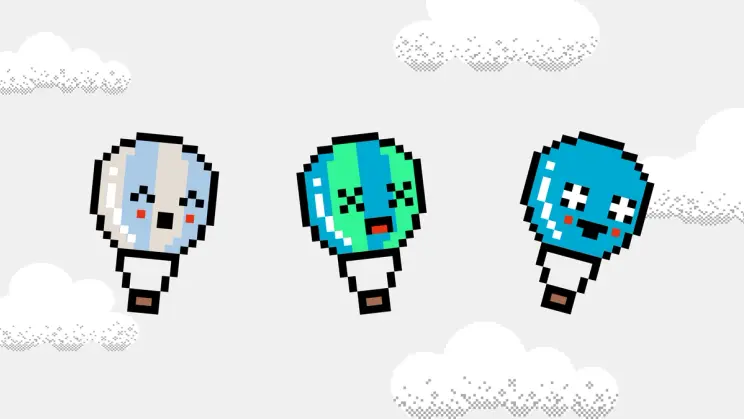
In her new game, Kim reclaims these mechanisms of vocal control. Like in the original Up, Up, and Away, players select a hot air balloon avatar—named after the artist’s and her friends’ dogs—which they navigate through a mountain range punctuated with billboards and obstacles. To move up or down, players must make one of four sounds—Aaaas or Oooos, for instance—in a specific tonality based on how Kim sounds when making each noise. Failure to match her vocalizations results in game over: the balloon frowns and crashes into Kim’s echoing mountains.
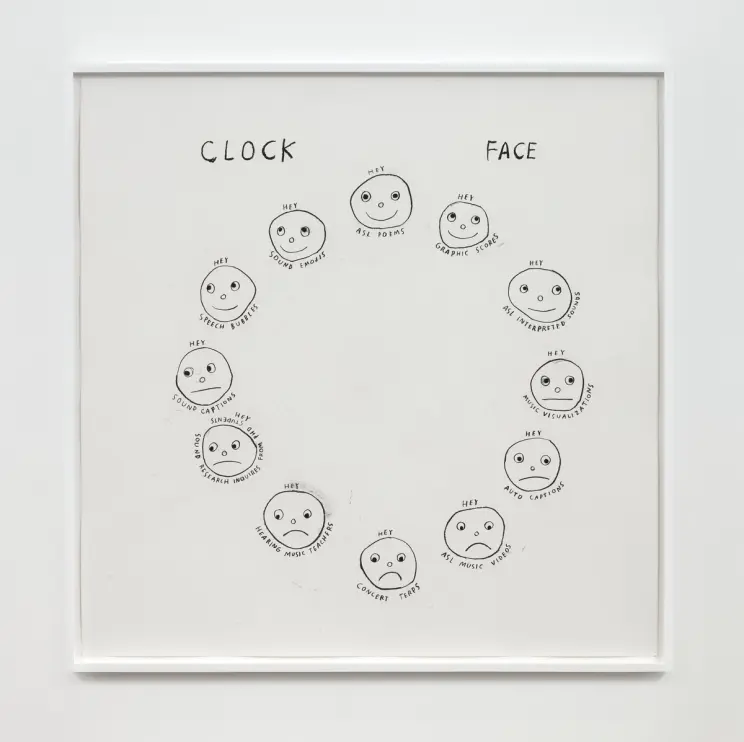
Both the hot air balloon’s changing facial expressions and the oppressive mountains in the game aesthetically reflect some of Kim’s previous drawings. She’s used smiley faces to convey a range of emotions she feels in response to things like ASL poems, graphic scores, ASL music videos, or concert interpreters (Clock Face, 2020). Mountain-like forms visually represent the concept of an echo, an allusion to the repeated encounters she experiences as a Deaf person, like museums lacking Deaf programming or hearing people continually asking why she doesn’t read lips.
The echo also gestures at how, when an interpreter voices a talk or an interview Kim is giving, the audience receives an echo of what she’s signed—and vice versa: when an interpreter is signing a spoken language event or an interviewer’s questions, Kim receives an echo of the original. Her mural Echo Trap (2021) is one instance where she visually represents this echo chamber by way of painting the sign for “echo” in ASL.
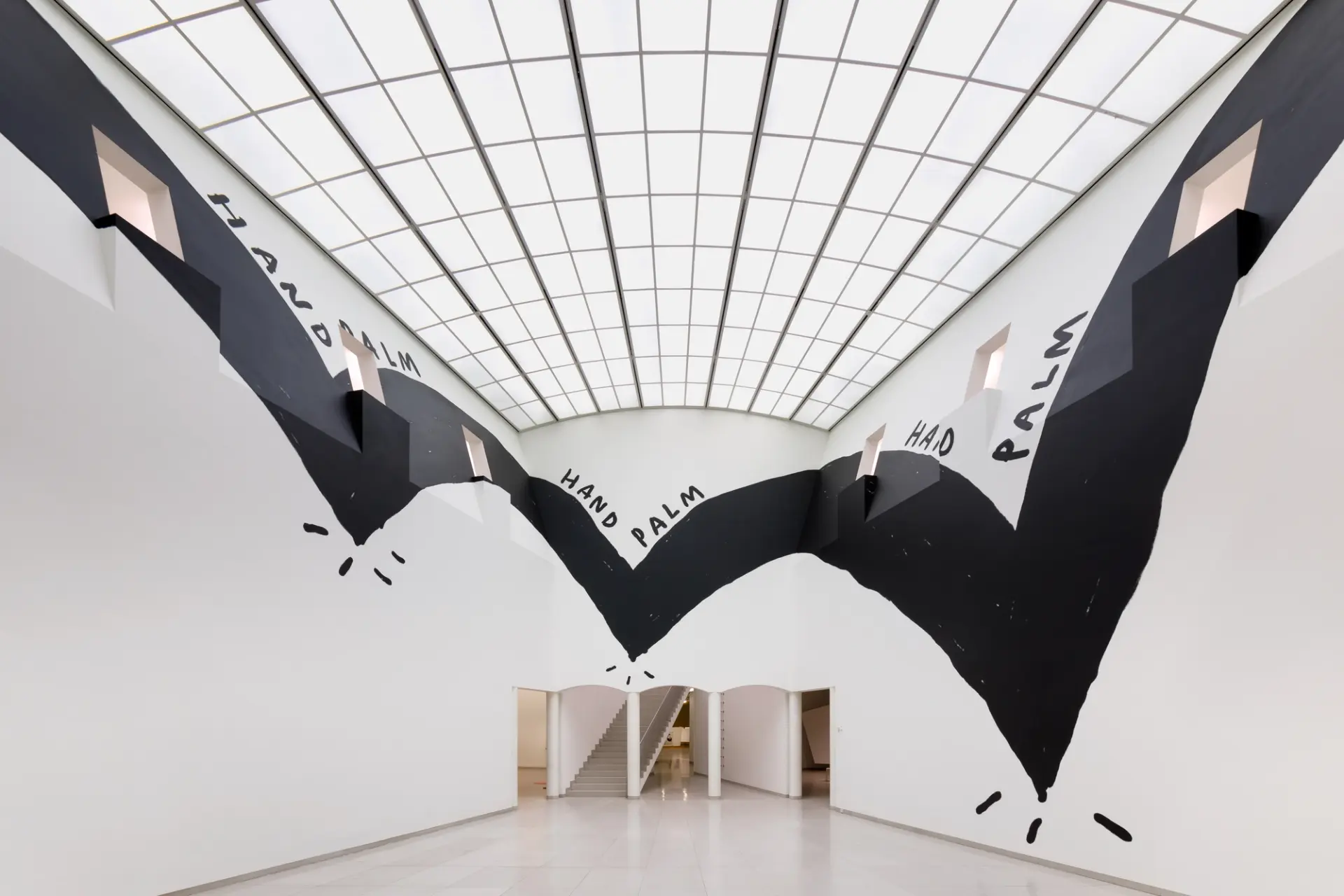
Christine Sun Kim, Echo Trap, 2021, MUSEUM MMK FÜR MODERNE KUNST.
© Christine Sun Kim, Photo: Axel Schneider.
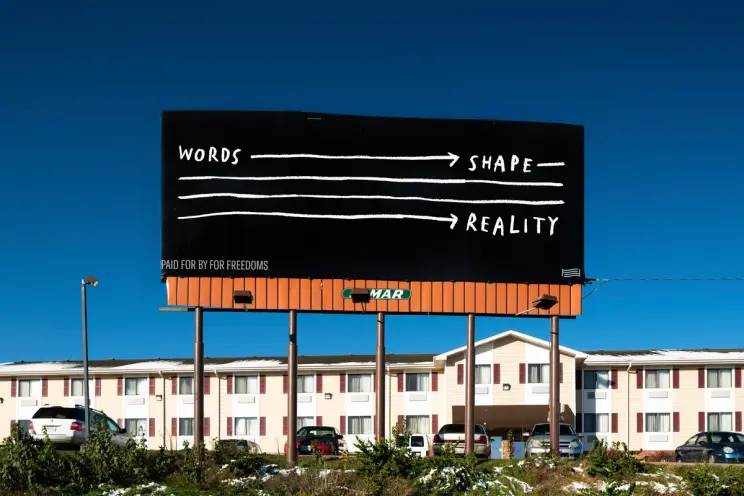
In Up and Away, as the balloon moves through the landscape, it also passes billboards inscribed with phrases of toxic positivity to encourage the player to keep going—and hitting one also results in a game over. These looming catchphrases—“You got this buddy!”, “Smile through it!”—nod to the handwritten billboards Kim has made for the artist-run civic engagement platform For Freedoms as well as the ableist encouragement she received as a kid from speech therapists.
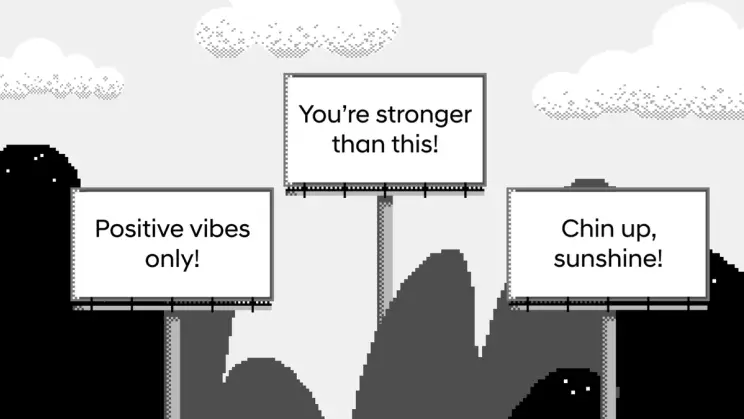
In speech therapy, Kim’s attempts at speech had to be approved by a therapist; she had no control over deciding what was a good enough sound. More than bringing together a powerful array of references from her practice, Up and Away inverts that power dynamic: The players have little control; their success is determined by their ability to appease a machine learning model—one built specifically to analyze their sounds in comparison to the artist’s.
“I want people to sound like me,” Kim says. “Not in a ‘trying to mimic the words that I can make or the speech that I can produce’ kind of way, but just to try making sounds differently than they otherwise might.”
Playing the game, I use my voice to make the displayed sound. I crash into a mountain. I click restart and then try to yell it. I crash again. A billboard, telling me in so many words that I can do it, when I very clearly am not “doing it,” makes me angry. After a couple more tries, I finally succeed and float through a mountainous landscape. I’ve adapted to the system’s requirements, following its rules instead of my own—perhaps not dissimilar, I imagine, to Kim’s experiences in speech therapy. But at some point, with no end in sight, I’m exhausted and let myself crash. Here, I also imagine Kim thinking “enough is enough,” thinking that the echo trap needs to be broken.
I’m reminded of my first encounter with Kim’s work, her installation at MoMA PS1, where no matter how much effort was exerted, an expected outcome would never arrive. Such feelings are precisely the crux of Up and Away as well as Kim’s practice at large: The artist uses universally recognizable symbols and methods of engagement to shed light on harmful, ableist societal structures and patterns of exclusion regarding spoken communication and aurally based experiences. And in doing so, her work challenges the viewer to reconsider their own behaviors and socially ingrained beliefs surrounding sound’s role in the world.