Hyundai Terrace Commission: Marina Zurkow: The River is a Circle, 2025.
Photo: Filip Wolak.
Elvia Wilk dives deep into Marina Zurkow’s Hyundai Terrace Commission at the Whitney Museum of American Art, an immersive, algorithmically-driven animation and installation that reimagines the Hudson River and Meatpacking District as a living archive shaped by ecology, history, and climate data.
Artlab Editors: Installed on the fifth floor terrace of the Whitney Museum of American Art, Hyundai Terrace Commission: Marina Zurkow: The River is a Circle (2025) immerses audiences in the Hudson River, whose estuarine tide flows in the background. The site-specific commission, which includes sculptures and illustrations animated with algorithms driven by data generated by the river, reflects the complex past, present, and future of this layered ecology.
Diving deep into Zurkow’s river, writer Elvia Wilk considers concepts of fluidity. The author of Oval, a speculative novel, and Death by Landscape, a collection of essays on art and ecosystems, Wilk expertly unpacks Zurkow’s engagement with water and rivers as fertile sites of entanglement. “The water’s edge is a threshold between the built and the wild, the visible and the submerged,” writes Wilk. “Nowhere is nature portrayed as pristine or unbesmirched: it is hybrid and entangled with technology, infrastructure, and cultural memory.”
The Whitney Museum of American Art’s address, Manhattan’s 99 Gansevoort Street, is a telling allusion to its many-layered history. The street itself traces what was once a Lenape footpath, which led to a busy trading post adjacent to the river. In the 1620s Dutch colonists arrived, eventually razing the landscape for agriculture; during the War of 1812 they constructed a military outpost on the site, named after continental army colonel Peter Gansevoort. By the early twentieth century the area had become the industrial zone of the Meatpacking District, and today the cobblestoned blocks are notoriously gentrified, packed instead with stores, galleries, and restaurants. As the street’s westernmost building, the Whitney looks out to the Hudson River unimpeded, separated only by the relentless traffic of the West Side Highway.
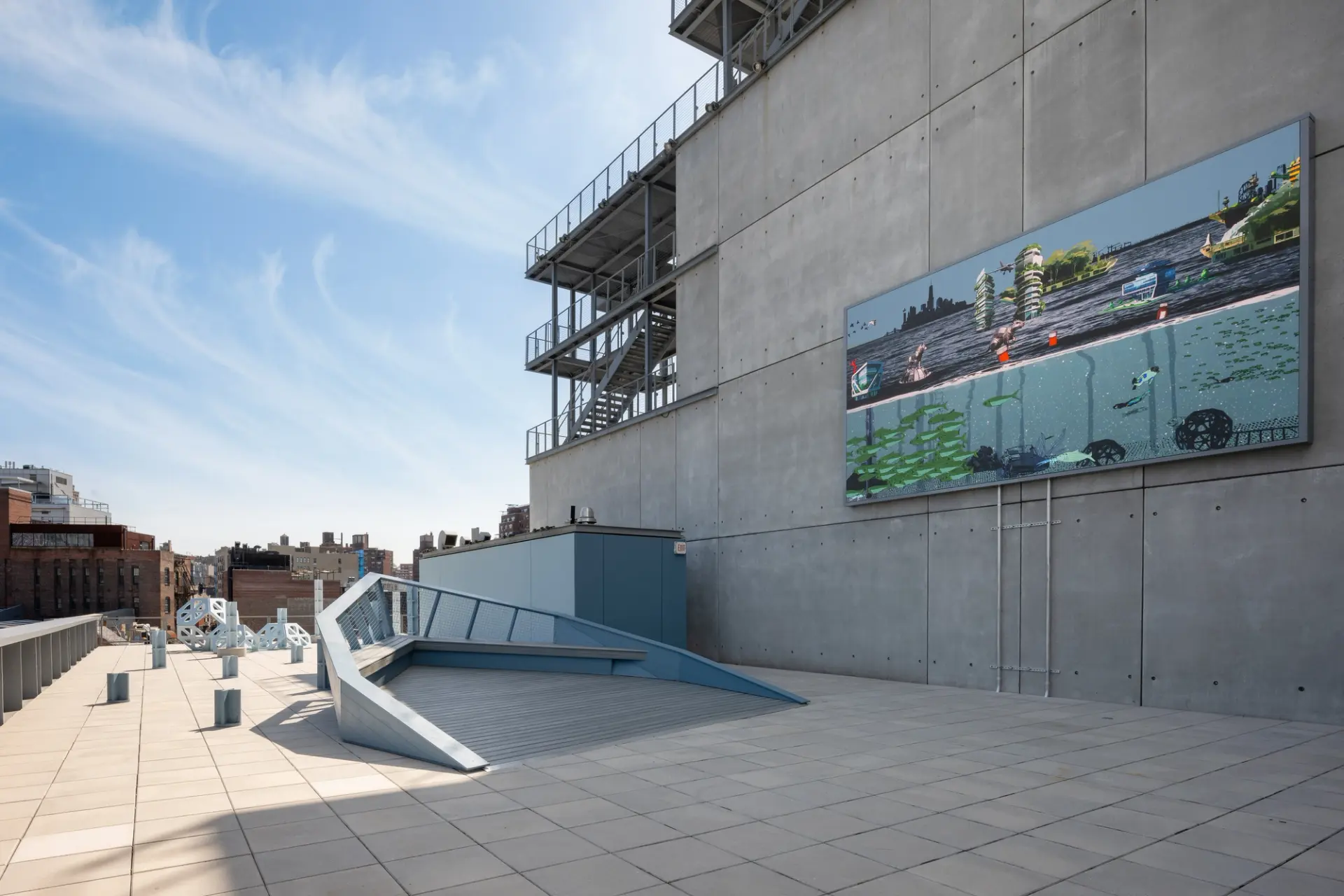
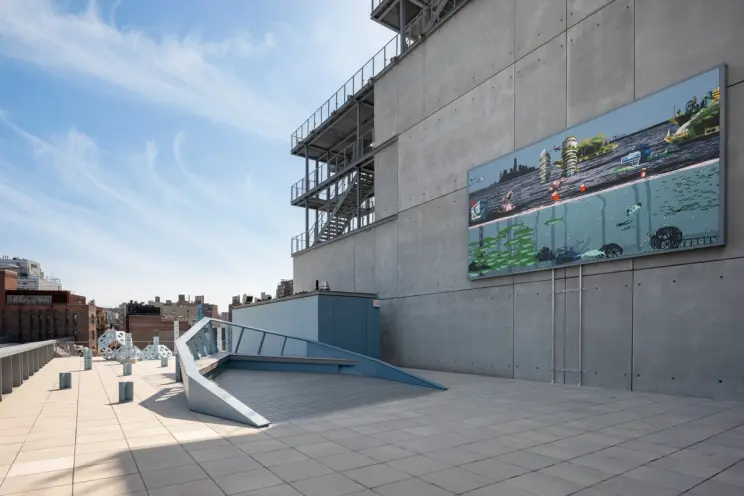
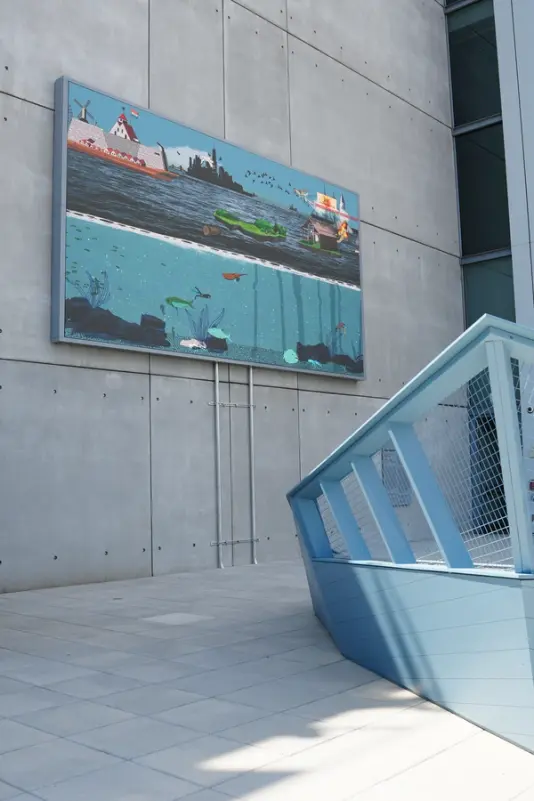
Set against this palimpsest of human and environmental histories, Marina Zurkow’s outdoor installation for the second Hyundai Terrace Commission draws deeply from the river’s currents. On opening night for The River is a Circle, I was repeatedly struck by the city’s lights flickering against the Hudson churning five stories below—I couldn’t help but look over my shoulder. Projected on the terrace wall, the large-scale animation is a split depiction of the river: above, the visible surface; below, the unseen life teeming beneath.
In the animation, eras blend and recombine, revealing the past, present, and imagined futures of the river ecosystem. The human and nonhuman agents of its transformation pass through the split frame. Above the waterline, geese may flock or drones may buzz overhead; on the surface, a Lenape dugout canoe, an oil tanker, or a speculative Solarpunk vessel may float by. Native plants like tobacco, once a vital trade good, drift onward, as do rafts carrying local historical characters—from a group of Dutch colonists to members of the ‘70s disco group, the Village People. Beneath the surface, the river is alive with animals: various beavers, six different species of eels, and four species of whales, creatures now so rare in the Hudson, they make headlines whenever they appear. Scuba divers swim among them, perhaps contemporary scientists searching the murky depths for clues. A QR code found on the artwork description panel next to the screen links to a glossary, where viewers can identify the hundreds of elements featured in the animation (also available on the Whitney’s website website ).
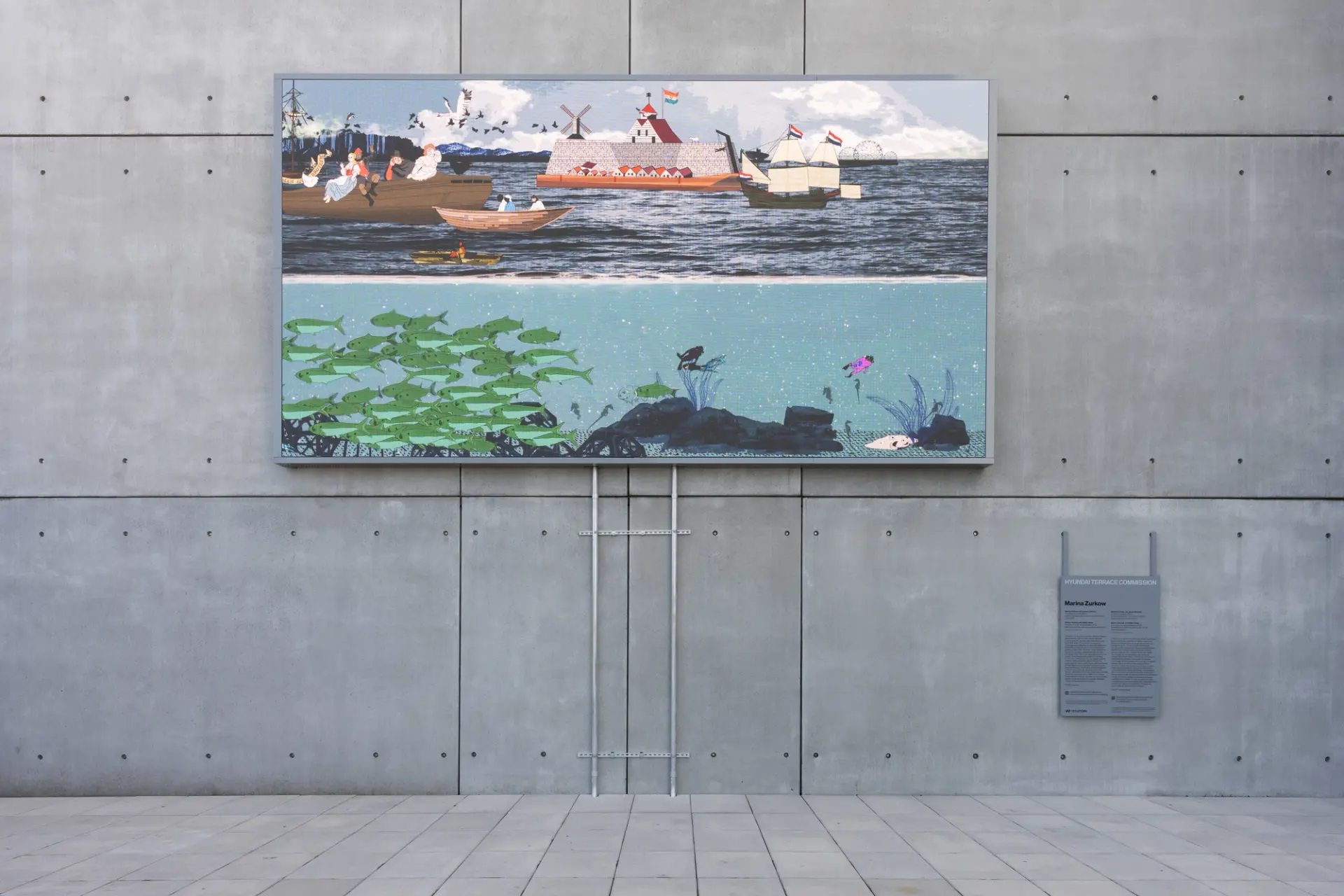
Hyundai Terrace Commission: Marina Zurkow: The River is a Circle, 2025. Photo: Filip Wolak
The River is a Circle is constantly changing, shaped by an algorithm that translates real-time climate data and affects the visual narrative accordingly. The result is a living artwork whose rhythms echo the immediate weather, tides, and seasons that the viewer experiences while standing on the terrace. For example, icons for high tide and low tide from the glossary appear on screen at moments when the Hudson River’s tide is at its highest or lowest points each day—the water washes up in the morning and flows out near dusk.
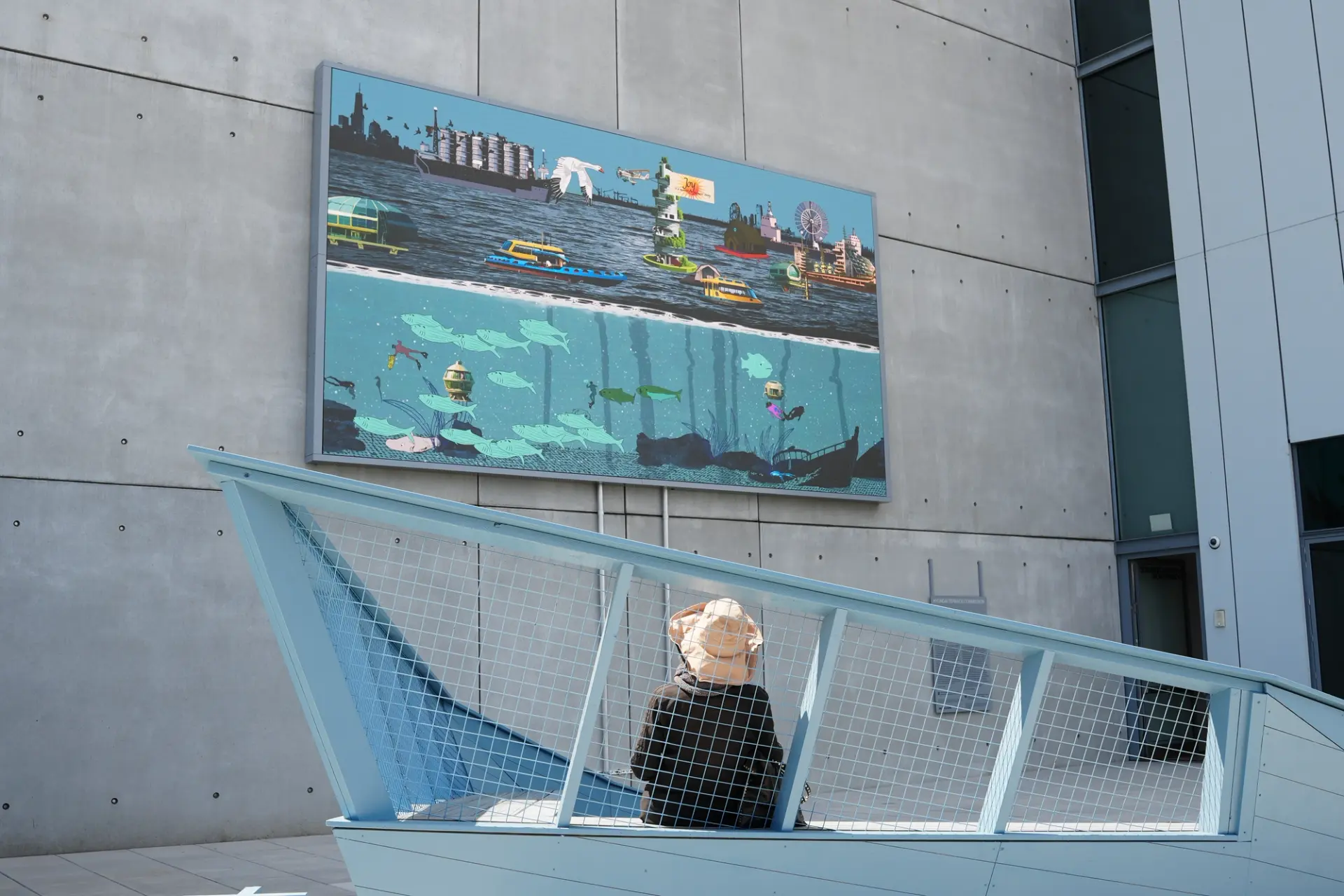
Hyundai Terrace Commission: Marina Zurkow: The River is a Circle, 2025. Photo: Katrina Peterson.
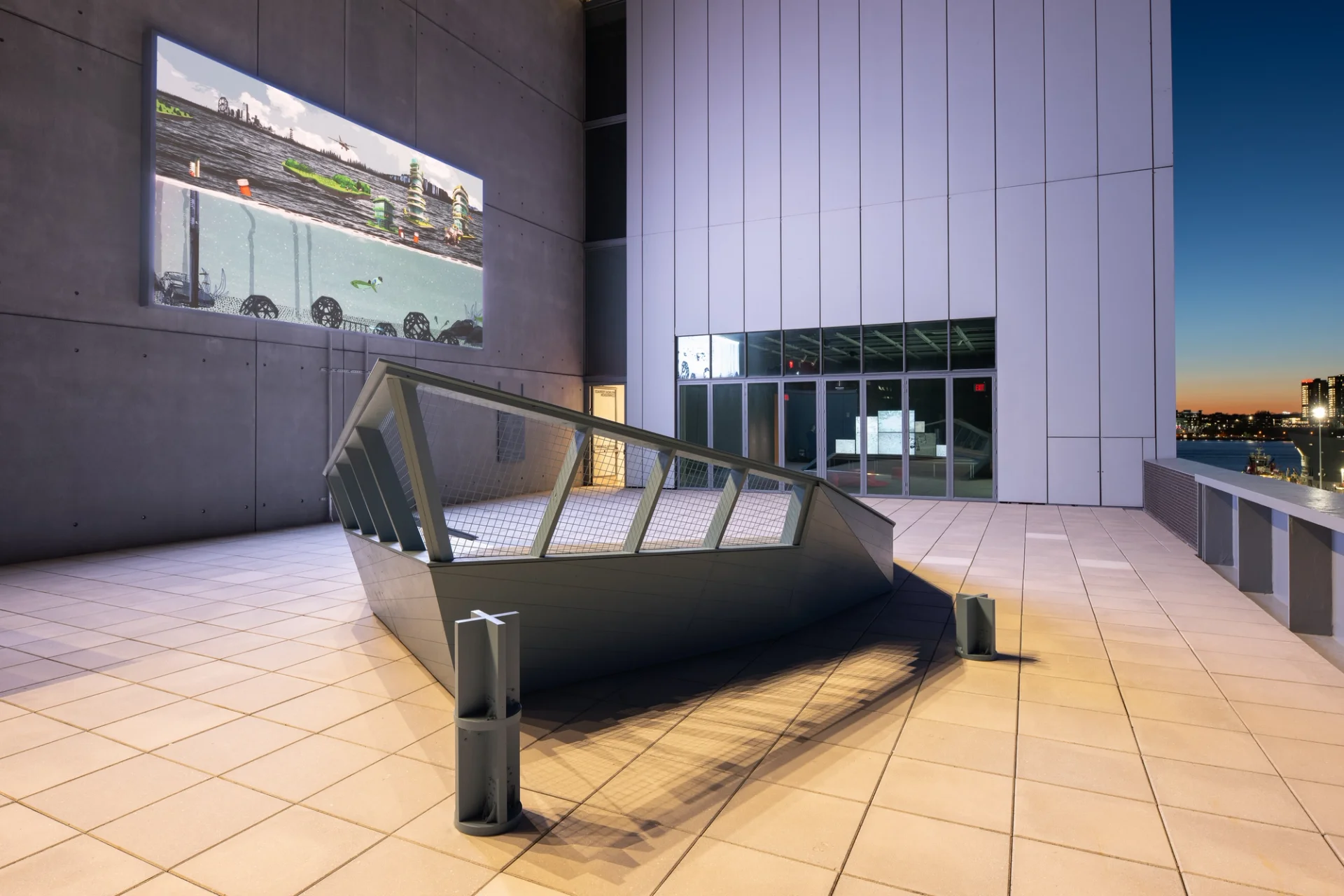
As with much of Zurkow’s digital work, the animations are hand-drawn by the artist, evoking a tension between artisanal craft and algorithmic logic. While data can map environmental and social change, it’s through artistic rendering and storytelling that we begin to grasp transformation across scales—from the microbial to the human to the planetary. To ground these stories in material reality, the terrace also features large sculptural oyster reef balls, structures used to restore damaged shellfish habitats like those once abundant in the Hudson. These physical elements are echoed within the animation itself, creating a larger sense of immersion.
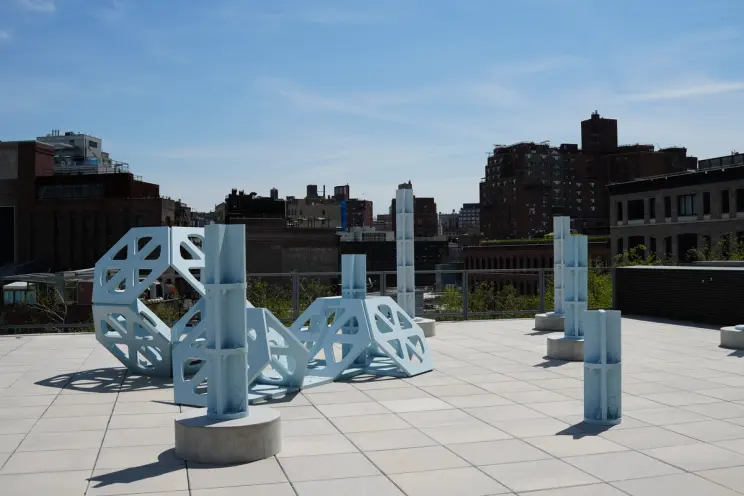
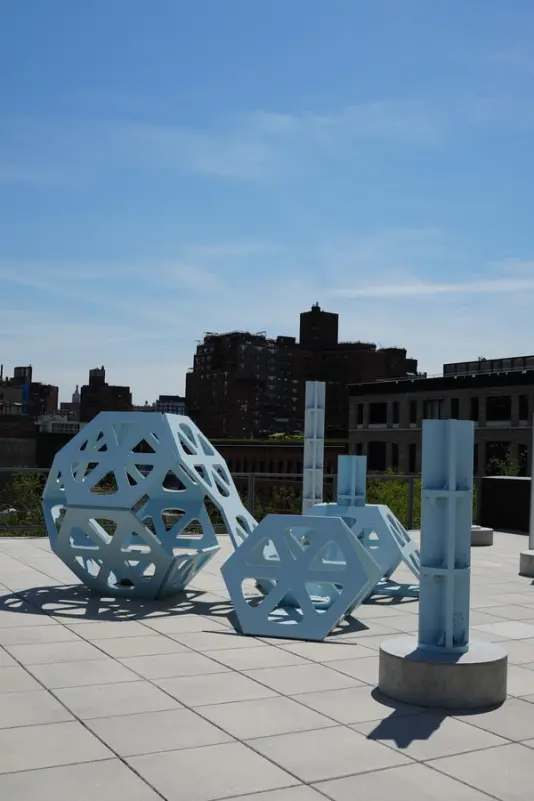
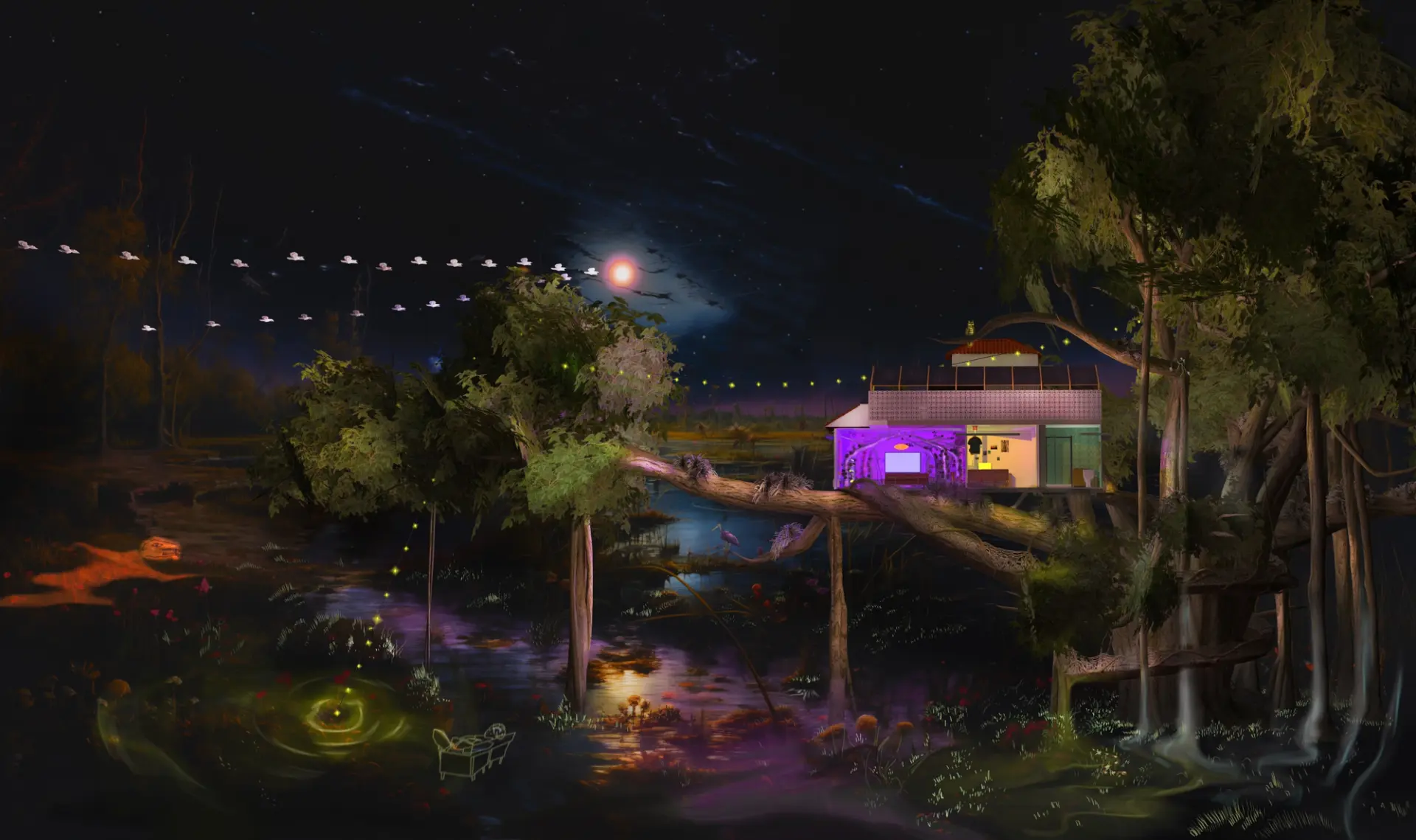
Zurkow created the piece in collaboration with media artist James Schmitz and architect Blake Goble, with research supported by the Hudson River Park Trust. Known for such collaborative, site-responsive work, Zurkow often stretches beyond the constraints of typical exhibition spaces—onto rooftops, into parks, and across online platforms. Her recent projects Does the River Flow Both Ways? and Hudson Follies (both 2022), also harness custom software to respond to environmental changes along the Hudson, which powers corresponding animations.
Each of these is a worldbuilding project in the fullest sense: blending narrative and system thinking, constructing speculative scenarios with their own internal logics. Waterways are especially fitting sites for this kind of investigation, as they are responsive and always in flux—the water’s edge is a threshold between the built and the wild, the visible and the submerged. Nowhere is nature portrayed as pristine or unbesmirched: it is hybrid and entangled with technology, infrastructure, and cultural memory.
Looking beyond the Hudson, Zurkow reflects on global waterways through the concept of “capitalist Pangea,” her term for the ocean as a planetary platform for constant traffic. In a post-Anthropocene world, humans treat the sea not as a boundary but as a site for capitalist exchange, mapped by trade routes, shipping lanes, and undersea cables. Though water covers 80 percent of the planet and is largely inhospitable to human life, people have transformed waters that once divided continents into a new site of resource extraction and economic exploitation. This impulse to turn the ocean into a continent is deeply colonial. Yet the name Pangea also gestures toward geological time, reminding us that oceans and continents are always in motion. Human time is only a sliver of that continuum.
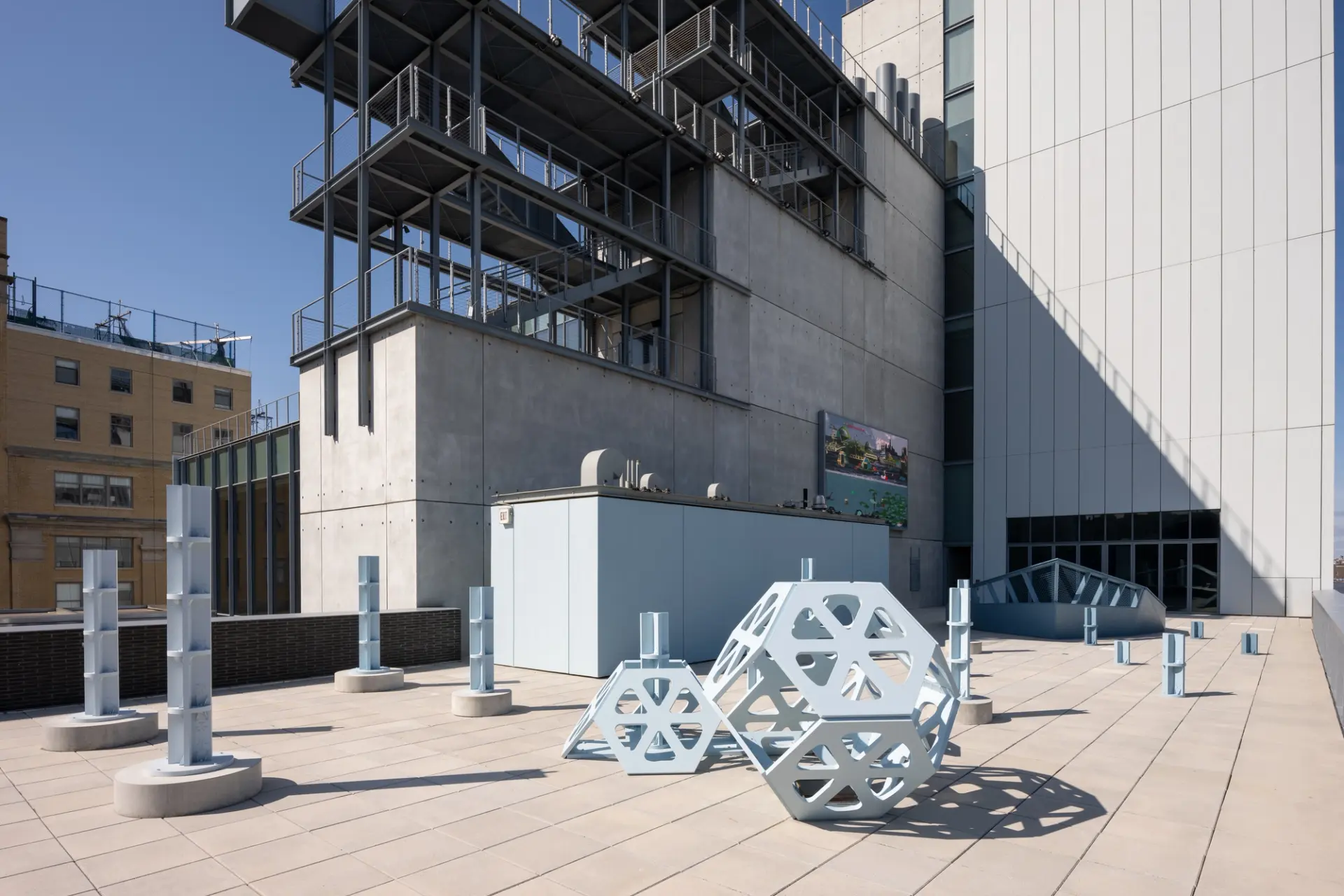
Hyundai Terrace Commission: Marina Zurkow: The River is a Circle, 2025. Photo: Filip Wolak.
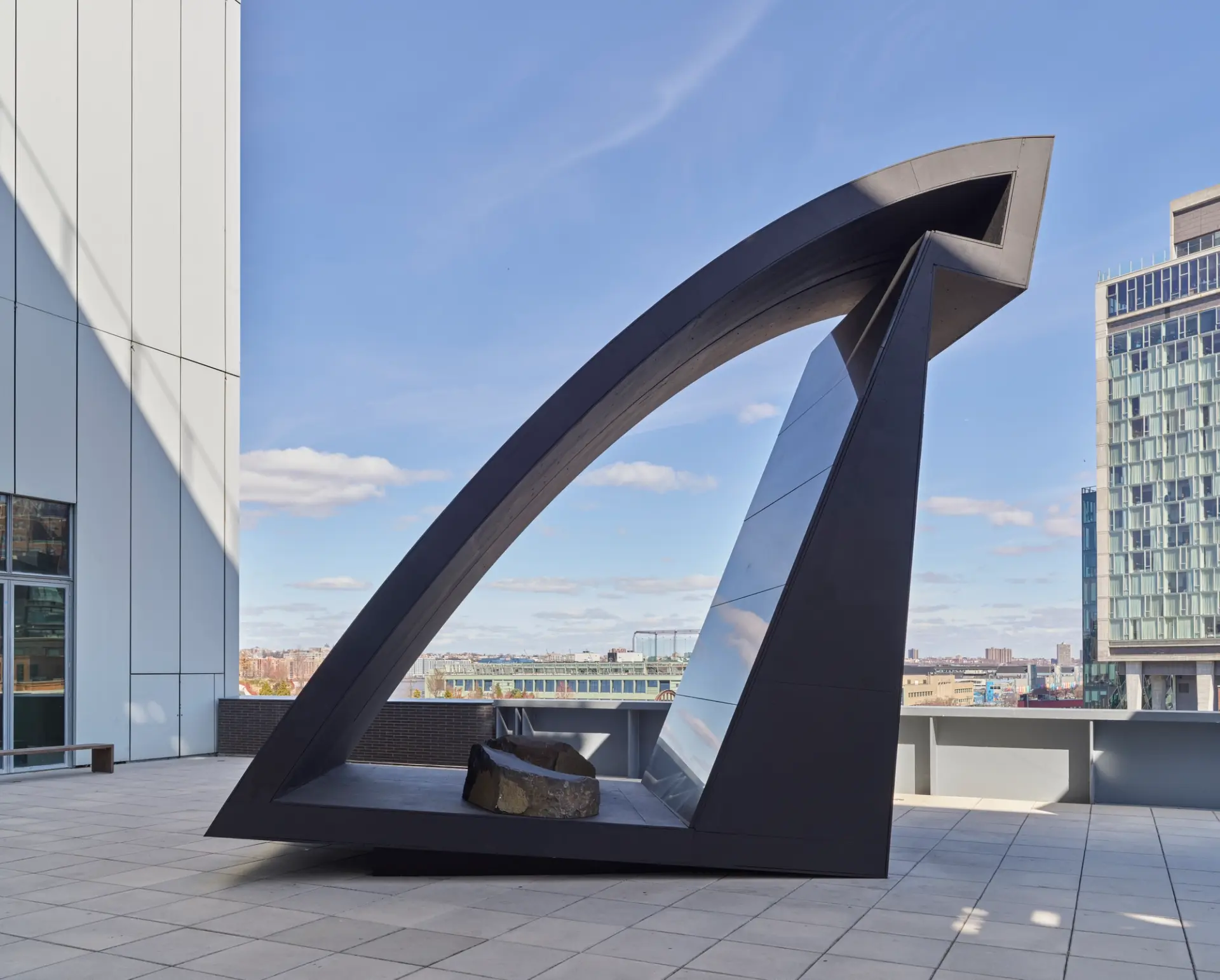
The fifth floor terrace of the Whitney is not a static backdrop but an integral part of the artwork’s conceptual frame. Positioning the animation on a wall that faces the city’s skyscrapers, water, and open sky, Zurkow situates art in dialogue with public space, ecological systems, and atmospheric conditions. The city itself is an ecosystem, and the museum is reoriented from a monolith beside the river to an entity in conversation with it, foregrounding the ecological and colonial entanglements that often go unacknowledged in cultural spaces. The museum sits within, not apart, from the urban ecosystem—the beauty is that the environment is not only depicted but felt in the very location where it’s installed.
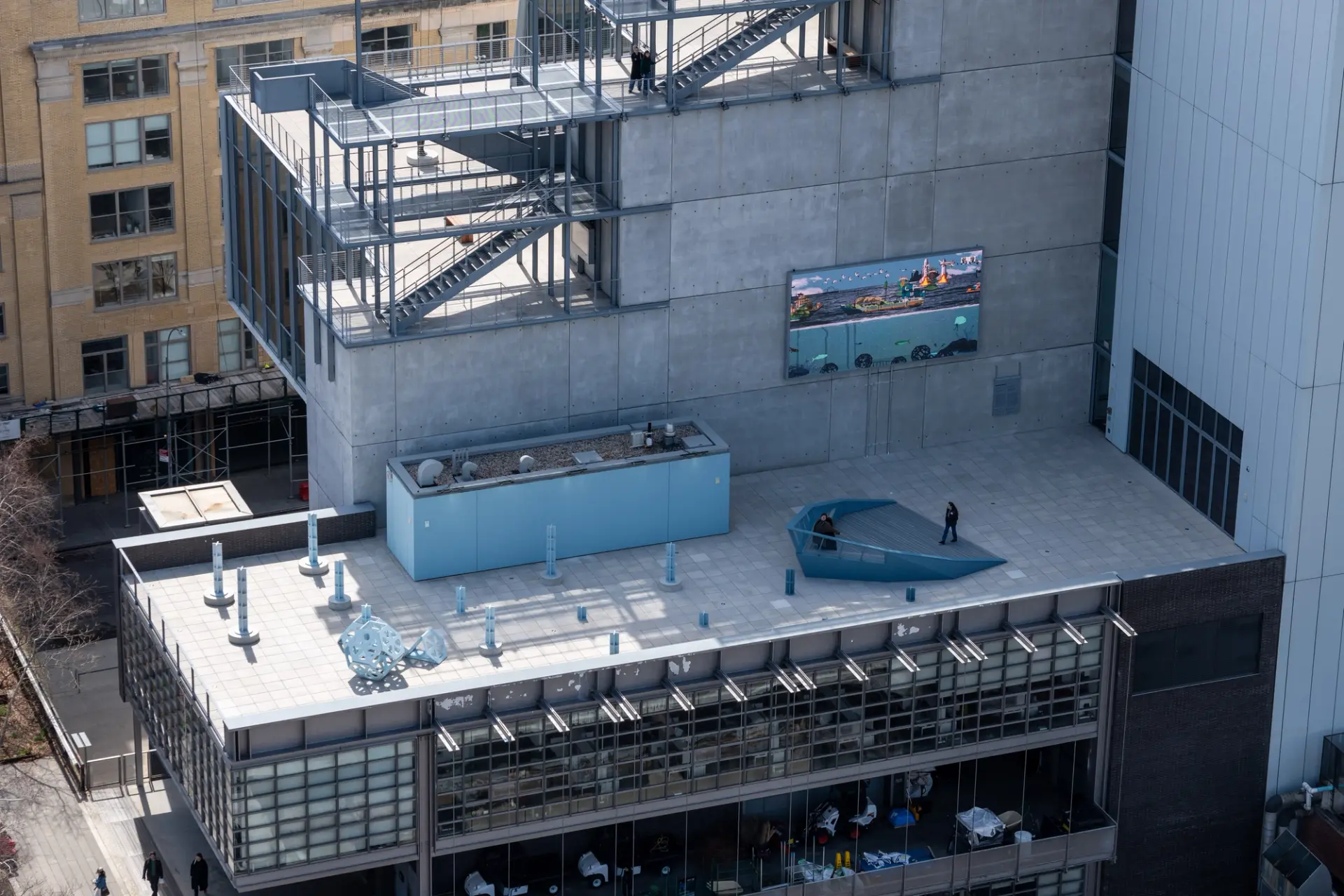
Hyundai Terrace Commission: Marina Zurkow: The River is a Circle, 2025. Photo: Timothy Schenck.
We think of rivers as flowing in one direction—with The River is a Circle, Zurkow prompts us to remember that all earthly waters flow into each other, circulating through cycles of evaporation, precipitation, runoff, and return. Nothing stays still for long. Perhaps, Zurkow suggests, the future is still fluid and changeable.