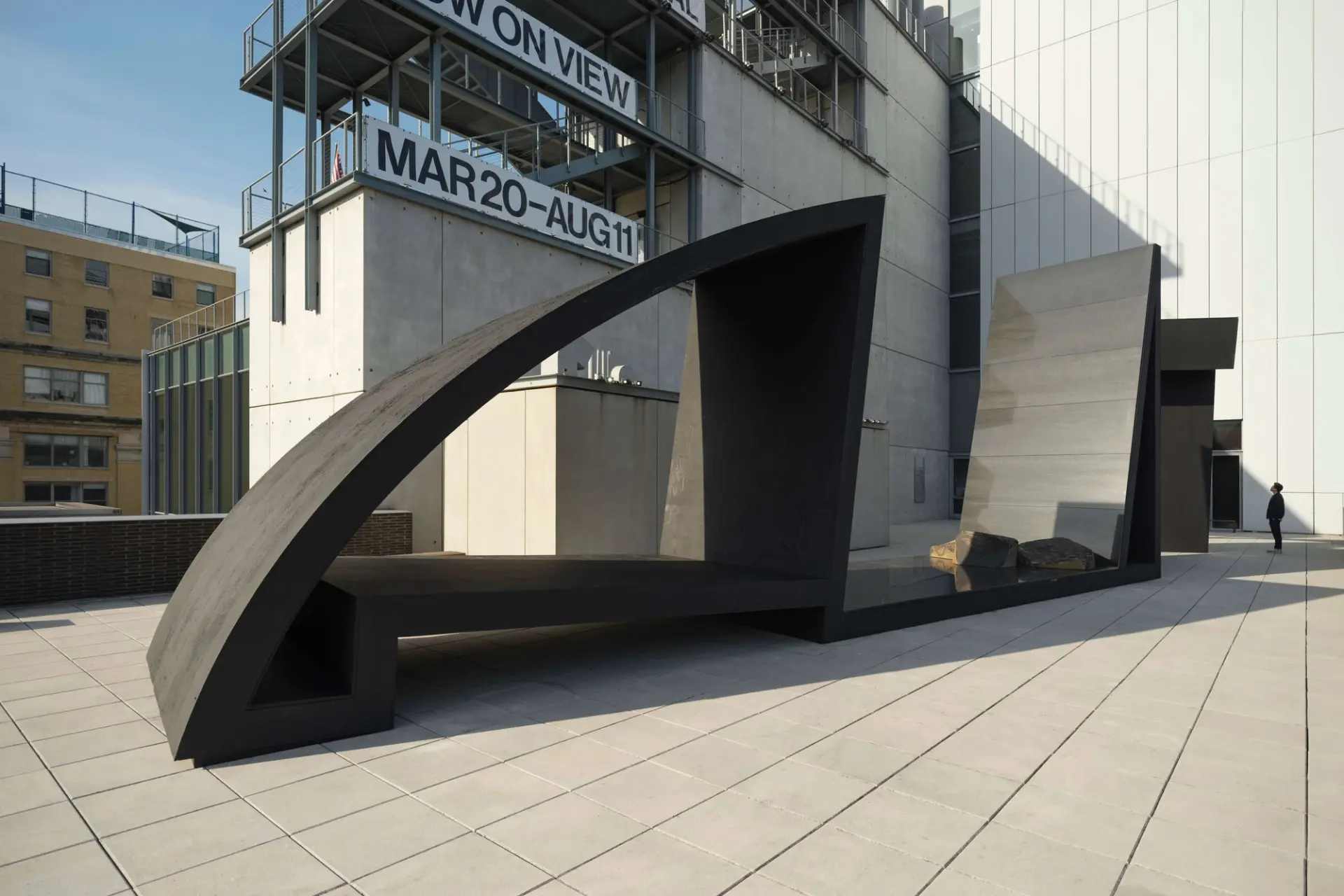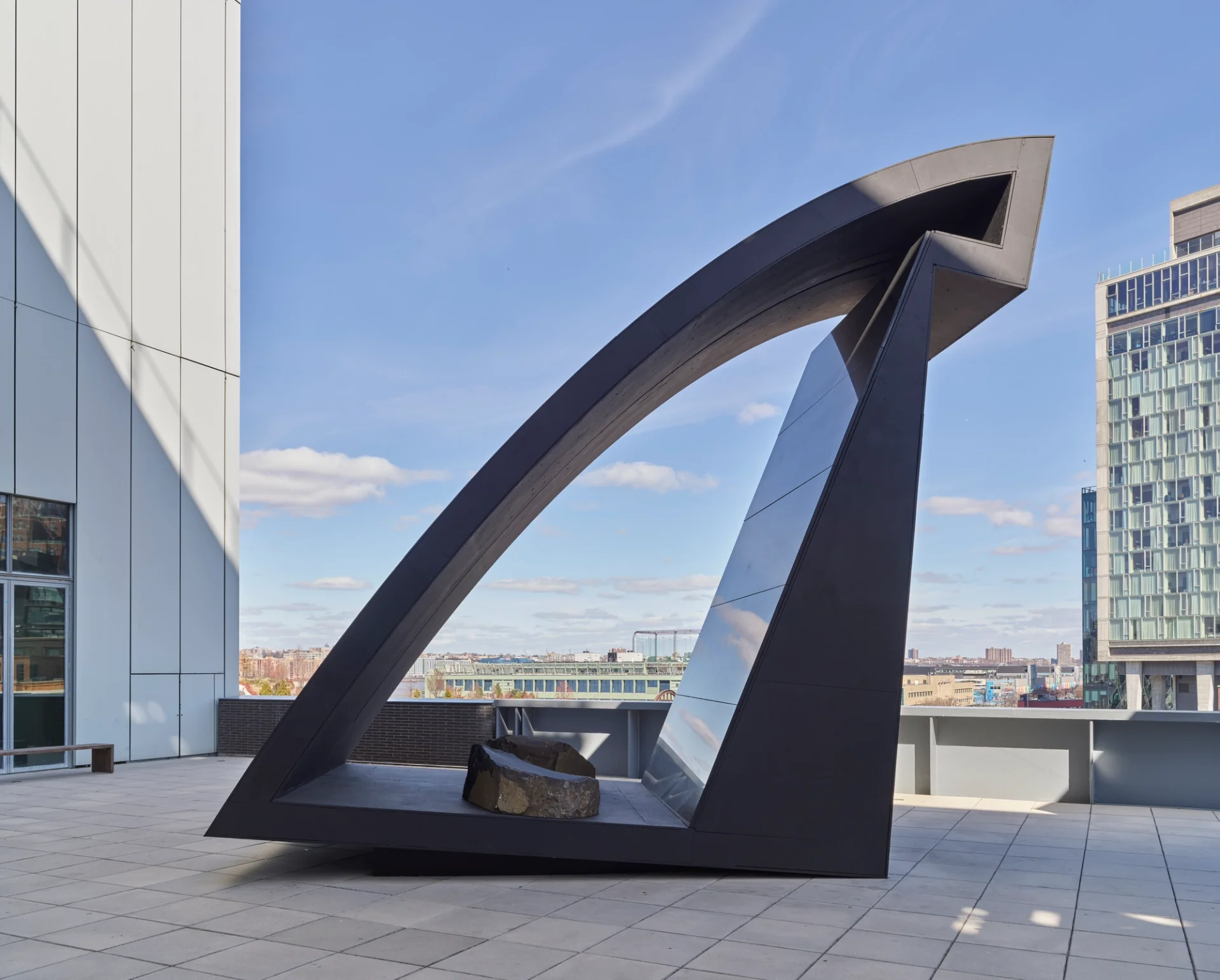
Hyundai Terrace Commission: Torkwase Dyson: Liquid Shadows, Solid Dreams (A Monastic Playground), 2024.
Photograph by Ron Amstutz. Courtesy of The Whitney Museum of American Art
Ladi’Sasha Jones reviews Torkwase Dyson’s Hyundai Terrace Commission at the Whitney Museum of American Art, a sculptural playground that invites visitors to engage with their surroundings through touch, movement, and reflection.
Artlab Editors: Part of a 10-year partnership between the Whitney Museum of American Art and Hyundai Motor, the annual Hyundai Terrace Commission gives artists and curators a platform to present site-specific works on the museum’s fifth-floor terrace. Accompanying the 2024 Whitney Biennial, for the inaugural Hyundai Terrace Commission, the Whitney unveiled Torkwase Dyson’s Liquid Shadows, Solid Dreams (A Monastic Playground), which invites visitors to touch, sit on, and imagine themselves in relation to the work and their surroundings. Writer, designer, and curator Ladi’Sasha Jones shares her experience with Dyson’s work, revealing the ways in which its evocations of play reflect the historic racialization of space, composition, and architecture.
Play is liberation. As a sustainable practice of learning and cultural production, play circulates as an urgent necessity for all. It helps us move between the intimations of our inner and outer worlds—bridging the imaginary and the real, the spatial with the corporeal.
Torkwase Dyson’s sculptural work Liquid Shadows, Solid Dreams (A Monastic Playground) evokes the social commons of play.
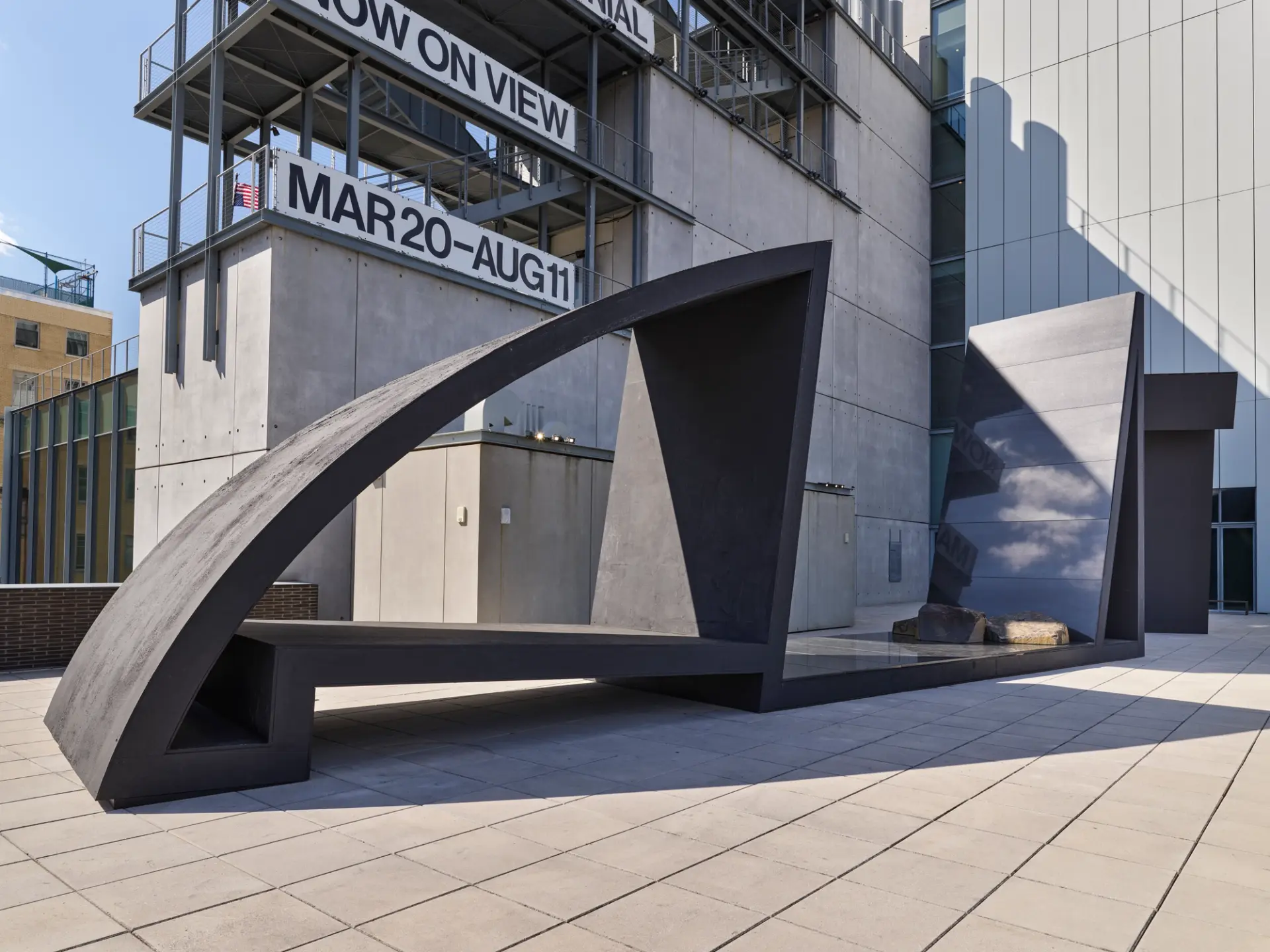
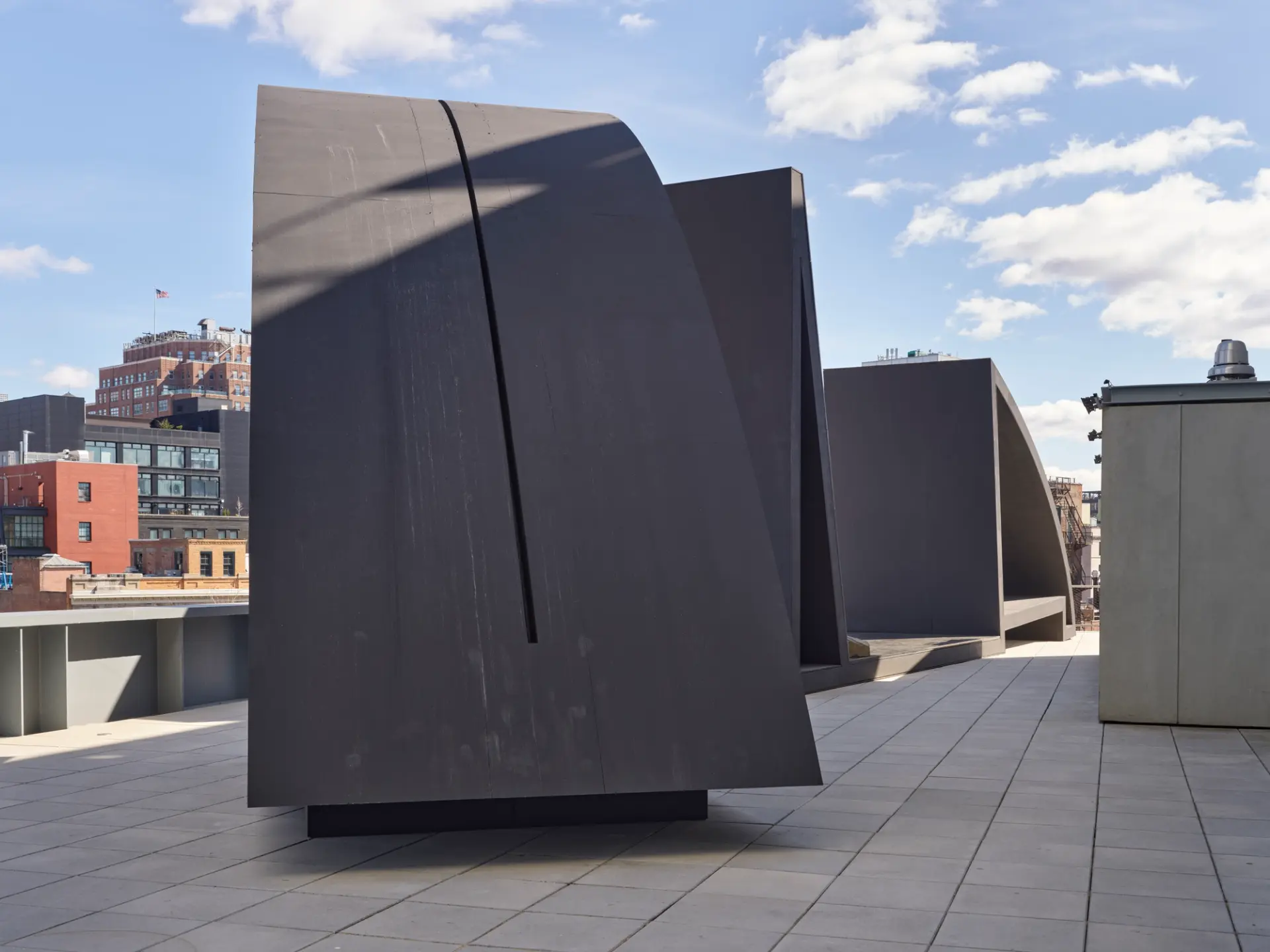
Presented on the fifth floor terrace of the Whitney Museum of American Art as the inaugural Hyundai Terrace Commission, the work’s open-air format places two monumental sculptures in relationship with urban light, air, and sound. With its tallest points reaching 25 feet tall, the scale of the installation is akin to an architectural pavilion site.
During my afternoon visit, the playground was sunbathed, illuminating the various textured surfaces of wood grain, sharp stone edges, and the smooth acrylic veneer. Upon entering the terrace, one encounters the smaller of the two sculptures which appear to tilt or bend toward the other. A diagonal cut stretches along the arc of the piece, opening to a shallow platform with two large stones and a vertical acrylic panel.
The larger sculpture consists of three parts: a triangular element, an elongated platform with three stones, and a duplication of the first structure with a twist in its orientation. The acrylic surfaces of this form create a mirror effect, reflecting the sculpture alongside the surrounding aerial plane of the built landscape.
With the open invitation for visitors to directly engage with the installation, people took advantage of the opportunity to interact with their bodies wherever possible. Visitors leaned up against the sides of the sculpture as they looked out toward the Hudson River just beyond the West Side Highway. Some lay across the stones, sat in the triangular alcove, walked across the open platforms, or knelt to peer beneath the raised sections of the piece.
As folks moved through the playground, I witnessed how they extended the parameters of viewership, engaging their bodies to explore the work through touch, and through exploratory movements of wandering and stillness. The environmental flows between people and the outdoor cityscape caused the installation to flicker with spontaneity.
Hyundai Terrace Commission: Torkwase Dyson: Liquid Shadows, Solid Dreams (A Monastic Playground), 2024.
Photograph by Ron Amstutz. Courtesy of The Whitney Museum of American Art
Set in the context of the 2024 Whitney Biennial, Liquid Shadows is among several installation works that gesture toward similar conceptual abstractions of the body and space. Caroline Lazard’s piece, Toilette (2024), investigates domesticity through healing rituals. The installation features a dozen medicine cabinets filled with Vaseline, representing its pervasive presence in domestic life. These cabinets, displayed along the floor as a network of mirrored forms, volumize the reflected presence of the material and surrounding bodies.
Meanwhile, a player piano takes center stage in Nikita Gale’s piece, TEMPO RUBATO (STOLEN TIME) (2023-24). The piano delivers its score silently to highlight the absent body and the legal fragility of performance labor and authorship. Both Lazard and Gale’s works invite the audience to engage with the corporeal aspects of production, bringing acts of care and performance into the public sphere.
Hyundai Terrace Commission: Torkwase Dyson: Liquid Shadows, Solid Dreams (A Monastic Playground), 2024.
Photograph by Ron Amstutz. Courtesy of The Whitney Museum of American Art
Liquid Shadows expands on Dyson’s ongoing commitment to examining Black geographical and ecological conditions. A key component of this focus is her formulation of “Black compositional thought” and its hyper shapes, as articulated by the geometric language that is expressed across Dyson’s work: the curve, triangle, and rectangle.
“My working term considers how paths, freeways, waterways, architecture, and geographies are composed by black bodies and how properties of energy, space, and objects interact as networks of liberation,” said Dyson in a 2019 interview with the writer and curator Monique Long. “It’s trying to negotiate what it means to have those multiple, radical conditions in space, particularly in this country, for brown and black bodies.”
Dyson’s ongoing research on Black spatial histories of liberation informs the geometric system she paints, draws, and sculpts. Material infrastructure is incorporated to complement and give greater meaning to her shapes: the reflective motifs represented in Liquid Shadows signifying the waterways connected to Black life, for example. The repetition of this geometric language sharpens these hypershapes instead of blurring them, enhancing their connection to spatial memory and justice.
We all carry architectural memories that are activated by our orientation to place and built forms. During my museum visit, I recalled the rooftop school playgrounds of my childhood across the city. Returning to the memory of these constructed sites for play in the context of Dyson’s work, I was prompted to reflect and act on my own impulses around leisure, touch, and rest.
Sharing the art playground with other visitors, I felt a desire to respond to the geometry by bending my spine or folding a limb along the curved surfaces. I joined others as they stood inside the structure, stretching and gazing up towards the sky. I waited for the chance to use the architecture to lounge in its angular shadows and take a break in the breeze.