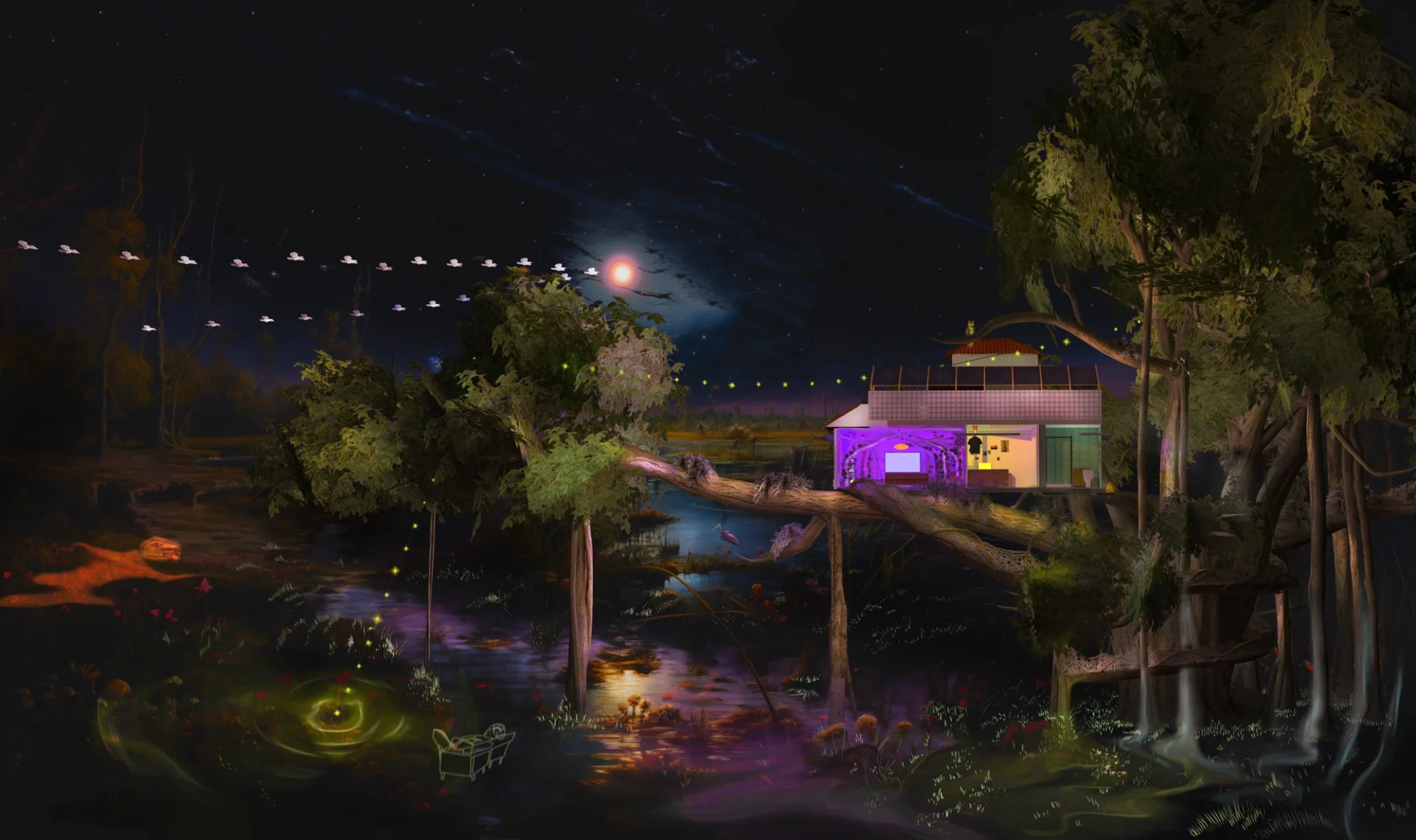
Lee Pivnik, The Living Room, 2023. Digital Rendering.
Courtesy of the author.
A kaleidoscopic look into the design process of Symbiotic House, a social sculpture for climate care and environmental repair in Florida and beyond.
Artlab Editors: For the first Ecological Horizons, Artlab Editorial’s new series, artist Lee Pivnik takes us on a meandering journey through South Florida’s ecosystems and the greater landscape of artists responding to climate collapse. A fifth-generation Floridian, Lee’s own response comes in the form of an ongoing social sculpture called Symbiotic House, which offers a prototype for how art might allow us to reimagine our relationship to the natural world beyond a framework of extraction.
Floating toward the exit of a steel-walled tunnel, a lush garden under a geodesic glass dome comes into sight. Over the speakers, a man’s voice with a transatlantic accent booms:
“How will we meet tomorrow’s growing needs for food production yet still respect the needs of the land? Some of the answers are being discovered just ahead. To help us maintain these carefully controlled ecosystems and for your safety, please remain seated in your boat at all times.”
I’m eight years old, and I’m at Disney World’s EPCOT in Florida.
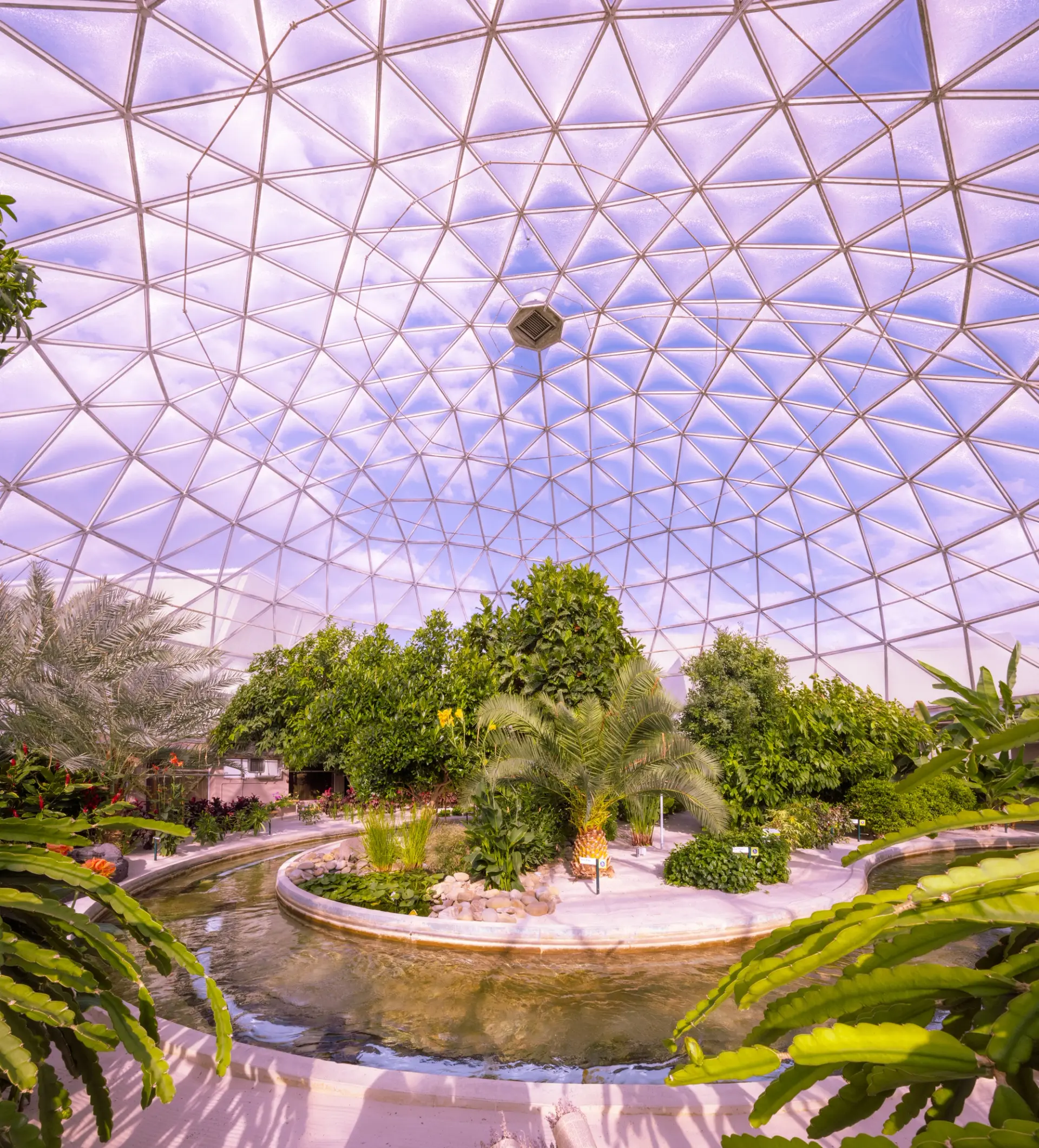
A manufactured river curves through a greenhouse at EPCOT’s “Living With The Land” ride. Bay Lake, Florida, 2023.
Photo by the author.
Originally envisioned in 1966 by Walt Disney as an “Experimental Prototype Community of Tomorrow” (E.P.C.O.T.), the theme park has become a landmark of Florida Futurism. Disney’s initial vision for EPCOT was a fully functioning city that showcased how cutting-edge technology could improve people’s quality of life. None of that context matters to eight year old me, however, as our boat continues through the manicured greenhouses that make up the “Living With The Land” ride. On this immersive journey through EPCOT’s “Sustainable Agriculture Production and Research Center,” plants fly through the air on a conveyor system that sprays their exposed roots with nutrient-enriched water. Our boat passes freshwater tanks of bass, tilapia, and catfish as we learn how water from their tanks fertilizes plants throughout the system.
Florida Governor Ron DeSantis was right to fear the potentially radicalizing power the potentially radicalizing power that Disney World has on children. At EPCOT, I was exposed to the power of integrated systems thinking and have been envisioning an agro-ecological, socio-transformational future for Florida ever since.
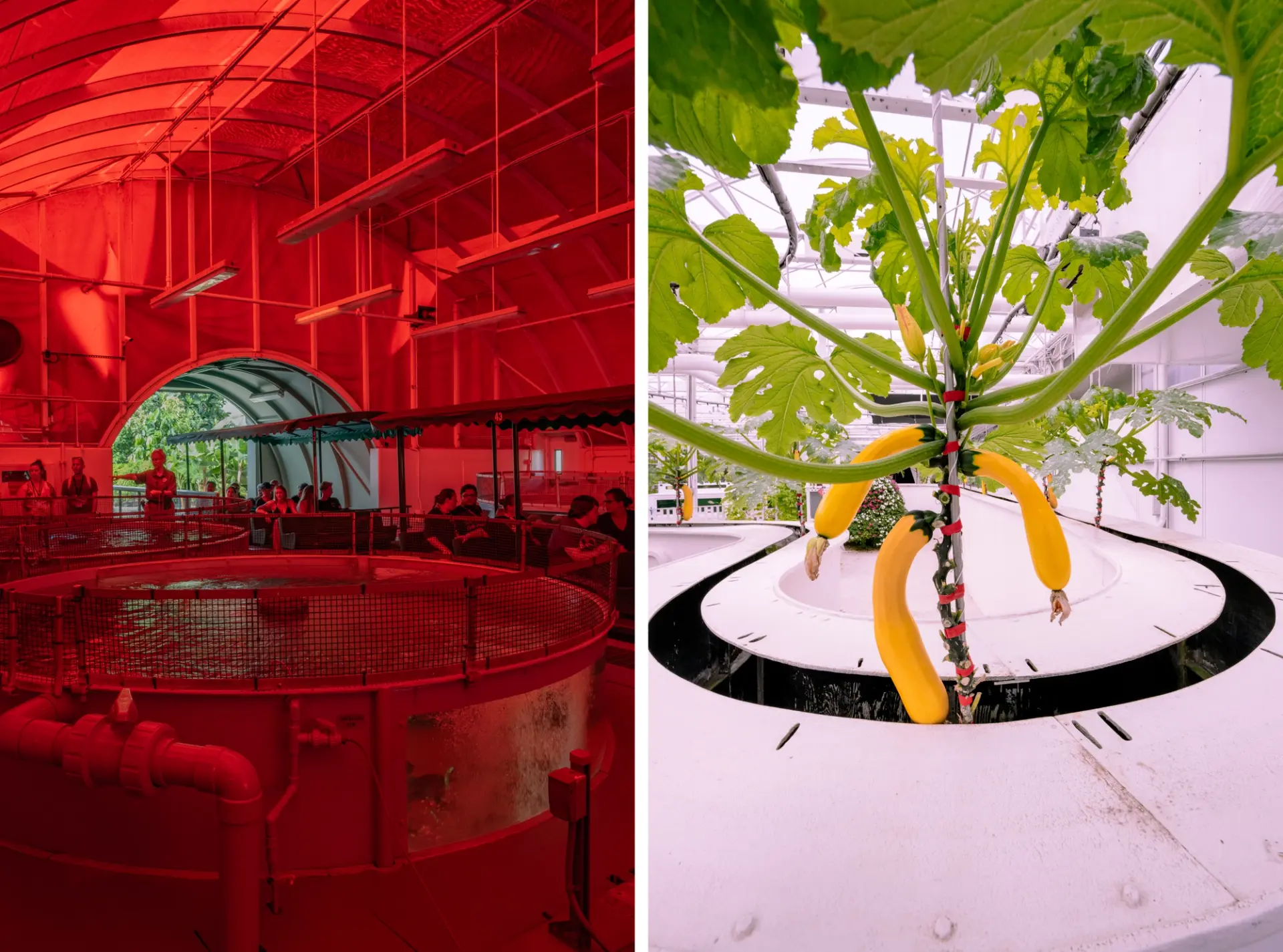
On EPCOT’s “Living With The Land” ride, visitors are introduced to futuristic agricultural practices, like aquaponics (left) and aeroponics (right). Bay Lake, Florida, 2023.
Photos by the author.
In recent years, this early family vacation has informed much of my practice. I’ve worked as an artist in residence at Biosphere 2, another futuristic Earth-systems research facility in Oracle, Arizona, that’s concerned with agricultural production and space exploration.
I’ve also co-directed a project called the Institute of Queer Ecology the Institute of Queer Ecology (IQECO) since 2017. A collaborative organism that creates artworks, exhibitions, and publications, at IQECO, we believe queer communities are uniquely positioned to lead on climate adaptation. On an individual level, queer life is mutable: we understand change and transformation in intensely personal ways. On a collective level, queer community is mutualistic: it is in-contact, relational; a space of eccentric economies and mutual support, of found families and connection. Through collaborative projects, IQECO aims to share this world of transformation and cooperation as a framework for addressing environmental issues together.
In 2021, this framework guided me in developing a long-term social sculpture called Symbiotic House. Over the past two years, the focus of Symbiotic House has been researching and developing adaptive architectural solutions to Miami’s environmental precarity, and designing a “multi-use space for multi-species survival.” Currently, I’m working on the first prototype dwelling.
Why Florida?
I’m designing the first of these Symbiotic Houses for South Florida, specifically, for reasons both strategic and personal. As the region navigates an intersecting climate and affordability crisis, it’s positioning itself as a “living laboratory” for adaptation, but must do so in a way that benefits both human and nonhuman inhabitants.
Symbiotic House is grounded in my experience as a fifth-generation South Floridian. I’m guided by stories my grandmother tells me of growing up in Key West in the 1930s, where she’d forage the trees in empty lots to pick mamoncillos and guavas. On drives, she’ll point to a power line and recall that “Kingfishers used to be here,” marking the changes in the ecology and cityscape over her lifetime. Through the stories and memories of my family’s history here, I understand this city in ways I could never replicate elsewhere.
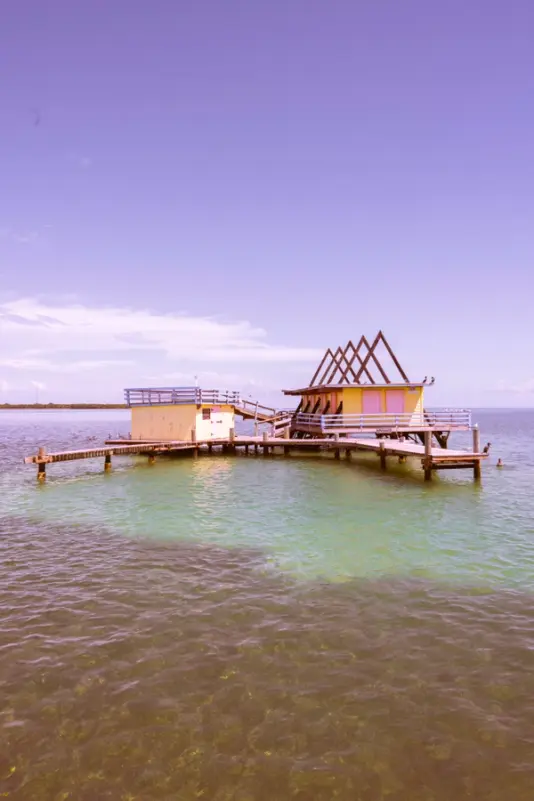
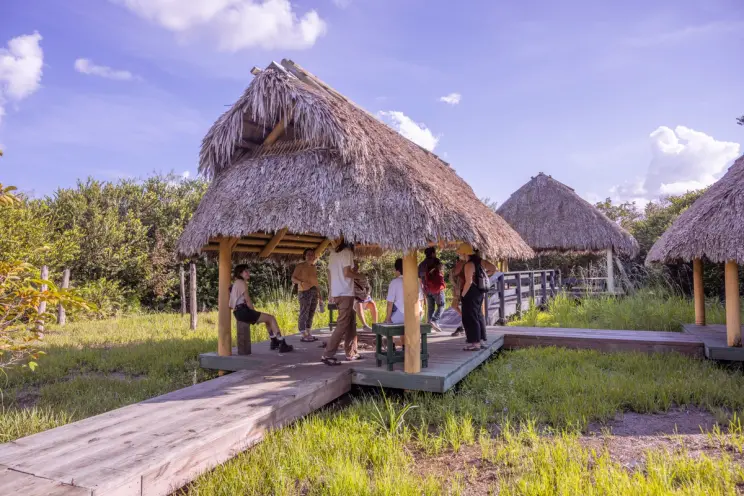
Miami is also ecologically unique among major American cities. Situated between two national parks, to the west stretches the expansive Everglades, known to the indigenous Miccosukee and Seminole tribes as Kaahayatle (Shimmering waters), and Pa-hay-Okee (Grassy Waters). It is also known colloquially across Florida as “The River of Grass.” To the east, hugging the shoreline, Biscayne Bay Biscayne Bay can appear just as endless. With its submerged seagrass meadows, it presents a very different aquatic grassland from the Everglades, punctuated by tracts of coral reefs.
Early in the pandemic, I began to go for afternoon walks along the bay. One hot mid-August afternoon, I arrived to an overwhelming putrid smell. It was the result of a massive “fish kill,” an anoxic event where a combination of factors (seagrass die-off, fertilizer runoff, extreme heat) combined to lower the oxygen available in the bay’s waters. Pufferfish floated on their backs across the bay’s surface. On the shore lay strange, soft, sun-baked creatures, many of which I had only ever seen images of.
The relentless loss of biodiversity is always hard to see, but this was different—it was like witnessing mass extinction. According to a report compiled by Miami Waterkeeper Miami Waterkeeper , this particular fish kill was the largest ever recorded in Biscayne Bay, affecting over 27,000 marine creatures from 56 species. The Everglades is a nutrient-poor ecosystem, and these added fertilizers, particularly phosphorus, can catalyze algae blooms through a process of eutrophication. Anoxic events like this are becoming commonplace across the world as fertilizers (both agricultural and residential) impact water quality.
In the last 200+ years, Florida has experienced rapid and profound changes. Much of the Everglades, once defined by the shallow, seasonal flow of water over it, was drained and developed. This flipped the dominant relationship between Floridians and their environment from one of mutual respect to one of subjugation and control, reflective of how settler colonialism exerts power over people and places globally. Symbiotic House is an exploration of what a return to mutuality in South Florida would look like today.
Everglades Minimalism and High-Modernist Engineering
Over the decades, the US Army Corps of Engineers has terraformed South Florida, mainly to control the seasonal flows and floods of freshwater from Lake Okeechobee, the “Liquid Heart of The Everglades.” The broad southern flow of water out of the lake sustains the region’s sawgrass marshes and cypress swamps, and replenishes the Biscayne Aquifer that Miami depends on. Despite these gifts, this wet wilderness was subjected to an engineered flood control system of canals, levees, flood gates, and pumps so that suburbs could be constructed in the historical floodplain and the water could be put to work for irrigating the newly arable muck soils directly south of the lake, designated as the Everglades Agricultural Area (EAA).
Dr. Zachary A. Caple, an environmental anthropologist based out of Aarhus University in Denmark, sees these efforts as having forced a design methodology of “High Modernism” onto the ecosystem. High Modernism is a useful framework for understanding an engineered Everglades. The techno-utopian ideology is marked by a rigid belief that advancements in science and technology can render complex environments in understandable ways so that nature can be conquered and transformed to meet human needs, disregarding the socio-ecological context of the landscapes it consumes.
I met Dr. Caple last year through a “Swamp Ecologies” seminar at the Institute of Contemporary Art Miami “Swamp Ecologies” seminar at the Institute of Contemporary Art Miami . His research investigates the human-altered phosphorus cycle as an agent of multi-species landscape change in Florida. As a result, he’s deeply critical of the High Modernist methodology that rationalized the degradation of this ecosystem but sees possibilities for a better, more sustainable future.
“The major barrier to Everglades restoration lies with the EAA—the 700,000-acre sugarcane production zone that fractures the historic connection between Lake Okeechobee and the 'glades,” Dr. Caple told me. The zone he’s referring to is dominated by ‘Big Sugar,’ a handful of powerful sugar-producing companies that have an outsized influence on how the land is used.
“Everglades advocates have dreamed of a state buy-out of Big Sugar and restoring sugar fields to wetlands,” he continued. “This is an important dream, one that takes seriously the possibility of reversing the damage of High-Modernist engineering of the last century. But it is also a dream that neglects the place ties of local farm communities and the potential for less violent forms of agriculture.”
For Rev. Houston R. Cypress, High Modernist engineering decisions have led to an aesthetic experience he calls “Everglades Minimalism.” An artist, poet, filmmaker, water rights activist, and member of the Miccosukee Tribe of Indians (Otter Clan), Houston has also advised my research with Symbiotic House over the past two years.
“What I mean by minimalism is that, while I’m still able to find the beauty in the land today, my parents and grandparents, everybody, would see so many more animals, so many more trees,” he told me.
I suggested that his family, in contrast, has memories of “Everglades Maximalism.”
“Yeah, Maximalism!” he responded. “Baroque, extravagant, and able to support all that. It’s bereft these days. Beyond how the degradation of the water quality is causing so many of these consequences, now you have invasive species like the pythons eating up everything—all the little animals, they’re not there either. That’s the minimalism of things. It’s still beautiful and moving, and you can still find certain plant medicines and things like that out there, but it’s just so quiet.”
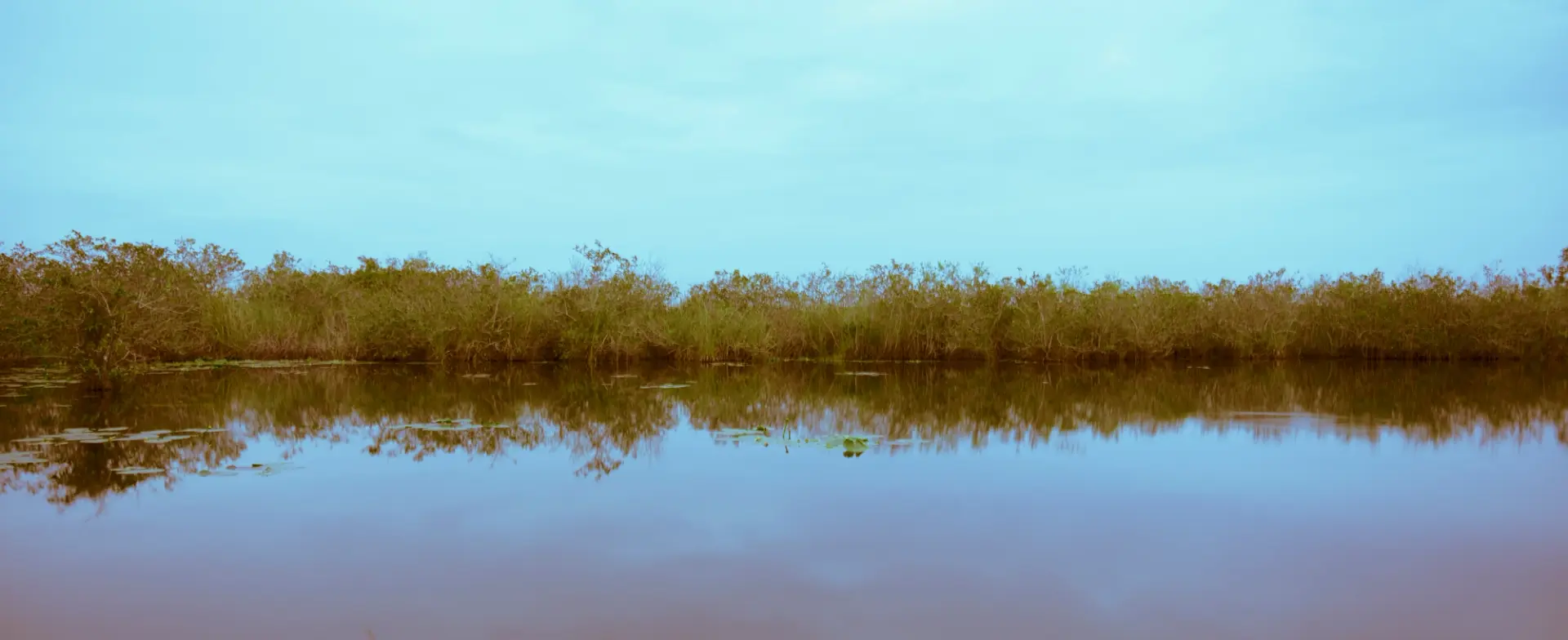
A quiet panoramic view of Everglades National Park from Anhinga Trail, 2023.
Photo by the author.
In 2000, Congress authorized a massive plan to restore the hydrology of the Everglades in an attempt to move away from the disastrous legacies of High Modernism and Everglades Minimalism. The Comprehensive Everglades Restoration Plan (CERP) is often described as the largest environmental restoration project in the world. However, 24 years later, its implementation has been exceptionally slow, complicated by the enduring power of Big Sugar.
Art in the Anthropocene
In her book, The Mushroom at the End of the World, author Anna Lowenhaupt Tsing describes how the rise of the European colonial plantation paved the way for our current proposed Anthropocenic epoch:
“In their 16th- and 17th-century sugarcane plantations in Brazil, Portuguese planters stumbled on a formula for smooth expansion. They crafted self-contained, interchangeable project elements as follows: exterminate local people and plants; prepare now-empty, unclaimed land; and bring in exotic and isolated labor and crops for production. This landscape model of scalability became an inspiration for later industrialization and modernization.”
In describing this colonial model, Tsing explains industrial agriculture as a threefold process of alienation based on severing the connections between crops, labor, and native biodiversity. These systems persist not just in South Florida, but around the world, making our planet increasingly unlivable. Florida is an ideal case study for a just transition because of the strange coalitions one must build here to make progress happen. In the words of early Everglades conservationist, Marjory Stoneman Douglas: “The Everglades is a test—if we pass, we may get to keep the planet.”
So, how do we move from such a broken system towards one that mutually supports people and the planet? The crux of it comes from what we value, what we care for, and how we spend our time and attention.
“I look back to what my ancestors relied on in the face of the United States’ war against them, the campaign against them to kill everybody off,” said Houston. “What they did was rely on their cultural and spiritual practices, the plant medicines, and the healing traditions that sustain us. So for me, what that means is a return to community, a return to celebratory practices, a reliance on healing, and definitely the arts.”
What Houston was vocalizing is a belief shared by many artists: that art itself is a spiritual practice akin to medicine. “That’s a really good strategy to rely on when we’re suffering like this,” he continued. “Like, let’s make art together, but the kind of art that can change the situation—socially engaged and politically astute.”
As an artist working to cultivate mutualistic relations between the city and the swamp, I’m drawn to relational art movements like social practice and regenerative land art as guides. Regenerative land art is a hybrid practice with roots in the land art movement, but is categorized by its active mission of environmental restoration.
Though Florida has its own unique history with land art, from Ana Mendieta’s ephemeral, bodily earthworks to Robert Smithson’s experimentations with a Spiral Jetty composed of mangrove trees, some of the best known and most successful examples of regenerative land art can be found elsewhere in the US.
My favorite of these is Mel Chin’s pioneering Revival Field (1991), a sculpture designed and planted on the “Pig’s Eye Landfill,” a superfund site in St. Paul, Minnesota, that was polluted with heavy metals. Chin sought to test whether plants could be used to “sculpt” the contaminated site, carving away at its pollution like a traditional sculptor carving marble. The resulting artwork proved the viability of using plants as bioremediators to remove soil toxins.
Presently in Los Angeles, Lauren Bon and Metabolic Studio are working on their own form of bioremediating sculpture, “bending” the LA river by diverting a portion of the water that the city would otherwise send out to the ocean, treating it through a recreated native wetland, and redistributing it to irrigate local parks. As part of their process, they’re tapping into the subterranean river beneath the concrete-encased surface water and have retrieved seeds that were buried when the river was first engineered. Their studio is just now beginning to bloom with flowers that haven’t been seen in the city in over 80 years.
As an extension of regenerative land art, I’m also drawn to ways artists are experimenting with how we might literally live our climate politics. In California, artists like Andrea Zittel and Fritz Haeg have developed their own nature-culture learning centers, with their homes at the center of their social experiments. Located in Joshua Tree, Zittel’s A-Z West is an artwork and living experiment spanning 80 acres exploring minimal living and self-sufficiency within the desert environment. Meanwhile, tucked away in the redwood forests of California’s northern coast is Haeg’s Salmon Creek Farm, a revived 1971 commune focusing on collaborative living and creative practices that blend environmental restoration and historic preservation.
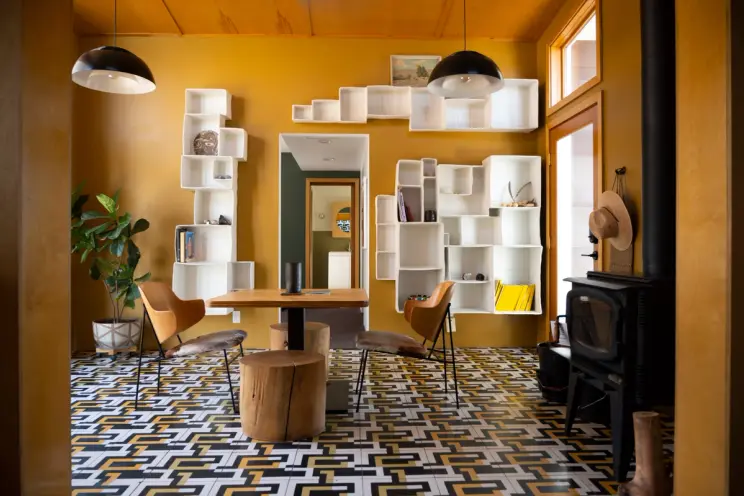
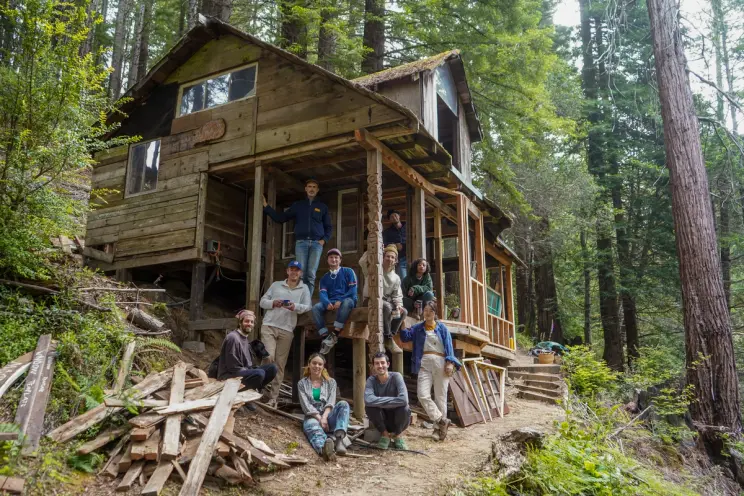
For both Zittel and Haeg, their collaborative artistic practices are based on intentional acts of dwelling. By reshaping our homes and ourselves, these artists explore how we might create different protocols of engagement with the world on mutualistic terms. Dwelling becomes an opportunity for living our climate politics through creating alternative, mutualistic relationships to food, water, shelter, energy, and the neighborhood broadly.
A Biomimetic Retrofit
As I imagine what a Symbiotic House would look like in Miami, I think more and more that it isn’t a “house” in the traditional American sense. A regenerative land project is pretty easy to fathom if you’re looking at a single-family house with a yard, but realistically, that option is becoming less and less attainable in Miami. The primary option available is an apartment with little to no outdoor space. How does a regenerative land project function without direct access to land?
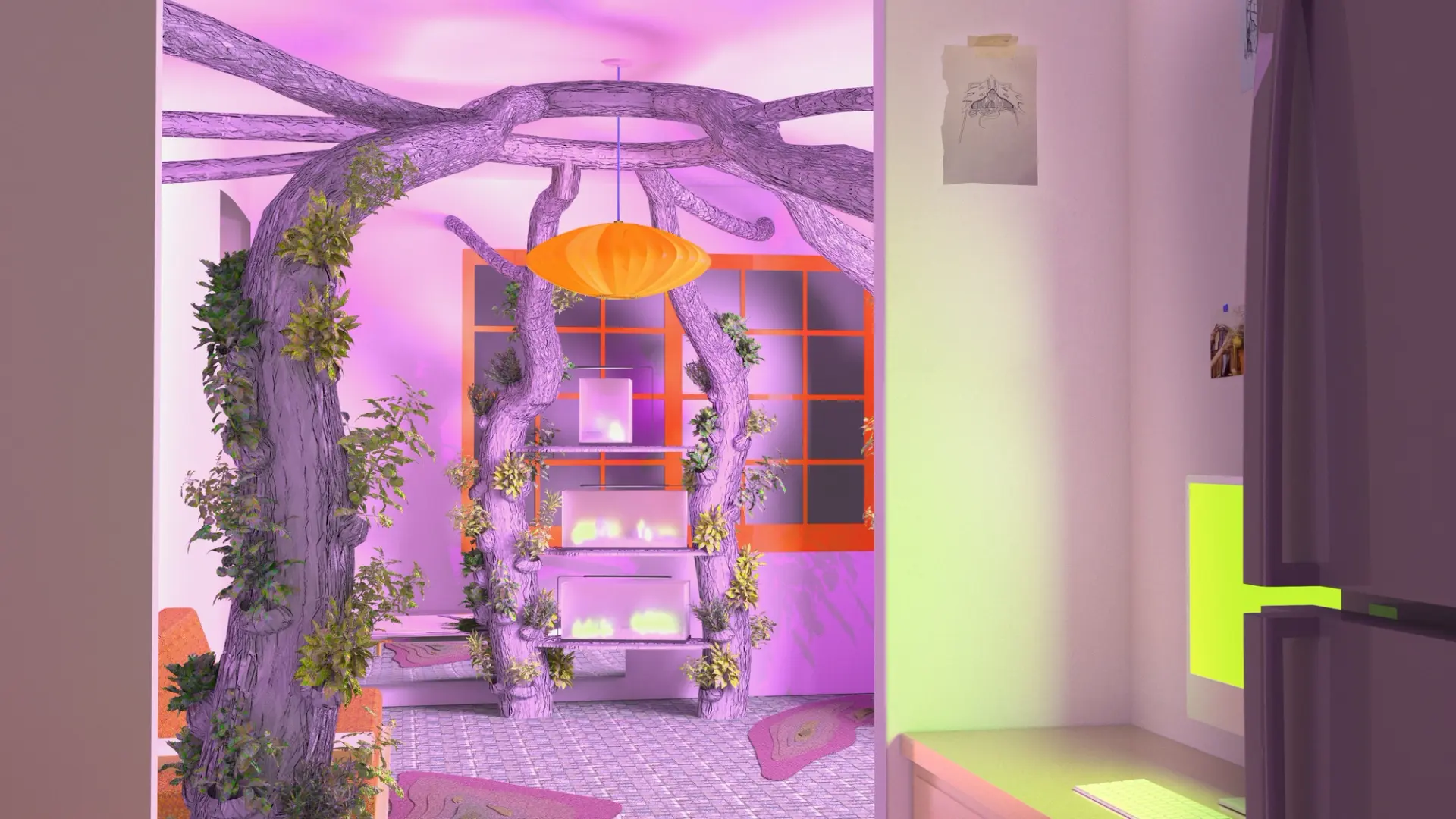
Lee Pivnik, Interior concept digital rendering of The Living Room showing vertical hydroponic system, 2023.
Courtesy of the author.
This question has guided me through the design process of The Living Room: a speculative retrofit of a South-Beach studio apartment into an inhabitable aquaponics sculpture. Aquaponic and hydroponic systems drastically reduce water needs because water is recycled throughout these closed-loop processes. Using water sourced from the areas around Lake Okeechobee most directly impacted by nutrient runoff, the sculpture would test my hypothesis that a network of larger aquaponic farms could remove excess nutrients from the watershed before they further disrupt our aquatic environments. The sculpture is biomimetic, based on the wild mutualisms already present in wetlands to shape a system where plants and aquatic animals live together for their mutual benefit. As water flows from aquariums to planters, the plants remove the nutrients present from runoff. The plants filter and clean the fish wastewater and return it to the aquariums.
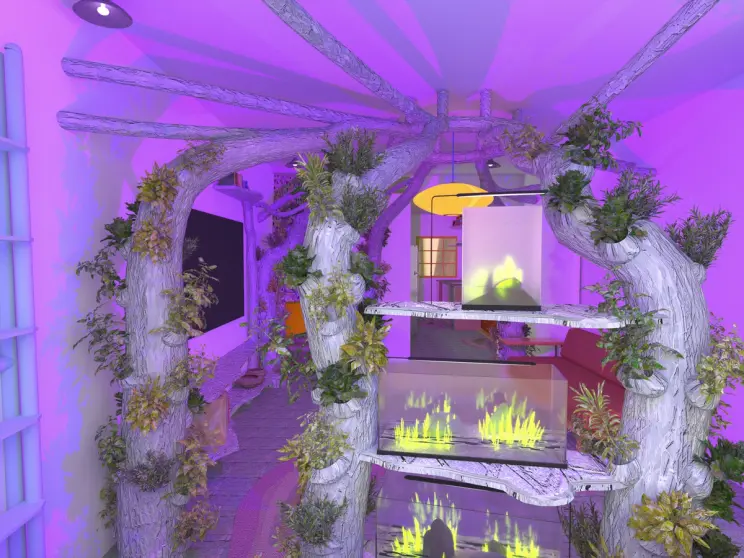
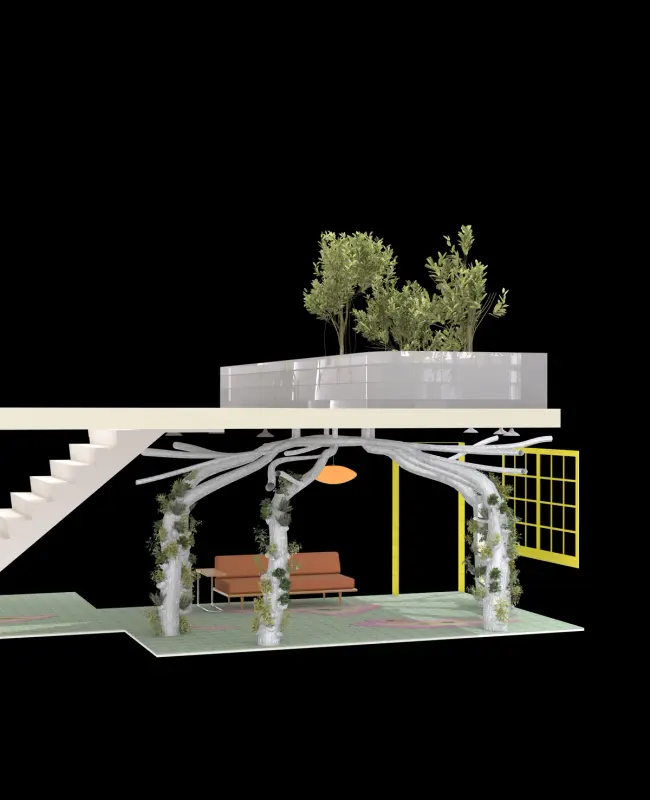
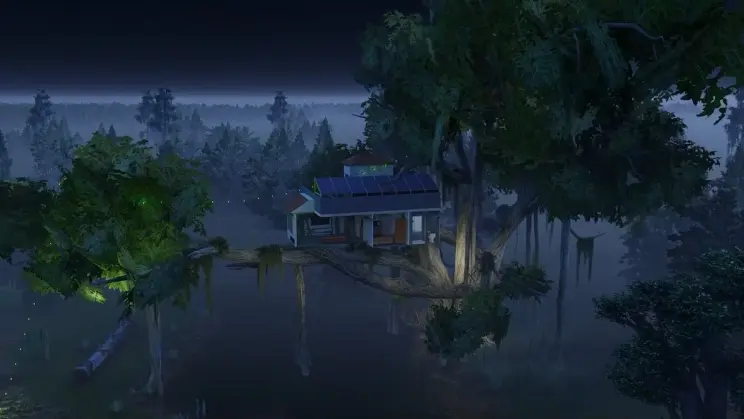
In the renderings here, you’re seeing the first draft of The Living Room, as it appeared last fall in the Meta City Biennale, an exhibition curated by Hans Ulrich Obrist and Venus Lau in Shanghai. This iteration of the work features a vertical aquaponics farm that visually and functionally mimics the vascular architecture of trees as they move water between their roots and leaves. These branching gardens are covered in mirror-mosaic, upcycling broken tiles and discarded glass to reflect light around the dim apartment, reducing the need for excess overhead grow lights. In these renderings, the apartment has been severed from its surrounding building complex and is placed high up in a Strangler Fig tree.
This aesthetic decision creates a visual connection between the biomorphic aquaponic system and these incredible architectural trees, challenging conventional architectural renderings and the sterile, minimalist visions of the futures they illustrate. The first design of the aquaponics sculpture was based on an apartment with roof access. Now that I’m finalizing the actual prototype location, I’m redesigning the work to be contained fully indoors.
With nutrient-runoff and eutrophication being tied so directly to the flow and quality of water in agriculture, I wanted to know if a larger scale Aquaponics farms could be specifically appropriate within the context of the Everglades Agricultural Area. “I think that state water managers and political leaders would do well to consider paludicultural (wet-farming) alternatives to sugar that empower the Glades towns (Belle Glade, Pahokee, Clewiston), create much-needed water storage, and filter nutrient pollution into the remnant glades,” said Dr. Caple. “I can envision an alternative future of community-owned farms organized around wetland crops (e.g. rice) and aquaculture. This is a technological and political project, requiring collaboration among diverse stakeholders, the reconfiguration of land rights, and centralized water management. It is also a vision that supports the flourishing of Everglades wildlife: wading birds, alligators, and panthers as well as less iconic species. We need to give large chunks of the EAA back to nature, but we also could also envision agro-ecological patches in a future land mosaic that draw people, water, and nonhuman species into life-giving arrangements. This would be a herculean engineering and planning initiative that works against the logic of growth for growth’s sake and, thus, is likely to fail. But there is too much at stake not to embark on the challenging work of collectively imagining a more livable future.”
If today’s EAA resembles the alienation of the 16th-century colonial sugarcane plantations in Brazil, Dr. Caple’s vision is closer to what’s in practice currently in Chenglong, Taiwan. In Chenglong, we can glimpse a future for Florida’s low-elevation agricultural areas, which will be increasingly threatened by sea-level rise this century. The land around Chenglong Village was previously conventional farmland. In recent years, however, with fields becoming inundated with saltwater, arable land has been rapidly receding. The farmers are adapting to this change through the kind of paludicultural wet-farming that Dr. Caple suggests, with an estuarine twist.
There’s even an artist residency helping facilitate the adaptation work. The Chenglong Art and Satoumi Lab is a project that invites artists to work with farmers and local school children to adapt to an aquaculture economic model for their changing farmland. Satoumi is originally a Japanese concept that denotes marine and coastal landscapes that have been formed and maintained by prolonged interaction between humans and ecosystems. In Chenglong, artists have utilized local, organic materials and surpluses like oyster shells from the new shellfish farms to construct outdoor installation works with residents.
Like the water, fish, plants, and people that will inhabit The Living Room, we’ll have to work together to catalyze this revolution towards mutualism in Florida and beyond. Reflecting on what they find poetic in the Everglades, Houston described the slow practice of a slough slog, as you wade through the river of grass:
“It’s the sticky prickly sensation that your bare feet make through the peat, as they eventually make their way to the scary part: the Oolite. It’s scary because you never know if it’s going to be smooth, or if it’s going to be like a pothole, or if it’s going to be sharp, or if it’s going to be uneven. I feel like that teaches you how to walk respectfully on the land, and to rely on all the supports that are there with you. Are you going to rely on the tree to help you walk, or your friend, or your own wisdom and experience? ”
I’m learning that the slog is ongoing and that these supports, be they trees, friends, or past experiences, keep everything flowing when you get stuck.