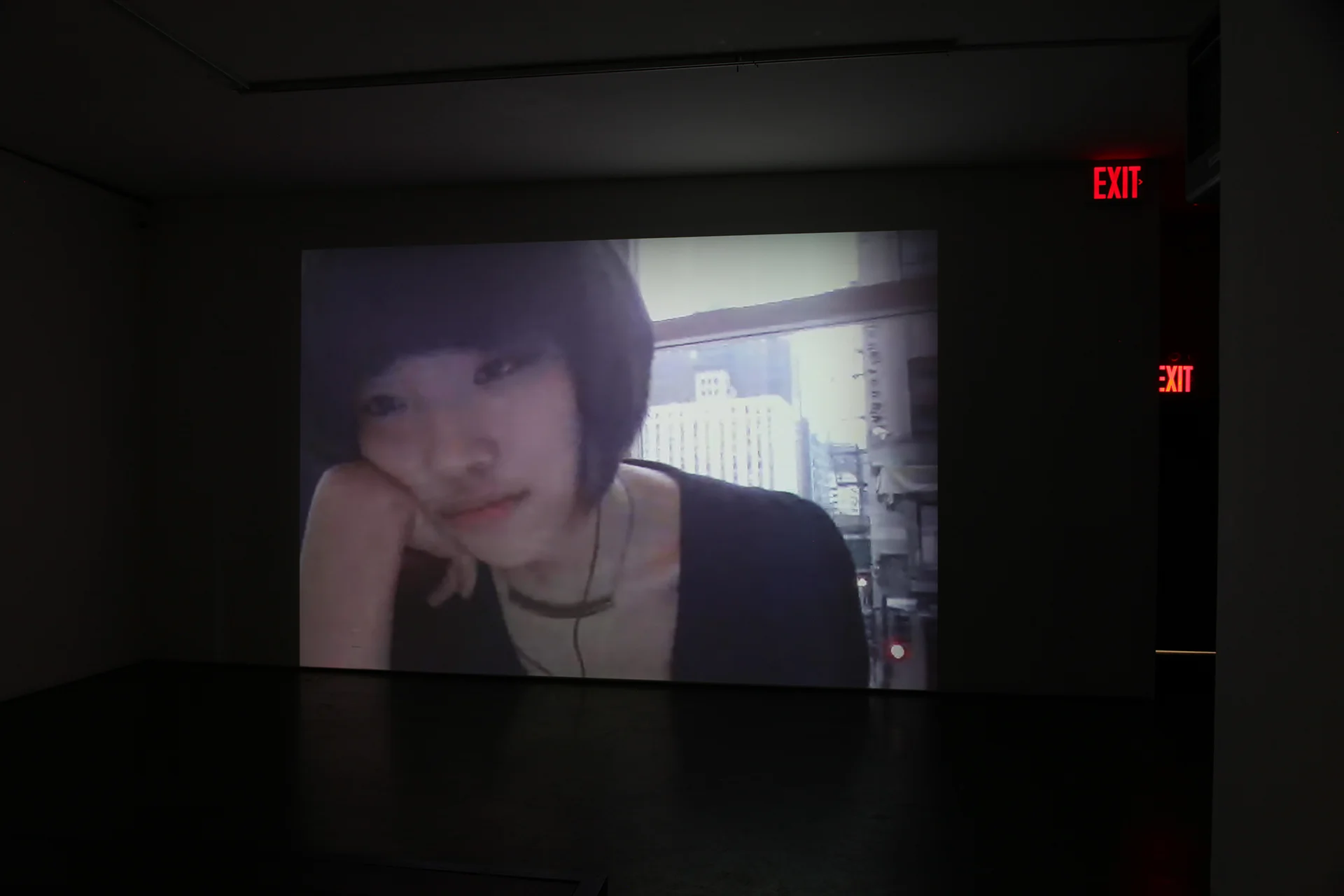
Chang Yuchen, For those who share mornings and evenings, 2025, Smack Mellon, New York, 2026. Courtesy of Smack Mellon.
In her first 2026 Artlab Editorial Fellowship essay, Yutong Lin navigates the impossible, excursive ways grief is translated through dreams and language in artist Chang Yuchen’s poignant works.
“From the very moment it is revealed, it is veiled.” —George Bataille, The Tears of Eros
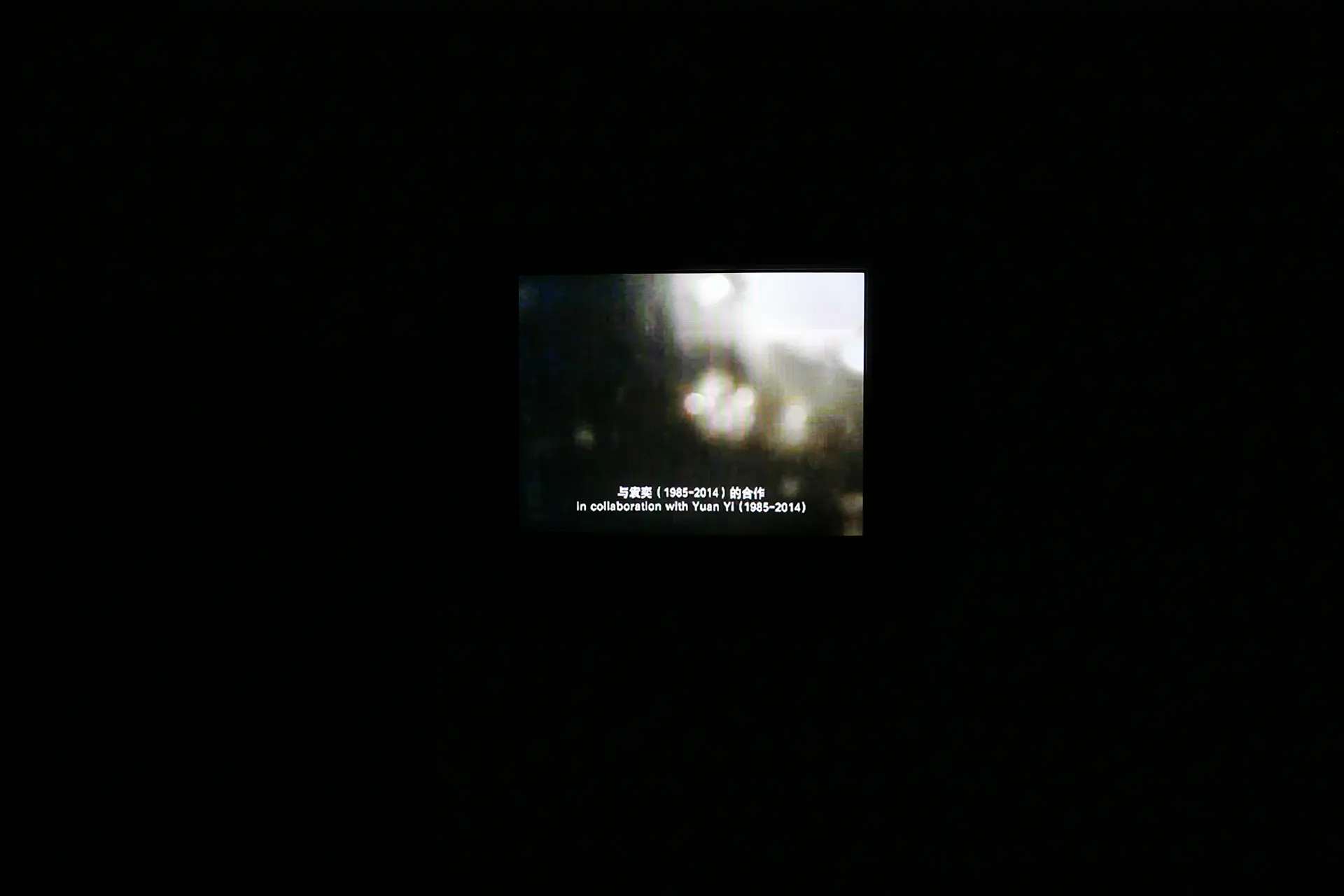
In the video work Ten Nights of Dreams (2025), a collaboration between artist Chang Yuchen and her late husband Yuan Yi, a cathode-ray television loops a single one-minute scene—footage Yuan Yi shot on a Nokia phone from a moving car in 2012, the camera’s lens pointed upward through the sunroof, looking into the night.
Outside of the car, snow falls heavily. Snowflakes melt as they hit the glass. Between the streaks of melting snow, streetlights flicker past—orange-yellow lamps cutting through the dark as the car moves.
As the scene loops for twenty-five minutes, words written by Yuchen appear line by line on the bottom of the screen, in Chinese and its English translation. They are transcriptions of ten dreams Yuchen had following Yuan Yi’s death, originally sent as messages to close friends, texted in her fragile state of waking.
One entry reads:
2014/7/23
梦到人死后仍在这个世界上
只是不能被看到听到
做什么都不会被感觉到
和死去的你在床上
很焦急地想和你交流
让你回来,试着继续做爱
…
阴差阳错我还是不能与你沟通
然后体会到死后生活的我懂得了你的无奈
两人一直在同一张床上
只是有时候你不能感到我
我不能感到你
I dreamed that after people die, they are still in this world
Only they can’t be seen, heard
Or felt whatever they do
I was in bed with you who had died
Anxious to communicate with you
to bring you back, to go on making love
…
By coincidence I still could not communicate with you
Yet as I experienced the life after death, I understand your helplessness
Two people are always on the same bed
only sometimes you could not feel me
And sometimes I could not feel you
…
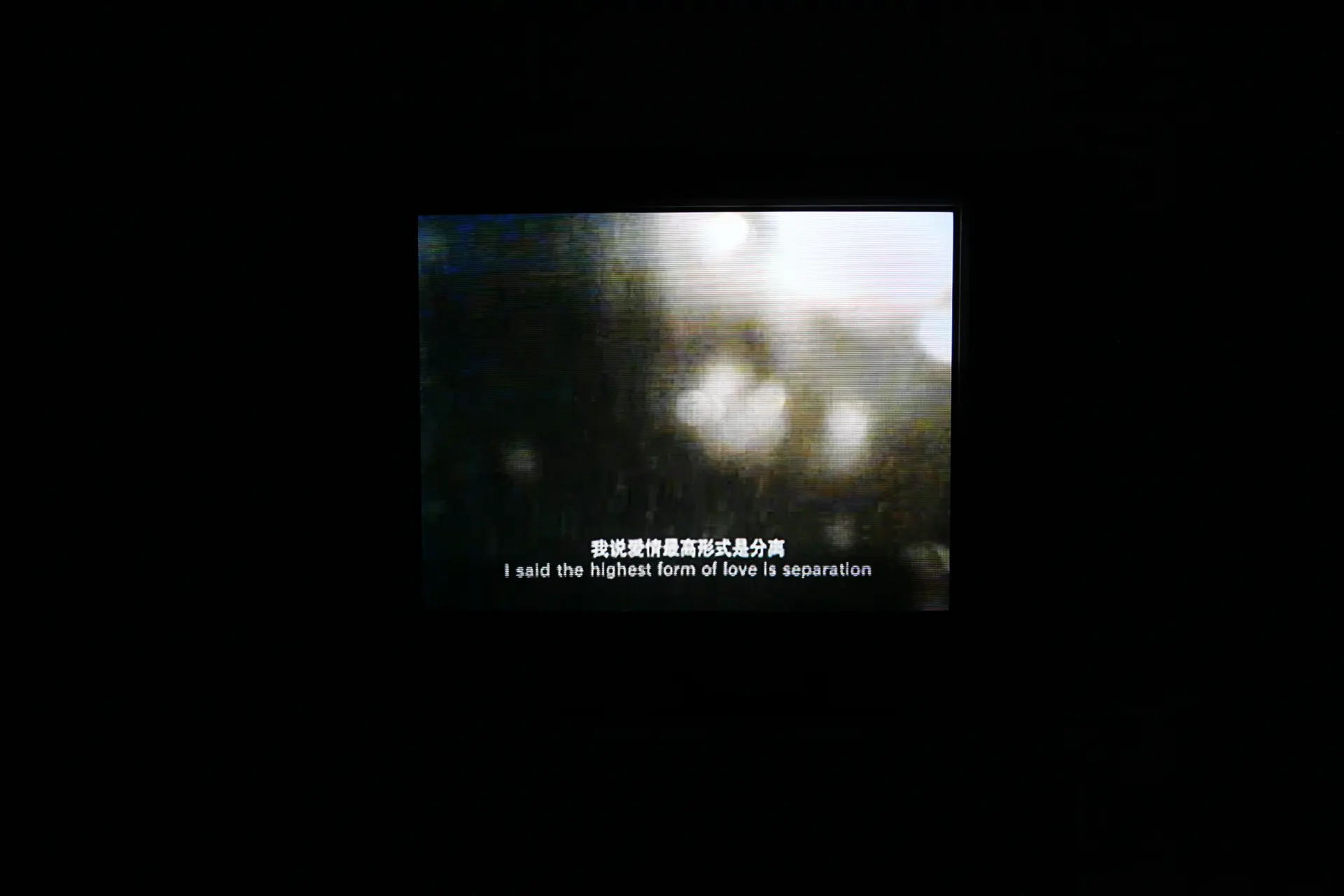
Chang Yuchen, Ten Nights of Dreams, 2025, Smack Mellon, New York, 2026. Courtesy of Smack Mellon.
As the video plays, audiences can enter and leave at any moment, catching one dream, or several. The text on screen appears, then fades.
I saw this work at Smack Mellon in New York with my friend S in December, 2025. We sat in a dim space in the back of the gallery. Outside, the wind was loud by the East River; even though it hadn’t snowed much, the cold and damp made it feel as if it had. S and I leaned against each other on the gallery bench, watching the image of snow falling on a quiet and solemn night over and over. There was hardly anyone else there besides us. We read Yuchen’s words, brutal and elusive, slowly.
S leaned into me and said she couldn’t bear to imagine losing her partner, or parents. My thoughts began to wander into moments of parting from my own past, of rushing through winter’s wind and snow. I cried—I was losing someone.
Mourning is full of agony and loneliness, and its expression is always oblique. In my own dreams, the mourned are mostly silent. I thought about my late grandfather, who came back to see me in a dream just as he was in life—not much of a talker, standing at the door with a slight smile, smoking, not saying a word.
While traversing the quiet snowy night of Yuchen’s Ten Nights of Dreams, one can be brought into their own private, rarely visited moments. This state, too, is much like dreaming—oscillating between what’s perceptible and what’s legible, only half-recognizable.
In loss, one constantly moves between “having” and “no longer.” Some moments become sharper than others—sharp enough that feelings turn blank, leaving a wordless immensity, as if the feelings are feeling you. As Yuchen writes in Ten Nights of Dreams: “Only sometimes you could not feel me, I could not feel you.” This sudden “sometimes” strikes without warning, even in dreams. The ache lives in this relay of partial existence—dreams are supposed to be where one can meet the departed, yet presence arrives only in relay, never quite absent, never quite present. It confirms a departure, telling you it’s time to accept the leaving, and yet there is also a desire to hold onto what is, unmistakably, still real and felt.
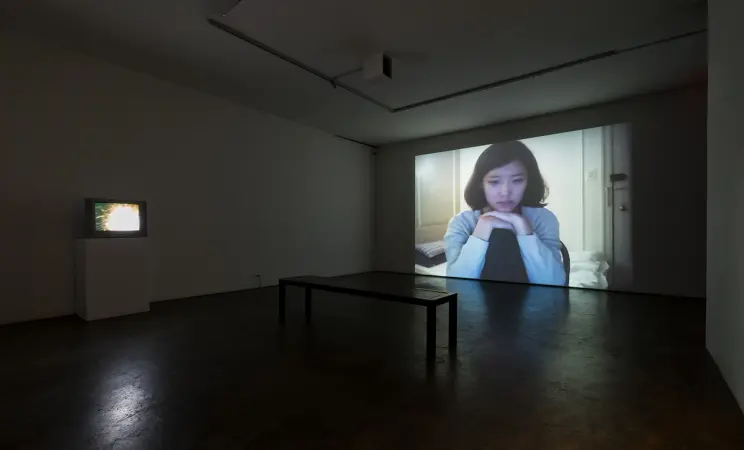
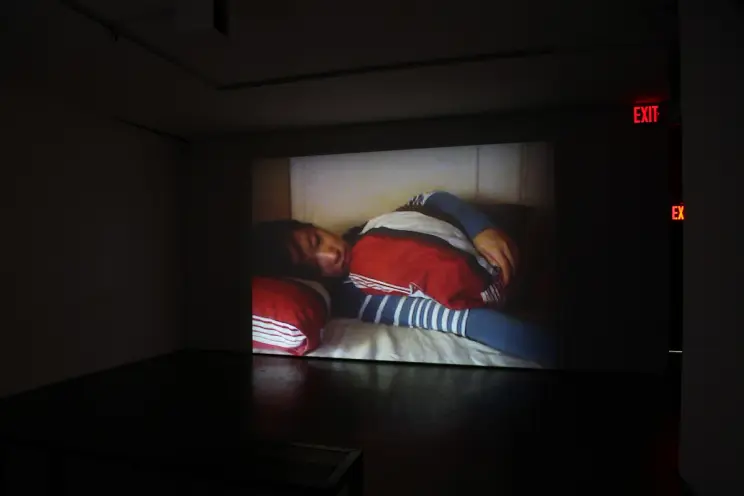
On a wall beside Ten Nights of Dreams, a projection of For those who share mornings and evenings (2025) flickered in the dark. In this work, Yuchen compiled years of screen-captures that Yuan Yi took of her during the countless video calls of their long-distance relationship. If For those who share mornings and evenings is about being held in the prolonged gaze of a loved one who has passed away—about facing rather than hiding—then Ten Nights of Dreams holds grief at the oblique through writing, in fragments of arrival and disappearance.
Writing is transformed by pain, and transforms it in turn; the act of writing almost becomes a necessity. The process of giving dreams over to language is, perhaps, also an endeavor against being swallowed by feeling. In a recent conversation, Yuchen explained how she uses the word “transcribe” rather than “describe” for her writings of dreams. “Even as I strive to transcribe,” she said, “the process of languaging dreams inevitably verges on describing them.”
The Latin origin of “de-” in “describe” carries a sense of distance, a folding away from the thing itself. But in the case of dream writing, the distance is not so much about a lack.
Dreams are, by nature, impermanent, with parts that cannot be fully captured by language. For Yuchen, there is something at odds between the flow of dreams and the syntax of language—the two cannot fully corroborate each other. Yuchen mentioned that Freud, in The Interpretation of Dreams, observed that dreams carry no adpositions indicating causality. The relationship between the subject and space is not fixed in a dream; it metamorphoses, unanchored, in time and in space.
To recount her dreams, Yuchen had to supply the grammatical connections they lacked. In doing so, Yuchen’s writing doesn’t just transcribe her dreams—it also translates them. In trying to articulate what loss does beneath the surface, to give it shape, her writings witness the reality of living with a hole. In that sense, the state of “trans-” in both “transcription” and “translation” also becomes a kind of crossing between worlds and bodies—she wakes in dreams, and in dreams she burns and churns. The passage of her grief becomes a passage of text.
Another entry from Ten Nights of Dreams reads:
2014/12/24
突然醒来
梦的横截面是像火在燃烧一样的痛苦
烧着我的身体
我的背影
爸爸在旁边
用罕见的温暖语调安慰我
他说如果他他又力量就不会这样安排
我好像很小,像个小孩
镜头特写我充满儿童特征的脸
眼睛被痛苦撑得大而失神
哭不出来
I suddenly woke up
the cross-section of the dream was burning pain
burning my body, my silhouette
Baba was beside me, comforting me in a rare gentle tone
He said that if he had the power, things would not be arranged this way
I seemed very small, like a child
Close-up of my face, full of childlike features
My eyes widened and vacant by the pain
Unable to cry
…
It is saturated with rage and remorse, condolence and violence. The body splits into two—one endures the bereavement, the other observes its happening. In a father’s consolation, “I” look toward myself who suddenly turned into a child, only to find myself unable to cry. Pain, in that moment, loses one of its most immediate outlets—tears. Revelation and concealment occur on the same face at once.
In “After ‘After Babel’,” an essay Yuchen wrote for Heichi Magazine on the experience of living between languages, she describes how words sometimes deliberately hide from her when she tries to recall them. In those moments, language withdraws, even as the feeling in the moment is so real: “Thought remains nameless. Nameless but vivid, like tears trapped in the chest, forever boiling.” This boiling she names is, in some sense, a somatic intensity that exceeds language. Mourning can begin with naming—setting what is too heavy into language’s imperfect vessel. But naming is not the same as release; the vessel does not undo the boiling. It gives it a place.
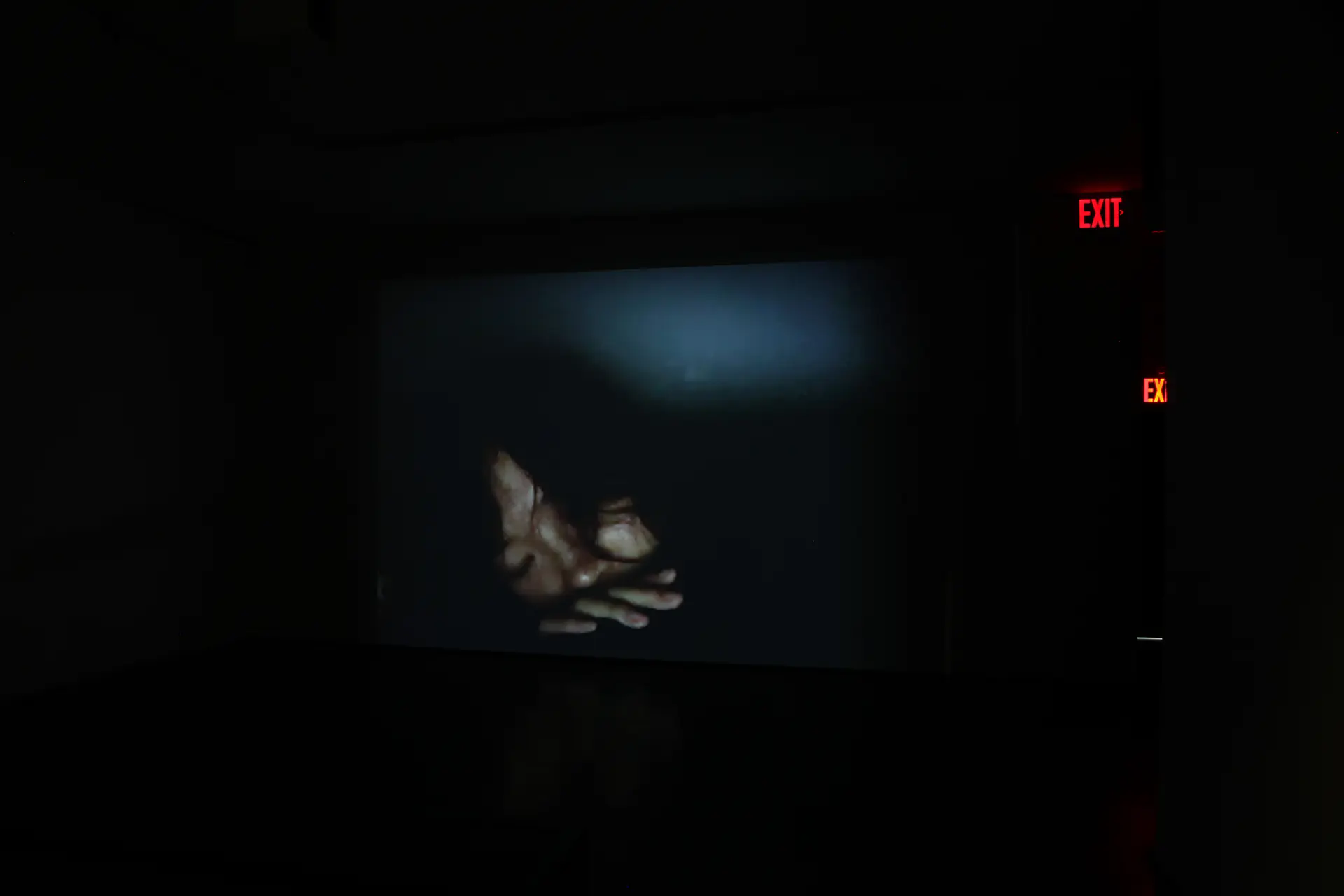
Chang Yuchen, For those who share mornings and evenings, 2025, Smack Mellon, New York, 2026. Courtesy of Smack Mellon.
Yuchen’s dream transcriptions become an embrace through this vessel. They hold these impenetrable, violent emotions, so that they do not congeal into an impasse of expression. Even in capturing that which is impossible to contain, these texts communicate—they will go to friendships and intimacies, to the next person who is reading them.
The same attention to the limits and textures of language runs through Yuchen’s wider practice, which has long observed the sensitivity, fragility, and sometimes unreliability of linguistic structures. Her method of writing and translation is marked by incredible patience. Stubbornly, repeatedly, she returns to the same subjects to think about and see them anew.
The process of making a work often takes years. In her project Coral Dictionary (2019–ongoing), she uses found coral remnants as units of language to translate sentences from Kamus Sari, a Malay dictionary. In the process of drawing these pieces of coral, she considers the weight, texture, and tonality of language, exploring the relationships between language and the body, nature, and history.
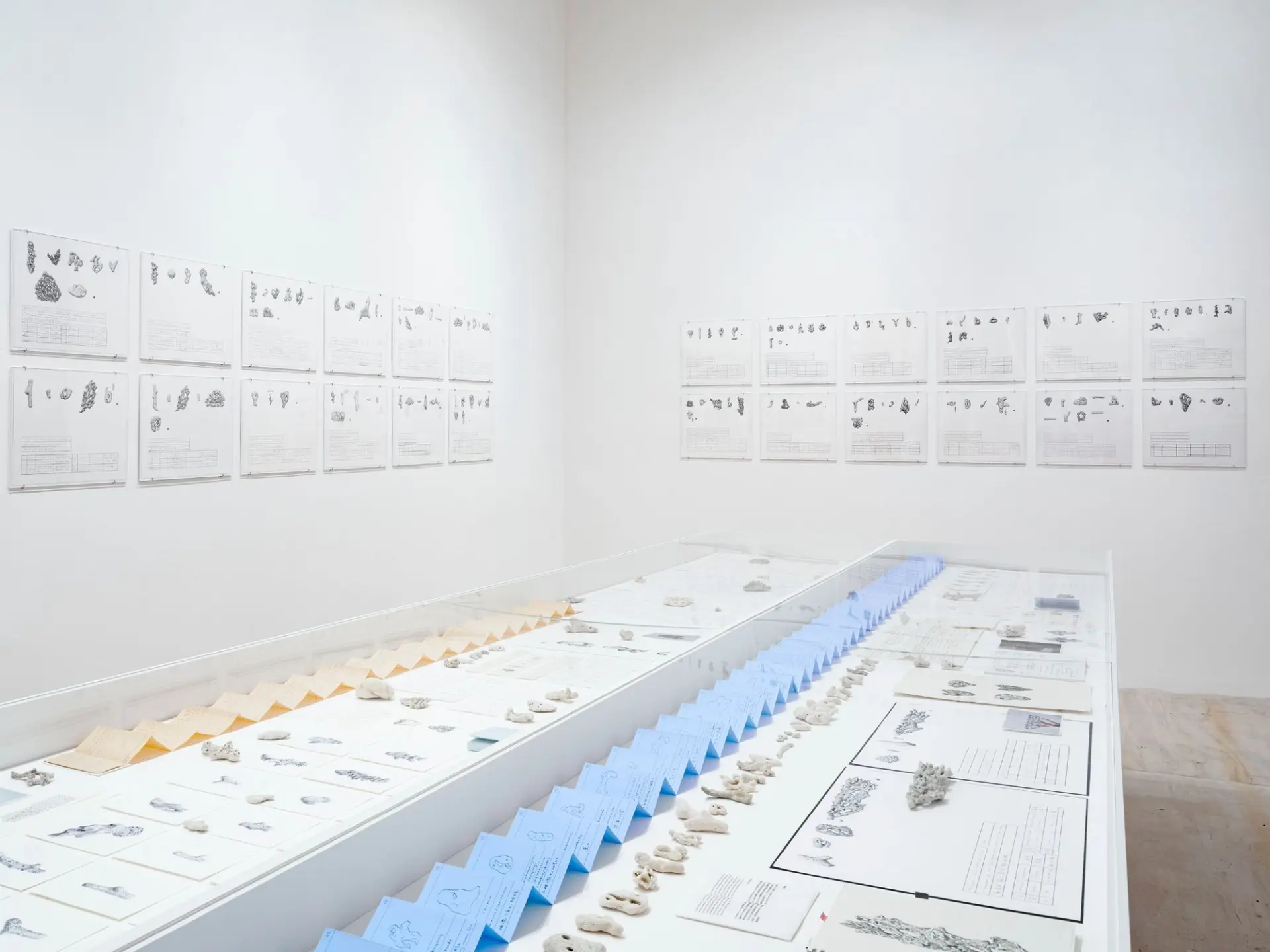
Coral Dictionary (36 Sentences), part of the group exhibition Greater New York, MoMA PS1, 2026. Photo: Kris Graves, courtesy of MoMA PS1.
Yuchen’s hide-and-seek with words recalls the work of the late fiction writer Yuan Zhesheng. In his novel The Lonely Game, Zhesheng describes an anecdote from his dad’s childhood: One feverish afternoon, his dad sleep-walked for who-knows-how-long into a graveyard, until a relative finally woke him. When Zhesheng’s dad recounts this story, it seems as if he doesn’t care much about it, even seeming a little embarrassed. But Zhesheng doesn’t see it this way. He writes: “To me, this is an achingly beautiful story...It has stayed branded in me, has grown in me, like a fable. It describes a boy barely acquainted with the world, who, arriving at a chance moment, walks—instinctively, fluently—toward that point before life’s beginning, or after its ending.”
The instinct of the artist and of the writer may be exactly this—what Zhesheng called the “instinct” to walk toward the point before life begins or after it ends—and to be changed by these moments of walking toward. Yuchen’s transcriptions do the same thing: She is, between waking and not-yet, instinctively moving toward that parallel space where Yuan Yi is still there. Languaging is that movement. While reconciliation is not guaranteed at the other end, by approaching these dark moments, writing accompanies this lonely journey. Perhaps, in facing the death of the beloved, processes of grief only become expressible through the oblique—the half-dreaming, half-waking “wanderings.” In Yuchen’s writing, I felt my own grief and my own rage.
Installation view of Chang Yuchen’s For those who share mornings and evenings at Smack Mellon, New York, 2025. Photo by Chang Yuchen.
In a blog entry announcing the exhibition at Smack Mellon, Yuchen wrote, “A long-distance relationship is like a dream—the other person appears only in the depths of night, visible, untouchable; and a dream, too, is a kind of long-distance relationship, a medium older and more enduring than video technology.”
As her ten dreams came to an end, the credits appeared: “in collaboration with Yuan Yi (1985–2014).”
The snow continues to fall. The orange streetlights keep passing through the dark, and the snowflakes keep dissolving on the glass. The night outside the gallery window is quiet.
The video invites us to dwell together in the dark.