In his first 2026 Artlab Editorial Fellowship essay, Travis Jeppesen identifies a crisis of style in contemporary art writing—and makes the case for how we might breathe new life into it.
I first began exploring the question of style in art criticism in the 2010s. Back then, one of the seminal new texts that everyone who cared about this topic was discussing “International Art English” (IAE) by Alix Rule and David Levine, published online by Triple Canopy and later, by popular demand, as a standalone e-book.
In that essay, Rule and Levine correctly tie the evolution of IAE to the emergence of the art criticism journal October in the 1970s, as well as Artforum. One can’t really speak of it as a “style” of writing, since it has none. Rather, IAE served a particular function: the professionalization of art writing as a particular métier, with its own standardized, albeit jargon-filled language. It is a writing that is dry and airless—yet one that many writers and editors would continue to aspire to, perhaps because it is relatively easy to imitate, requiring no innate sensibility or individual style, but rather grounded in buzzwords and pedantry, essentially valuing sophistry over substance. (Some of the more humorous examples Rule and Levine offer include “the absence of space,” “the subreal is… formed of the leftovers of reality,” “the act of making objects enables her to control the past and present.”)
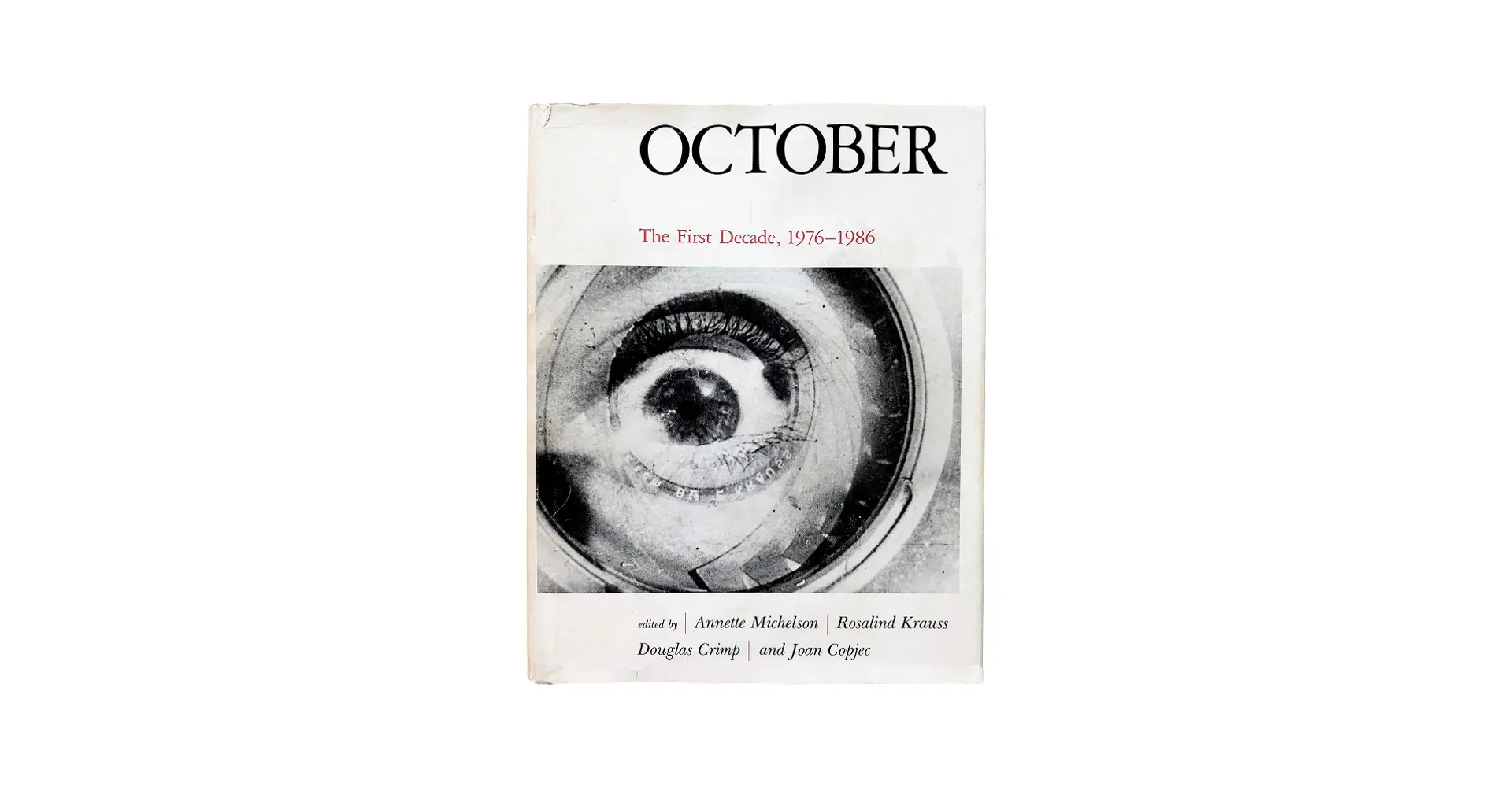
MIT’s art criticism journal October, 1976–1986
The essentially technocratic vernacular of IAE, more than a decade on, has been further flattened into a corporate artspeak: the language of mega-institutionalization, the banalization of sentences riddled with empty jargon, into a realm that borders on senselessness. Increasingly, it seems that this writing has no intention of being read by a human—instead, it is produced in order to be scanned by bots. IAE has entered the age of AI, from which it has become inseparable.
What this language lacks are sensibility, affect, humor, pathos—anything that might feel recognizably human. As we move into a new era in which we can expect a great deal of exhibition texts to be AI-generated, where there will be even less of a demand for art writing than there currently is in this rapidly depleting market, we can only imagine the situation will grow worse, more desperate—at least until more writers and sympathetic editors come along and decide that a shift must take place, away from the uniform style of IAE, and into the scarier unknown. Within this more open stylistic field comes a proliferation of difference.
In their essay, Rule and Levine scratch the surface without getting in too deep on one of the more significant underlying conditions undergirding IAE: that of class, of professionalization. Writing in IAE is less meant to serve the populist aim of appealing to the general reader, than to signal one’s belonging to the class of art world professional. “Whatever the content,” Rule and Levine write, “the aim is to sound to the art world like someone worth listening to, by adopting an approximation of its elite language.”
It could therefore be suggested that one direction that an opening of the field might take is towards de-professionalization. That means bringing in writers from drastically other fields, those who are not professional art world people, those lacking the IAE language as well as the specialist knowledge that the contemporary art world mythologizes as being essential to one’s participation in it, and in reality effectively closes off the field—and the art itself—from any populist inclusion.
This might re-introduce some fundamental things about writing that those long engaged in the medium have seemingly forgotten. One is that all writing that is truly worth anything ultimately emerges from a place of not-knowing. Indeed, this is the place that most of us are in when we approach an artwork for the first time, having not read the gallery press release, in a state of unfamiliarity with the artist’s previous work, knowing nothing about it. This “blank slate” approach is an ideal place to begin, because it necessitates a journey—and if you promise a reader a journey, they will almost always take you up on that offer. In doing so, the barrier between writer and reader dissolves, as we journey forth from an originating position of not-knowing, not-understanding, ambivalence, and ambiguity, that essentially replicates our initial encounter with the artwork.
The notion that these qualities—not-knowing, not-understanding, ambivalence, ambiguity—are revelatory of a flaw needs to be challenged. Or better: their flaw status embraced. Because flaw is intrinsic to style—which, after all, is a way of drawing attention to the means of one’s transmission without distracting from the message that is simultaneously being conveyed.
How exactly is flaw and badness more generally related to the project of style in art writing? Despite the humorous examples of senselessness Rule and Levine pull for their essay, the real tragedy of most IAE is its intrinsically—and especially IAE in the age of AI—sanitized nature, the fact that it is so clean, so over-edited, so devoid of flaw. These are qualities that might otherwise give the thing texture, drawing attention to itself, hence fomenting a style. As author and playwright Jon Fosse writes in the first volume of his Septology: “a good picture needs something bad in it in order to shine the way it should.” Another means of thinking about style, then, is to think of it as texture (another entity on its way toward extinction thanks to the flattening proliferation of the pixel), flawed filth, without which, the merely good, the polish, has nothing against which to define itself.
Jon Fosse, Septology Volume I, 2019.
The central crisis facing criticism today is that of style. When approaching the vexed question of style in contemporary art writing, it is important to define our terms. Style, after all, has at least two potential definitions here: one rooted in similarity, the other in difference. In its usage in the field of art history, style is meant as a unifying quality that spans a particular grouping of art works; it thus enables categorical thinking; a mode of thinking that I would define as “closed” around a fixed meaning. The latter definition of style—the one I am concerned with here—is style as something that is unique and idiosyncratic in an individual work of art or piece of writing; style as opposed to fashion (similar to how the late Jean-Luc Godard characterized the difference between culture and art: “Culture is the rule, art is the exception”); style that is—not always, but often—rooted in ambiguity, ambivalence, and not-knowing, and is thus “open” in its approach to meaning-formation.
When we speak of style, we must also inevitably talk about form—or, given our space constraints here, we can at least talk about format. Might there be an alternative vehicle for art writing outside the standard modes of feature, catalog essay, review, interview, press release? Must everything be frozen in the (pseudo-)essayistic? Certainly attempts to transcend the rigidity of these media have been tried out over the years, but there are isolated examples of exceptions to the rule—of what we might call style. One might point to Gertrude Stein’s portraits in prose, Eileen Myles’s “travel writings on art,” poetry written in response to artworks, ficto-criticism, object-oriented writing—all attempts to write alongside, or else within, the art object, rather than outside/about it. For style very often—though not necessarily—requires a more intimate positionality vis-a-vis the art object.
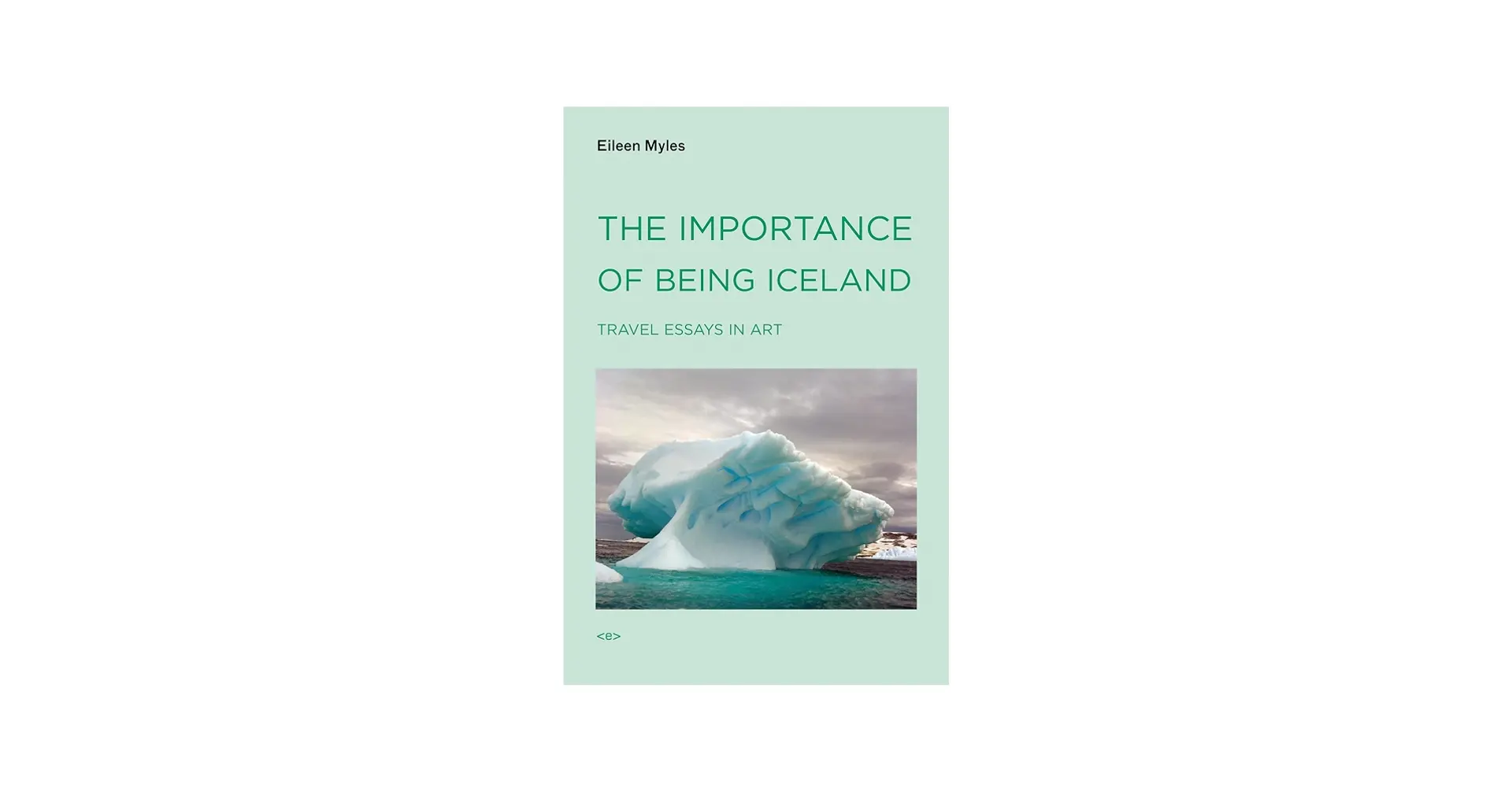
Eileen Myles, The Importance of Being Iceland: Travel Essays in Art, 2009.
No form, no genre of writing should all be the same, stylistically speaking. When that occurs, as in the case of much contemporary art criticism, it means that industry has triumphed. In this case, as we have seen, it is an industry that comes premised with certain presumptions: that of class, that of status, that of necessary exclusion. When I speak of the lack or uniformity of style in much of the art criticism that is published today, it should be clear that I am not arguing for a single new style to emerge; what is needed is an opening of the field, an expansion that would allow a multiplicity of styles to flow forth. Just as there is not, nor should ever be, a single predominant style in painting or the novel, there need not be only one in art criticism—which, as a form of writing, must also be viewed and practiced as an artform in and of itself.