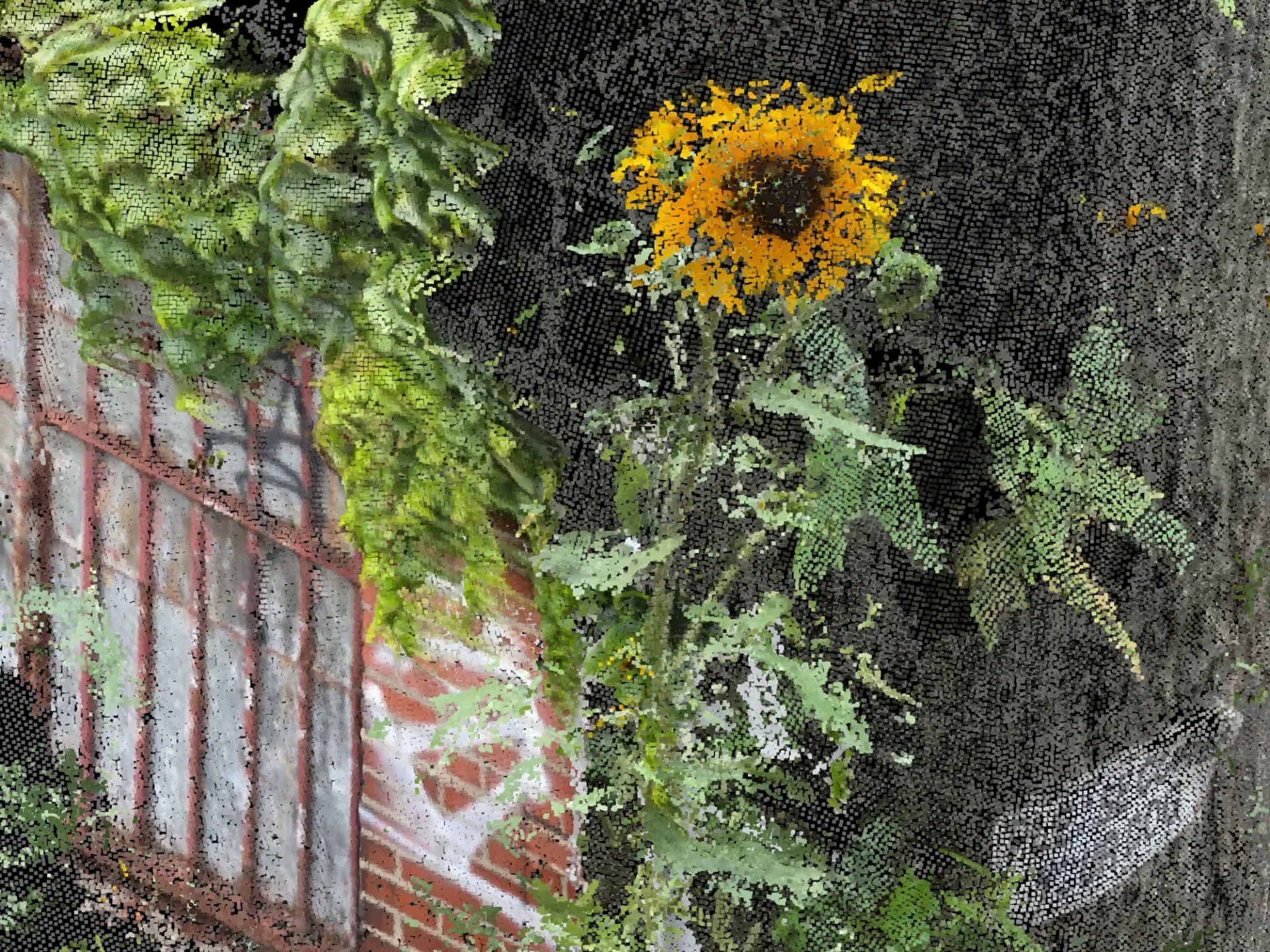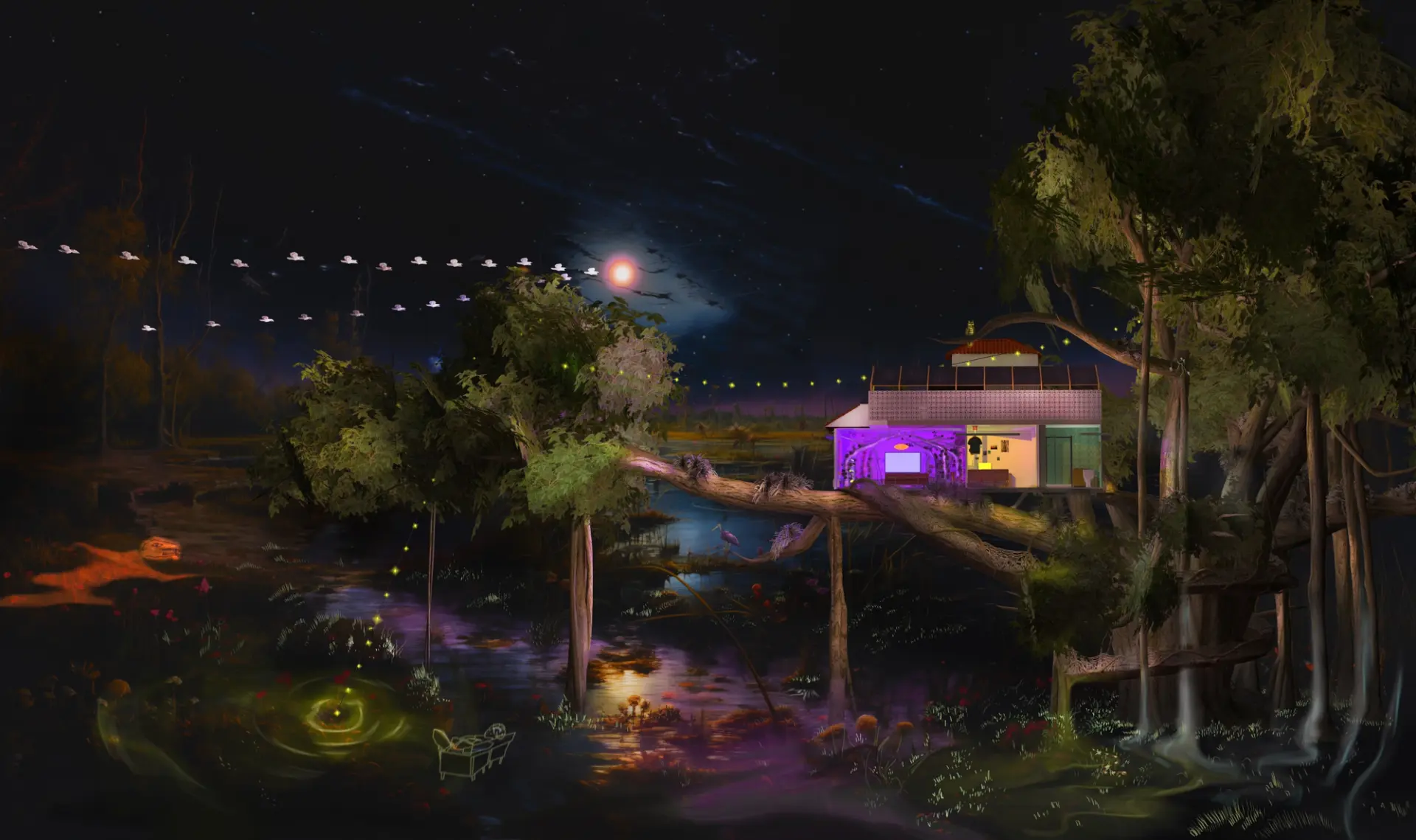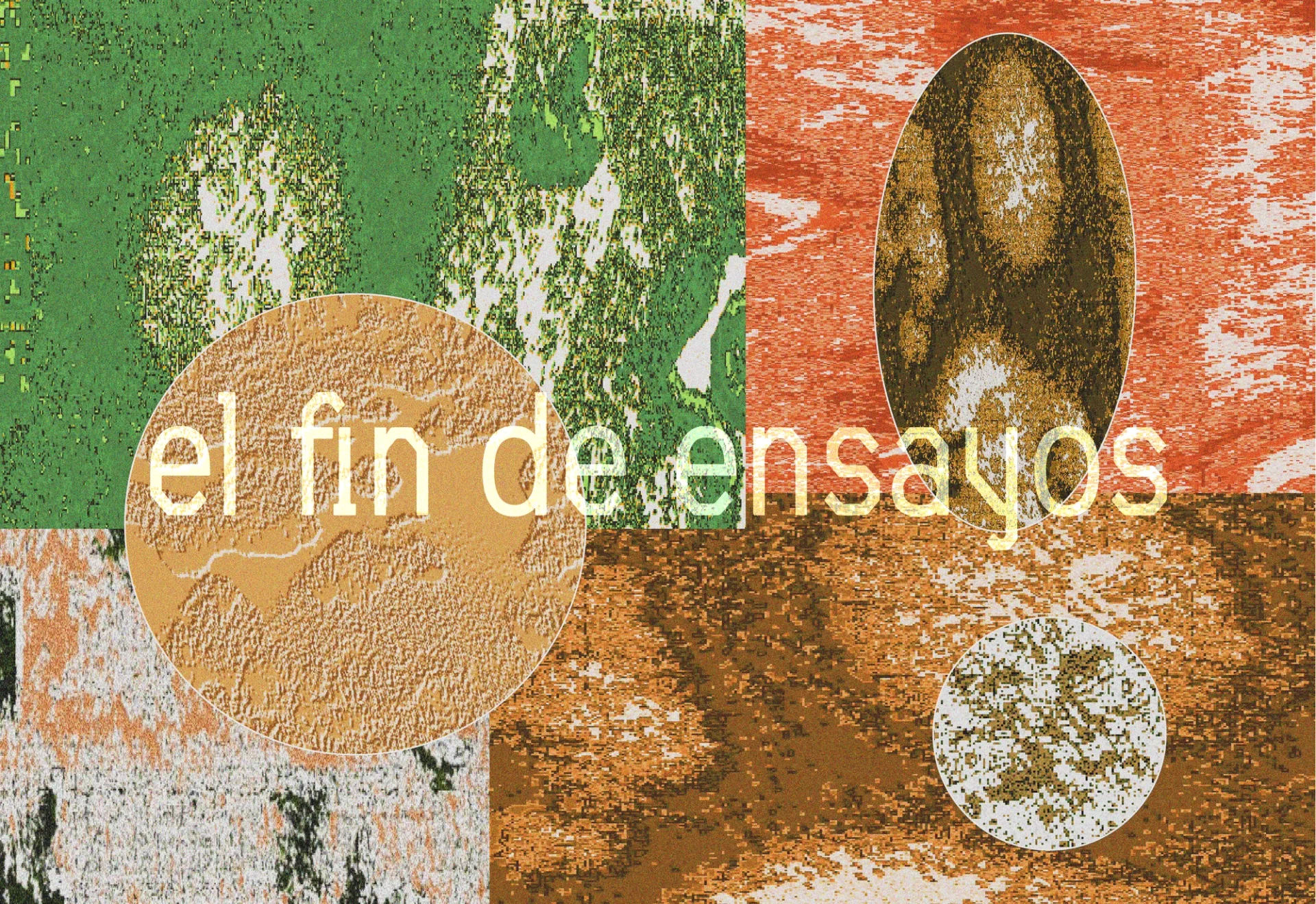
Rosario Ureta, El Fin De Ensayos, 2024.
Commissioned by Hyundai Artlab, © Rosario Ureta.
Curator, writer, performer, and researcher Camila Marambio describes how the peatlands inspired her to retire Ensayos, the eco-cultural research collective she founded 14 years ago.
Artlab Editors: Throughout the better part of the last two decades, peatlands have been fertile ground for curiosity, advocacy, and inspiration for Camila Marambio. These endangered biomes encouraged murkier and disoriented understandings and practices over product—they also offered Marambio lessons in letting go, decay, and endings. Marambio guides us through the swamps, reflecting on all that they’ve taught her.
During my early days as artist-in-residence at Puerto Rico’s nature conservation organization Para La Naturaleza Para La Naturaleza , where I am now Curator of New Perspectives, I came to know the peat-producing mangroves of the archipelago. These tropical swamp forests challenged me, pushing me beyond my understanding of peatlands as acidic, unwooded wetlands. The mangled coastal forests of Borikén rise from the brackish waters of the Atlantic Ocean in a rhizomatic protest against their savage destruction—according to UNESCO, 75 percent of Puerto Rico’s mangroves have been lost to coastal development, agriculture, and urbanization.
I have been listening to the cries of peatlands for half a decade. Each new one I hear prompts a unique response-ability. All of them amalgamate to create a rallying cry, a plea for greater acknowledgment of their existence, validity, and legal rights: Bog is Good! Praise Bog! Holy Peat! Hol-Hol Tol! Peatlands are a sacred register of what cannot be codified, captured, or even understood. Tuning in to their il/legibility, in/visibility, and in/audibility opens us up to the potential of emancipation from regimes of distinguishability. They offer reprieve from limited sense-making, leaving us in a liminal state, with slippery minds. They activate other forms of knowing, a sort of murky sensuality. Most of all, peatlands offer (me) ongoing lessons in con/fusion.
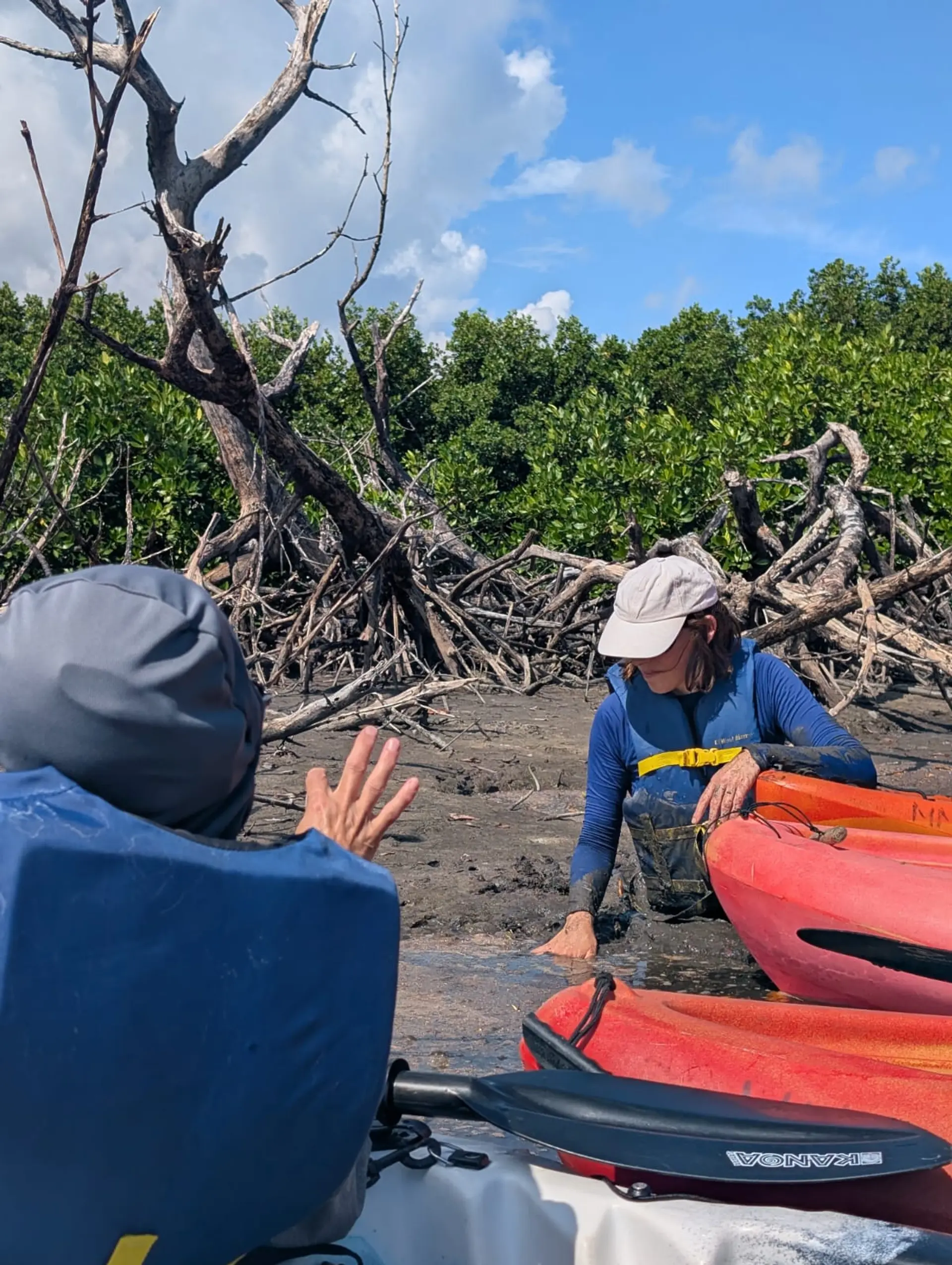
Camila and Michy submerged in the mangrove during the first session of Escuela Turbia (Bog School) in Puerto Rico, 2024.
Photo by Renaud Proch.
For the past 14 years, I have led a nomadic eco-cultural research collective called Ensayos Ensayos . In English, Ensayos means “rehearsals.” Ensayistas are artists, scientists, and activists who collaborate on eco-cultural inquiries. The inspiration for our “undisciplined” methodology came from Sørfinnset Skole/the nord land Sørfinnset Skole/the nord land , an art and ecology project in Gildeskål, Norway, founded in 2003 by artists Geir Tore Holm and Søssa Jørgensen, with Kamin Lertchaiprasert and Rirkrit Tiravanija. Sørfinnset Skole looks at how contemporary art can function in long-term dialogue with a coastal community and was itself modeled on the land foundation land foundation , which in 1998 began merging ideas from different artists to cultivate social engagement.
Like Sørfinnset Skole, Ensayos was originally rooted in a physical place. Based in Karokynká, Tierra del Fuego, the archipelago at the southernmost tip of Latin America, we spent years navigating the political ecology of the region through playful, performative experiments that aimed to queer conservation science “fieldwork.” By formulating transdisciplinary research questions and devising trans-methodologies of observation, attunement, and discernment, we complicated the notion of the “object” of conservation. This practice eventually led Ensayistas to establish “pods” in our home localities, specifically in our peatlands: the bogs, fens, and mires of Bogerudmyra, Norway; Minjerribah, Australia; and Amenia, New York.
A peat-producing wetland is a landscape that experiences large amounts of water at the surface, either permanently or for considerable periods during the year. Waterlogged conditions prevent plant material from fully decomposing, giving way to peat formation through the accumulation of organic matter dropped into still water. Degradation processes require oxygen—without it, what remains is a wet mush of partially decomposed plants. In cooler climates, peatland vegetation is mostly made up of shrubs, sedges, and Sphagnum mosses. These are the primary builders of peat. In warmer climates, grasses and woody vegetation provide most of the organic matter. In the neotropics, peatlands may form under mangrove forests. In the words of the youth-led wetland conservation collective Re-Peat Re-Peat , “Peatlands are queer ecosystems, difficult to put in a box and highly shaped by local factors…. Every peatland is just what it is: its own peatland to be met with fresh awe and curiosity….”
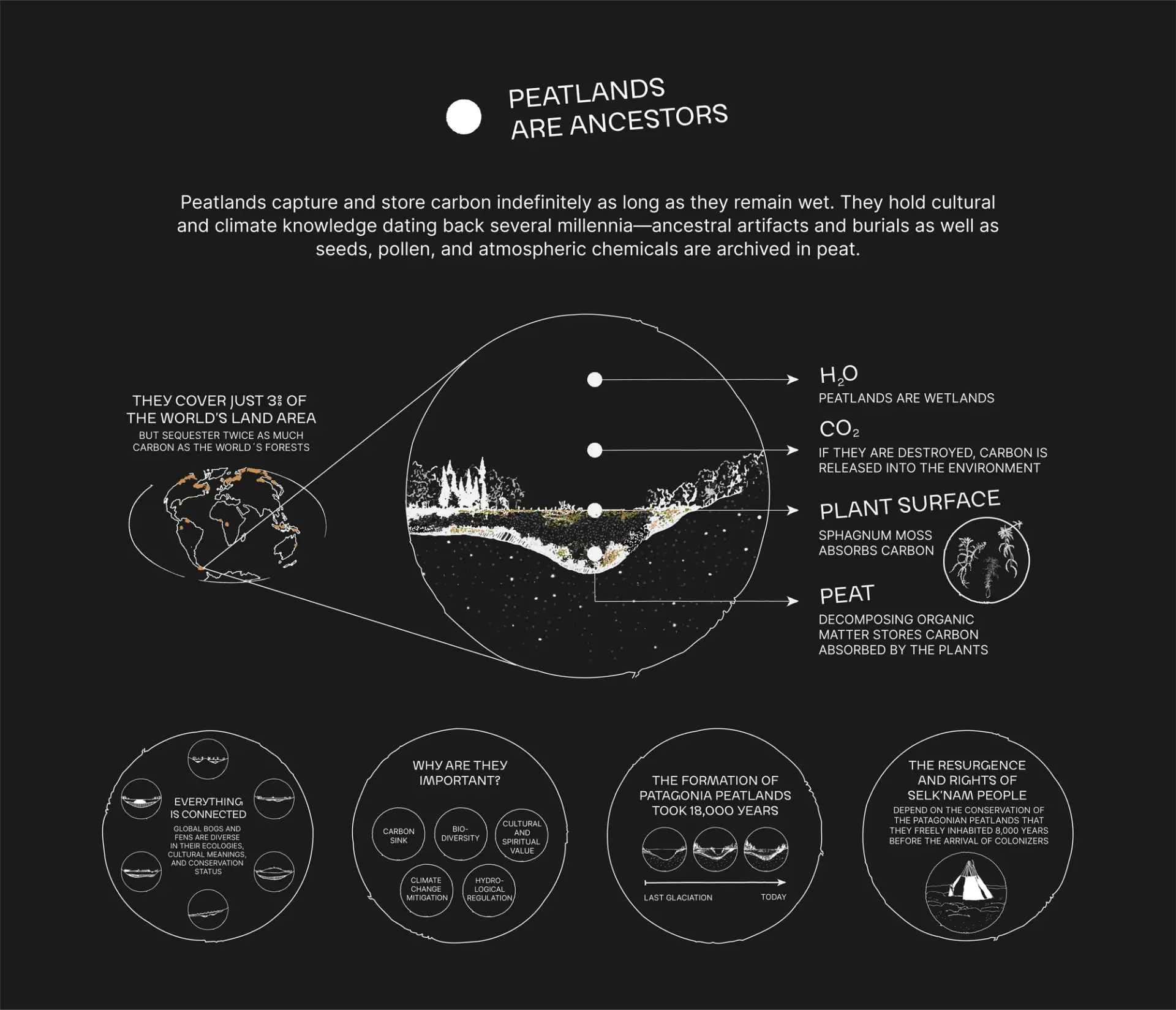
Infographic for Turberas developed for Turba Tol Hol-Hol by Ensayistas, designed by Rosario Ureta, 2022.
In 2020, for our 10-year anniversary, Ensayistas first plunged into virtual Patagonian peatlands for the play Cucú and Her Fishes [object Object] . Due to the COVID-19 pandemic, the play was developed and performed over Zoom as part of what became the first digital summer residency at the New Museum. This experimental ecofeminist drama, inspired by Maria Irene Fornés’s Fefu and Her Friends, begins at a country house partially sunk into a peat bog. As a group of women plan a fundraising scheme for ocean advocacy, debates about ecological justice and interspecies ethics escalate. The understudied metabolic relationship between oceans, peatlands. and humans became our obsession.
As we sank deeper into the turbidity of peatlands, the disruption of our planned, in-person residency became a turning point: we veered towards a model of nestedness, leaving behind our original conviction that we must always return to Tierra del Fuego to do our fieldwork. Peatlands emancipated us from notions of foreignness under which we had been operating and gave us the freedom and responsibility to become immersed in our own diverse ecological niches.
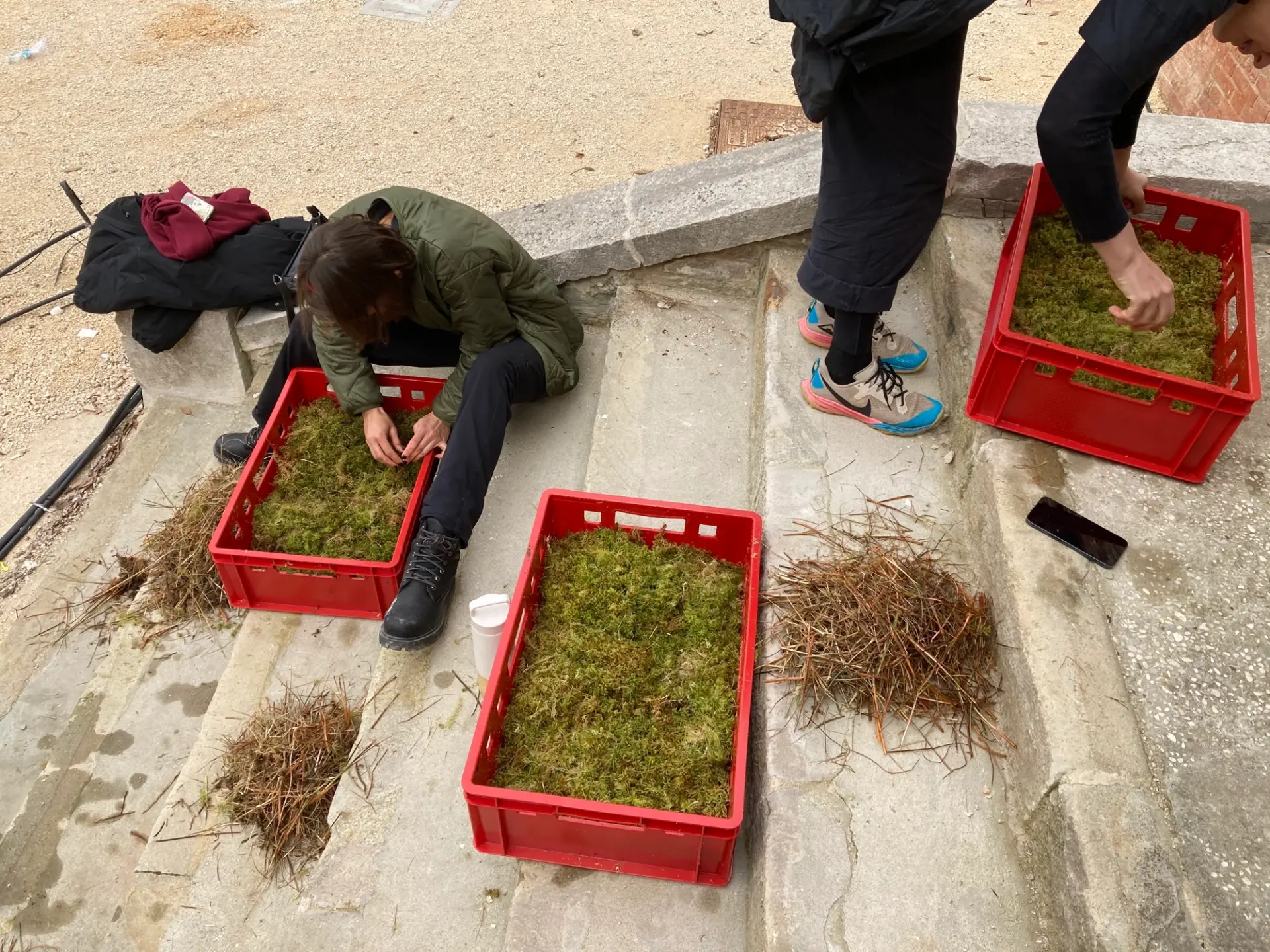
Weeding the Sphagnum moss coming from the experimental rewetted peatland plots managed by the Griefswald Mire Center in Lower Saxony, Germany for the installation of the SphagnumLab within the Chilean Pavilion Turba Tol Hol-Hol Tol Turba Tol Hol-Hol Tol at the 2022 Venice Biennale.
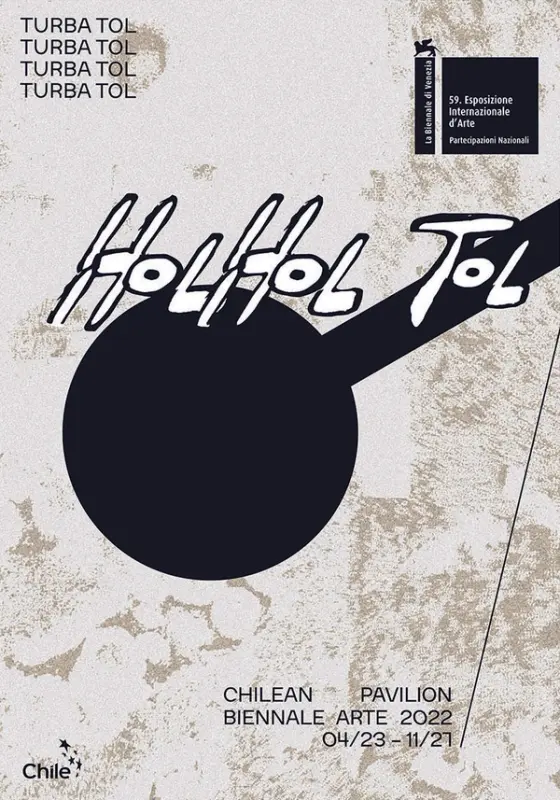
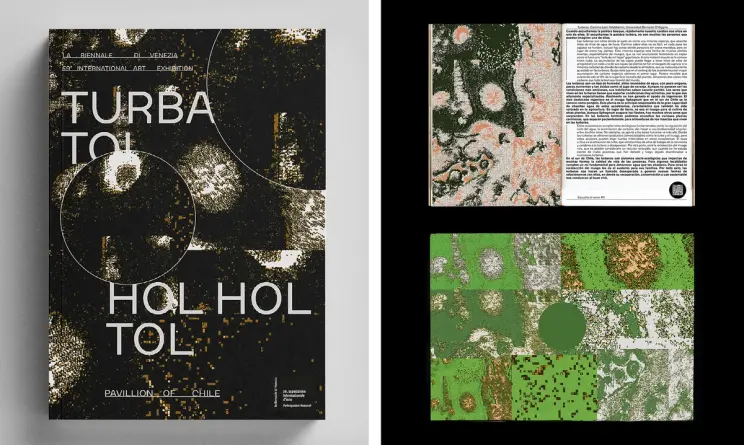
In service of effective conservation tools, we quickly created a hydro-feminist podcast hydro-feminist podcast so each Ensayos pod could articulate its unique approach to local peatlands. We learned and taught about Northeastern bogs as part of our joint “Art & Ecology” curriculum for the Nomad MFA at the University of Hartford in Connecticut. We wrote papers about translating Indigenous Selk’nam notions of peatland custody into a scientific roadmap for the conservation of Chilean peatlands. And we staged the bi-national peatland seminar that gave birth to the Patagonian Peatland Initiative and consequently led to spotlighting Patagonian peatlands in the Chilean Pavilion Turba Tol Hol-Hol Tol [object Object] at the 2022 Venice Biennale, which grew into The Venice Agreement The Venice Agreement , an international accord to uphold local-to-global peatland conservation efforts.
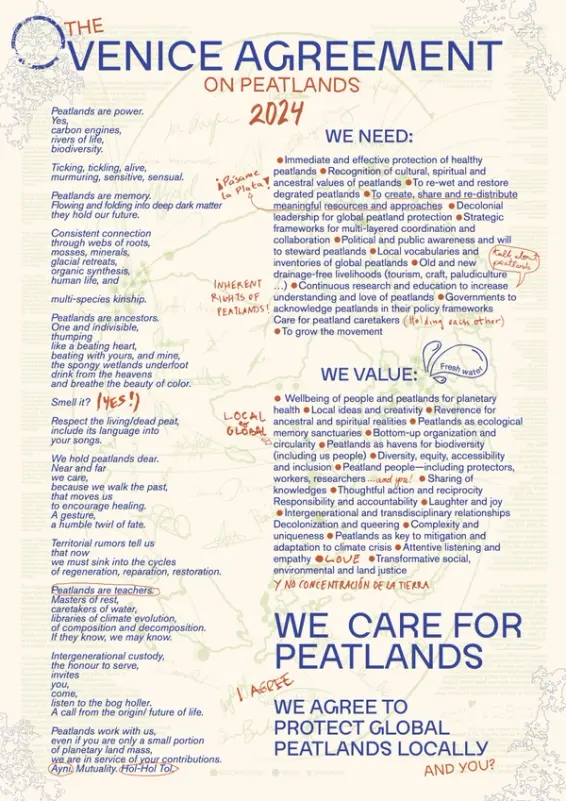
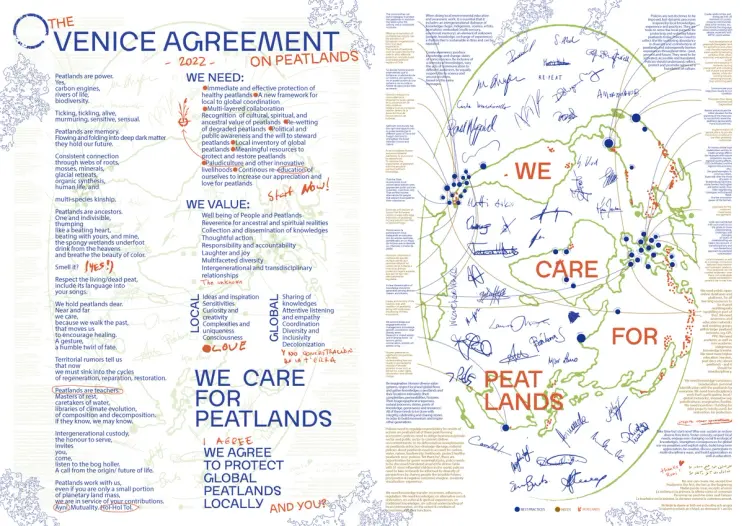
Soon after curating Turba Tol Hol-Hol Tol, in 2023 I found myself in the Caribbean reflecting on all that Ensayos had accomplished in its 12 years. It was in this moment, guided by the mangrove peatlands, that I came to know that it was time to retire Ensayos from the art world. The more our work was receiving recognition, the less we could continue to “rehearse.” There is a nearly prophetic line in Cucú and Her Fishes, wherein Cucú, played by the ecologist Bárbara Saavedra, , declares, “When we are together inside four walls, under a roof, away from the peatlands, away from the water, from the forest, we forget we are part of something intricate, much larger than us…. We need to be out there, we need to be there enough that we stop thinking of it as the outside. This is how we can shake off our humanness, this is how we can transform!” Retirement, I thought, is a strategy that requires offerings and sacrifice, giving up the discursive safety of the art world, the separateness that art needs in order to establish itself as a superior process of reflection, as representation rather than submersion.
The I-Ching persistently and emphatically repeats that only change is eternal in the universe. Everything that exists passes through the phases of growth/decay, activity/passivity, advance/retreat. If we view these cycles cosmically, retreat is not defeat or injustice, but an essential part of the game and the wisdom of life.
Why is it so hard for us to let go of the figure of the artist/author? To relinquish the productivist individualistic values that have degraded the conditions and quality of life for most forms of life? What must continue to be done to re-blend art and aesthetics with science, activism, spirituality, and policy work? What stories must we tell about the end of life as we know it in order to allow for new/old fusions, con/fusions, with our surroundings?
With these questions in mind, I led Ensayistas on one final exercise of collective rehearsals around endings. First, I invited Boricua filmmaker Llaima Suwani Sanfiorenzo Llaima Suwani Sanfiorenzo to guide us through her filmic collective self-portraiture methodology, proposing that we consider the process a retirement gift, an Ensayos exercise in learning when and how to end things well. The resulting film premiered on November 22, 2024: Ensayando el Fin Ensayando el Fin (Rehearsing the End) collects portraits of 14 Ensayistas who offer personal stories, music, images, and illustrations to mark the public and intimate milestones of a project coming to an end after 14 years. Each Ensayista shares their unique vision of how Ensayos is part of their biography, crystallized in valuing and caring for a place like Tierra del Fuego, interconnected with Venice, Paris, New York, Meanjin, and the fjords of northern Norway. It is a wild assemblage of storytelling styles that narrates a tale of interdependency and care networks through overlapping images, sonic dialogues, and behind the scenes memories. The film blends corporal expression, textile art, sensory experiments, and scientific laboratories in a delirious, turbid mess that hopefully leaves viewers with this final feeling: there is a sacredness to losing one’s self. It is a communion with the ungraspable. No need to be distinct, best to be part of la turba, the unwieldy mob. United. Con/fused against the face of the tyranny of the individual.
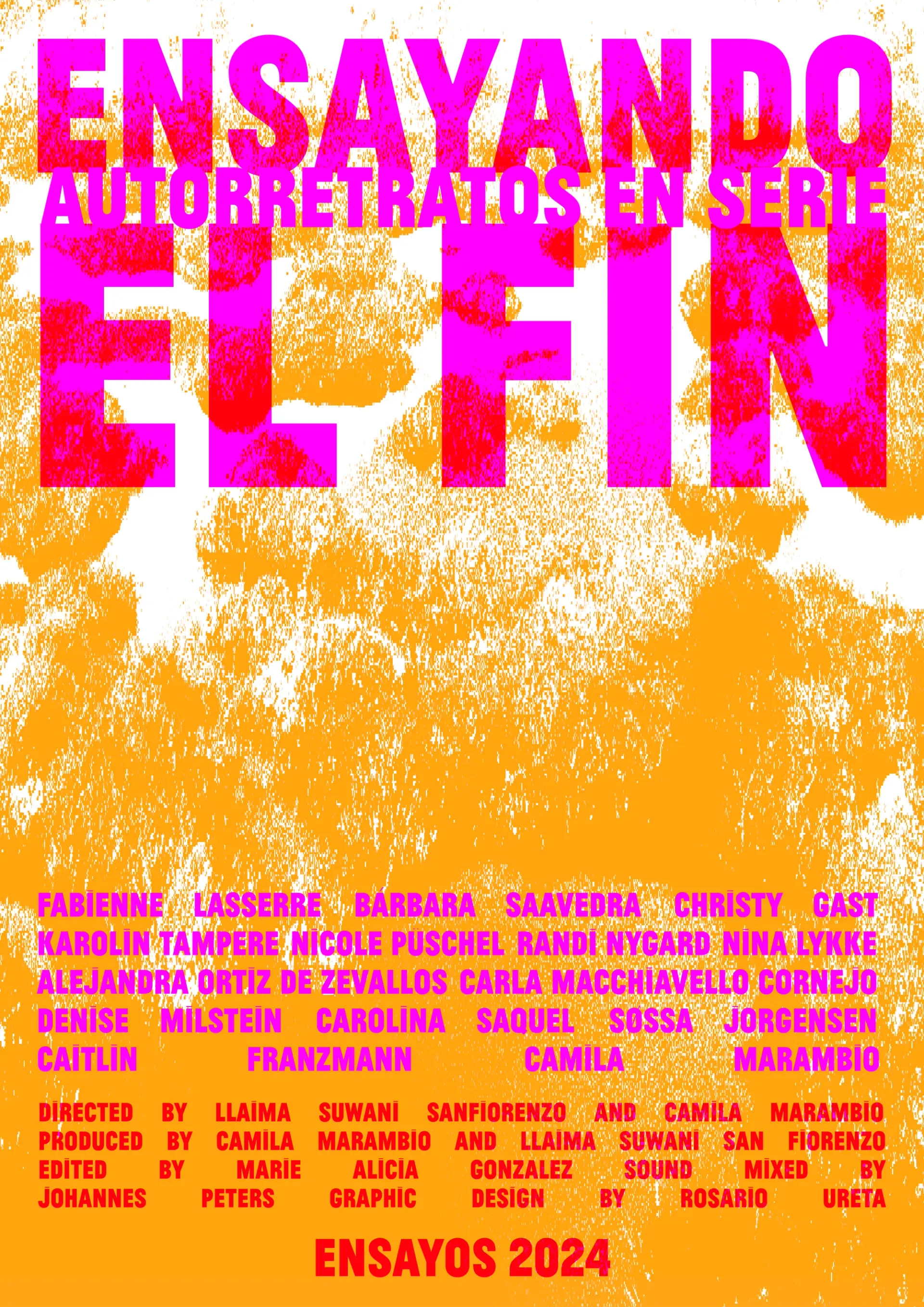
Film Poster of Ensayando el Fin by Rosario Ureta (2024).