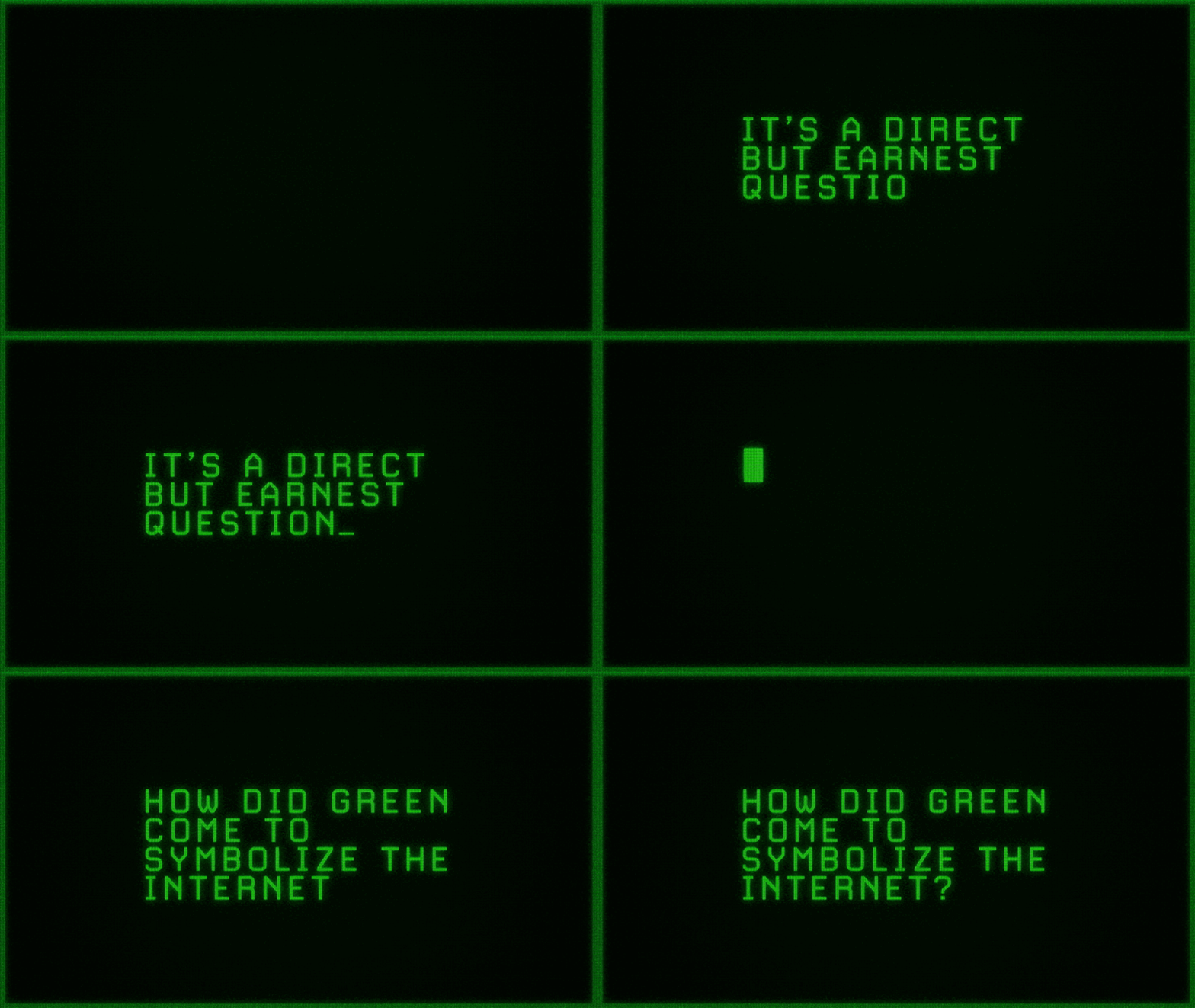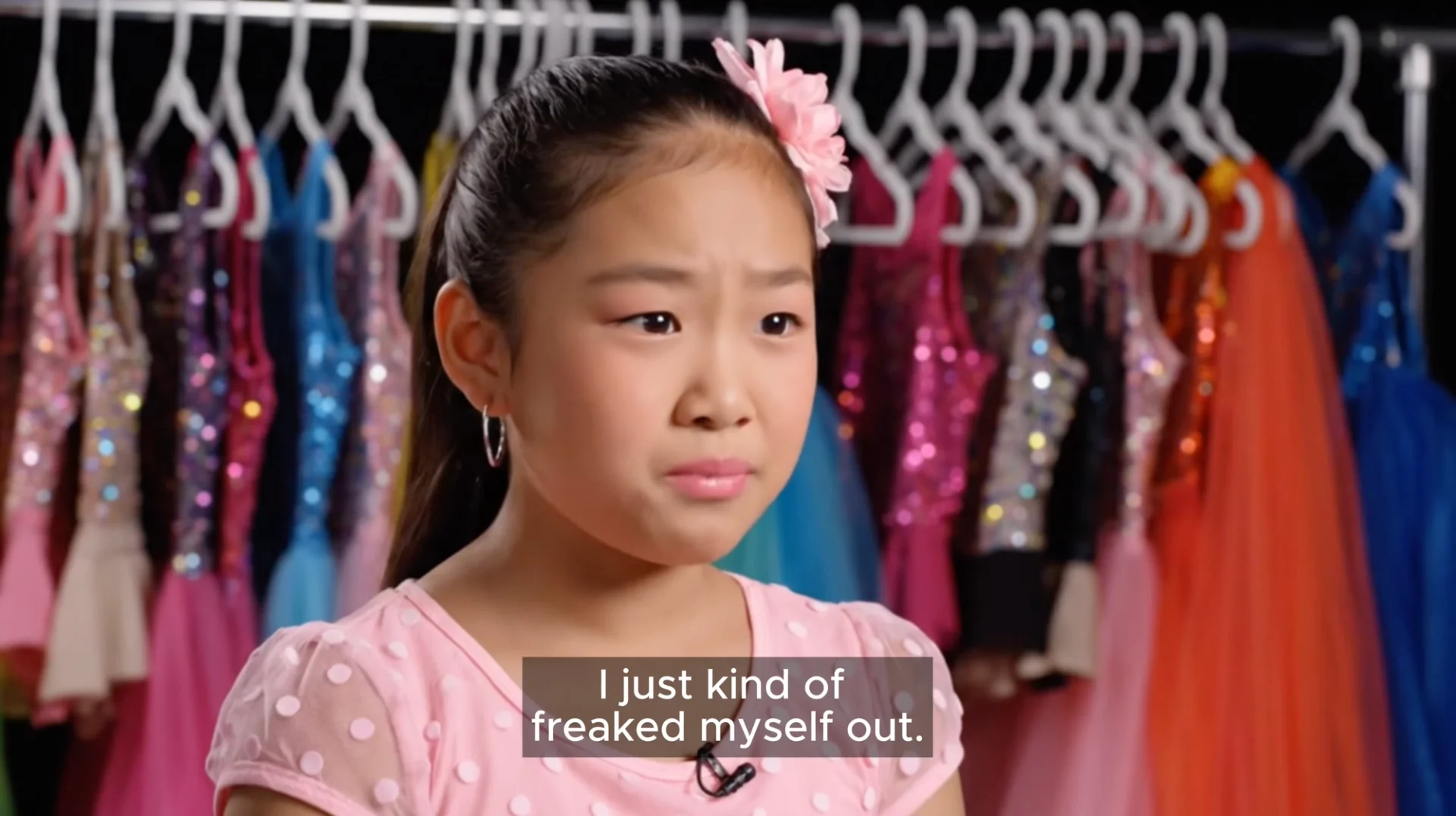
Maya Man, StarQuest, 2025, custom generative software, color, sound. Courtesy of the artist.
Artist Maya Man writes what it means to make art with AI.
Artlab Editors: Artist Maya Man questions what counts as “real art” and breaks down her process to reveal how working with AI continues the legacy of the conceptual turn.
On the cusp of her highly anticipated album release, American singer-songwriter Olivia Rodrigo debuted a new, limited-edition picture disc vinyl available exclusively through her website. The portrait, an oil-painting by artist Chloe Wise, features the pop star gazing up at the blade in her hand. Under the duo’s Instagram post announcing the product Instagram post announcing the product , comments celebrated the commission as a sign of support for “real art.” A top comment with more than six thousand likes declares: “In a World of AI this is very important.” The replies enthusiastically echo, “for real, I was so relieved to see how she's been working with real artists,” and “yesss this and the music/lyric videos being real art is so important to me.”
Painting is no longer merely painting—it is now also distinctly “not AI.” Marketing teams are duly taking note of this new shift in public opinion. A recent ad for the cryptocurrency marketplace Coinbase, titled “Your Way Out,” “Your Way Out,” features a man trapped in a video game-style world. He walks with a Sims-like diamond over his head, encounters NPCs, and moves through a world made up of blocky geometry. A strategic behind-the-scenes video reveals that the entire production was made without CGI, using costuming and physical set design to achieve digital-looking effects. One commenter concedes that the commercial is “a work of art” in spite of their own distaste for the company. Another remarks: “Wow interesting I thought the whole time it was AI slop (AI filter over real footage).”
Unsurprisingly, the words “real” and “art” continue to swirl at the center of the general public’s anxiety around generative AI’s consequences for creative production. But I am continually puzzled by artists’ who echo this fear. Is the sanctity of art truly threatened by AI? Or do these fears merely distract from AI’s more dire consequences? What makes art “real” anyway?
We are not in an art historical age that judges art on aesthetics and craftship alone. Since the 20th century’s conceptual turn, the public has been increasingly and steadily exposed to work by artists who foreground concept and process. Canonically, Duchamp didn’t make Fountain (1917) with his own hands—he produced the idea, and the rest was ready-made. Countless artists have doubled down on this throughout art history: Sol LeWitt defined a series of his work through a set of executable guidelines, and these guidelines were often works in and of themselves. In Grapefruit (1964), Yoko Ono, a Fluxus pioneer, defined instructions for producing a work: “Get a telephone that only echoes back your voice. Call every day and talk about many things.” These artists essentially wrote algorithms, a set of step-by-step instructions intended to produce a specific outcome. In other words, they wrote prompts.
My most recent body of work, StarQuest, restages scenes from the American reality-television series Dance Moms through prompting generative AI text-to-video and text-to-music models. The final work consists of 111 unique, 8-second videos. But the medium of the work is software: a web-based application that infinitely shuffles all of the scenes like songs on a playlist. The work has no set duration and there is no single video file to play. Instead, an algorithm rearranges the clips in real time, producing an ever-changing sequence, akin to the way that content is served via TikTok or Instagram Reels.
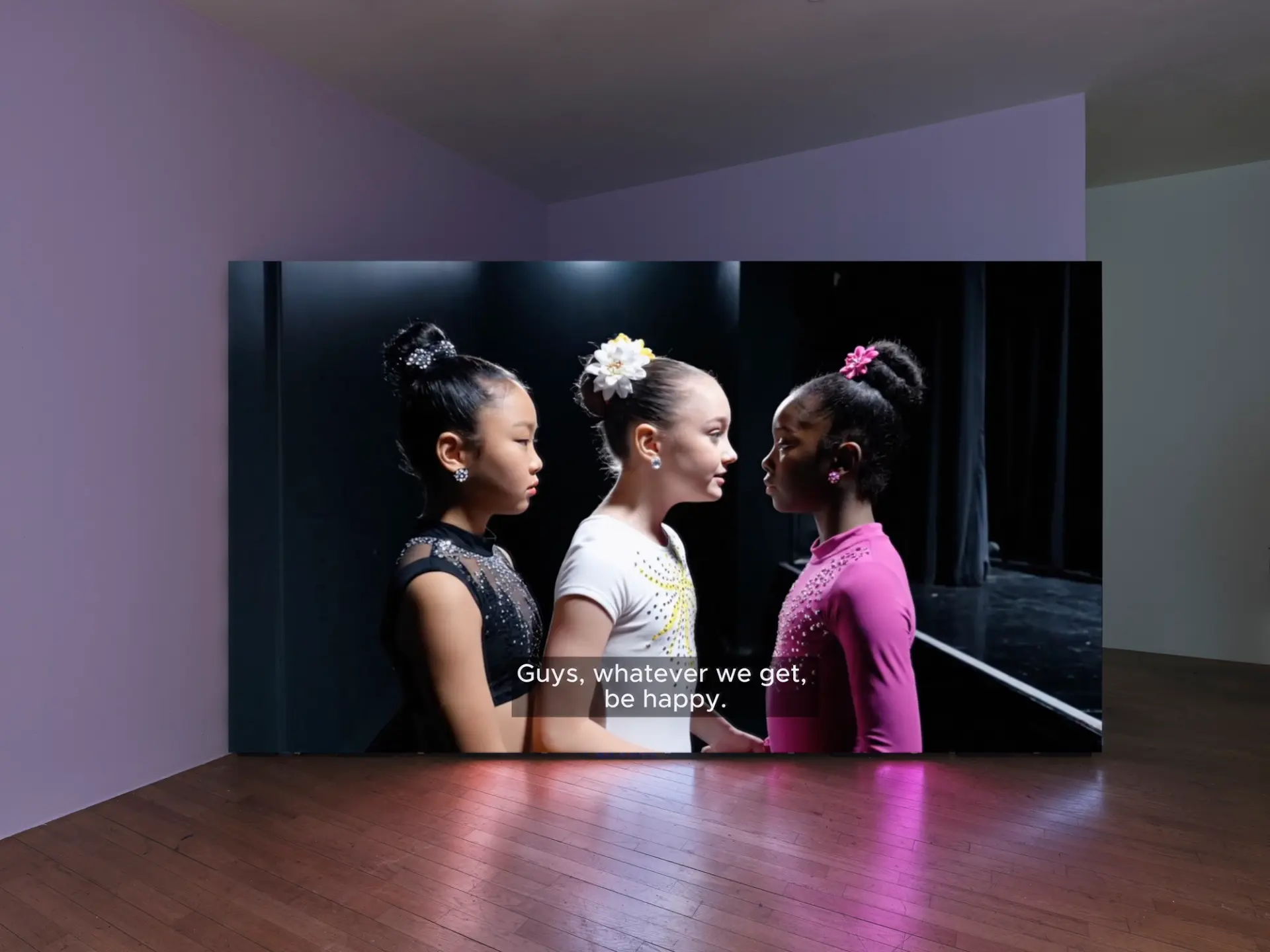
Maya Man, StarQuest, 2025, installation view in StarPower, bitforms, New York, 2026. Photo by Max C Lee-Russell. Courtesy of the artist and bitforms gallery.
This project grew out of my fascination with the parallels between the discussion of “reality” in both reality television and AI-produced media. Even though most people agree that reality television is highly staged and produced, we still watch it with a suspension of disbelief. My practice is haunted by questions around what constitutes someone or something “real,” especially in relation to the internet. Appearing to be “real” online is equated with moral goodness and authenticity is next to godliness. That’s how I was trained to be online and that’s also how machine learning models have been trained since the early days of AI research. A model is deemed successful if its output can fool a person into thinking it is “real.”
While producing StarQuest, I drew on not only the reality show Dance Moms, but also my own experience. Like the cast of Dance Moms, I grew up as a competition dancer in the suburbs of Pennsylvania. Writing prompts to produce this piece felt like revisiting old memories laced with sequins, tulle, and fluorescent studio lighting. To produce each shot, hyperspecific details—the dancer’s age, her dress, how she moves—are strung together to act as instructions for the AI-video model to execute.
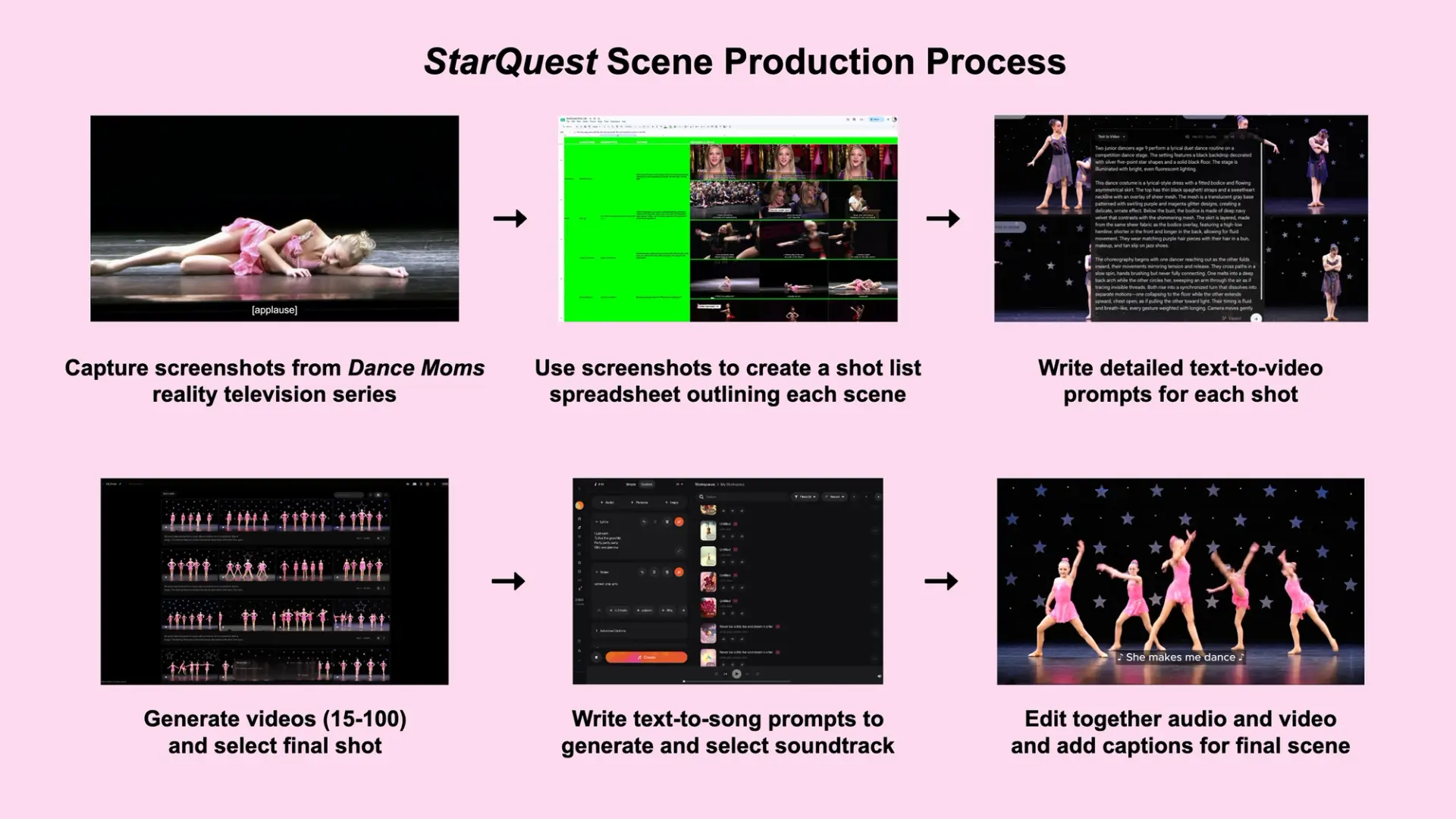
Process visualization diagram. Courtesy of Maya Man.
As I constructed these prompts, I was surprised to no longer identify as a dancer in the work. I had become the coach. The dancers perform on stage, executing instructions as trained. The process of making this piece, looping back and forth between prompt and video for hours in the studio had shifted my perspective. I ruled over my digital dancers with my directions and my vision. I sculpted them and their experiences through my written prompts. I was not performing choreography—as the artist, I was writing it.
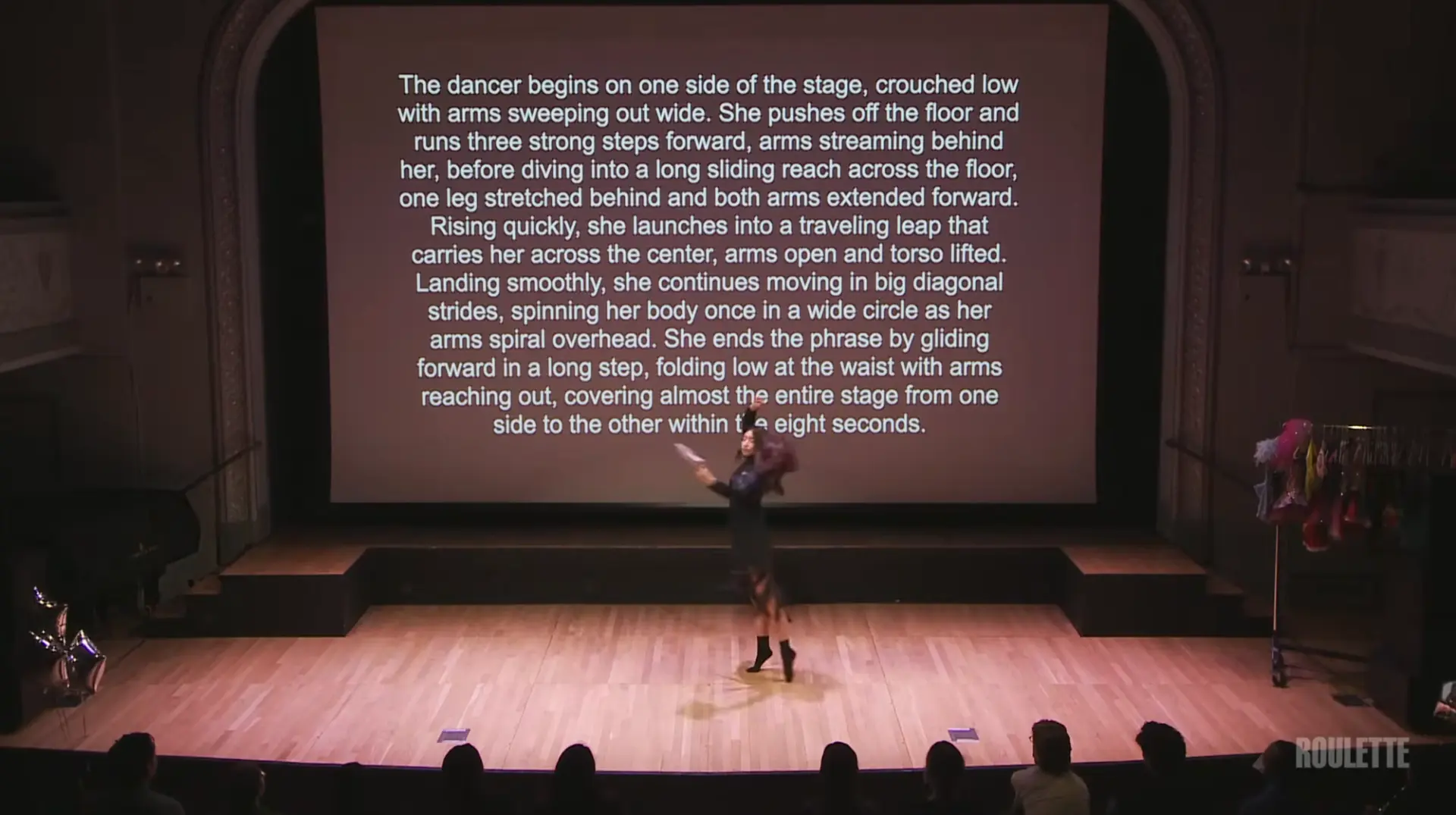
Maya Man, StarQuest, performance-lecture, presented by Harvestworks, Roulette, Brooklyn, 2026. Courtesy of the artist.
In Sol LeWitt’s 1967 Artforum essay, “Paragraphs on Conceptual Art,” he writes that “the idea becomes a machine that makes the art.” The conceptual form of art demands “that all of the planning and decisions are made beforehand and the execution is a perfunctory affair.” Like many conceptual artists, my practice consists of designing systems. I am actively interested in putting distance between myself and the work, destabilizing the "artist's hand” and the agency it implies. StarQuest’s use of AI is not a shortcut to avoid the more laborious and expensive process of live-action filmmaking. Instead, it is a deliberate conceptual choice. The model’s visual interpretation of a prompt, mistakes and all, become an essential part of the piece. Reality is more fragile than ever and the post-truth era of content requires us to up our level of media literacy. My desire to critique a culture of gamification, aspiration, and optimization is inherently tied to my use of a technology that carries urgent implications for the manipulation of public thought through generative media.
Thus, I view reactions to dismiss AI based on a forced definition of “real art” that opposes new technologies, as escapist. It betrays a desire to hide from the contemporary world rather than confront it, which I believe to be the antithesis of what contemporary artists can and must do. As Rachel Ossip writes in “Eat Poop You Cat,” her piece on generative AI artmaking for n+1: “Any boycott of GenAI imagery is bound to be as effective as a boycott of digital photography to prevent photo developers from losing their jobs, or putting your laptop on the curb in hopes of reinvigorating the market for typists.”
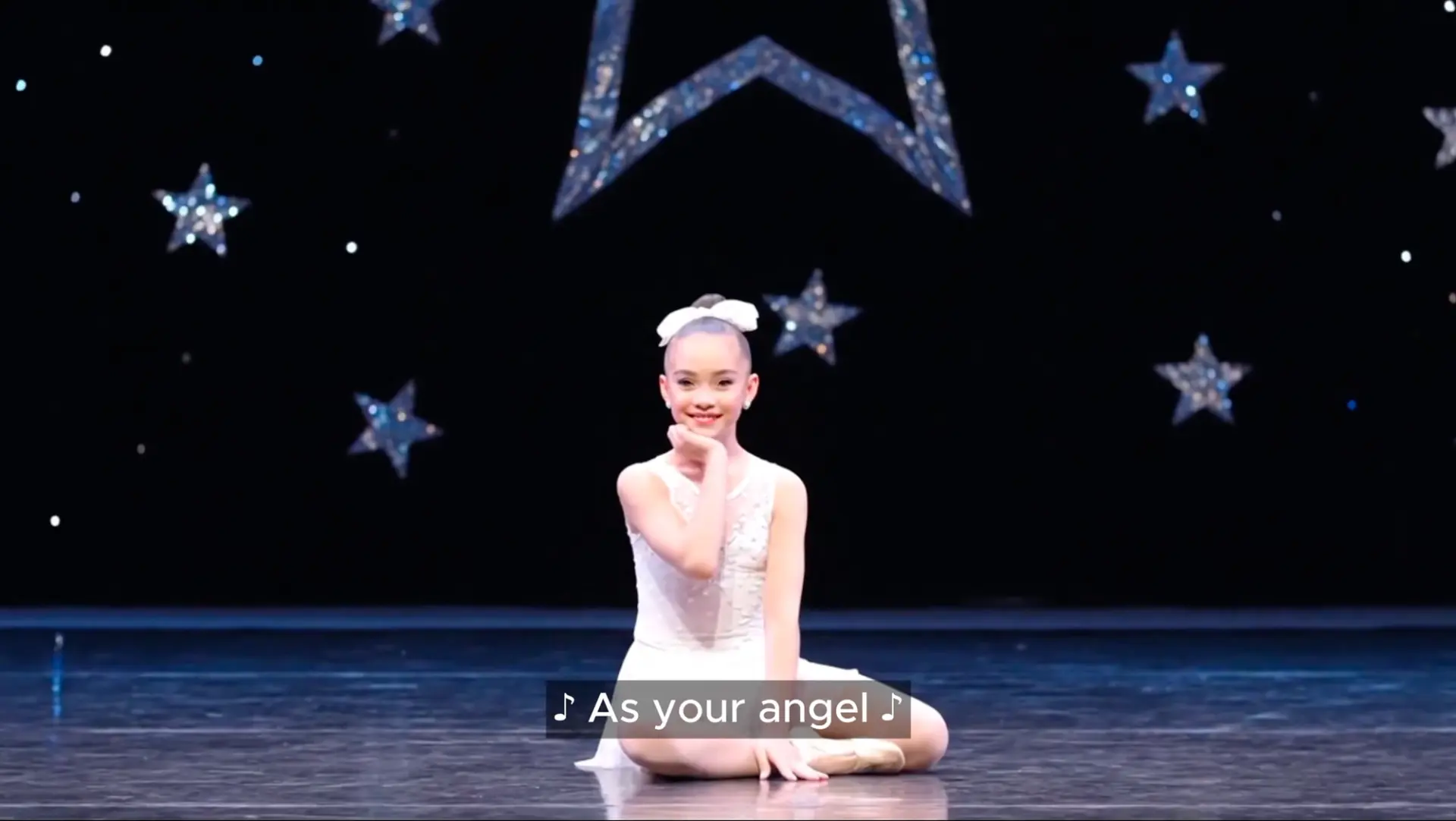
Maya Man, Still from StarQuest, 2025, Courtesy of the artist and bitforms gallery.
Of course, the vast majority of AI-generated media will be slop. Generative AI accelerates the rate of the production of writing, music, images, and video—but slop holds little relevance to art. In a recent essay for Spike, Lucas Gelfond argues that “mass slop has nothing to do with art, just like photos to remember your parking space don’t implicate photographers, nor does a receipt degrade writing.” My camera roll is filled with self-captured images, but I don’t dare fancy myself a Photographer. Similarly, I don’t fancy content coming from an account posting AI-generated influencer-style “day in my life” videos of their Yorkshire terrier account posting AI-generated influencer-style “day in my life” videos of their Yorkshire terrier “art” in the traditional sense. That isn’t a knock on the content. But I believe it’s important to clearly differentiate the contexts in which these images operate and what they are trying to do.
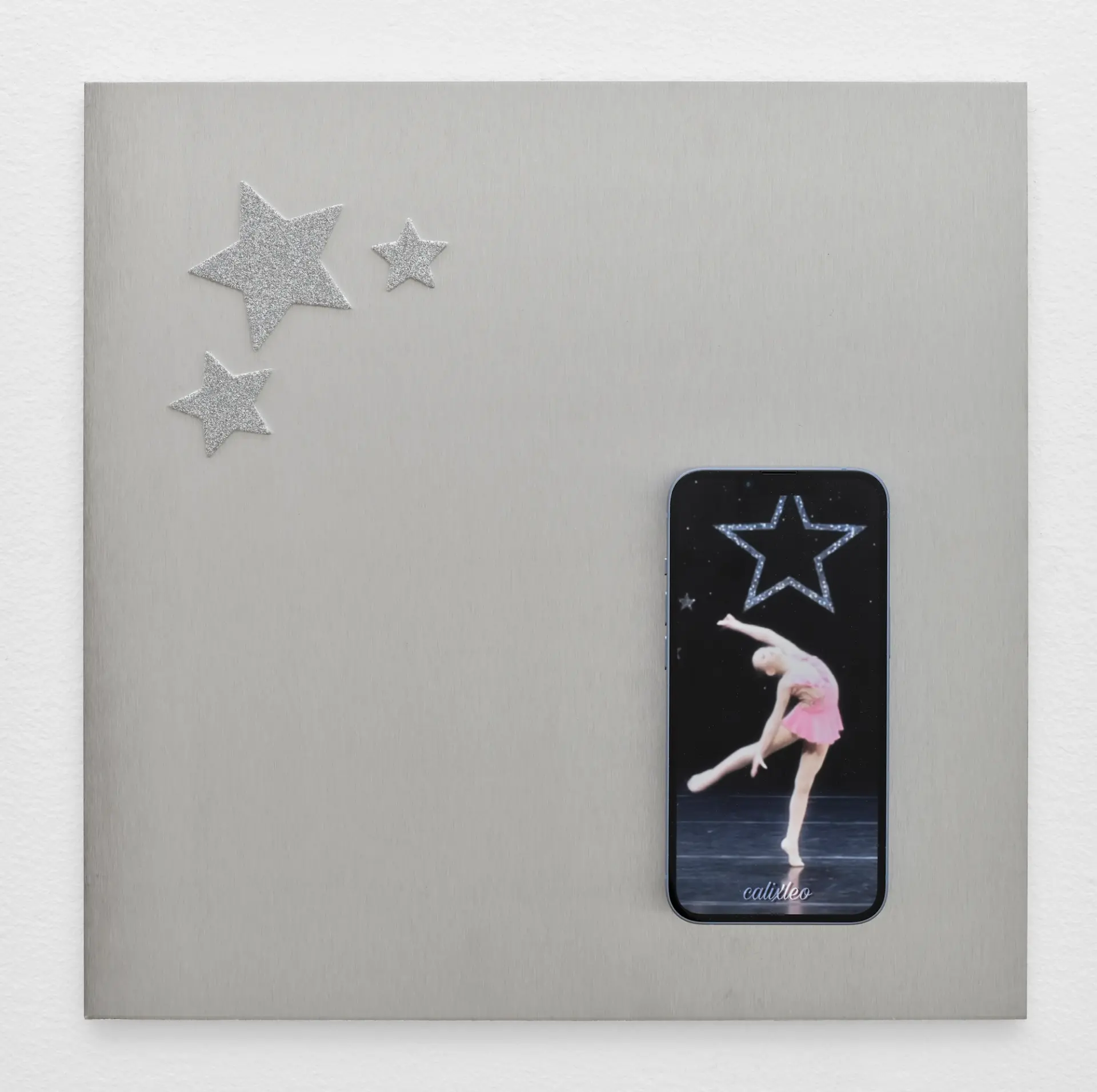
Maya Man, StarQuest Edit #1 (like a fucking dream), 2026, metal panel, smartphone, smartphone mount, video (color, sound), 11 seconds, loop. Photo by Max C Lee-Russell. Courtesy of the artist and bitforms gallery.
Though AI threatens labor and commercial artistic opportunities, I do not believe that it threatens fine art. The best work made with AI does not employ neural networks as a craft, but instead as a conceptual methodology. Artists have rolled with the punches through the introduction of a range of emerging technologies. French painter Paul Delaroche, famously, ostensibly, declared that, “painting is dead” upon first seeing a photograph in the mid 1800s. But maybe, looking back, the more appropriate reaction would have been to assert that painting is liberated. From that point on, it no longer needed to operate as a primary method of image-based documentation. Since the advent of personal computing, everything from the internet, Photoshop, CGI, and TikTok have been accused of undermining the sacred practice of “real” artmaking. But through it all, we now have the hindsight to know that artists have reacted and recalibrated in strange and fascinating ways, with many incorporating these tools thoughtfully into their practice, and forging on. Being an artist today means reckoning with the absurdity of reality as it’s rendered. I trust no one more than artists to keep it real.