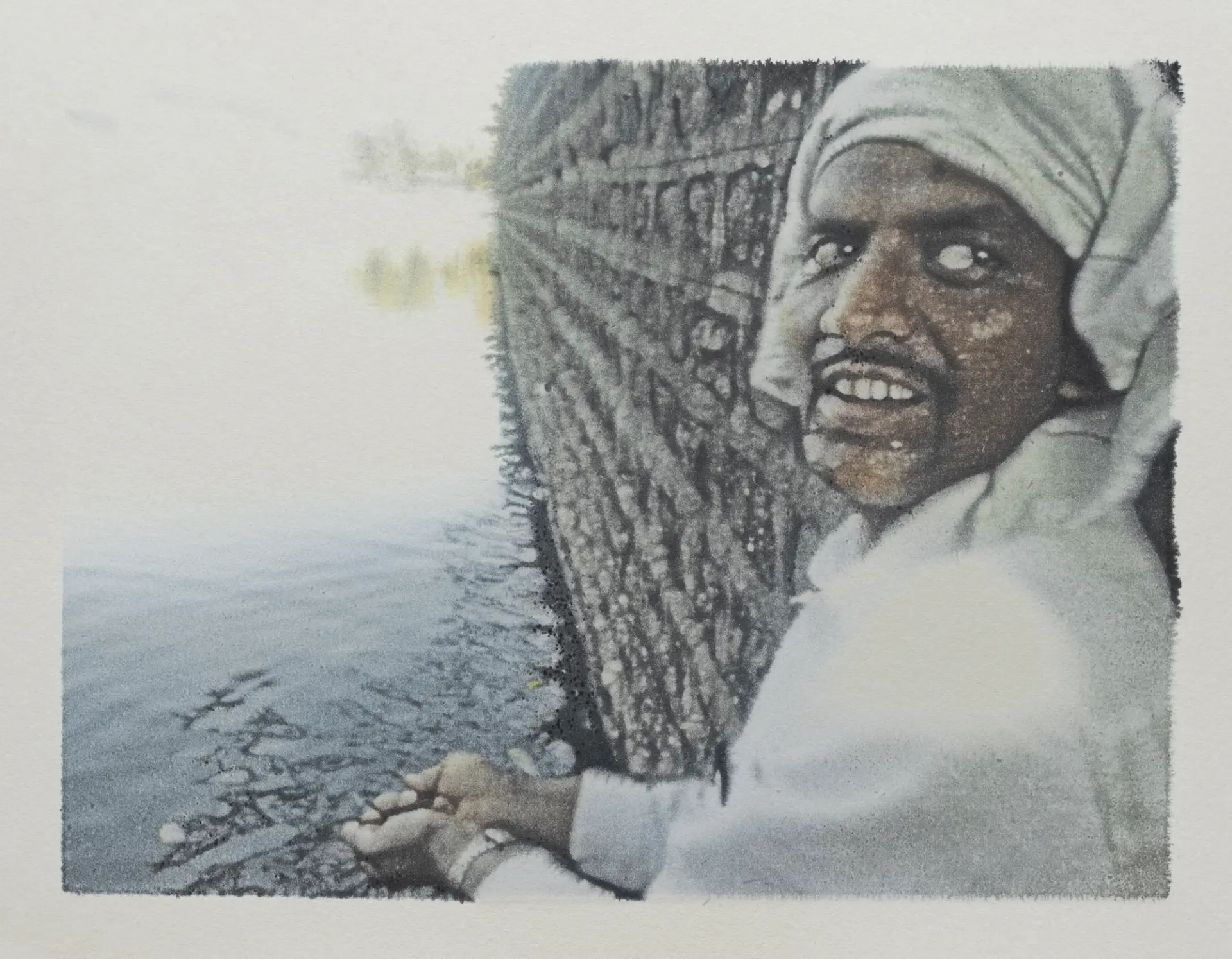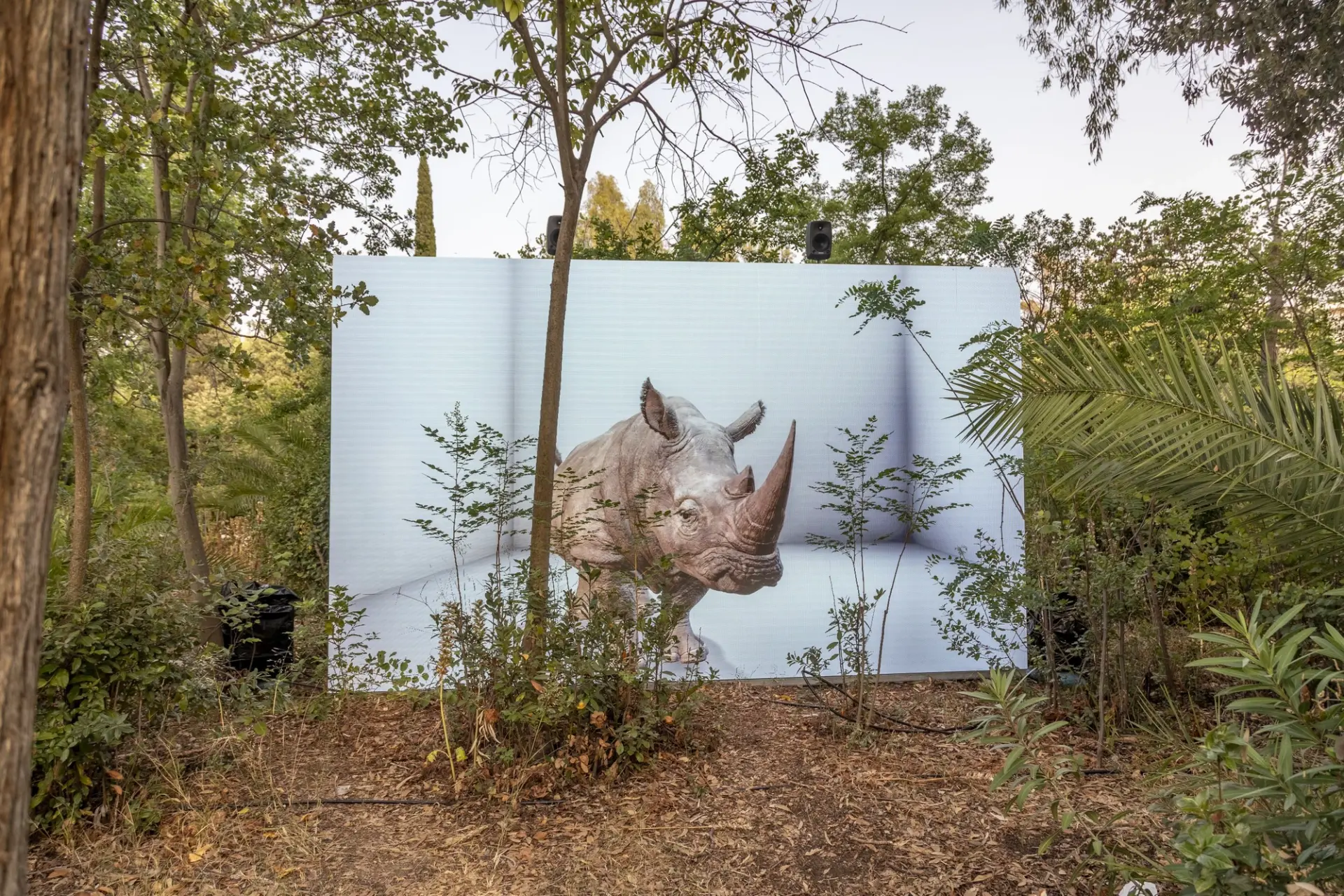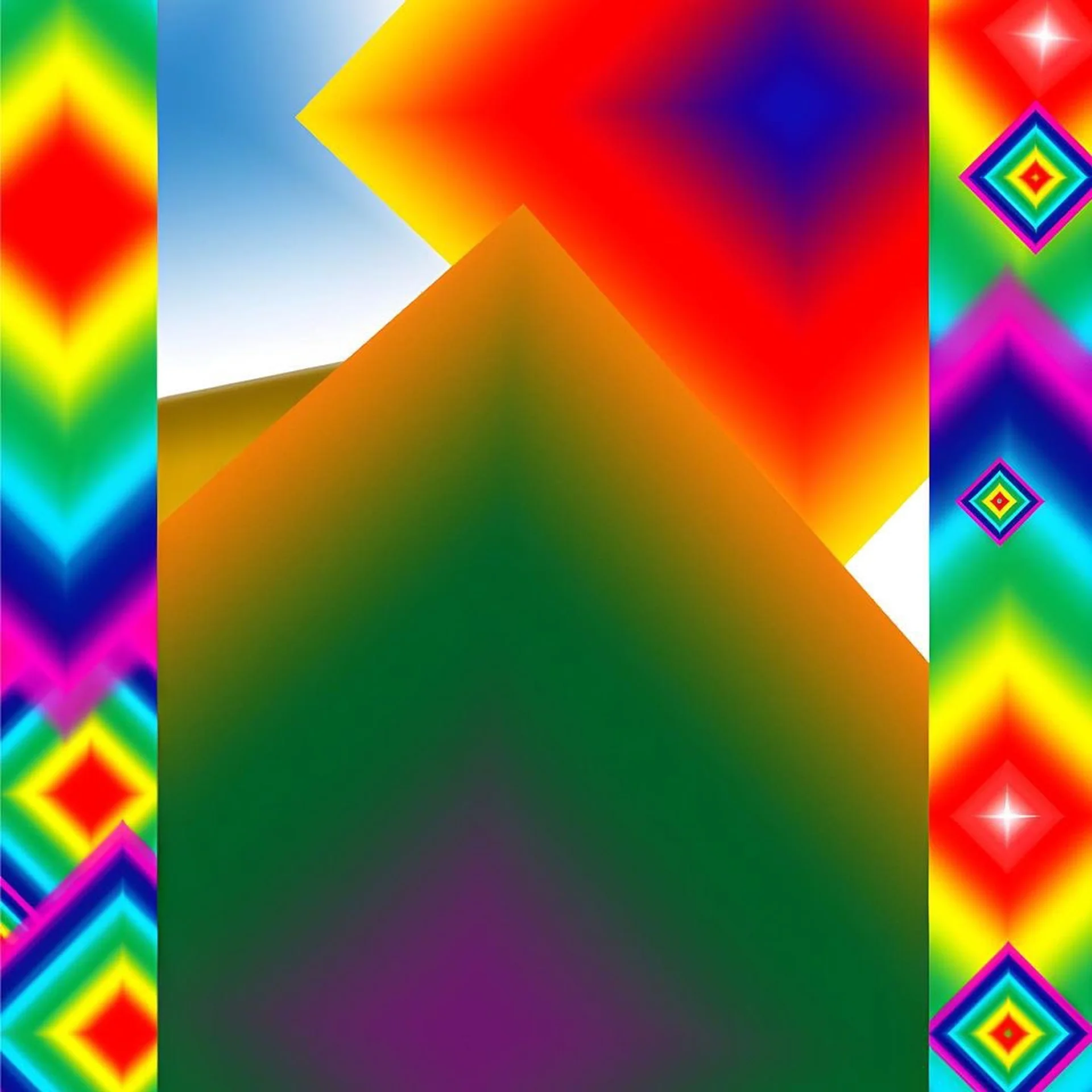
Edgar Fabián Frias, Animacy, 2024.
Courtesy of the artist.
2024 Artlab Editorial Fellow Kira Xonorika explores how Indigenous artists are creating pluralistic worlds through emergent technologies.
Artlab Editors: For her first essay of the 2024 Artlab Editorial Fellowship, Kira Xonorika traverses the cosmos of Indigenous histories and thought to outline a constellation of artists using technology to materialize Indigenous Futures. By rendering the invisible, reinstituting magic, relearning language, and refuting linear timelines, artists like Edgar Fabián Frias, Maya Chacaby, and Violeta Ayala are mapping new possibilities for Indigenous return.
For the spirits of Tongva Land, whose embrace gave me tekoha.
Land back: home
Land back is not a metaphor
Land is the familial bond to all beings
Indigenous Futurism is planetary intelligence
Indigenous Futurism is the affirmative effect of reparations
Culture can—and often has—functioned as a weapon of colonialism. It tells a people that they are ugly while upholding its own notions of beauty. It tells a people their practices are ridiculous. It introduces art that bears the aesthetics of divinity, symmetry, and proportion. It brings foreign artifacts and calls it advanced technology.
This semiotic cluster is a spell. It takes away all the resources and invents their privatization. In the face of resistance, it enforces domestication or death until it's internalized. It will tell a people that it is here to save them. Future generations will be numb from trauma.
The complexity of culture is its amalgam. To traverse and reassemble what has been deterritorialized, it is vital to identify constellatory thinking—a plurality of Indigenous futures that emerge despite the colonial project-spell of homogenization.
Earlier this year, I participated in a panel on the future of artistic agency framed by artificial intelligence at the Salzburg Global Seminar. Over the course of four days, artists, activists, policymakers, scientists, and technologists were brought together on the theme of ‘‘Creating Futures: Art and AI for Tomorrow's Narratives.”
In spaces where global policy is generated, I am accustomed to tokenism; typically, I am the only trans or Indigenous person in the room. This time, however, there were many of us, including Berlin-based Purhépecha-Mestiza cyberfeminist, Dr. Tiara Roxanne; Brazilian artist and scientist, Walla Capelobo; Anishinaabe professor and artist Maya Chacaby; and Turkish-Hawaiian artist and AI policy advocate, Sherry Wong. Naturally, we gathered. Through it, I found family.
Our collective work produced a decolonial guide for the seminar that included protocols for confluences and dignity—a roap map to facilitate the flourishing of futurity via material conditions. In order to engage in decolonial production meaningfully, we established that one must be 1) Actively working on dismantling obstacles and systemic barriers 2) Redistributing resources and sharing power 3) Committing to long-term structural changes at all levels 4) Building reciprocal partnerships based on respect and accountability, and 5) [Engaging] a justice-oriented approach.
Maya Chacaby noted that for Indigenous peoples, it is only until now that we have been able to imagine building our civilizations. Affirmative material conditions and resources brighten paths; creating these material conditions allow for the symbolic reparation of recovering imagination. One of the most critical things we, as Indigenous artists, can establish is this right to imagine. And now that we are resourced, what do we invest, protect, and project into the future? What is the constellation we will draw in the night sky?
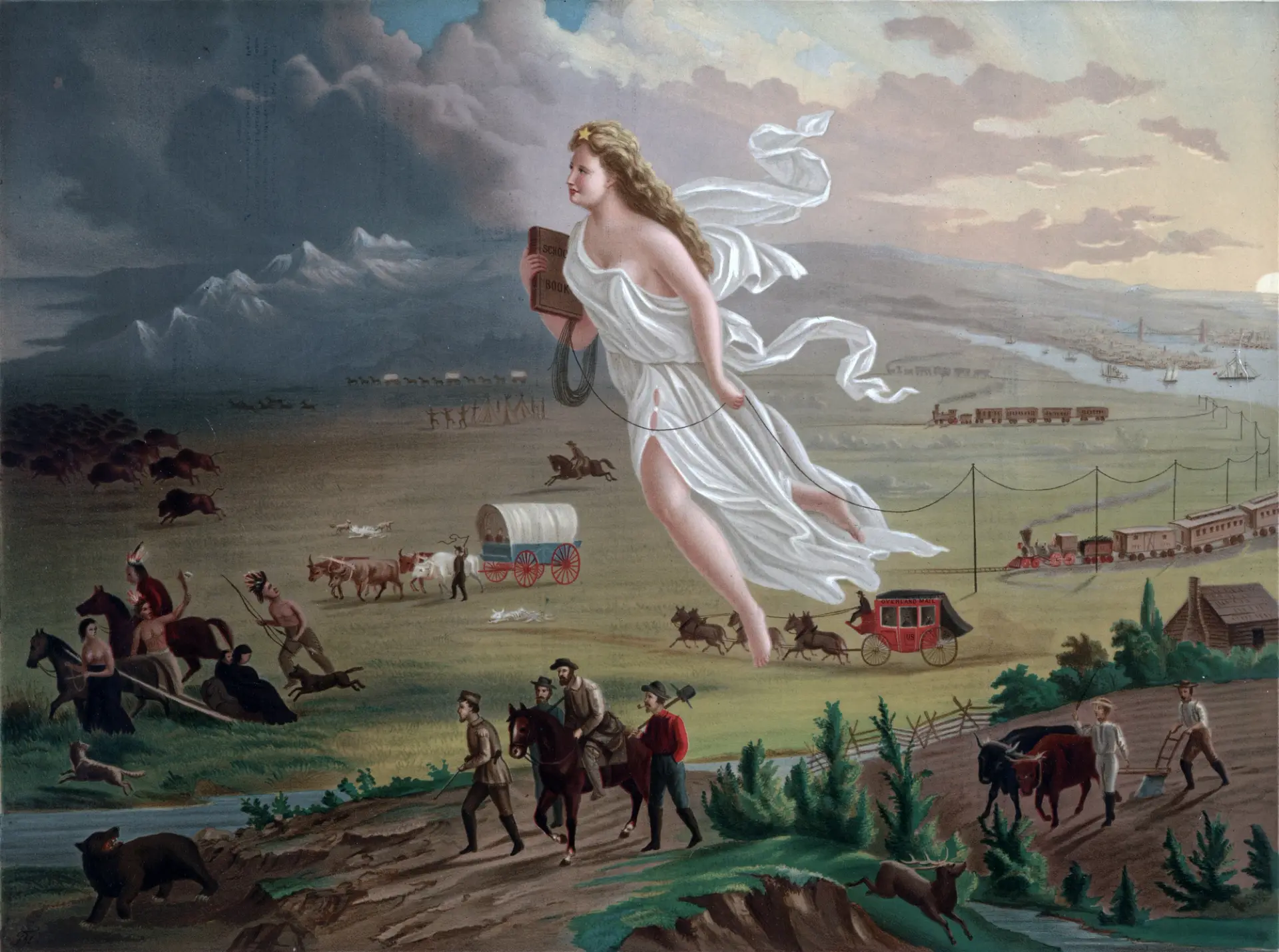
John Gast, American Progress, 1872.
Photo: Autry Museum of the American West, Los Angeles.
Source: Wikimedia Commons
In “American Progress,” a didactic painting from 1872, the painter John Gast details the creation of a legacy of American exceptionalism. Presented as a chronology of territorial conquests, the painting features an allegorical angelic figure of “Progress” descending from the heavens with a star crowning the top of her head. She guides settlers westward with guns, wagons, railroads, and domesticated animals. As they move ‘‘forward,’’ we see native peoples being displaced. Gast paints land as a resource for extraction, navigation, transit, and frontier dominance.
Divine anthropocentric intervention is central to Western epistemologies. This is evidenced through “Manifest Destiny,” the 19th century belief in the divine right of settler expansion across North America illustrated in Gast’s work. It is also evidenced in the 1493 papal ‘‘Doctrine of Discovery,’’ which authorized European military exploration and the stealing of territories which had not been inhabited by Christians in the ‘‘New World” and throughout Asia. At their core, these philosophies aim to uproot and eradicate the non-human, the extra-human, and the more-than-human—the other.
How do Indigenous artists move forward while navigating such histories? Is the work of futurist foresight always objectivist, aiming to dismantle or reinvent paradigms ahead of the past? Is memory something that only belongs to the linear past, housed in archives and processes?
When I think of return, I think of memory processes that are part of somatic revitalization, and in this, the possibility of inhabiting the world in another dimension of sovereignty. This process exists between the Krenak (an Indigenous people of Brazil) term "florestania"—citizenship of the forests—and the Anishinaabe (Indigenous peoples of the Great Lakes region of North America) understanding of Toni Morrison’s “rememory” as a return to the woods as a space for communing. Return here means returning with what has been separated. It does not imply a romanticized condition of idealizing the precolonial world, but a return to a way of “being” in the world—to reassemble realms.
The opening of portals and incantations are a part of such plural cosmotechnics—the operations they conjure transcend binary frameworks. One of the contemporary challenges in translating re-Indigenization is that our sovereignty often questions the Western tendency to separate science, art, and the unintelligible. Regimes of intelligibility are colonial technologies that preserve the axis of the gender binary, written vs oral communication, and surveillance. The ostensible objectivity of the Western scientific approach faces difficulties when grappling with that which cannot be translated, as it adheres to regimes of visibility and transparency. But how does it account for more opaque operations—the invisible and the untranslatable?
Against these fixed outlines, Wixárika artist and brujx Makuyeika, Edgar Fabian Frias creates virtual, holographic maps that embrace diffusion and fluidity. Unlike Gast’s “American Progress,” the figures in Frias’s works are integrated into the landscape, their colors synthesizing with the environment. These are maps for contemporary ancestors, drawing from “Nierika,” a Wixárika technology for world-making.
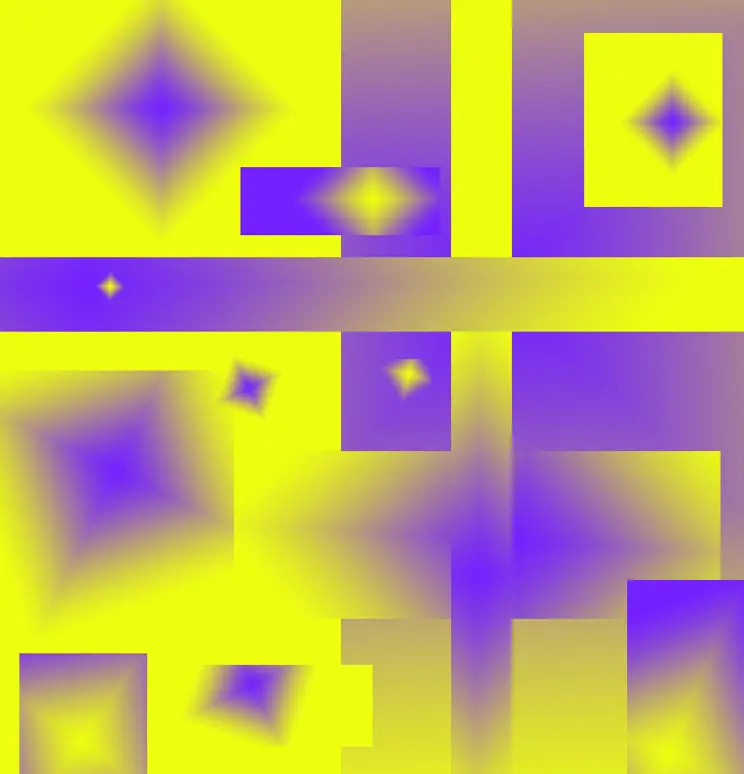
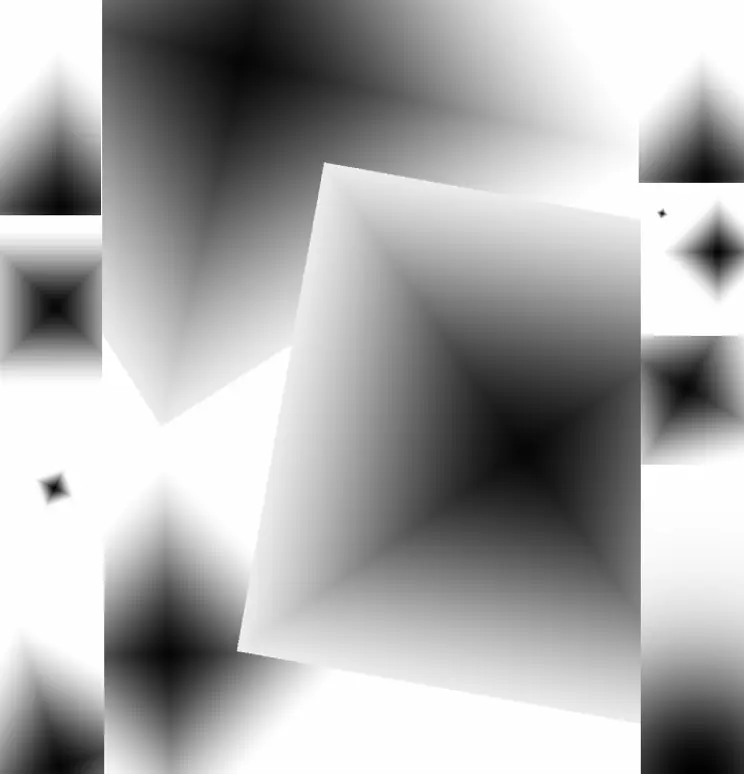
Unlike the maps we read today, Frias’s maps are multidirectional and polyfocal, where the landscape merges into synthetic geometries and colors. Color is seen as medicine and activism against what the artist describes as “Western chromophobia,” which can deepen anxieties and conservative approaches—desires for order, control, and intellectual detachment. The motifs are synthetic forms containing nonhuman ancestors, from mitochondria to mountains, stars, and stones, reflecting a profound connection with deep time. Many Wixárika visual representations were originally created from seeds and painted with natural materials. Like many Indigenous cultures, they have embraced transculturation and the use of industrialized materials to continue their practices.
These multidimensional maps are leading to oneself, to a center. Home is where the heart is. Home is where Ancestral Intuition (AI) says “yes.”
Frias’s family didn’t disclose their Wixárika background until Frias was in their 30s because of the shame induced by assimilationist practices in Catholic Mexico. The cruelty of colonialism projects shame onto Indigenous peoples worldwide, attacking their self-esteem as a precondition for land occupation. This is essentially a process of disconnection and disembodiment—a disorientation. According to Dr. Tiara Roxanne, these are “codes the Indigenous body is subjected to using settler colonialist language.” Language has functioned as a point of negotiation, weaponized against Indigenous peoples to erase memories, intuitions, and genealogies. While language hosts communication, it is also a system of perception. It is a home and a spellmaker. This power has been transferred to algorithms, as they seek to automate these previously established semiotic systems. English, being the lingua franca of technology, automates these systems into algorithms.
On Turtle Island and Abya Yala territories (aka: the Americas), projects like Maya Chacaby’s “Biskaabiiyaang: The Indigenous Metaverse Biskaabiiyaang: The Indigenous Metaverse ” are leveraging such technologies—particularly video game engines—to re-teach Indigenous languages like Anishinaabe.
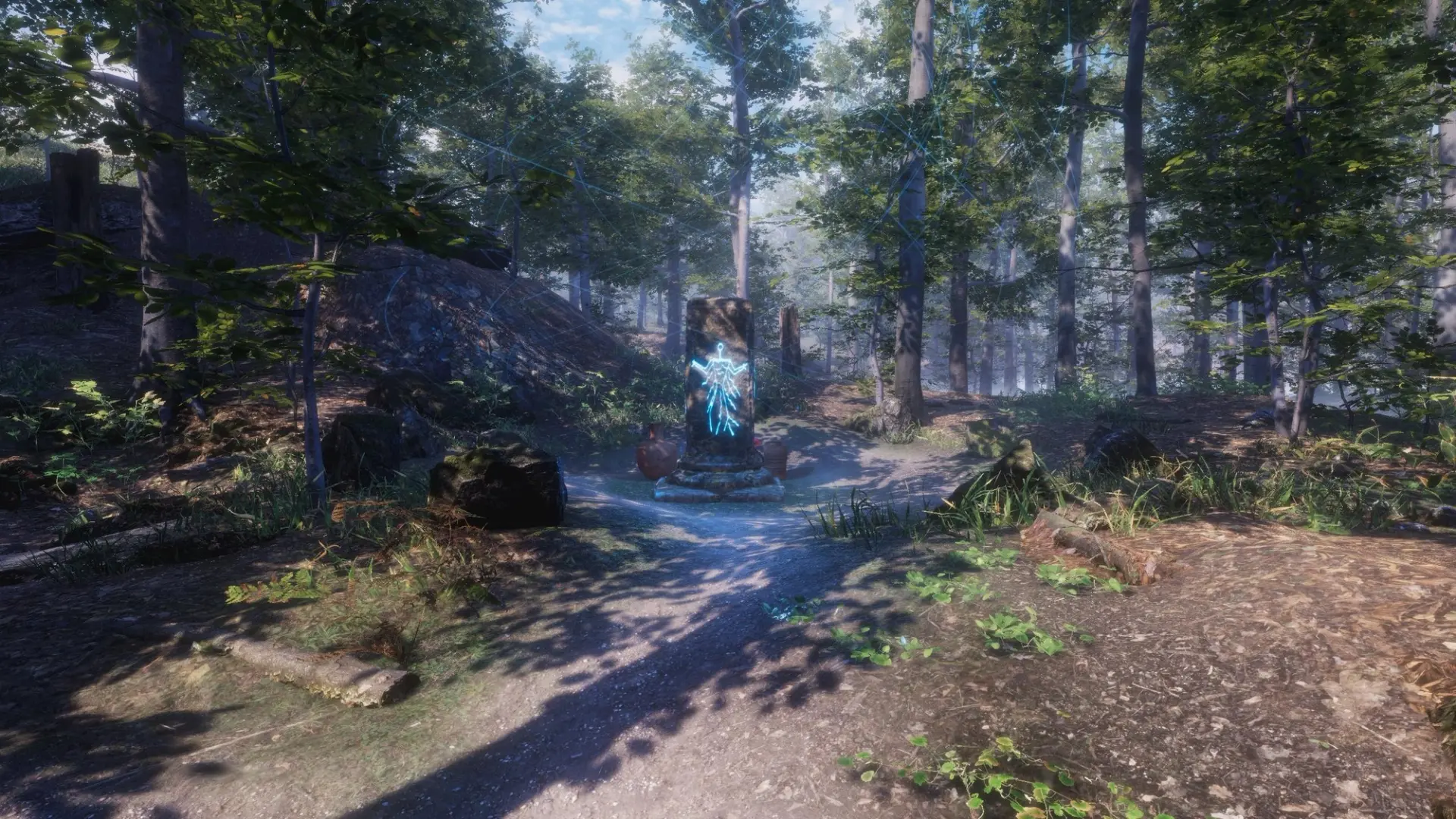
Maya Chacaby, Biskaabiiyaang: The Indigenous Metaverse, 2022.
Photo: Biskaabiiyaang.
Language is alive, and its memory has the capacity to communicate knowledge. In Anishinaabe, the word biskaabiiyaang describes the experience of returning home after a long, arduous journey. It is also often used to invoke cultural resurgence, resist colonial violence, and reclaim ways of being. In her book ‘‘Walking the Clouds,” Anishinaabe professor—and inventor of the term “Indigenous Futurisms”—Grace Dillon explains that biskaabiiyaang is inherent in Indigenous future-making. She writes: “It might go without saying that all forms of Indigenous Futurisms are narratives of biskaabiiyaang […]which involves discovering how personally one is affected by colonization, discarding the emotional and psychological baggage carried from its impact, and recovering ancestral traditions in order to adapt in our post-Native apocalypse world.”
“Biskaabiiyaang” gamifies the experience of preserving language in the aftermath of “contact”—a term used by many Indigenous nations as the apocalypse. Using metaverse technologies and Anishinaabe storytelling traditions, “Biskaabiiyaang” creates an immersive virtual setting for Indigenous peoples to learn their native language safely and return home.
Similarly, Violeta Ayala’s “Las Awichas” uses immersive technologies to reclaim South American Andean symbols and characters. The first Quechua member of the Academy of Motion Pictures and Sciences, as a filmmaker, creative technologist, and artist, Ayala deeply understands the role narratives play in constructing and crystallizing realities.
Translating to “The Grandmothers,” “Las Awichas” uses augmented reality and artificial intelligence to bring the wisdom of ancestral Quechua women to life through animated animal avatars—the gecko, spider, llama, monkey, whale, hummingbird, condor, and jaguar. As these vital creatures interact with the world of the viewer, they bridge interspecies relationships, robotics, land, and memory.
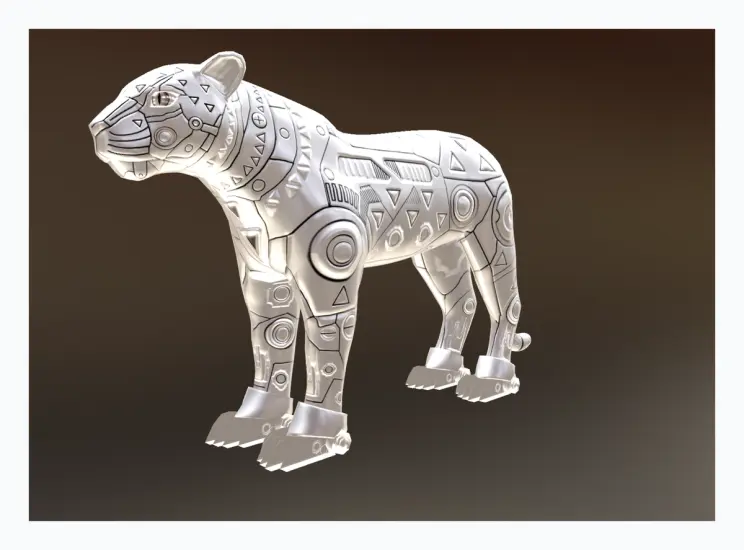
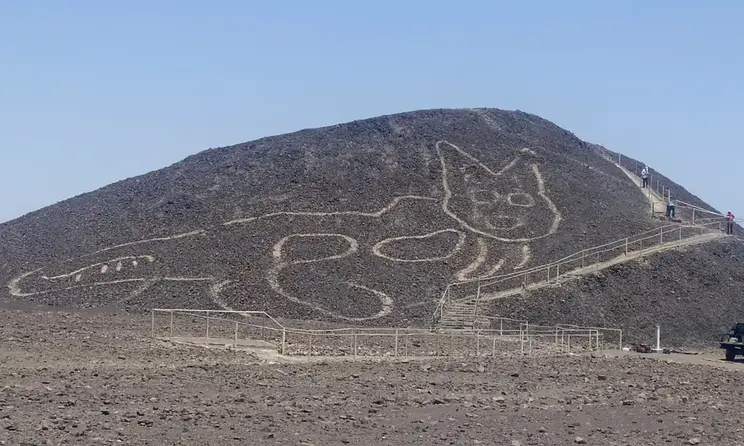
The animals selected in “Las Awichas” are largely inspired by the animals depicted in the Nazca Lines—an ancient series of giant geoglyphs created between 500 BC and 500 AD in present-day Peru. Created by removing top layers of reddish-brown pebbles to reveal the lighter-colored earth beneath, when looked at from above, these furrows in the ground form shapes both abstract and figurative. While the function of such geological inscriptions is a mystery, many researchers have speculated their connection to astrological systems or aquifers.
In “Las Awichas,” the animals of the Nazca Lines are transfigured into today’s technological avatars: robots. Originally conceived of as AI-generated portraits, today, Ayala’s awichas function as prototypes in the artist’s ongoing research and work building robotic agents that are informed by Quechua technologies. By connecting them with maternal lineages, Ayala subverts what she sees as a predominantly masculine aesthetic surrounding robotics, something easily observable in the semiotics of Tesla products and their genealogy from Mad Max.
Much of Western science fiction has been consumed with developing roadmaps for dystopia, wars, and cycles of epistemic-ontological extraction that have defined a legacy for the world. We are currently experiencing a historical moment where technoscientific development has made realities out of what science fiction—under the pretext of serving as a cautionary tale—has unwittingly glamorized and uplifted. This has been the great failure of fiction, which has today become science.
Through their reclamations of futurist narratives and scripts, Indigenous artists like Ayala, Chacaby, and Frias are creating systems to constellate the end of apocalypse technologies and cycles. Acknowledging the power in opaque operations and methods, incantations that Western science cannot grasp, these artists employ magic as an integral force in understanding the full possible scope of our reality. In Frias’s words, “Magic is an active movement in agency and purpose for collective intertwining.” Indigenous science and technology is regenerative.
In order to end apocalyptic thinking, the task of Indigenous Futurisms involves connecting with the creative aspect of epigenetic memory—recentering oneself to counteract the effects of somatic dysregulation as a consequence of acculturation. Indigenous Futurisms also invoke a break with linear conceptions of time. Here, I look to the Aymara of South America, who understand that the past is today, and the future is behind. For Indigenous Futurisms, moving forward is also returning.