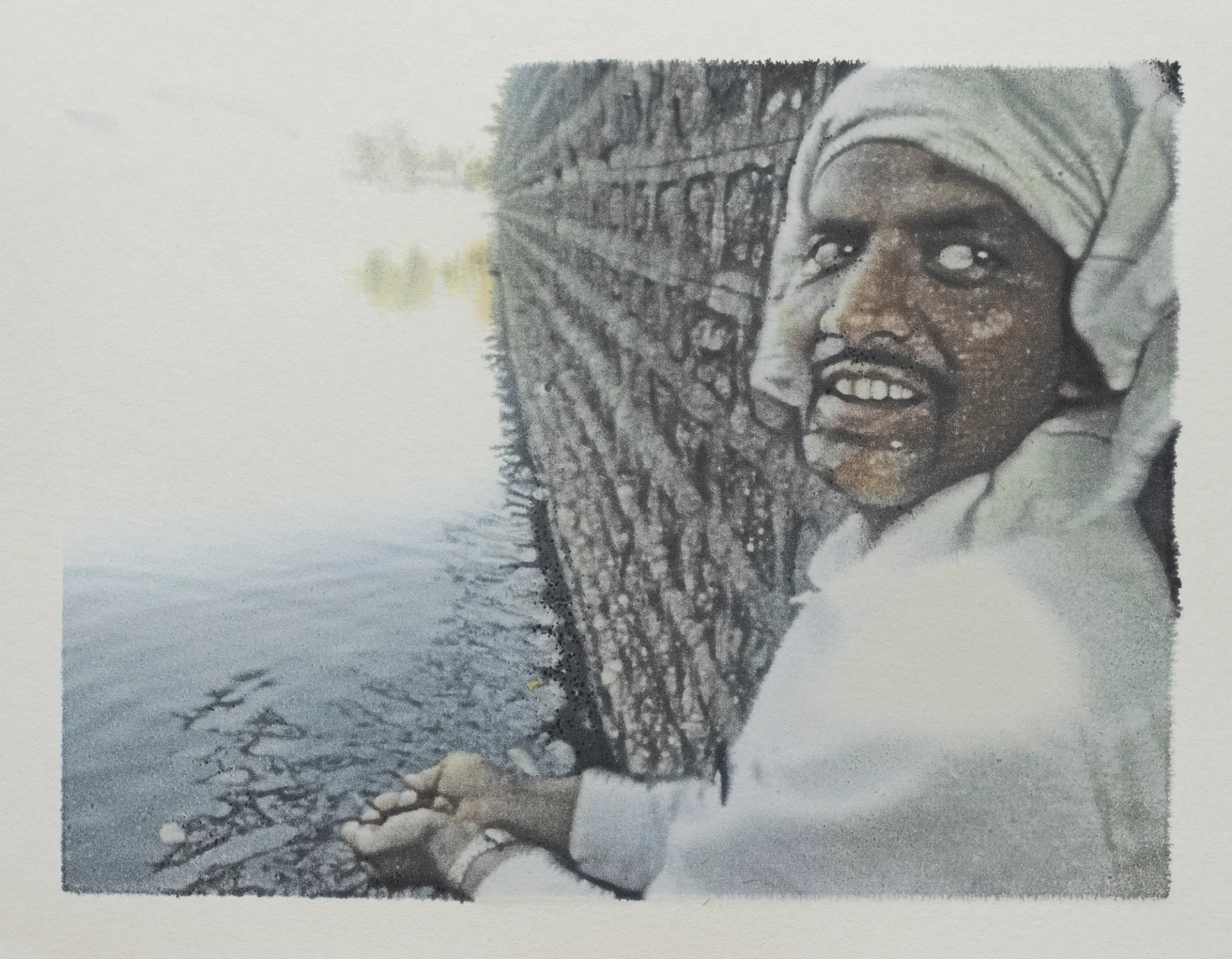
Rajyashri Goody, Is the water chavdar?, 2022. Inkjet transfer monotype.
Courtesy of the artist.
A new generation of contemporary creatives in India are engaging with the enduring legacy of the country’s caste system.
Artlab Editors: In their capstone Fellowship article for Artlab Editorial, Skye Arundhati Thomas writes about India’s caste system, exploring how contemporary artists, writers, and scholars engage with the past and present to challenge its enduring legacy and shape a future where equality might prevail.
The Well
On March 20, 1927, Dr. B. R. Ambedkar marched alongside 10,000 of India’s Dalit or so-called “Untouchable” caste to assert access to drinking water as a fundamental civil right for all. A scholar, lawyer, and leader of an anti-caste resistance movement, Dr. Ambedkar led the procession to a public water tank in Mahad, Maharashtra, known as the “Chavdar” tank—chavdar being the Marathi word for “tasty.”
Ambedkar called this journey a “satyagraha,” a term meaning “holding firmly to truth,” drawing from Buddhist philosophy.
For her 2022 show, Is the water chavdar?, at New Delhi’s GALLERYSKE, artist Rajyashri Goody revisited the Mahad satyagraha to show how the action endures in public memory nearly a century later. “Our touch, even our shadow, [is] considered impure,” writes Goody of the exhibition.
In a series of monotypes—where the ink is leaky, and faces are blurred—the artist presents Google images uploaded by visitors to the Chavdar tank. These are photographs taken mostly from phone cameras; most of them are selfies, with one arm visible in the shot and the characteristic sideways tilt of the head. Goody abstracts these photos, adding water to the ink to make its effect imprecise. In doing so she protects the people in the images she appropriates, rather than objectifying them.
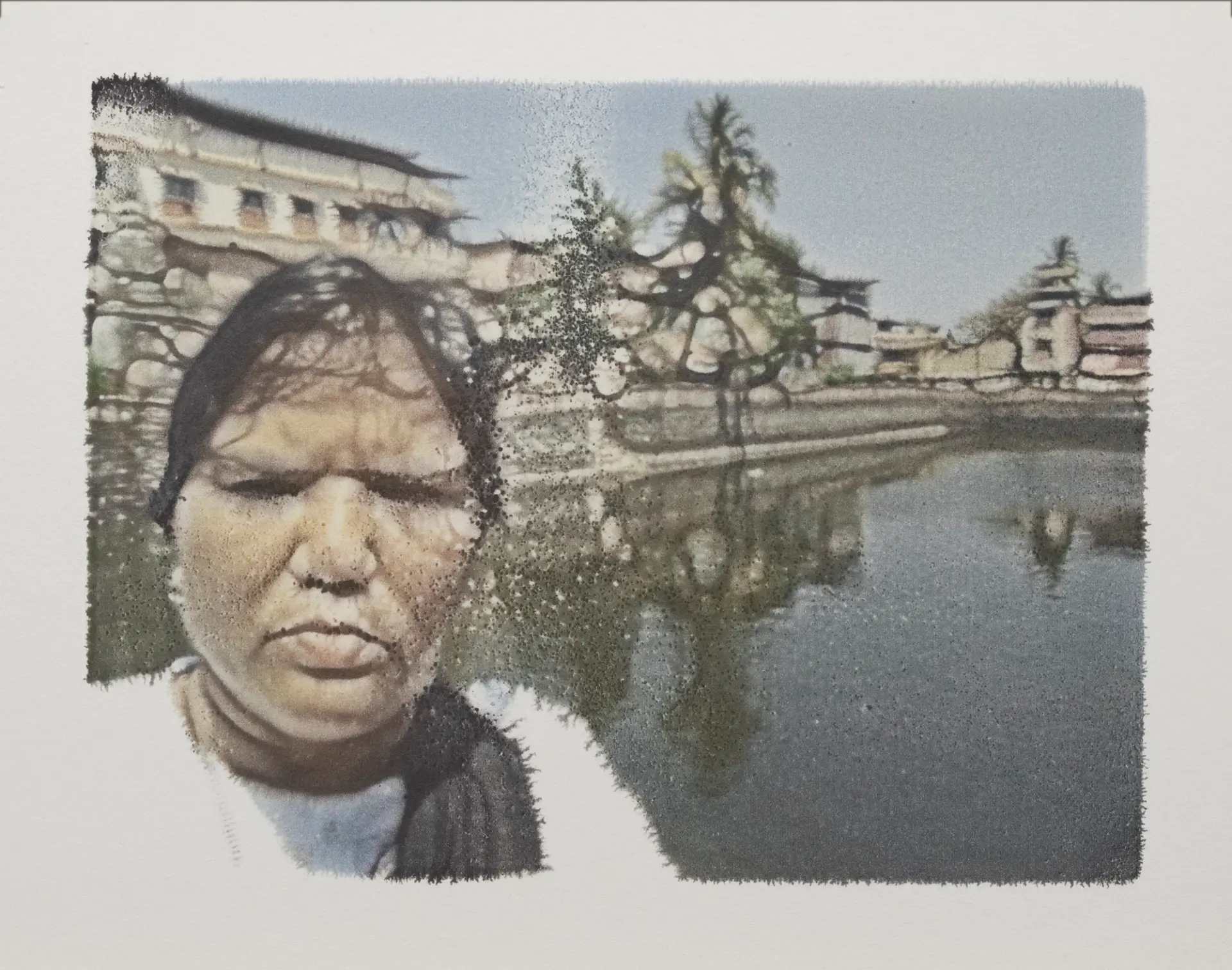
Rajyashri Goody, Is the water chavdar?, 2022. Inkjet transfer monotype.
Courtesy of the artist.
Ongoing visits to the tank mark the significance of Ambedkar’s Mahad Satyagraha, one of the most important anti-caste revolutionary moments in modern history. In India, caste is social, cultural, essentialized, and even internalized to such a degree that it’s how life in the subcontinent is fundamentally organized. To this day, caste determines where one can access drinking water, what one eats, what language or dialect one speaks and whether one can learn to read and write it, where one lives. It’s a formalized apartheid whose construction goes back thousands of years.
Caste is not the same thing as class as there is no social mobility. As the scholar and activist Anand Teltumbde writes in MAHAD: The Making of the First Dalit Revolt (2022): “A person born in a caste finds his life chances frozen by his caste.” Caste is also different from race. Dr. Ambedkar succinctly articulates this distinction in his seminal text, The Annihilation of Caste (1936): “The caste system does not demarcate racial division. The caste system is a social division of people of the same race.”
By 1927, when the Mahad satyagraha took place, under colonial law, Dalit people had technically been granted the right to access public amenities such as drinking water. The law, however, cannot easily displace such a deeply rooted system of segregation. “The goal of [the] eradication of untouchability is amorphous,” writes Teltumbde. If the eradication of the caste system is to be measured and manifested through access to civil rights such as water, who then, Teltumbde challenges, is able to grant these rights?
“This act…of quenching one’s thirst from the water of Chavdar was not only a fight for the basic human right to drink water,” Goody continues, “but more importantly, it laid the foundations for a casteless society.”
The Body
Nearly 30 years after the Mahad satyagraha, in November of 1956, Dr. Ambedkar placed the Buddha and Karl Marx in direct comparison in a speech made to delegates of the Fourth Conference of the World Fellowship of Buddhists in Kathmandu, Nepal. No spiritual discourse may be divorced from its political origins, and in placing the two thinkers in relation, Ambedkar made a necessary analysis. “The purpose of philosophy,” Ambedkar said, drawing from Marx, “is to reconstruct the world.”
A crucial reform of the Ambedkarite politic was to encourage a conversion to Buddhism.
In his speech, Ambedkar quotes the Buddha on matters related to property, labor, and ownership. Just as Marx would 2,381 years later, the Buddha fundamentally opposed the privatization of possessions. For Marx, society is composed of the proprietors and laborers, while the caste system operates on the strict separation of labor categories. Members of certain castes are tied to the same profession for generations; caste names are often derived from forms of labor. The spatial structures of villages are also determined by the caste communities that inhabit it, with lower caste relegated to the outskirts of village life.
This arrangement has moved into urban life too. In the early twentieth century, the colonial urban planning of Indian cities pushed workers into social housing projects called “chawls.” Mumbai, with its cotton mill compounds, was once the central hub of British industry.
Chawls were typically one-bedroom apartments with shared toilets, styled after London slums. It was mostly migrants that were forced to live here; people who had left their villages in order to gain social mobility by accessing the freshly capitalist forms of economic independence as promised by the introduction of mass industrialization.
Artist Amol K Patil’s grandfather, Kisan Patil, was one such chawl inhabitant. He was a sanitation engineer, and also a writer. He composed a series of iconic plays and performance poetry in Marathi. Patil’s father was also a playwright and poet, and involved in the Movement for Social Justice and Respect.
This legacy permeates through Amol’s work, both in practice and spirit. In his early work, he filmed a series of videos based on his father’s scripts, and made small kinetic objects that animated the social commentary of the writings from his family.
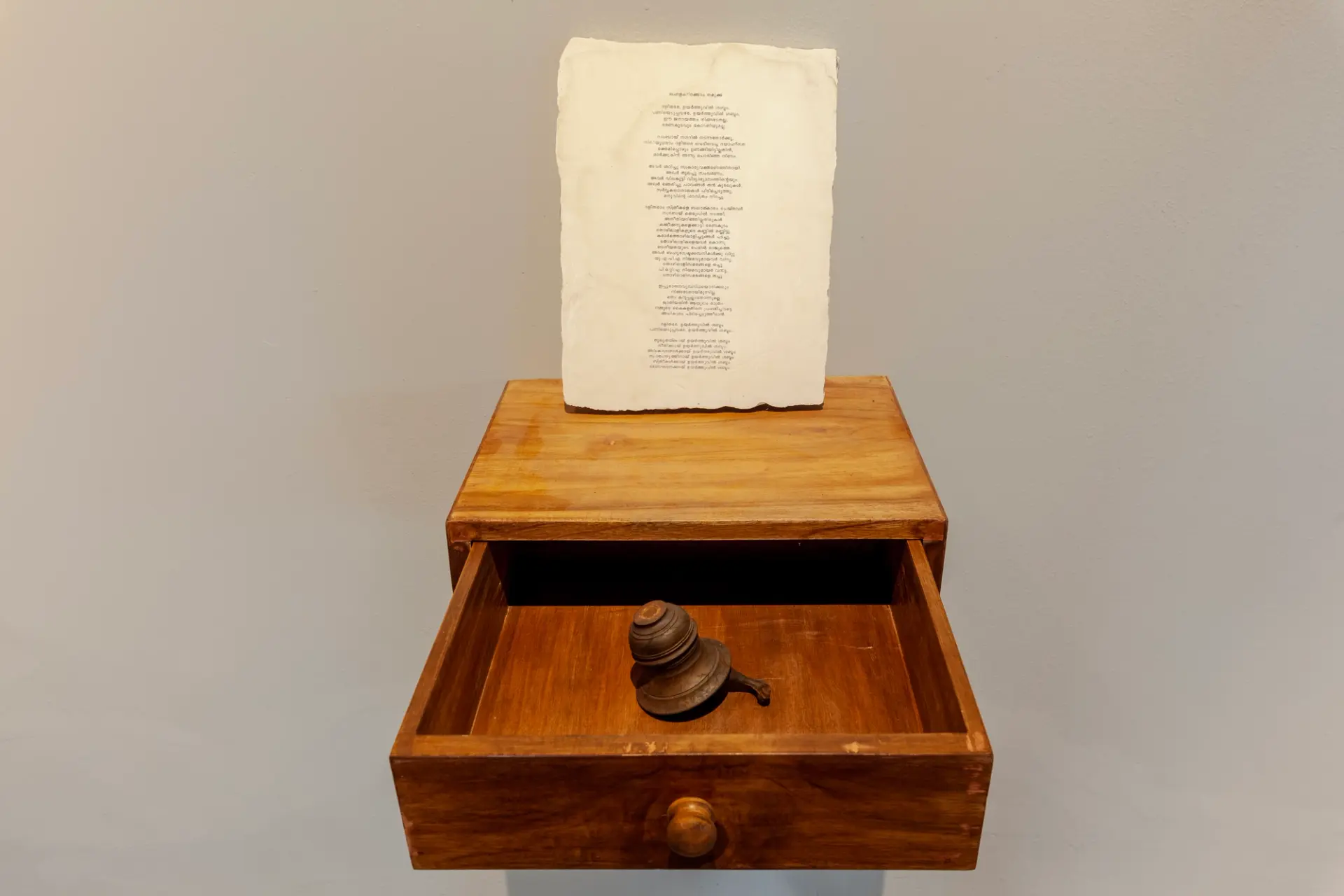
Amol K Patil, The Politics of Skin and Movement, 2022.
Photo by Kochi Biennale Foundation / Joseph Rahul. Courtesy of the artist.
A more recent work by Patil, a multi-part installation titled The Politics of Skin and Movement (2022), first shown at the Kochi Muziris Biennale, is a collection of static and kinetic sculptures, drawings, musical devices, furnishings and texts that have been compiled in a saturation of sound, movement and poetry.
In one bronze figure, we see the spine and folded shoulder blades of a person holding their elbows at their waist. The twist of muscle and bone embodies a stillness, an extreme quiet. The metal, which resembles clay, appears fleshy and supple—a characteristic that recurs in another bronze sculpture where a single, angled arm protrudes. Perhaps it is what holds the wall up, or the remains of someone involved in the wall’s construction.
Elsewhere, a single leg springs from under a block of material. This heavy wedge seems to be balanced, and held together, by the effort of this lonely limb. In a fourth bronze figure, a face is pressed into a brightly-painted orange wall, we only see the crimp of this person’s hair, the curving helixes of their ears, which smoothly join a jagged neck, cut off from the rest of the body.
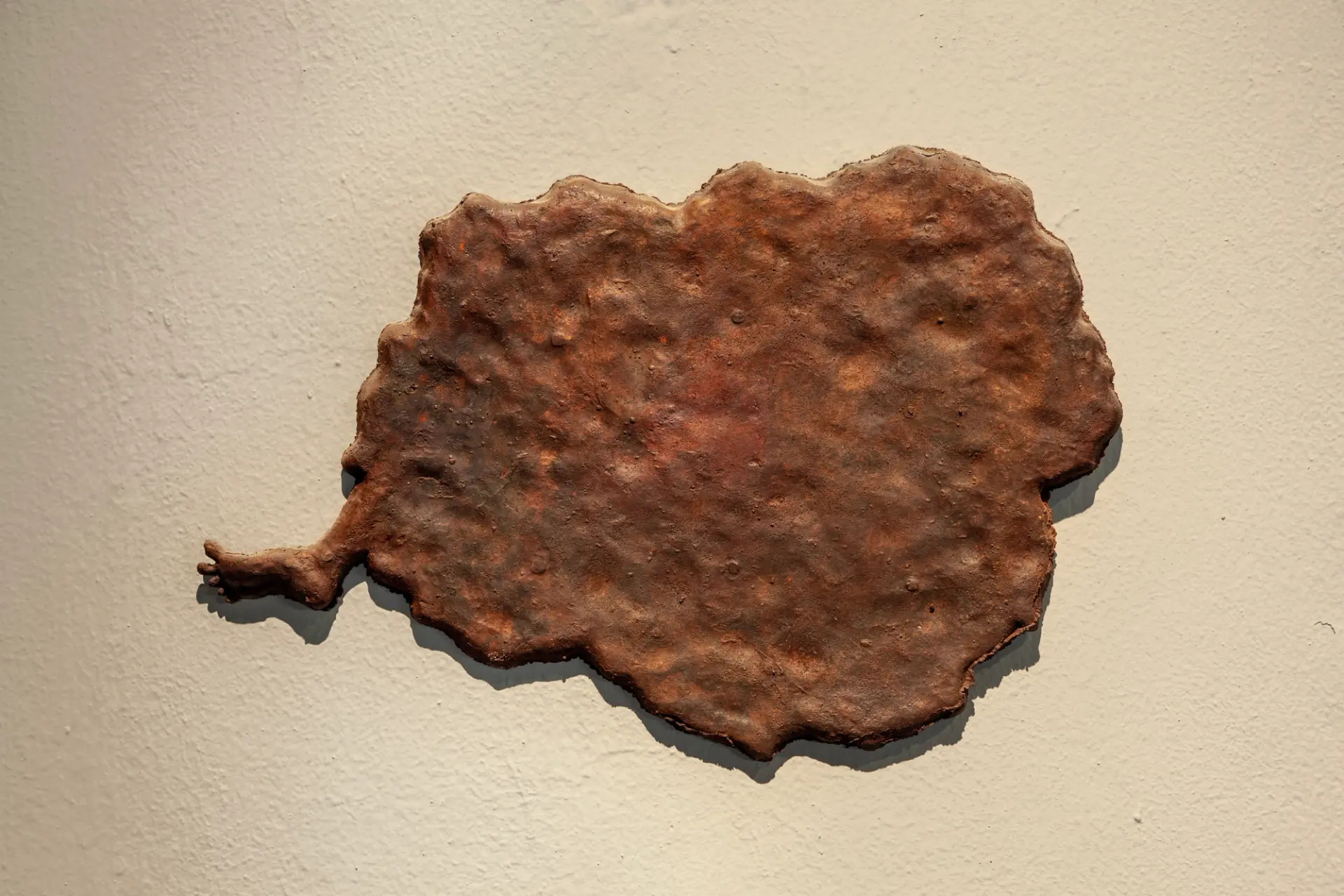
Amol K Patil, The Politics of Skin and Movement, 2022.
Photo by Kochi Biennale Foundation / Joseph Rahul. Courtesy of the artist.
Bodies slip in and out of space and time in The Politics of Skin and Movement (2023). These bodies are turned to fragments, moving deftly between histories, each offered in arrangements that are at once quietly reconciled as they are energized, active, potent. They are those of protest and movement, as much as they also capture a certain chiasmic, almost philosophical, stillness.
The River
“If the word Dalit means ‘broken’ or ‘crushed,’ then the journey towards liberating oneself from such brokenness is a perennial cycle of being broken and getting up,” writes Dalit scholar, activist, and rapper Sumit Samos in his 2022 memoir, Affairs of Caste. Among other things, the book is a powerful meditation on Dalit subjectivity, and the representational burdens that are placed on those who must continuously perform identity as a manner by which to maintain political agency in the contemporary moment.
Photographer Jaisingh Nageswaran is from the village of Vadipatti, and has spent a large part of his childhood frequenting the drenched edges of the Vaigai river, which twines across the southern Indian state of Tamil Nadu. While the rivers of India are totemic in the mythological imaginary, they are also incredible feats of geography, running up and down forest and flatland, hills, and rugged terrain, before emptying into the seas and ocean that skirt India’s borders. The Vagai drains into Palk Bay, a shallow stretch of water between India and Sri Lanka, characterized by strong winds and surf currents that surge in from the Bay of Bengal.
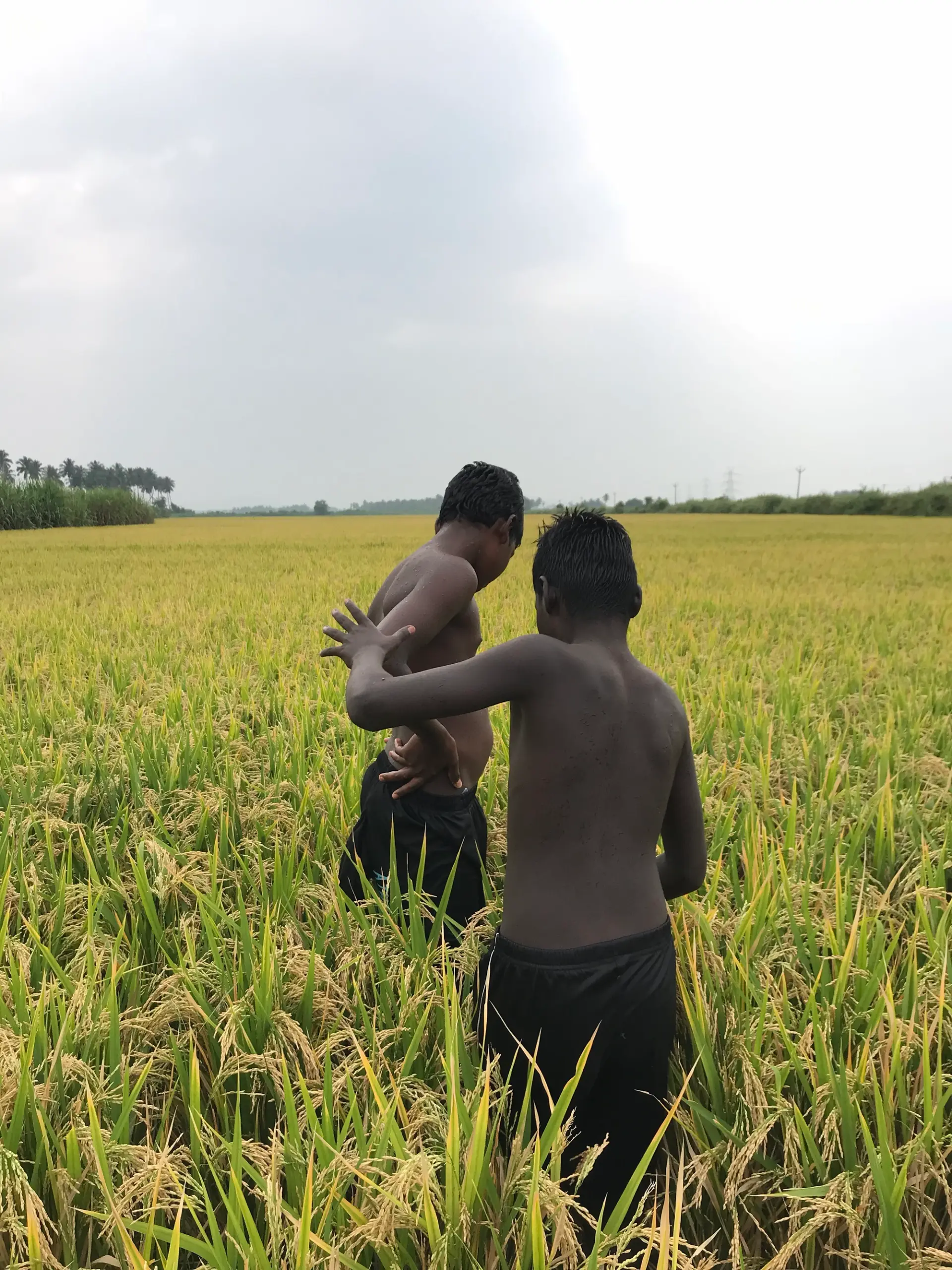
Jaisingh Nageswaran, Down by the Mullaiperiya, Ongoing.
Courtesy of the artist.
In his ongoing series Down by the River: Mullai Periyar, Nageswaran takes his camera for walks along the banks of the Vaigai, photographing portraits of people. Through mostly head-on shots, the artist reveals a kind of confrontational intimacy with his subjects in addition to softer, quieter moments of contemplation. Henna-coloured fingernails look silken in an image where a nimble palm grasps the neck of a bottle, containing a pair of silvery fish, their long whiskers curling at the bottom of the glass, the water murky but bearing the slight reflection of the surrounding landscape.
Nageswaran’s compositions are often painterly, where the river’s water becomes a mirror. Water is also a glistening adornment, particularly on bodies. In another image from the series, we are shown a close-up of a person’s curved nape and shoulder blades. Shining droplets soak the fine hair that twists down the long indent of their spine. Here, the body takes on the likeness of the river, symbolic of how body and land move in parallel.

Jaisingh Nageswaran, Down by the Mullaiperiya, Ongoing.
Courtesy of the artist.
“I started arranging a storyline with myself as the observer, analyst, receiver, and of course, the creator,” writes Samos. “I was not merely a passive subject around whom events occurred.”