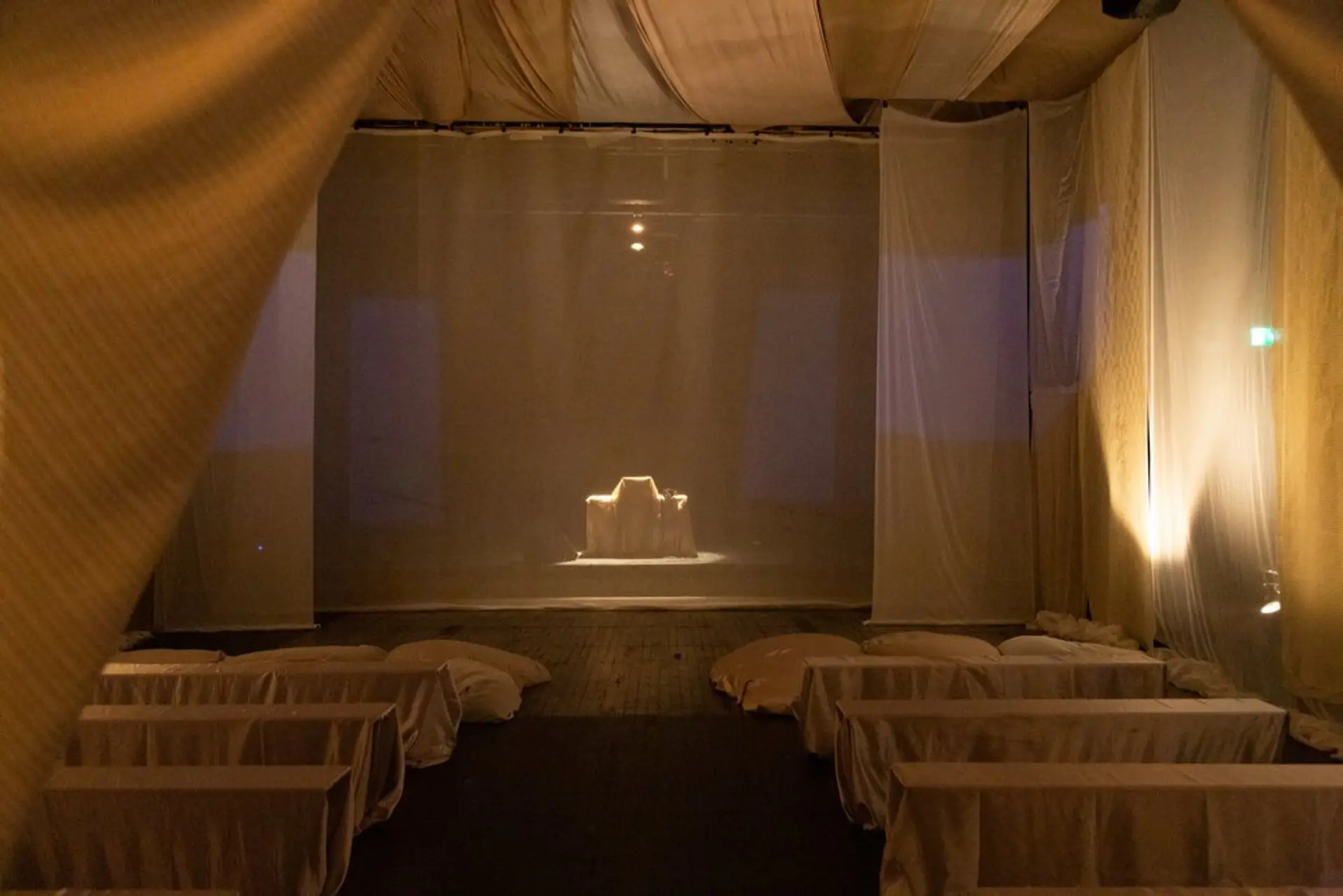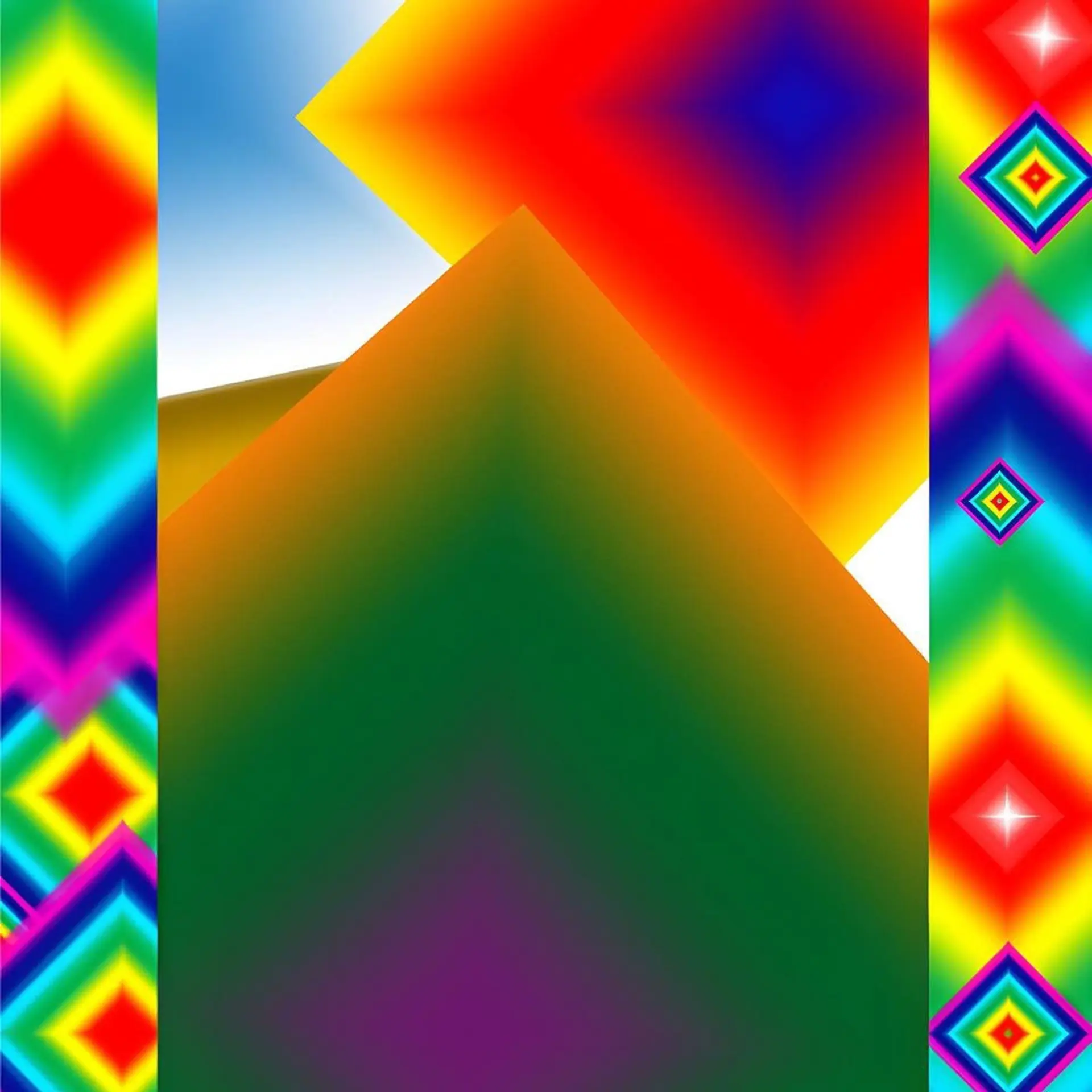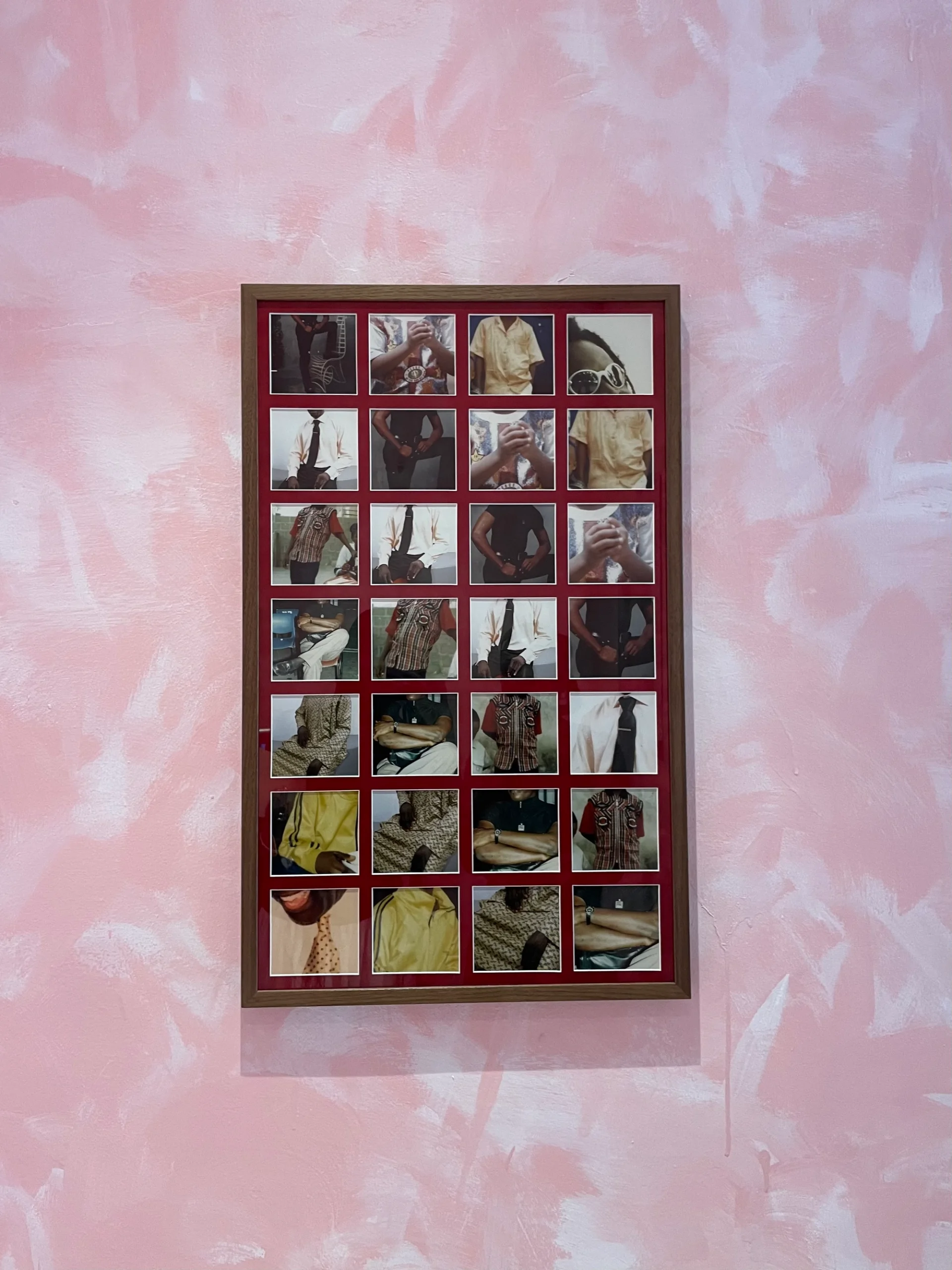
Olukemi Lijadu, Installation view of Study IV (Change your style), 2024.
Photographed at Manifold Lagos, Alára.
2024 Artlab Editorial Fellow Olamiju Fajemisin continues her exploration of Nigeria and diasporic identity, bringing us along her journey through Lagos Art Week.
Artlab Editors: For her second essay in a three-part series exploring the manifold nuances of Nigerian diasporic identity through culture, 2024 Artlab Editorial Fellow Olamiju Fajemisin takes readers with her as she travels to Lagos for Lagos Art Week. Through an intimate whirlwind of openings, concerts, and festivities, Fajemisin shares her reflections on the city’s thriving art scene.
The safety of “diaspora,” not as a place but as a right to claim a place and its heritage, has done a lot to upset hierarchies of authorship. Whereas in my previous essay for this series, “Embodied Dualisms,” I addressed how comparative analyses—such as between Western and Yoruba philosophies per Professor Sophie Oluwole—can be instrumental towards understanding certain postcolonial conditions, there is only so much which can be discussed from the position of being “abroad,” regardless of whatever colonially entwined relationship that may exist between Country A and Country B.
With the support of the Artlab Editorial Fellowship, the decision to go to Lagos for my next essay was easy; the organic imposition of “Lagos Art Week,” as it is becoming known, was a perfectly timed opportunity to engage first-hand with contemporary Nigerian artistic production in the form of gallery shows, performances, and interpersonal exchanges.
Slightly worn out from the early autumn European fair circuit, I landed at Murtala Muhammed International late on a Tuesday, and spent the entirety of the next day sitting for the obligatory braids, texting to see who was in town, and making plans.
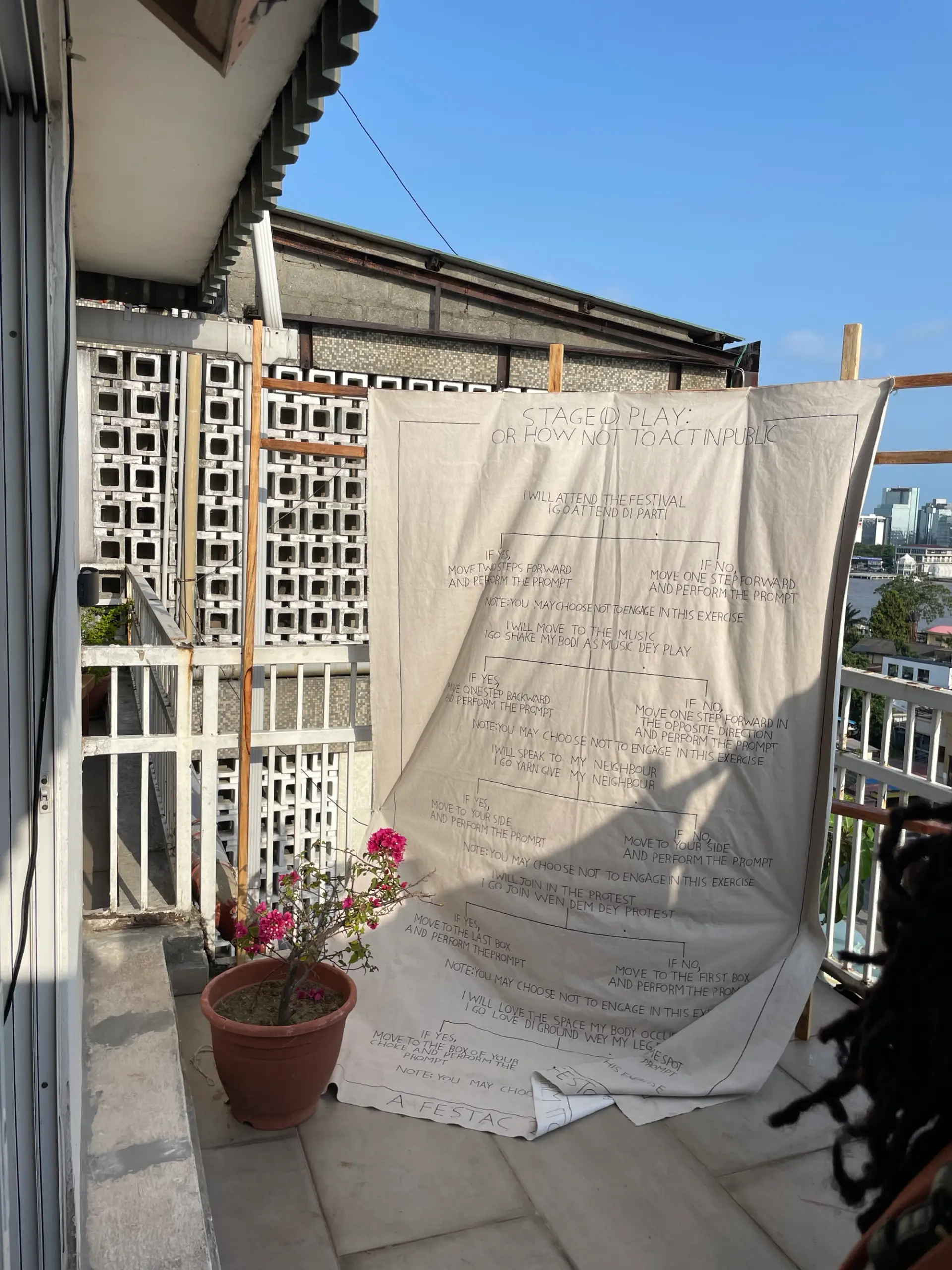
Stage(d) Play: Or How Not to Act in Public, a score from a public performance by FESTAC 77 participants installed on the balcony at The Treehouse.
Photo: Olamiju Fajemisin.
Thursday, October 31
My first stop is Alára, a contemporary “African luxury concept store” where I’m meeting the artist Olukemi Lijadu, who I mentioned in my previous essay as having presented a seminar on Yoruba metaphysics. I find her tucked away in a top floor annex. She is taking installation shots of her newest works, “Trading Memories Part 2” (2024), a moving image montage; and a series of collages, “Study IV (Change your style),” “Study V (Aunty give me Cake),” and “Study VI (School uniform).” Characterised by close-up details of thrifted photographs of a Nigerian family assumed to have expatriated to the UK, these images have been rearranged and integrated with images from Lijadu’s personal archive according to gesture, occasion, and texture.
The series has been realised as an investigation into the unexpected aesthetic and documentary similarities between families in the Nigerian diaspora as well as the historic intentionality of photography. It is also Lijadu’s contribution to Manifold Lagos, the latest iteration of an ongoing curatorial presentation by Faridah Folawiyo—daughter of Alára owner and collector Reni Folawiyo—dedicated to showing work by young, female-identifying artists from the global Black diaspora.
Folawiyo walks us out of Alára slowly, down the central marble double ziggurat of the Sir David Adjaye-designed building, passing Yoruba beaded thrones among other Alára stock, between which 87 separate artworks have been temporarily installed. These include two untitled multimedia abstract works on canvas and wood by the New York-based artist Turiya Adkins; luscious archival prints of Lagos artists in their studios from a 2023 series by Amanda Iheme; typographic banners by the London-based Unyimeabasi Udoh comprising die-cut, lightly screen-printed paper letters spelling out phrases in English and Anaang, a minority Nigerian language; and three intricately beaded and embroidered àdìrẹ quilts by Fadekemi Ogunsanya, installed as wall hangings.
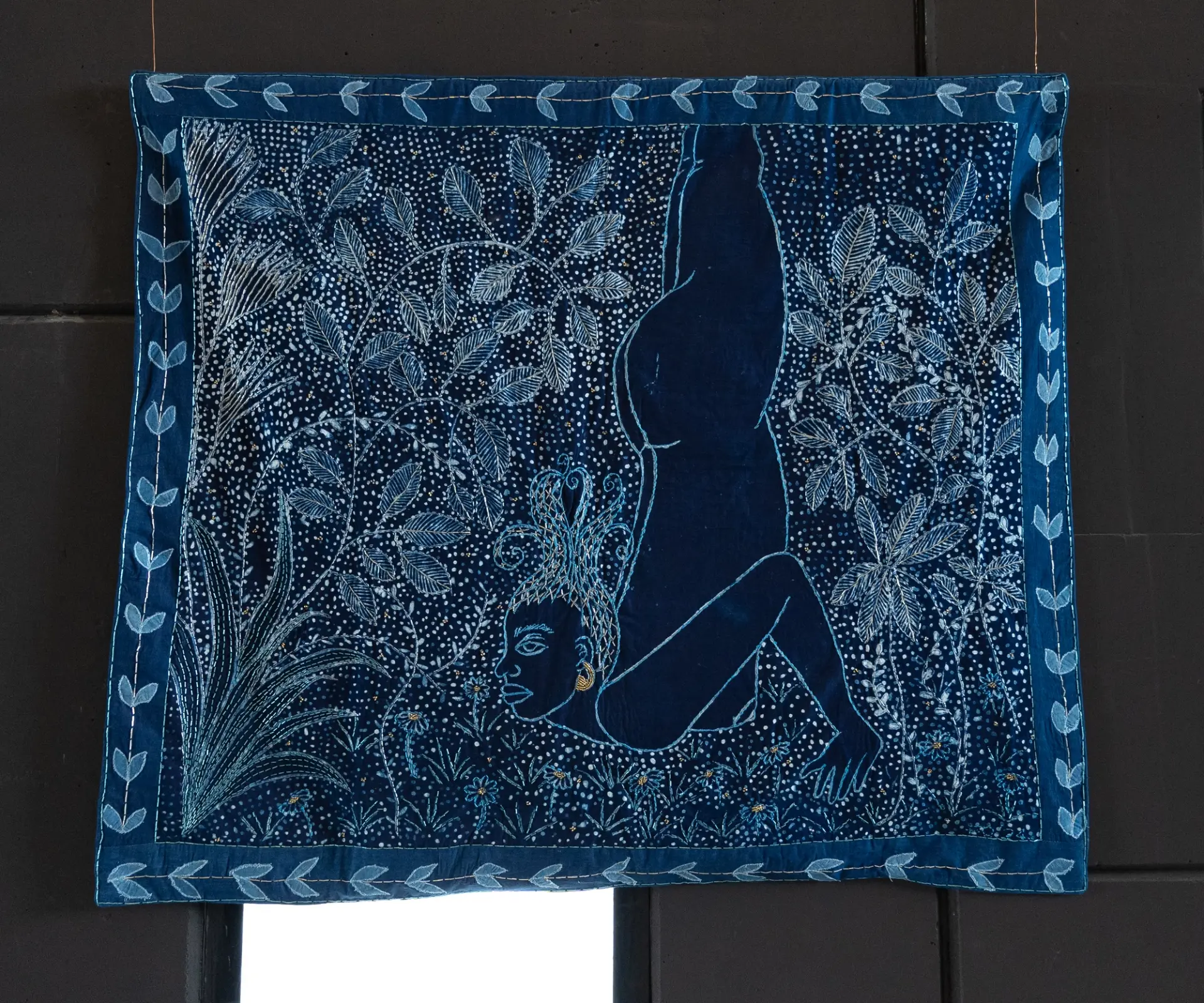
Dreamscape (2024) by Fadekemi Ogunsanya.
Photo by Olayinka Babalola.
Whereas Ogunanya had previously made àdìrẹ-inspired paintings at her studio in London, she will explain to me the joys of working collaboratively and in Nigeria over dinner later in the evening. “We were able to have a kind of knowledge exchange between the Yoruba and Northern dyeing techniques,” she tells me, referring to workshops she held to process her fabrics according to the respective indigo dying traditions in Abeokuta, outside of Lagos; and Kano, close to the border with Niger.
Lijadu and I jump into a car and are shuttled north across Third Mainland Bridge on our way to Yaba Art Museum at the Yaba College of Technology, arriving at the Yussuf Grillo Building. Dedicated to the memory of the late, beloved Nigerian painter, the building is a very fine, albeit decaying, example of tropical modernist architecture, with its broad, shade-giving eaves and gusty stairwells.
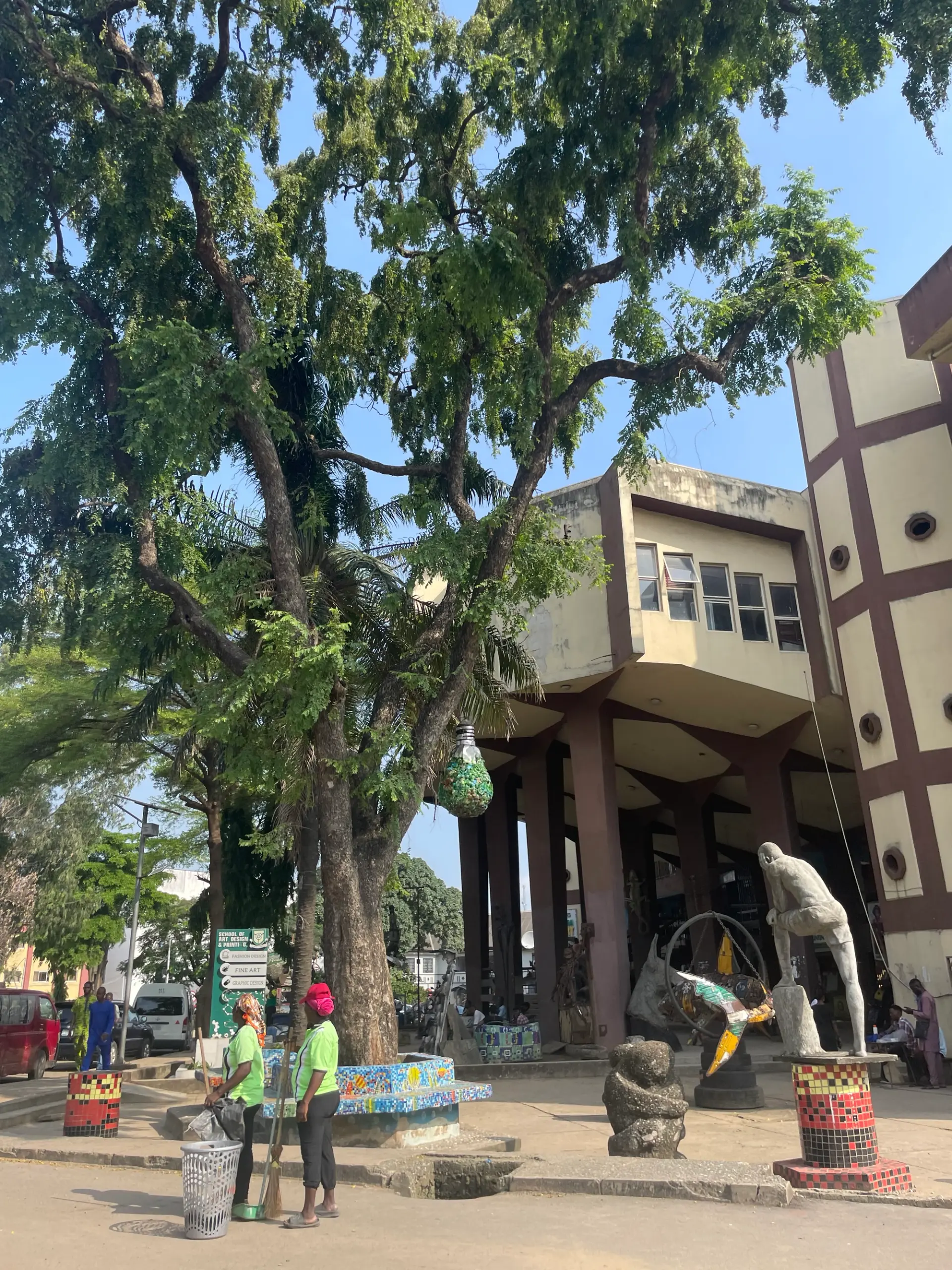
The Yussuf Grillo Bulding at Yaba College of Technology.
Photo: Olamiju Fajemisin.
We are there to attend the opening of Deep as the Sea, Wide as the Sky, taking place in the building’s basement. Co-organised by project space 16/16, the Goethe Institute of Nigeria, and the Centre for Contemporary Art, the exhibition has gathered a varied group of practitioners concerned with “archiving and expanding knowledge production on indigo and its significance in contemporary culture.”
We sip mocktails served in sculptural goblets made from recycled plastic bottles by the 16/16 makerspace (a collective of curators and caretakers including Tushar Hathiramani, Godwin Musa, and Toke Joseph) while perusing the works—hand knotted wall-hangings, resist-dyed manifestos on cotton, and moving image—and participating in a cassava paste drawing workshop with artist Osione Itegboje. The workshop is the first of a series of programs intended as an educational project, fostering collaboration and an understanding of the significance of indigo as a social, environmental, and cultural concern in Nigeria. We leave with a palm-sized paper plateful of small chops (an assortment of fried local snacks) each.
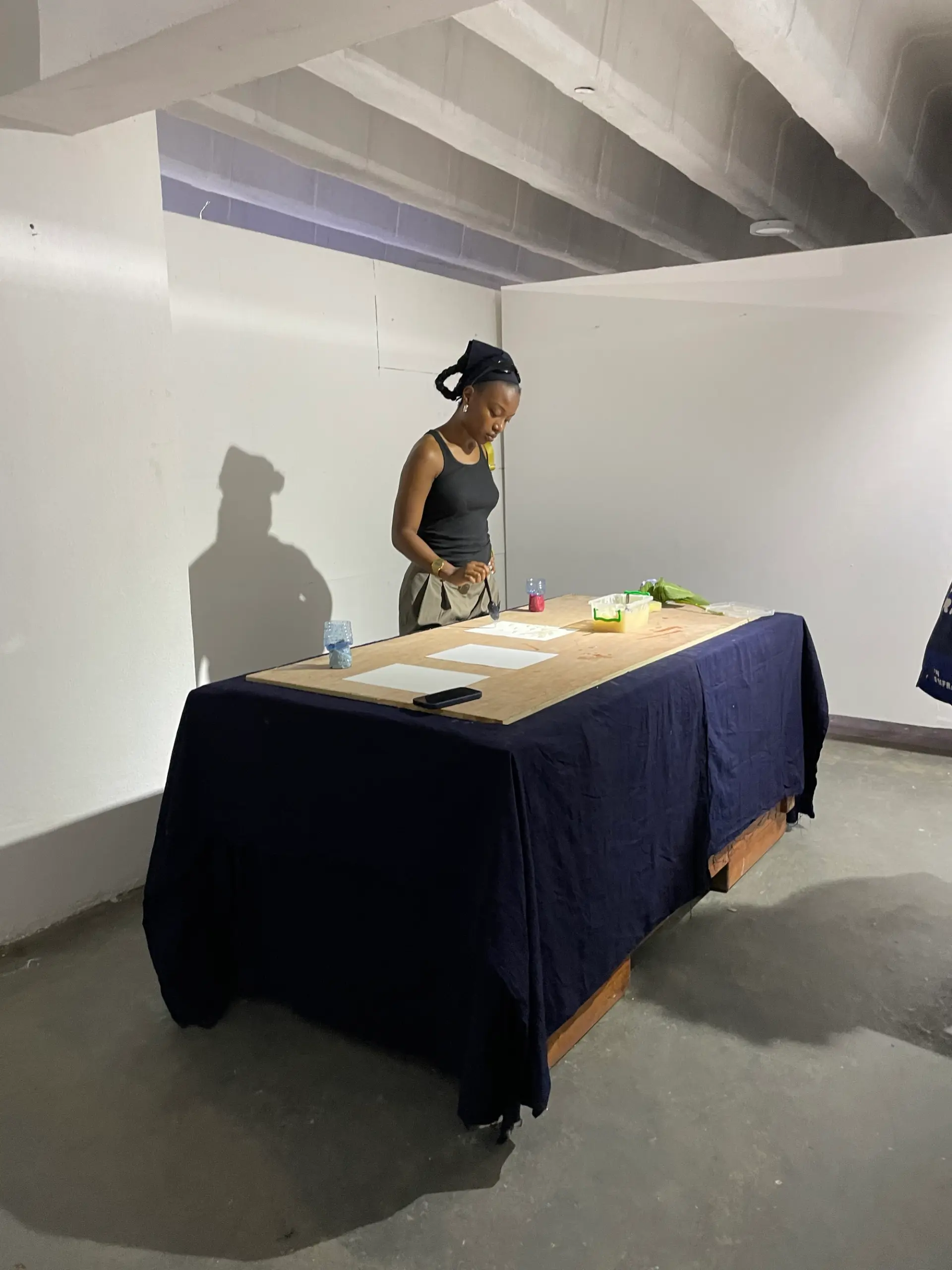
Lijadu participating in Osione Itegboje’s cassava paste drawing workshop at Deep as the Sea, Wide as the Sky at the Yaba Museum of Art.
Photo: Olamiju Fajemisin.
Driving back across the lagoon, one can pick out fishermen through the thin haze. We continue on to The Treehouse, a high-rise apartment-cum-exhibition space on the north shore of Victoria Island, overlooking Ikoyi. The elevator is out of commission, so we walk up seven flights of stairs in stiff humidity.
The exhibition, Write, If You Please, is organised by Maryam Kazeem of Lagos-based experimental publisher, Iranti Press, which facilitates multivocal writing experiments building off the legacy of the 1977 pan-African festival, FESTAC 1977 (also known as the Second World Black and the African Festival of Arts and Culture). Speculatively titled FESTAC 2077, the ongoing project through which this exhibition was produced was described by participating artist Timilehin Oludare as a series of public interventions, site visits, and collective activations. Recovering from the heat on the balcony, we regarded the collaboratively-made mixed-media installation of rusty filing cabinets and pothos vines stuck with JSTOR printouts of the “Pan-African Cultural Manifesto” (1969) manifesto, from which individual words and lines had been carefully burned.
Our penultimate stop is at The Federal Palace Hotel, on whose grounds the opening of the ninth Art X Lagos is taking place in an enormous, air-conditioned tent.
Scaled down to a third of the size of the previous year’s iteration, only ten galleries are participating in this year’s fair—a tactical, well-received response to restrictions imposed by the current crunch on the naira. “It’s not business as usual in Nigeria,” said Art X Lagos’s founder, Tokini Peterside-Schwebig, to UAE-based paper The National. “...we want to be part of a solution-orientated society.” This smaller fair does, however, place a stronger emphasis on non-commercial programming.
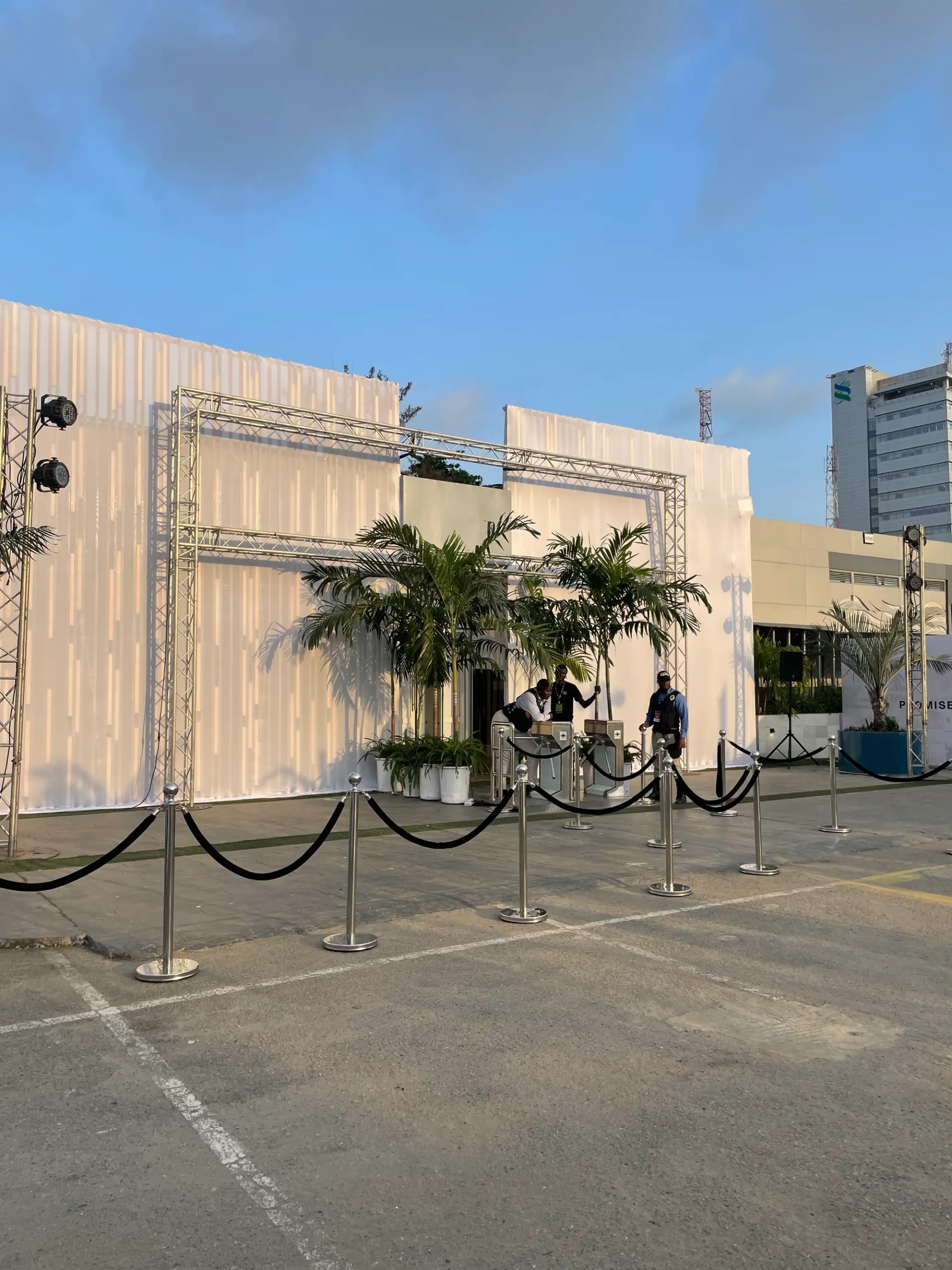
Turnstiles to enter Art X Lagos.
Photo: Olamiju Fajemisin.
Titled Promised Lands, in reference to the generative potential of rapid population growth and thus expansion of the youth class in Nigeria, the fair is organised around a central amphitheatre hosting a programme of film screenings, talks, and performances. To the left is the non-commercial special projects wing that includes a library. To the right is the high-quality yet slimmed down gallery section. While the majority of the spaces are based in Lagos, one is from Douala, Cameroon; another from Kampala, Uganda; one from London, UK; and another is based between London, UK and Accra, Ghana.
I squeeze through the throng of champagne flute-toting collectors to see the work, becoming particularly enthralled by Ekene Emeka-Maduka’s idiosyncratic, exaggerated figuration at Kanbi Projects, and Abe Odedina’s pan-culturally inspired portraits at O’Da Art Gallery.
Olukemi, Faridah, Fadekimi, and I close off the night at a Thai restaurant in an Ikoyi high rise. Etinosa Osayimwen, winner of this year’s Access ART X Prize, is seated at the next table. As we leave, we can hear a listening party spilling over the balconies of 16/16 some floors up.
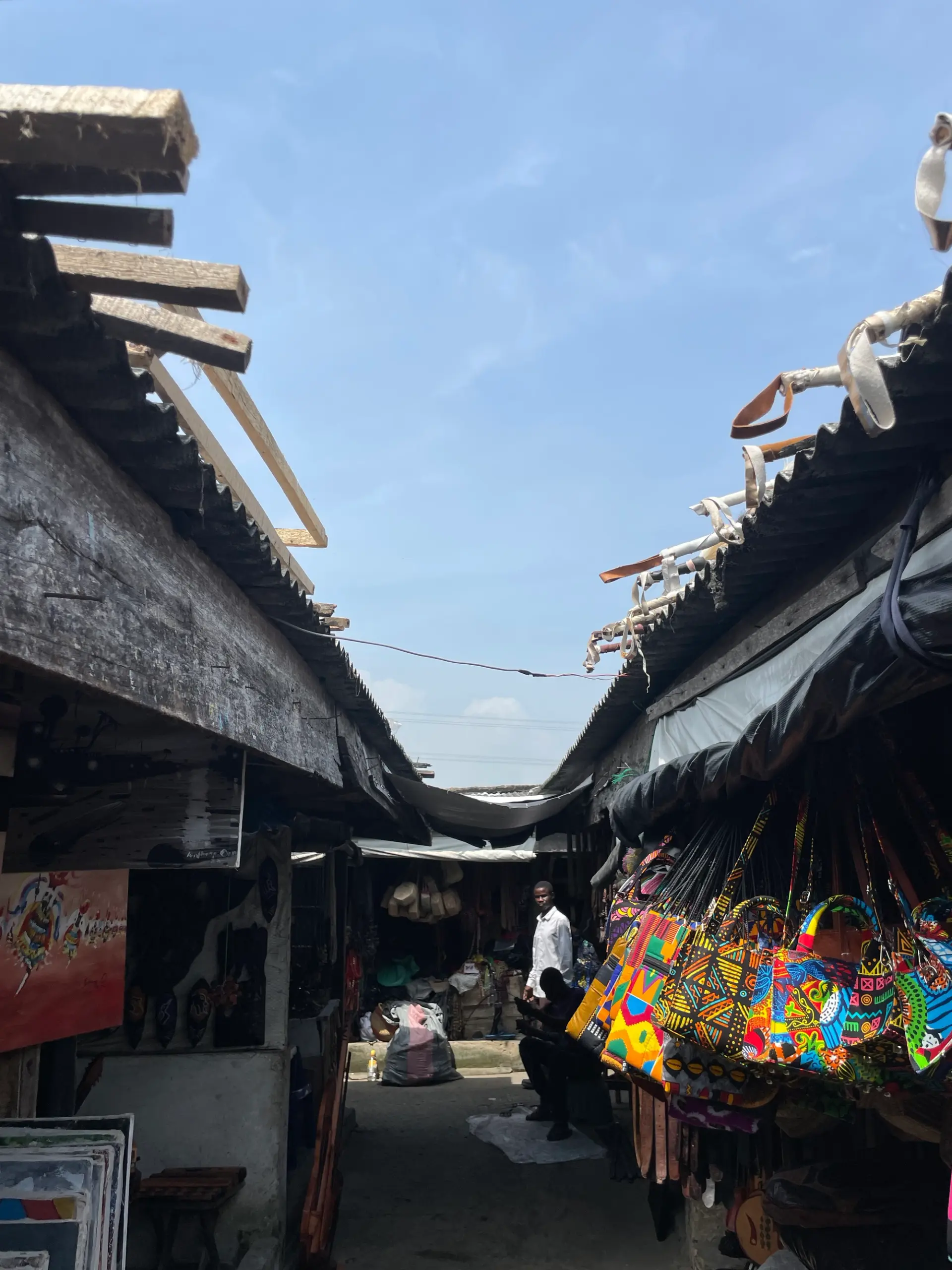
Lekki Arts and Crafts Market.
Photo: Olamiju Fajemisin.
Friday, November 1
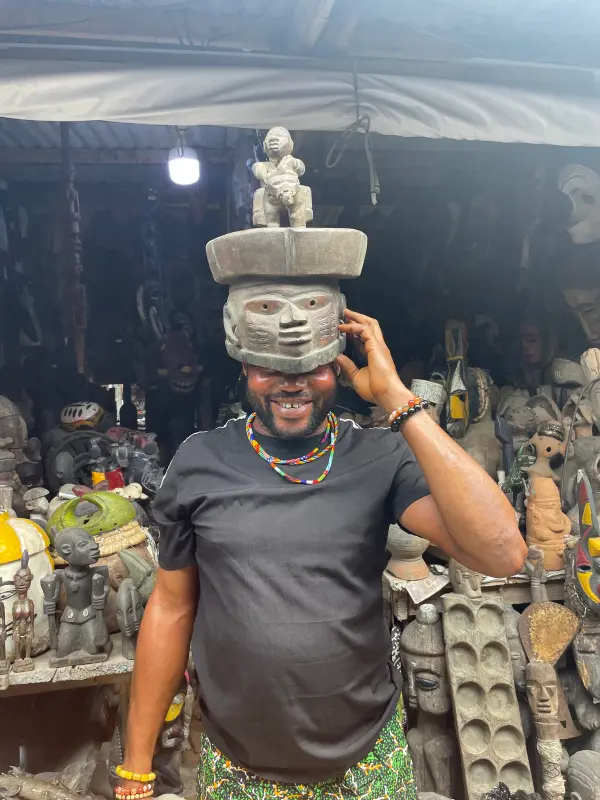
My first stop today is Lekki Arts and Crafts Market, a covered labyrinth of goods and artworks, where the label of “souvenir” can be applied to the most innocuous of homewares as well as antiques of questionable provenance and legitimacy—likely legally unexportable. I shop for wooden and raffia tableware and resist-dyed textiles; luck out on a pair of contemporary ibejí (meaning “twins”) pocket-sized sculptures; and browse rows of stalls rammed with dusty bronzes, intricately carved furniture, traditional ceramics, and paintings stacked up in the tens. Inflation is at a 28-year high, so I am carrying an obscene wad of cash around in a make-up bag.
Strolling through the aisles of beautiful yet practical handcrafts, I think about the colonially-minded bias against “craft” as a material pursuit, versus “art” as an emotional, intellectually driven one, and how insecure an assumption this is. While there is a clear class-based critique to be made regarding Lagos’s burgeoning art market, it is literal markets such as here which demonstrate the clear history of artistic appreciation across Nigerian cultures.
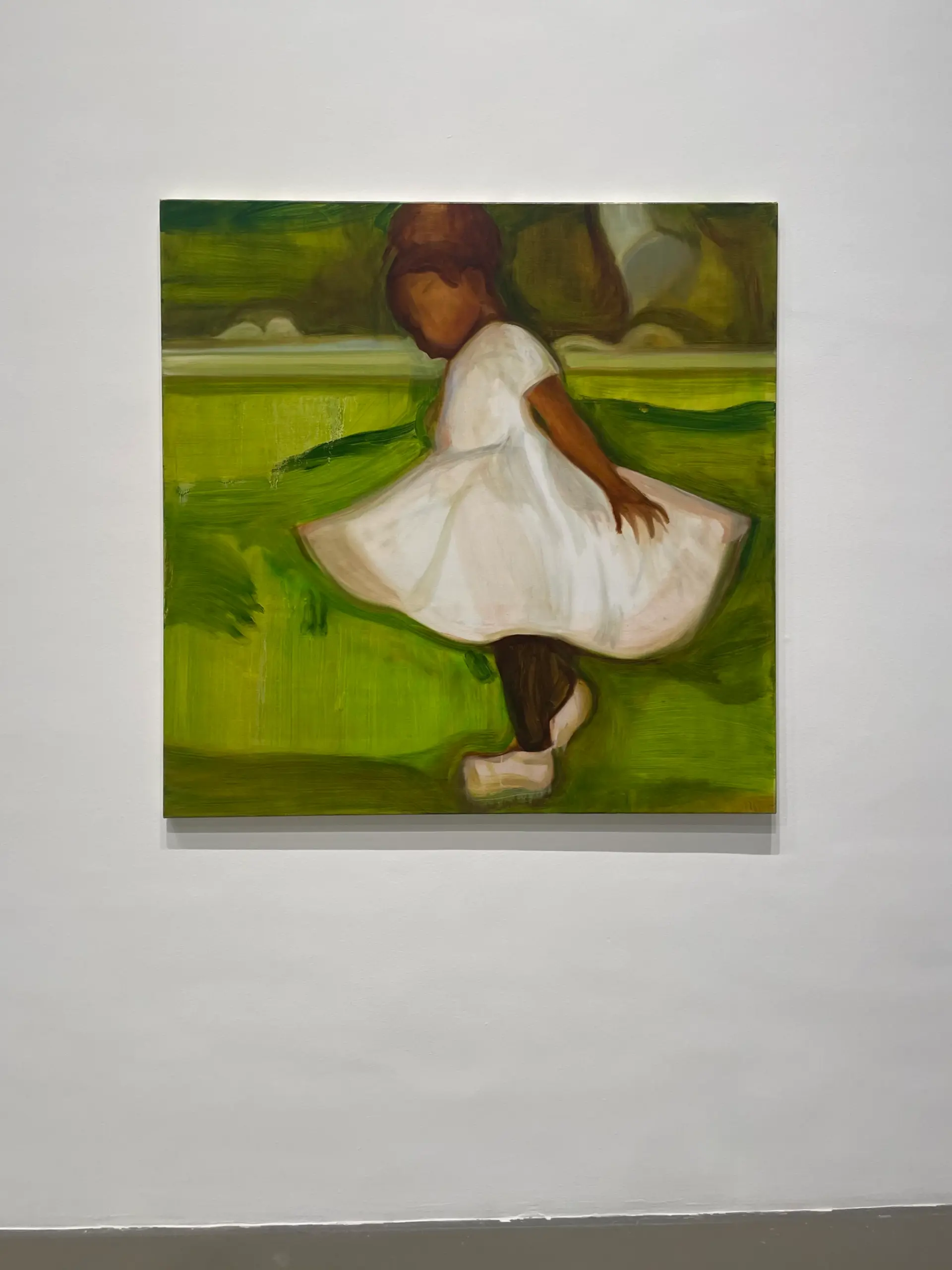
Spinning (2024) by Sikelele Owen at Tiwani Contemporary, Lagos.
Photo: Olamiju Fajemisin.
From Lekki, I go to Tiwani Contemporary, where there is a standing luncheon celebrating the solo show of London-based artist Sikelela Owen. Her loving, smudgy paintings of familial scenes look as if viewed through the eye of one’s memory. Nearby is Rele Gallery, where the sculpturally-impastoed paintings of Iyunola Sanyaolu are on view. And down the street is kó, where I take my time going through Kindred Spirits: A Gathering of the Aka Circle of Artists, a rigorously curated group presentation of paintings and sculptures made by the Aka Circle of Exhibiting Artists, who were at the forefront of Nigerian artistic production from 1986 until the mid-2000s.
A short drive later I arrive at Quintessence, an arts and crafts shop and sometimes cultural venue founded in 1972. Here, I pick up a book, “Nollywood: The Video Phenomenon in Nigeria” (2005), and an artwork—an intricate relief in aluminium depicting a northern Nigerian river festival—by an artist whose name turns up no results on Google. It was made in Osogbo, a city north of Lagos where the New Sacred Art Movement was founded by Austrian emigree Susanne Wenger, and where the artist-restored “Sacred Grove” forest on the banks of the River Osun was designated as a UNESCO World Heritage in 2005. I pay in more handfuls of naira and dollars.
Before midnight, I carpool back to Alára to attend the Manifold Lagos party, a sweaty, nightlong affair soundtracked by Lijadu’s selection of R&B and nostalgic Nigerian pop.
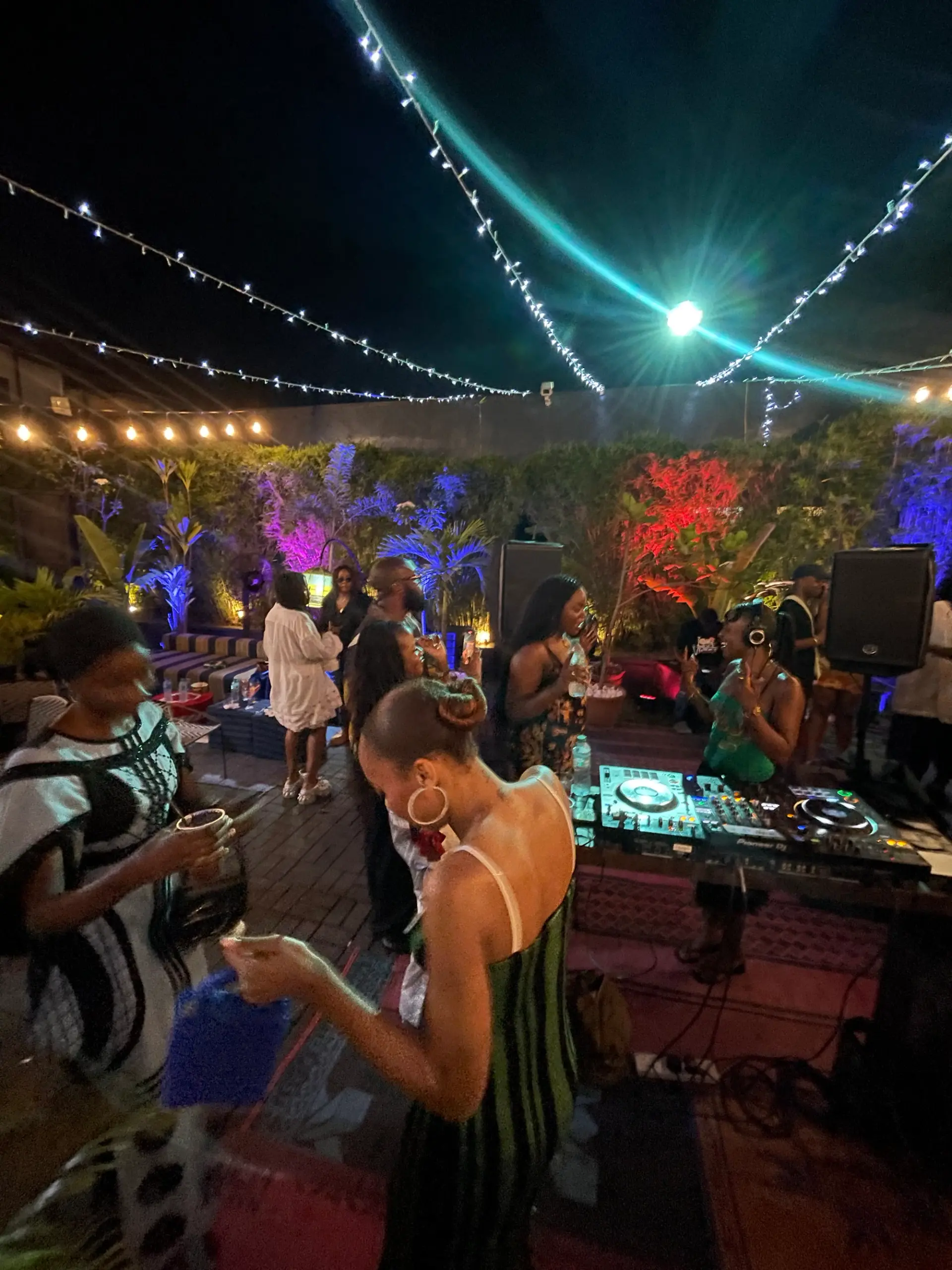
Lijadu DJing the Manifold Lagos party.
Photo: Olamiju Fajemisin.
Saturday, November 2
I am fighting sleep on the road to the Yemisi Shyllon Museum, about an hour and a half east of the city on the Lekki Peninsula. Due to the ongoing fuel crisis, there is less traffic on the usually congested expressway, which is lined with urban sprawl and the occasional palm grove patch. Still, the car crawls slowly over the potholes.
I am the only visitor at the museum, an iron oxide cube poking out of a green field. The institution’s namesake is the country’s largest private collector of Nigerian and West African classical, modern, and contemporary art. Peering through glass cabinets at carved wooden devotional objects, ceramics, and bronzes of extraordinary quality from the Edo, Benin, and Ife Kingdoms, I am most taken by the “Igbo-Ukwu Snail Shell” (c. 800-900), an intricately detailed lost-wax cast of a perfectly coiled land snail shell excavated from a tomb in 1939.
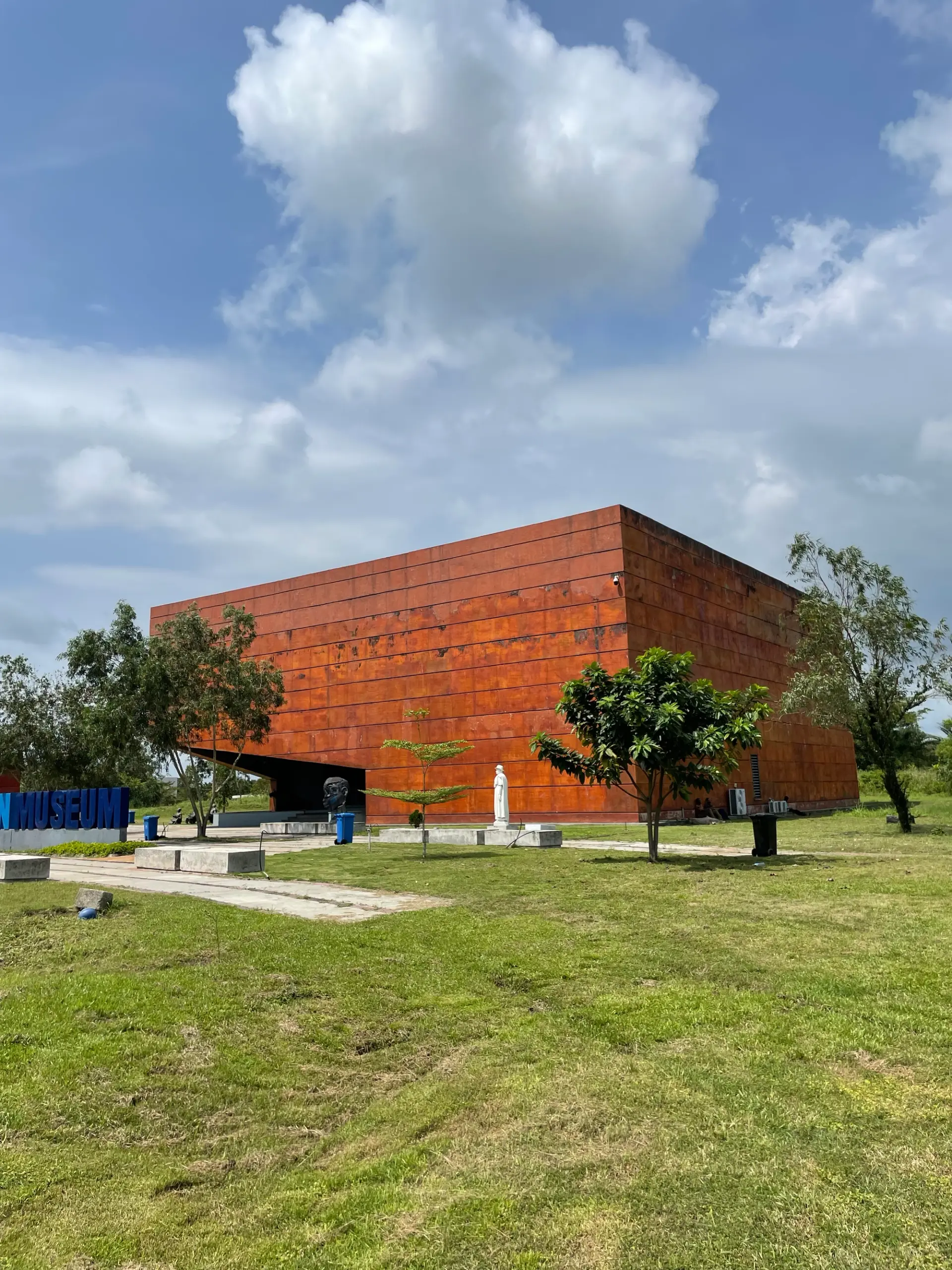
The Yemisi Shyllon Museum.
Photo: Olamiju Fajemisin.
Meanwhile, the temporary exhibition, Collecting Now: Perspectives of Contemporary Art Collecting in Nigeria, boasts loans from the homes and storages of six collectors based in Lagos and Abuja, including Shyllon. Openly acknowledging the privileged status of collectors as cultural “gatekeepers,” the exhibition attempts to reconcile the dialectical nature of arts patronage as both a commercial and passionate pursuit by allowing patterns of taste and technique to establish themselves naturally. Works in this section range from abstract calligraphic gouache on paper by Uche Okeke, mixed media figuration on canvas by Sola Olulode, and contemporary reimaginations of historic masks by Yinka Shonibare.
The museum’s upper level is dedicated to the Nigerian modernist movement, showing works exclusively donated by Shyllon. The exhibition begins with a selection of figurative portraits from the 1930s—works which, at the time, would have been a total departure from traditional artistic methods which had generally produced functional and ritualistic objects out of clay, wood, and metal.
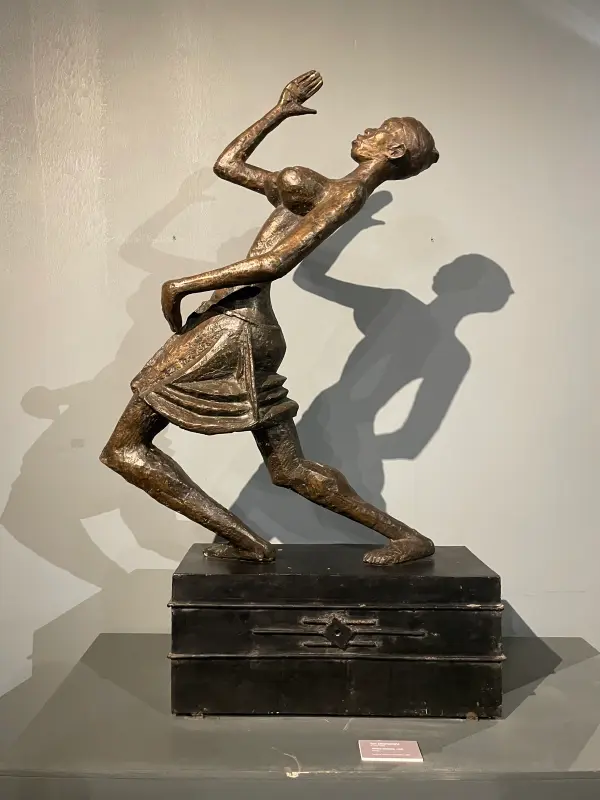
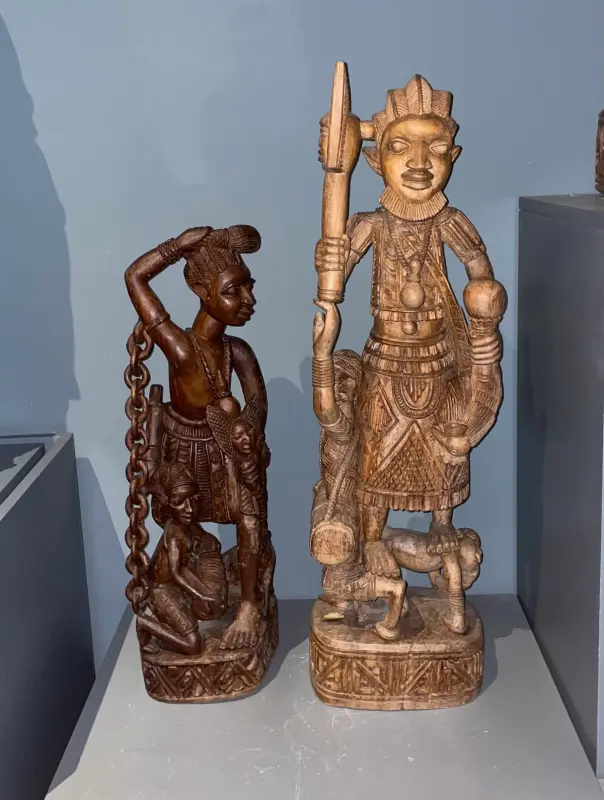
Evidence of the acute influence of colonialism on Nigerian artistic production (as well as the intuitive resistance to this) is traceable through the works displayed here. Aina Onabolu’s sober charcoal drawing on creased brown paper, “Awaiting the Verdict” (1932), for example, depicts a young, local man hearing his sentence in a British imperial courtroom, functioning both as an example of early Nigerian realism, as well as a critique of the necessarily brutish occupying state. Similarly, the innovatively composed ornamental figure of Ben Enwonwu’s “Africa Dances” (1959) invokes silhouettes from traditional Yoruba sculpture, however the lady dancer slices the air with her limbs in a defiant, rather than ritual, act.
Returning to my aunt’s house, I take a brief nap before heading to Art X Live!, where Lijadu is playing again, opening for Nigerian musicians Cruel Santino and S-Smart, and Fújì legend Adewale Ayuba.
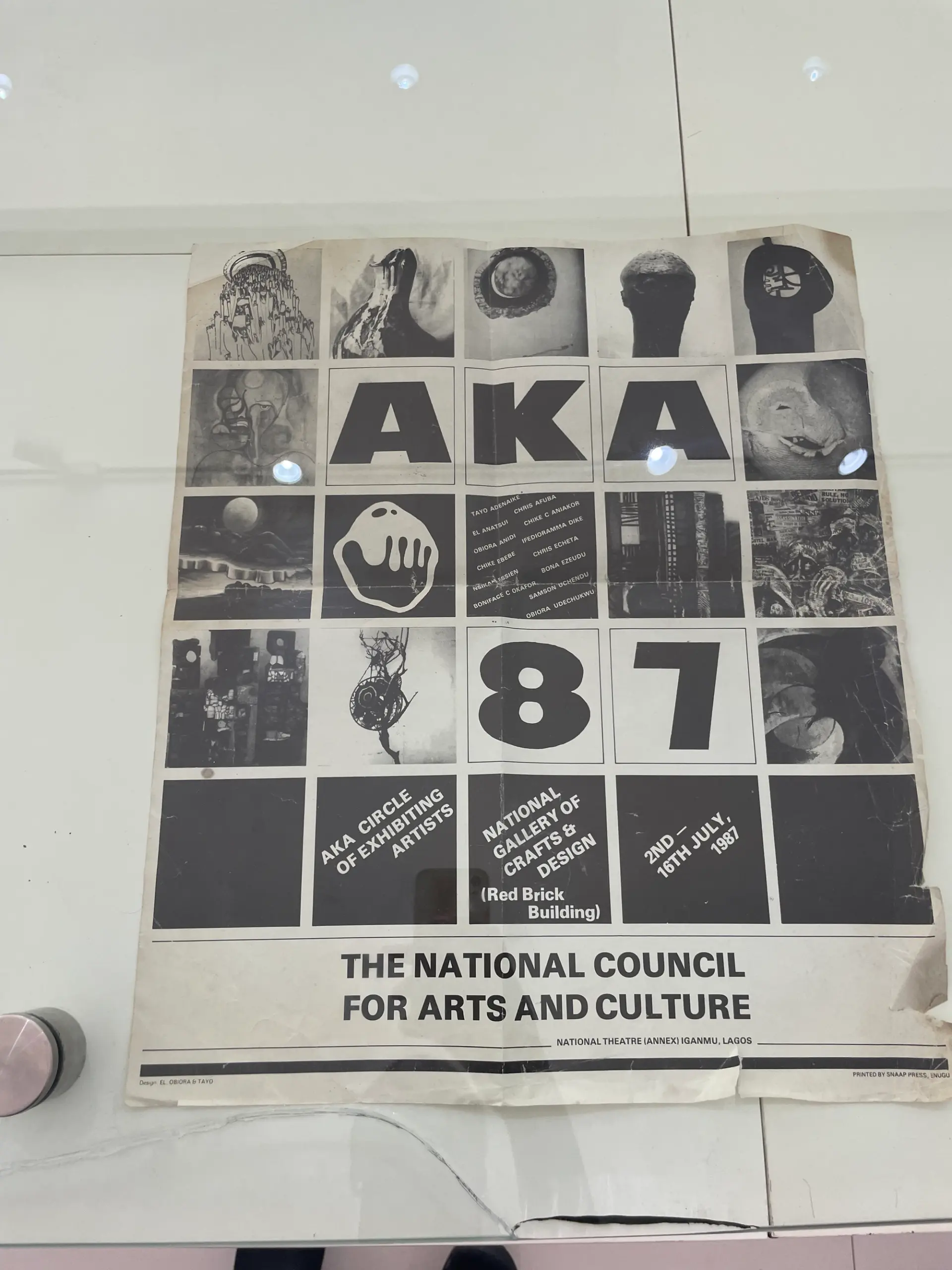
Poster advertising a 1987 exhibition of the Aka Circle of Exhibiting Artists, included in the survey show at Rele Gallery.
Photo: Olamiju Fajemisin.
Sunday, November 3
While the majority of my obligations today are with family, I break away to attend a lecture by Professor Chika Okeke-Agulu.
Titled, “Community and the Individual Talent: El Anatsui and the Aka Circle of Artists” the talk is introduced by Iheanyi Onwuegbucha, curator of the Aka exhibition at kó, and given in the presence of Ghanaian-born Anatsui himself, who, sitting in the front row, is regularly illuminated by camera flash.
Founded by Anatsui and Obiora Udechukwu in southeastern Nigeria in 1985, the Aka Circle of Artists was formed in an effort to collectively challenge conventional ideas of Nigerian versus Western art through radical studio practice and exhibition making. Following a non-hierarchical structure, the group was regarded for their collaborative, dialogue-driven approach blending local, traditional artmaking techniques with modes of Western modernism to carve out a new chapter of African modernism.
Professor Okeke-Agulu begins the lecture by offering the knowledge that the word “aka” means “hand” in Igbo. He explains that, just as the unequal nature of fingers is what makes the hand work so efficiently, so too do the divergent practices of Aka’s members strengthen the group as a whole. Okeke-Agulu exemplifies this phenomenon in the case of Anatsui, citing his radical “Broken Pots” series (1977-81) as evidence of the potential of fragility.
I have to leave towards the end of the Q&A if I am going to make it to family dinner. Lingering on my mind are half-formed questions I should have asked: How can the current status of Nigerian cultural production be imagined following the “Aka” analogy? Can there be a formal correlation between the symbolic image of the hand and the concept of a diaspora? And which artists today, whether they are based in Nigeria or abroad, continue to embody the values of the Aka Circle in their work?
As a platform for local, regional, and inter-diasporic cultural exchange and production, “Lagos Art Week” has a bright future ahead. Although largely based on models exported from the West, the events and exhibitions I attended compensated through a clear demonstration of socially and environmentally critical programming shining a light on local talent.
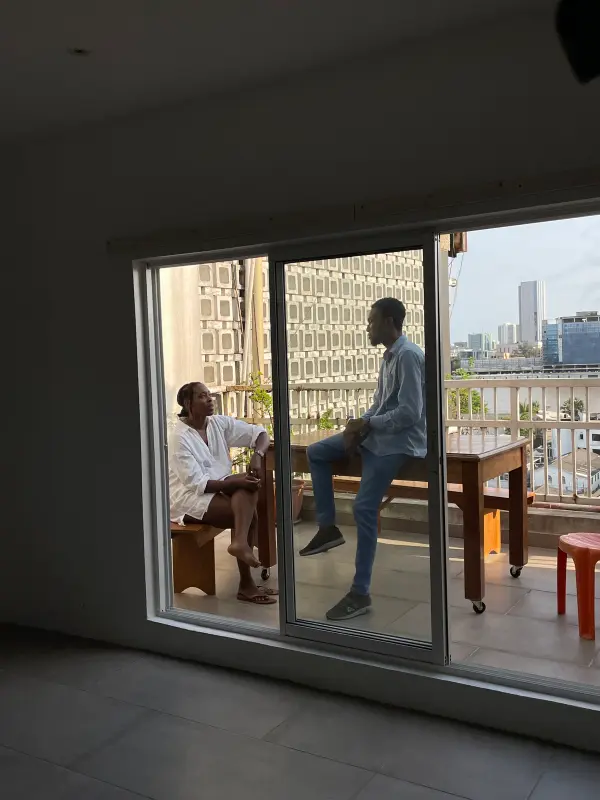
I was already on my way to the airport when I received an unfortunate notification informing me that my flight had been delayed for two days. Scrambling to book myself onto the next plane to London, I found myself prematurely nostalgic for this symbolic climax of pure Lagosian frustration. Ticket acquired, I slumped across the backseat of a car which barely nudged through the all-out “go slow” traffic jam choking Third Mainland Bridge; tonight of all nights. I gladly accept that, for as much planning is required to navigate this city, one must always be prepared to pivot calmly away from unforeseen crises—I guess, this is what it means to be a part of a “solution-oriented society.”