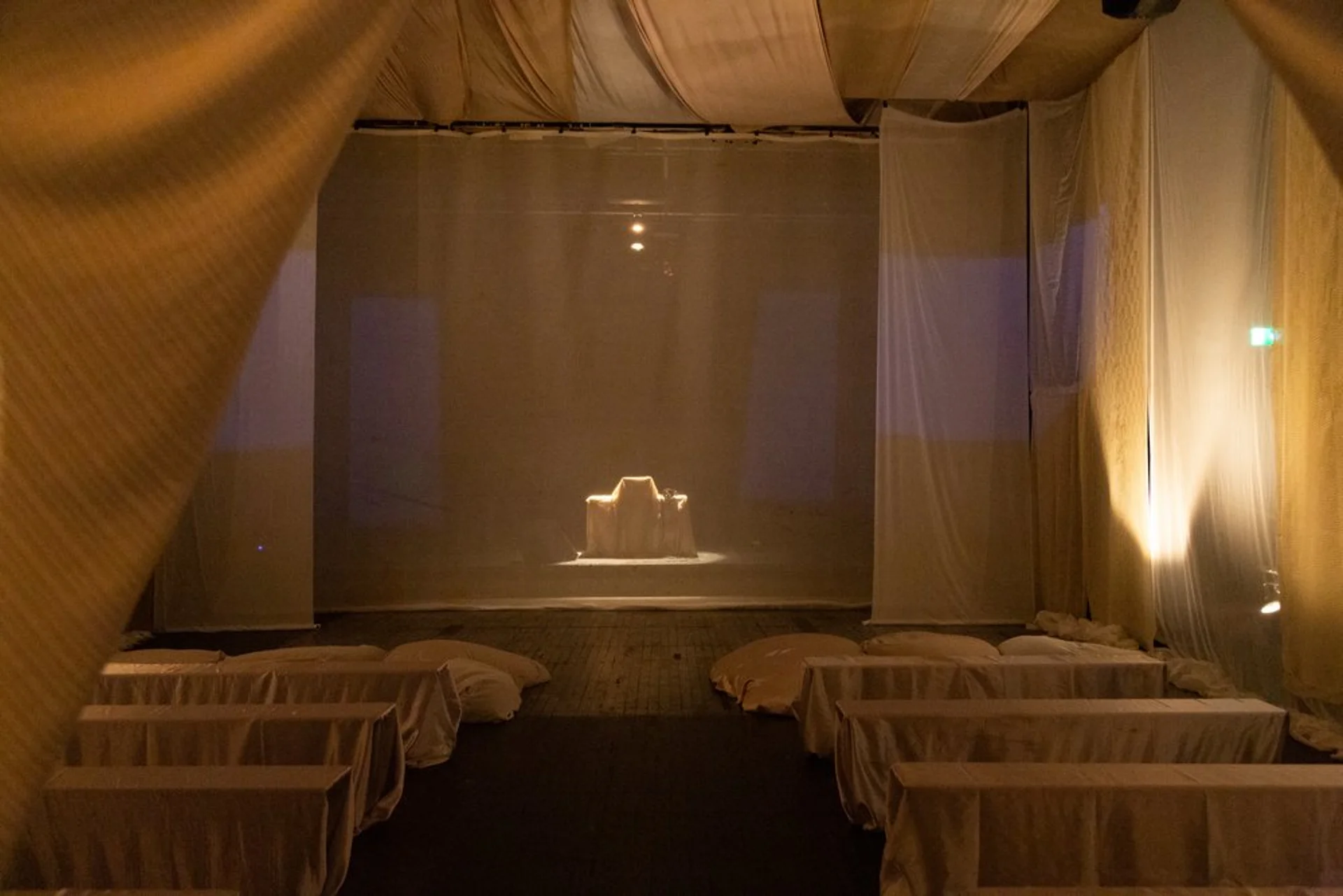
Installation shot, Olukemi Lijadu, Guardian Angel, 2022.
Courtesy of the artist, V.O. Curations, London. Photo: Christa Holka
2024 Artlab Editorial Fellow Olamiju Fajemisin deepens our understanding of contemporary Yoruba culture and diaspora.
For her first essay of the 2024 Artlab Editorial Fellowship, Olamiju Fajemisin expands on her ongoing inquiry into diasporic identity and cultural production by bringing us into her research process as she prepares for an upcoming trip to Lagos.
The act of research is continuous, without a defined beginning and ideally never ending; flowing like a stream, tumbling rocks we hope will one day take significant shape. An embodied, often unwitting practice, research occurs through acts of reading, scrolling, chatting, listening, and revisiting. In order to move forward with my ongoing research on contemporary Yoruba cultural production and lived experiences, I must first go back. I scour through PDFs for passages which had once piqued my interest and might now be of greater relevance, and comb through text messages and emails—including ones I’d written to myself—in search of clues.
My mind turns to a seminar on Yoruba metaphysics given by Olukemi Lijadu—artist, musician, and fellow Nigerian-at-large—that I encountered a year ago during my final semester at the Sandberg Instituut, Amsterdam. Lijadu focused specifically on the writings of the late University of Lagos professor, Sophie Oluwole, whose magnum opus, Socrates and Ọ̀rúnmìlà: Two Patron Saints of Classical Philosophy (2014) interrogates the dominance of Western philosophical and intellectual traditions via a rigorous comparative analysis between the life’s work and legacies of two canonical thinkers belonging to separate factions of world history.
Drawing attention to the major similarities and fundamental differences between Socrates and Ọ̀rúnmìlà’s respective philosophical schools, Oluwole introduces the term “complementary dualism” to propose a view of reality in which matter and ideas are to be understood as inseparable and compatible, as opposed to independent in nature and function—the latter attitude being preferred by the Western philosophical tradition.
During her session with my class, Lijadu emphasised how she sees complementary dualism as a “framework through which to think through the condition of Africans in the modern world.” She explained how the theory resonates within her own artistic practice due to its ability to “hold contrasting truths at the same time,” and “destabilise the fixed understanding we have of ‘truth’ itself.”
Interdisciplinary not only in that she is working with several media—including moving image, archival photographs, and sound—the way Lijadu compiles an array of elements into gesamtkunstwerks allows for potentially oppositional effects, reflecting the complexities of human nature. Through these tensions, Lijadu draws out new possibilities for comprehension and relation beyond what can be only ambiguously expressed through language.
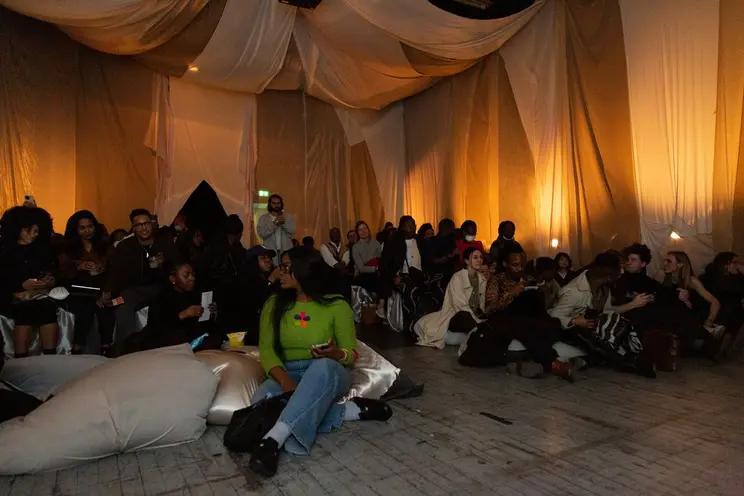
Such is the case with “Guardian Angel” (2022), a hybrid installation-cum-performance staged at The Treehouse Lagos, a creative platform, incubator, and exhibition space organised out of a downtown Lagos high rise apartment by artist Wura Ogunji. Comprising a multi-channel installation which uses both archival and original footage and activated by a live performance of a score composed by Lijadu, as well as a narration in the form of Oluwole’s appropriated words, “Guardian Angel” serves to explore the artist’s (and consequently Nigerian society’s) relationship to religion and Christianity.
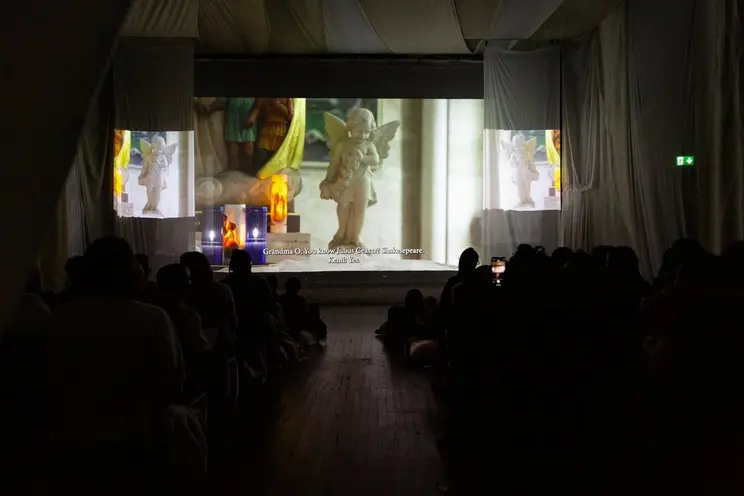
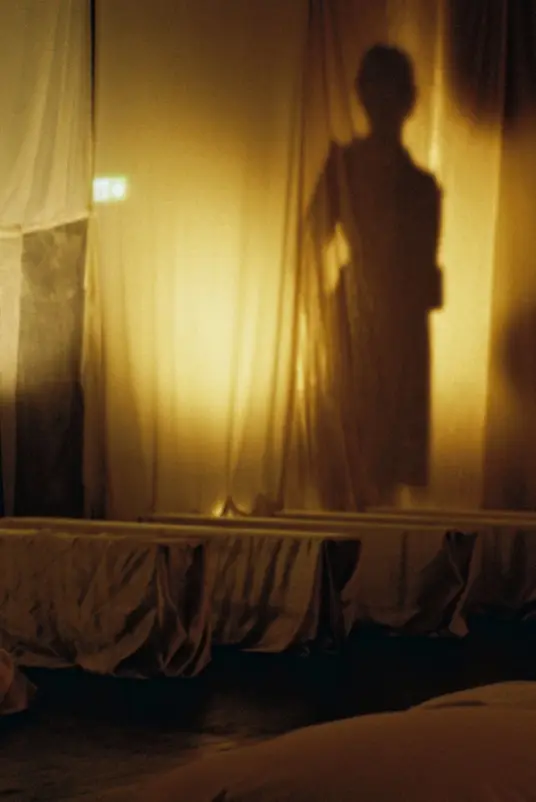
When I spoke to Lijadu about works like “Guardian Angel” in a recent conversation, she explained that these works deal specifically with how Christianity has “coloured our understanding of our own philosophical and epistemological heritage.” The effect of this intermedial interplay is antithetical yet unambiguous, simultaneously acknowledging how Christianity and Western cultural values in general have been imprinted into the contemporary Nigerian psyche while also holding space to acknowledge how the religion was weaponized as a tool of colonialism, used to demonise Indigenous forms of knowledge production. “How can we acknowledge two things at the same time,” Lijadu mused rhetorically, “rather than forcing the mind to draw a line in the sand?”
Wanting to hear Oluwole’s own tongue, I type her name into the YouTube search bar and click on a video titled “You Are A Stupid Idiot If You Condemn The Whole Of Your Culture!” Unsurprisingly, she is erudite. Soft-spoken, too, skipping between languages, her powdery Yoruba lilt skirts the corners of the argument to which I am listening devotedly. Oluwole is lawyerlike in her ability to explain what the Yoruba philosophical tradition is in terms of what it is not.
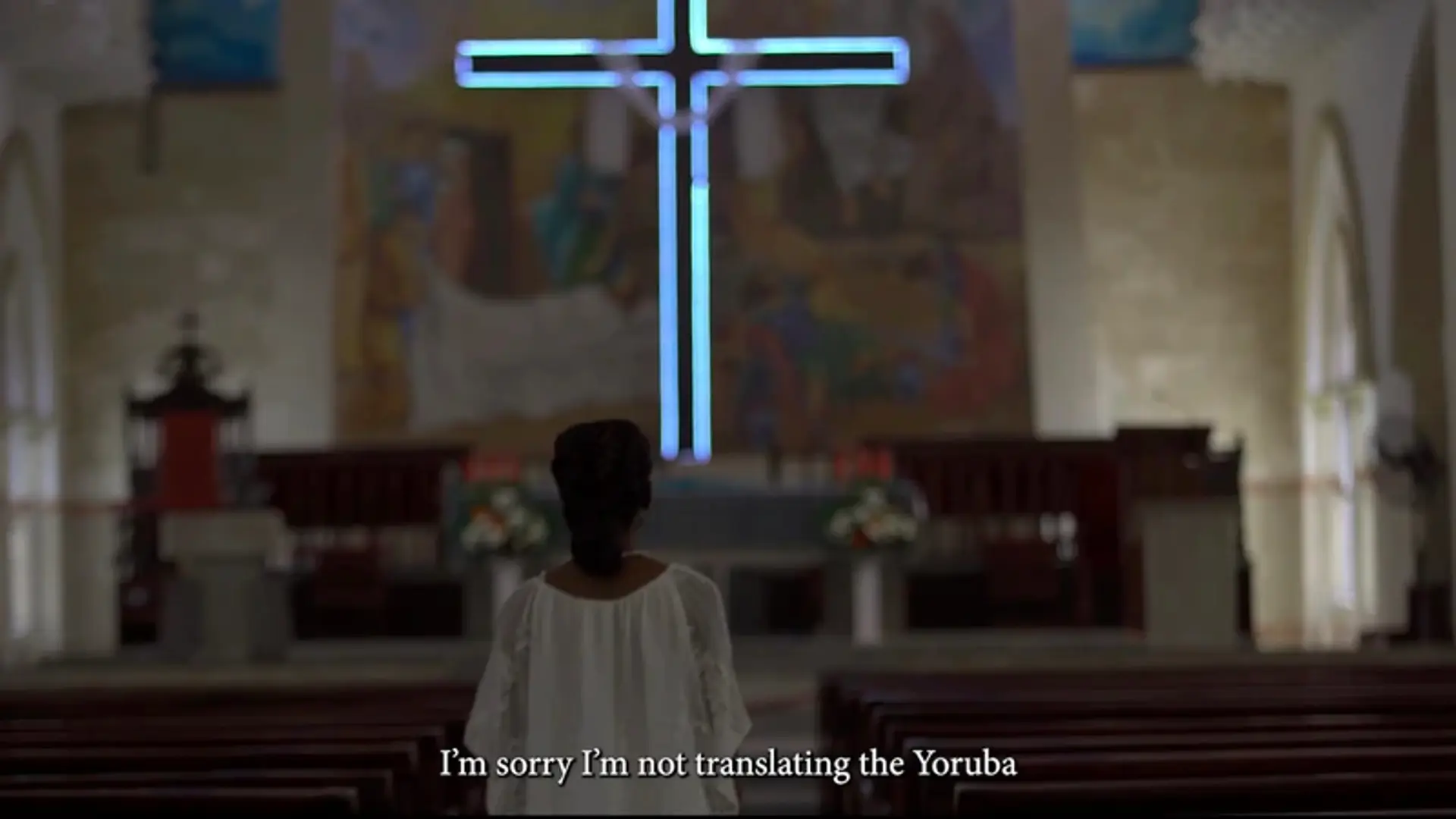
Still from Olukemi Lijadu, Guardian Angel, 2022.
Courtesy of the artist.
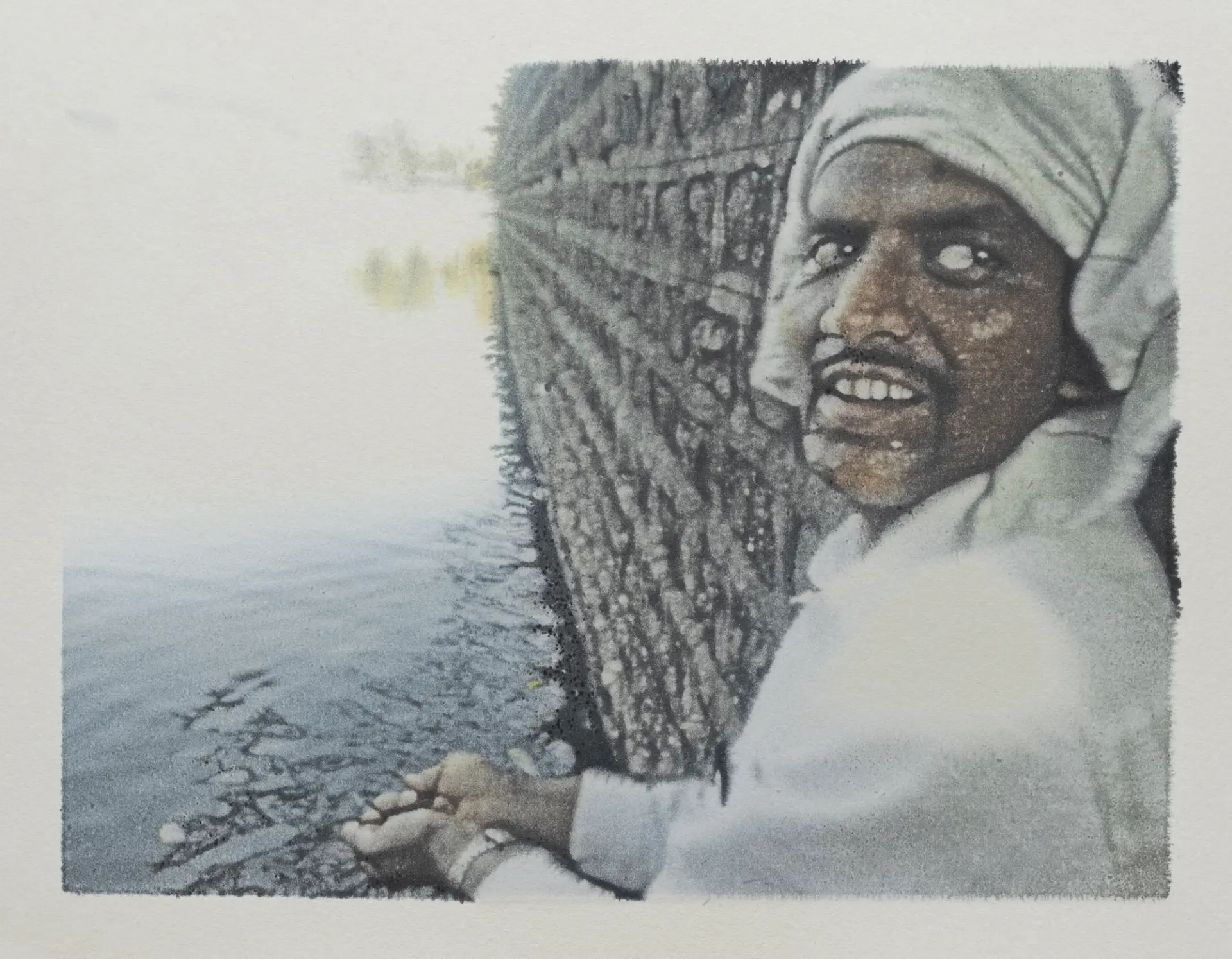
I find myself increasingly drawn to the inherent contradiction of complementary dualism and how it can evade the shortfalls of the English language, typically hell bent on seeking resolutions, absolutes, and full stops. Imagining ways this oxymoronic concept might be further applied, my gaze cannot help but settle on the wonderful fabric of Oluwole’s buba and matching little gele, both perfect examples of Yoruba indigo wax-resist dyeing techniques known as adire.
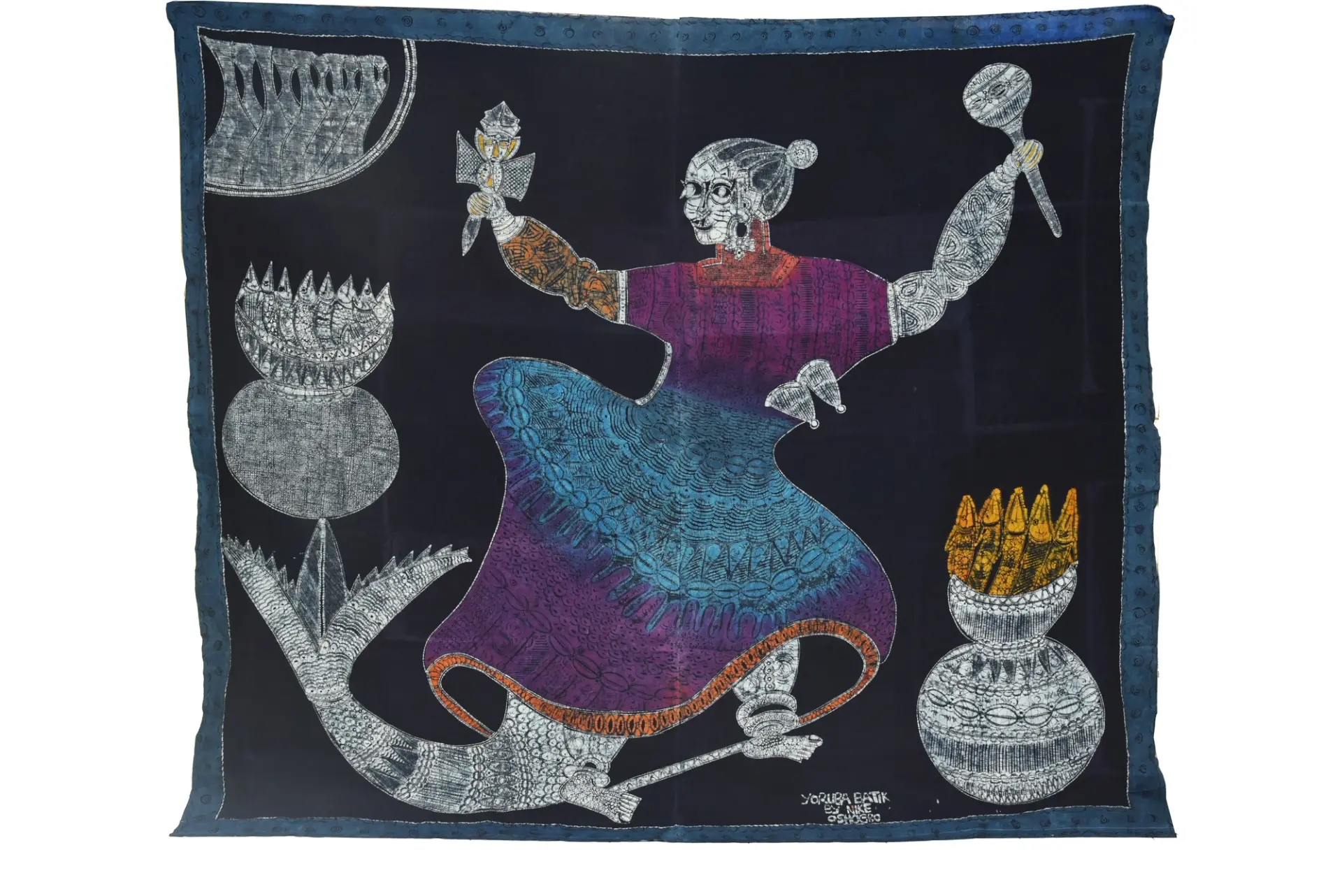
Nike Davies-Okundaye, Osun, The Goddess of the River, 1987.
Courtesy of the artist, kó art space, Lagos.
In fact, Oluwole was often photographed in adire—an intricately detailed, thalassic-hued cloth potentially classifiable as a wearable art, beyond a practical, decorative fabric. It occurs to me: complementary dualism may well exist across all factions of Yoruba creative output. Not wanting to lose focus, I quickly add “buy adire” to my Lagos To-Do List—preferably, I’d get some sheets from beloved textile artist Nike Davies-Ogundaye, who runs an eponymous gallery, the largest of its kind in West Africa—before returning to listen to more Oluwole.
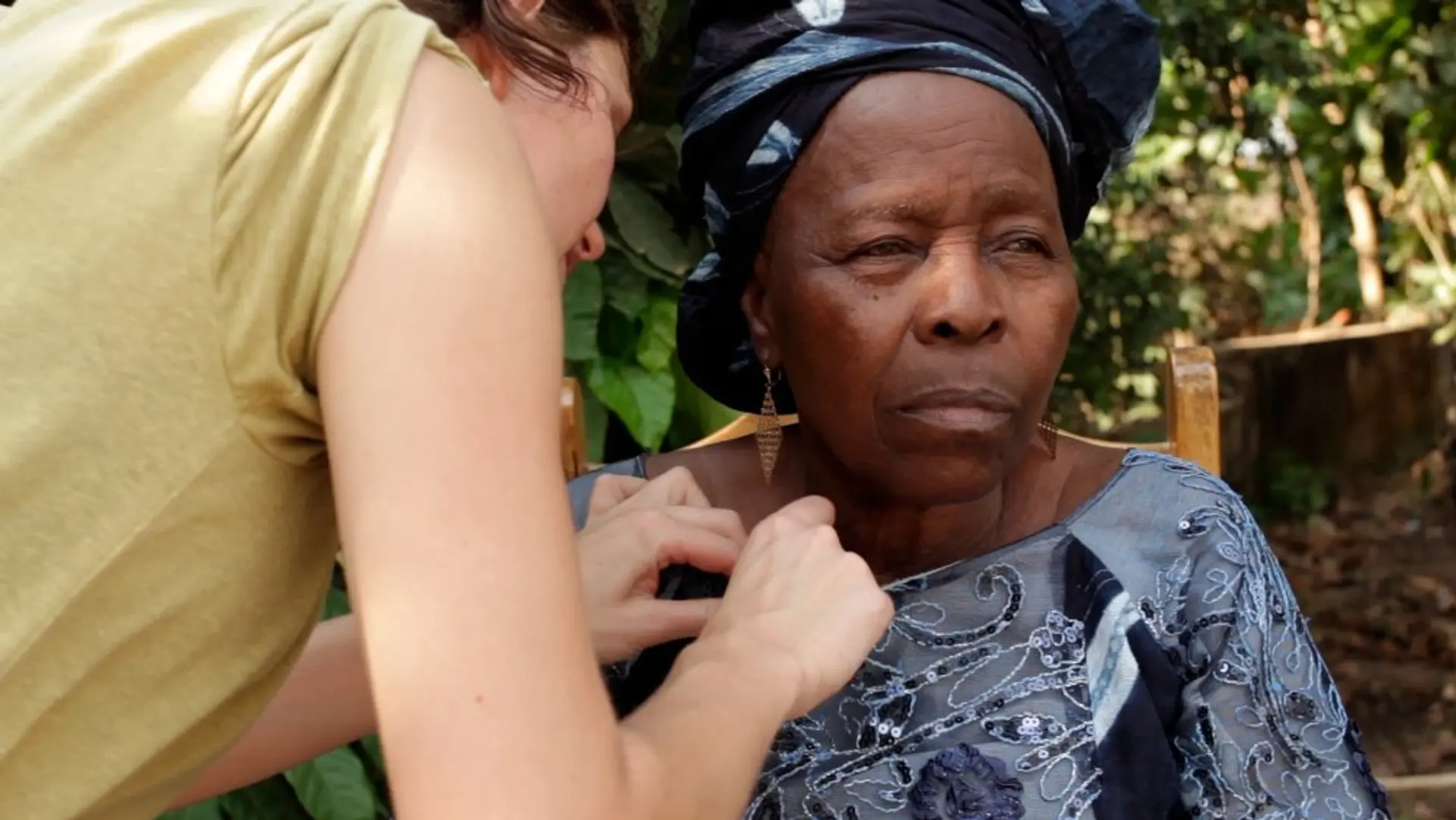
Sophie Oluwole.
Image courtesy of ZAM Magazine.
Dating back to the 1800s and historically produced by women, for whom the sale of adire became a rare, lucrative means towards mobility, the trade boomed in the early twentieth century on account of the influx of imported fabrics by colonial European merchants. Relevant also is how the different patterns realised through orally passed down methods of tying and dying signify different tribal, familial, and local heritages. This tradition is one that Davies-Ogundaye carries throughout her practice—which also includes highly-skilled embroidery—, realising intricate mural-like artworks extolling national and political symbolisms and critiques in a kind of post-folk art. Naturally, complementary dualism is required towards my understanding of this.
This creative double consciousness manifests across several Yoruba media, including, but not limited to the philosophical, the textile, and the sonic. Akpala, for example, is a kind of griot music characterised by bells, rattles, thumb pianos, a chorus of voices in dialogue, and the talking drum—a historic instrument whose warbling sound can produce inflections in imitation of the human voice and which can be carried across great distances. Not just a form of musical entertainment, akpala can also be considered as a means of practical communication.
Lijadu agrees with this, citing research she undertook while on residency this summer at Villa Albertine in Chicago, where she investigated the links between West African music and Black American electronic music, focusing specifically on Chicago house and Detroit and techno. She arrives at the position that the drum machine is an updated technology of the talking drum and the djembe, two West African musical staples which crucially provide space for collective ritual and communion, positing such an instance of intercultural exchange as an example of complementary dualism.
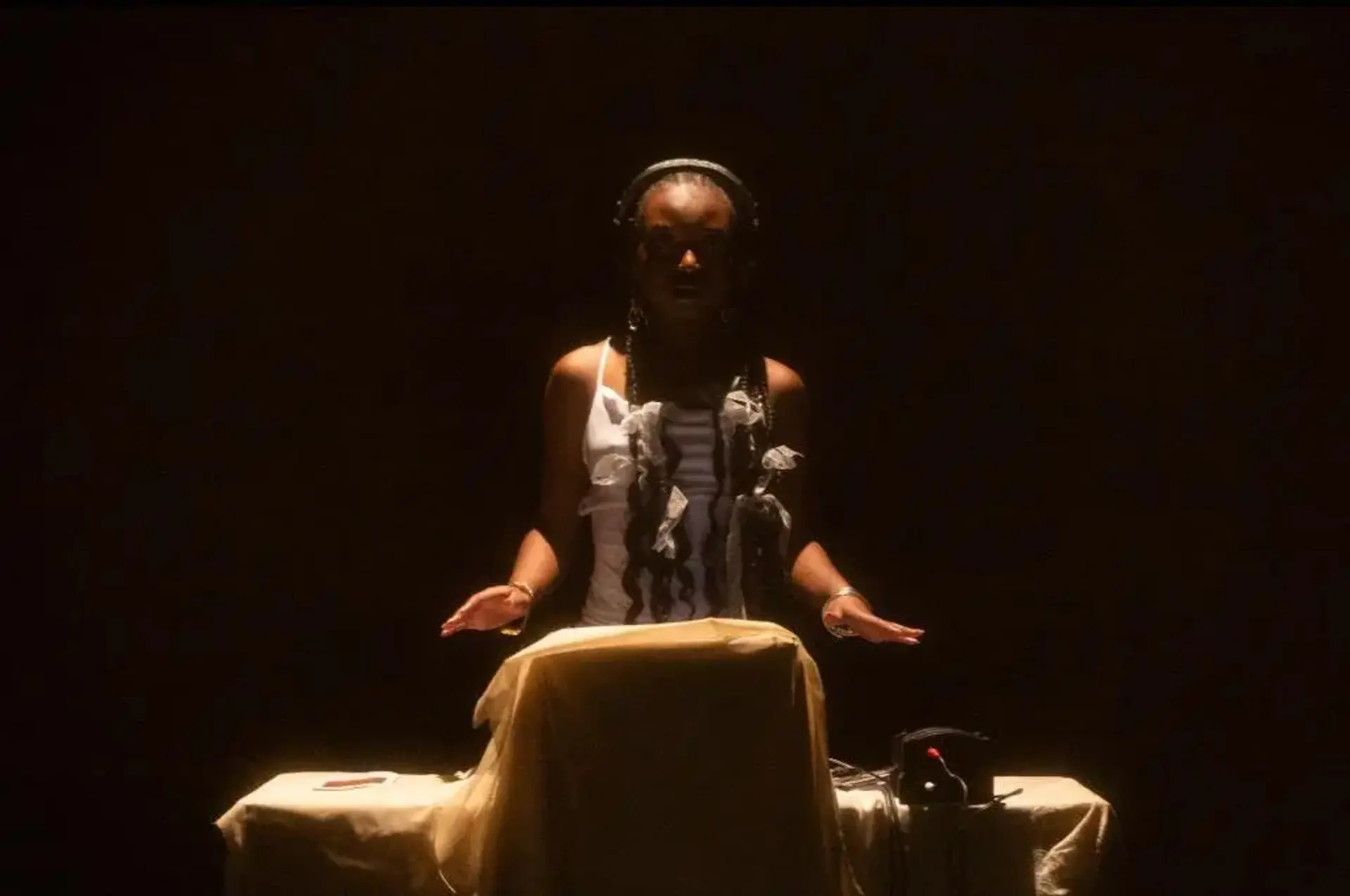
Installation shot, Olukemi Lijadu, Guardian Angel, 2022.
Courtesy of the artist, V.O. Curations, London.
Though increasingly complicated and expansive, in its materiality, complementary dualism is also banal. I realise this as I prepare to fly, turning my British passport over in my hand, noticing how the crumpled, pre-Brexit-burgundy booklet has been rubbed completely of its golden coat of arms, its corners velveted from a decade of being thumbed over, its pages speckled with the disintegrated lining of a vintage handbag. I think of how, in its worn state, this passport pales in comparison to my Nigerian one—a pristine, stiff green rectangle I usually keep hermetically sealed in a sandwich bag and pressed carefully between hardcovers—now making a rare, essential outing.