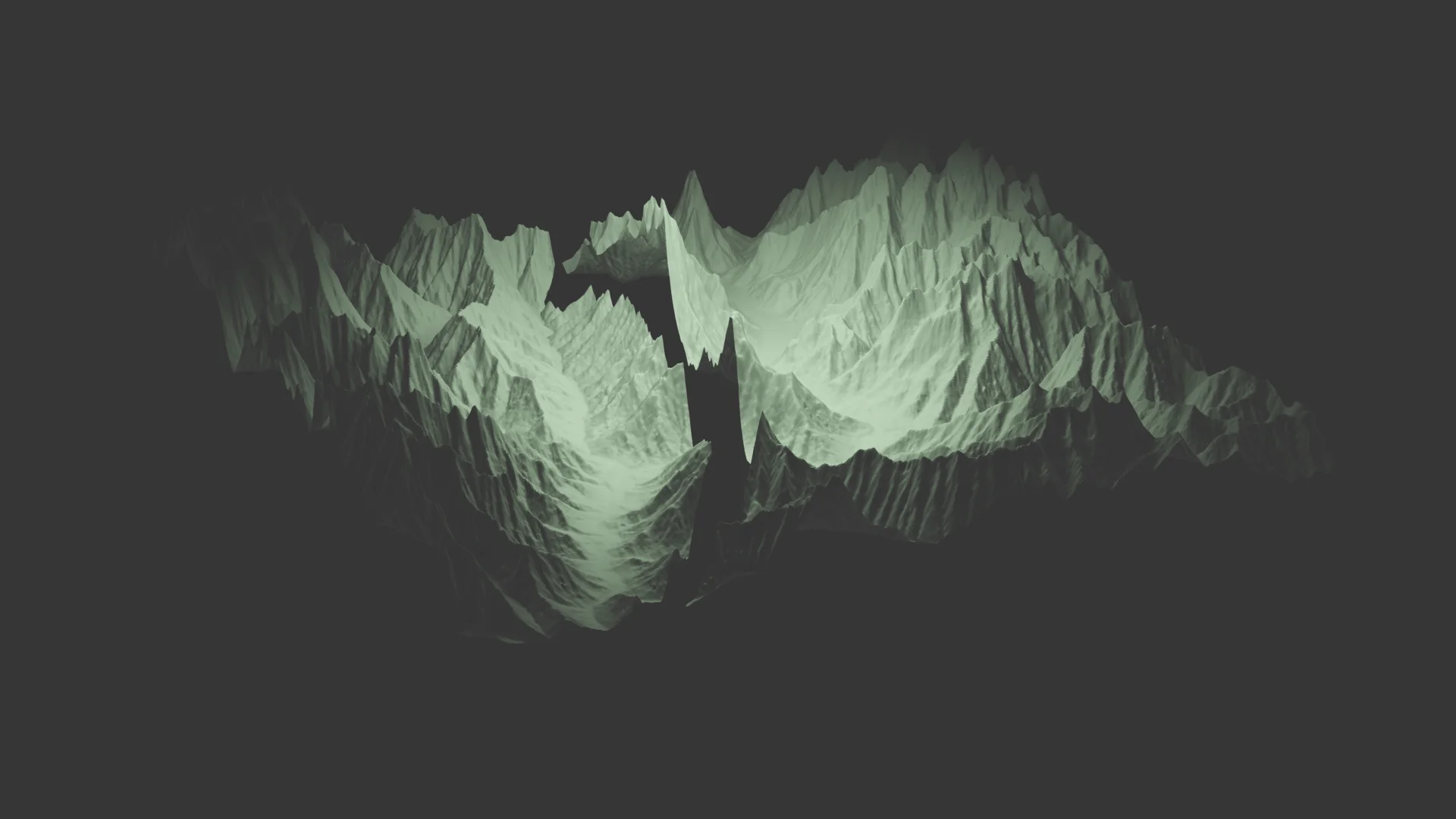
Illustration by Avian D’Souza. Commissioned by Hyundai Artlab for Artlab Editorial.
2023 Artlab Editorial Fellow Skye Arundhati Thomas examines the work of Kashmiri photographer Nawal Ali, uncovering the stark contrast between Kashmir’s breathtaking landscapes and its ongoing geopolitical struggle.
Artlab Editors: In 2022, Skye Arundhati Thomas accompanied Kashmiri photographer Nawal Ali on a trip to the Line of Control (LoC), which marks the de facto border dividing the Indian and Pakistani-administered parts of Jammu and Kashmir. Ali’s photographs capture the day-to-day lives of communities along the border, giving a new visual narrative of the region’s beauty and hardship. This essay is the second in Thomas’ three-part series on contemporary South Asian artists for Artlab Editorial, which is accompanied by illustrations by artist Avian D’Souza, who has created a 3D topographical map of the region. Ahead of early next year’s release of their second book, Pleasure Gardens: Blackouts and the Logic of Crisis in Kashmir, co-written with Izabella Scott and published by MACK Books, Thomas revisits Ali’s work. The forthcoming publication is an urgent two-part project that investigates land disputes, military occupation, and communication blackouts in Kashmir.
In Nawal Ali’s photographs, the outside presses in—a staggering, astonishing landscape. Her work takes us to the Kashmiri side of the Line of Control—the de facto border between India-occupied and Pakistan-occupied Kashmir—most of which sits at an elevation of about 12,000 feet. These Himalayan valleys, forested by surreal, unending topographies, are characterized by their brutality.
First, there is the brutality of landscape: the harsh plateaus, the icy climate; the unearthly-seeming confluence of crystal-pure glaciers, blue mountains, and rivers that glister as they move. Then, there is the brutality of the political and social conditions the people of these valleys are subject to. Woven into the composition of these landscapes are razor wires and electric fences; strategically angled, ready-to-shoot heavy artillery; and patrols with automatic guns.
As the eye passes over a particularly scenic plateau it will likely land upon the tin roofs of military barracks, the sandbags of dug-out bunkers. The rolling mountains are interrupted by smoggy chimneys of army camps, and by the lurching trails of metal fencing that indiscriminately cut across rock, moving along stretches of near-perpendicular slopes, as though defying gravity. The LoC, in its living manifestation, set as it is in one of the starkest terrains in the world, is an impossible border, a hard-pressed presence in a topography that is utterly unsuited to it.
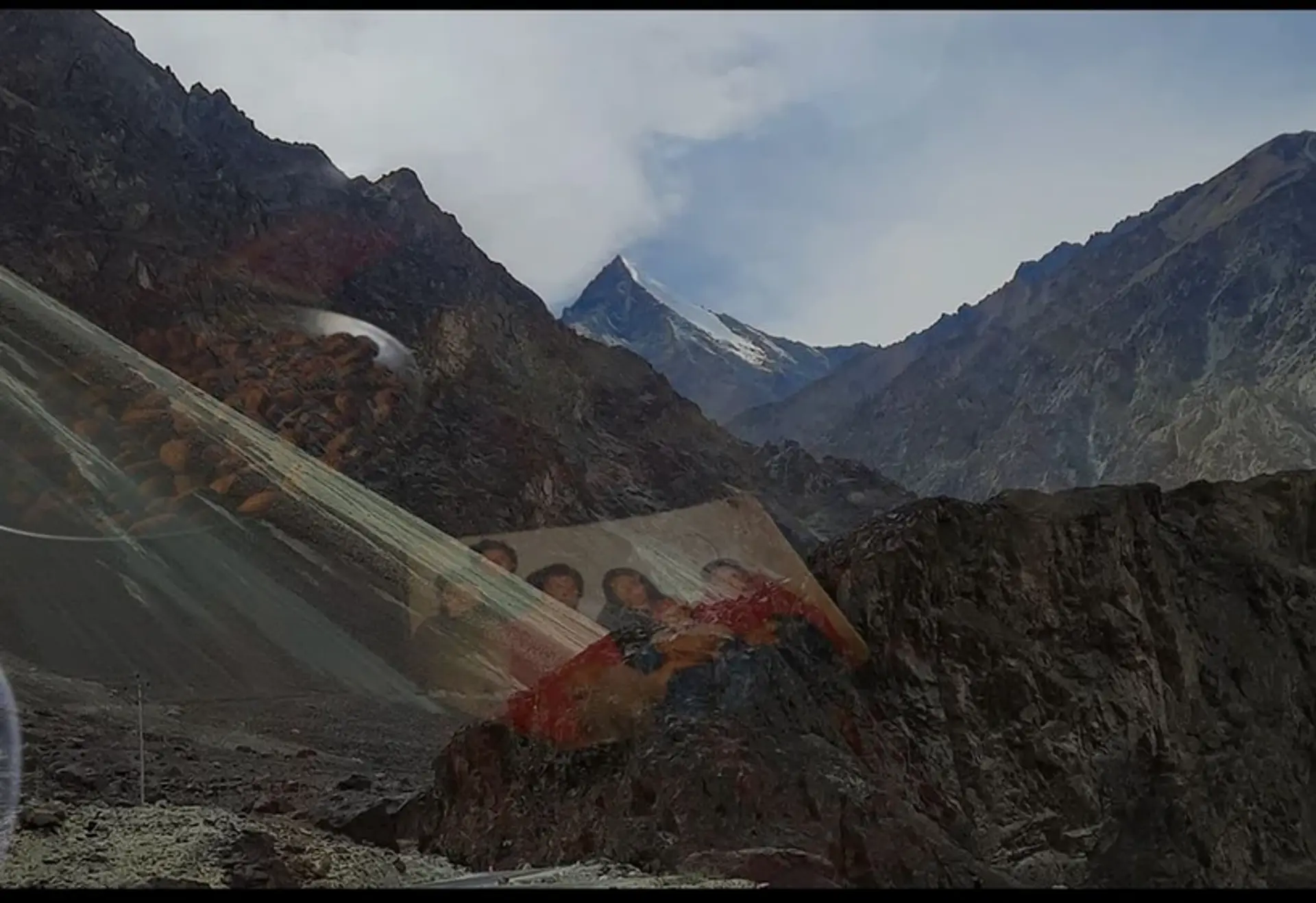
Nawal Ali, The Line of (State) Control: Untitled, 2021—ongoing.
Courtesy of the artist.
Ali is a rare photographer to travel through these elevated valleys, and she gives us glimpses not just of the geography, but also of the interiority of people’s lives there. Portraits that comprise details of kitchens, the carpet-padded insides of family rooms. The work gently displays how the outside world inflects upon the surfaces of people’s homes, and onto those that inhabit the small interstices between toughening landscape and political dispute. Sometimes, Ali’s transfer of outside to indoors happens quite literally: in an image from the series Line of Control, a family photograph, held next to a plate of dry fruit, is reflected in a window’s glass, from which is visible a wild, almost unforgiving mountain vista.
Ali’s ongoing series Line of (State) Control is a survey of an erstwhile obfuscated landscape. In the imaginations of people in mainland India, the LoC is either romanticized for its astonishing views, or, more often, reiterated as a site of permanent conflict. It is the frontline of India’s ongoing conflict with Pakistan, and ultimately the reason provided by successive Indian governments to increase the presence of military and artillery in the region.
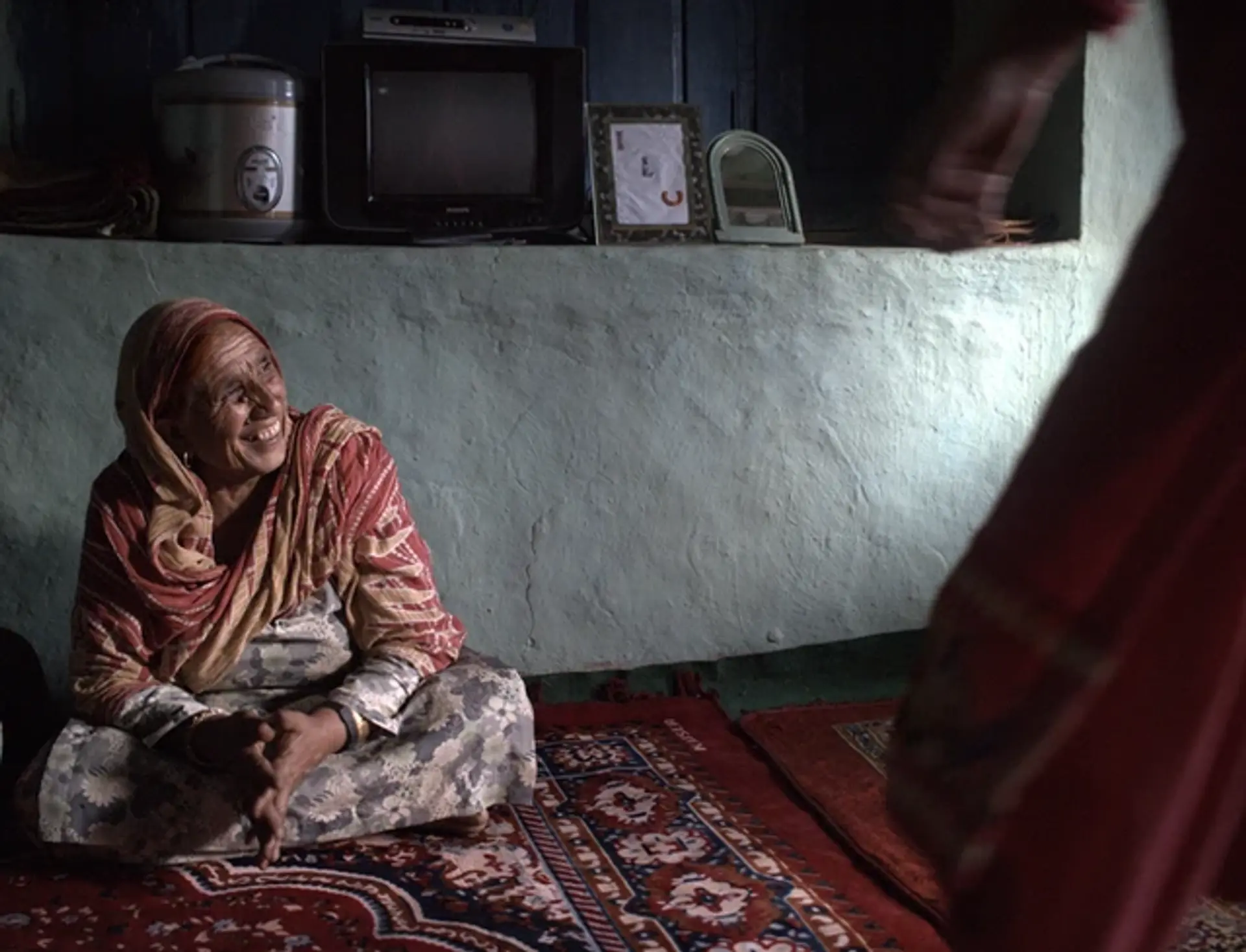
Nawal Ali, The Line of (State) Control: Untitled, 2019—ongoing.
Courtesy of the artist
Ali’s lens concentrates more on the seemingly contradictory—but in fact acutely symbiotic—intimacies of this place, from a flickering snow-tipped peak to the layering up of fabric inside a pastel-painted home, where Ali’s host claps her hands together, leaning to one side, as she tells the story of how she came to live there. In a note accompanying the latter photograph, Ali recounts what her host, Zahida Begum, told her. She was carried to the village of Saujian in a palanquin from her village, just a short distance away, a hometown that has now been absorbed into Pakistan-administered Kashmir. When she was younger, the borders between the divided states were more porous, but now, anti-personnel landmines saturate the grounds below. The constant threat of their deadly potential has been distilled into the everyday as deterrent, as warning, and reminder of how, especially in this place, life finds abrupt ends.
The coherence of the Indian occupation’s claim on Kashmir vastly depends on its ability to uphold a narrative of the region’s startling, fantastical beauty. The wide lakes that reflect the sky almost perfectly, like glass panes installed into the earth. The jagged, frost-coated mountains that get more dramatic as you climb northward, deeper into the Himalayas—this site of ancient history that also bears the contradiction of being as yet young. The Himalayas are still growing, nearly one centimeter every year, where the Indian and Eurasian plates continue to collide, firmly thrusting the peaks further up into the sky. But this scenery blisters as soon as you look closer: the kilometers-long coils of electric wire, the threat of landmines.
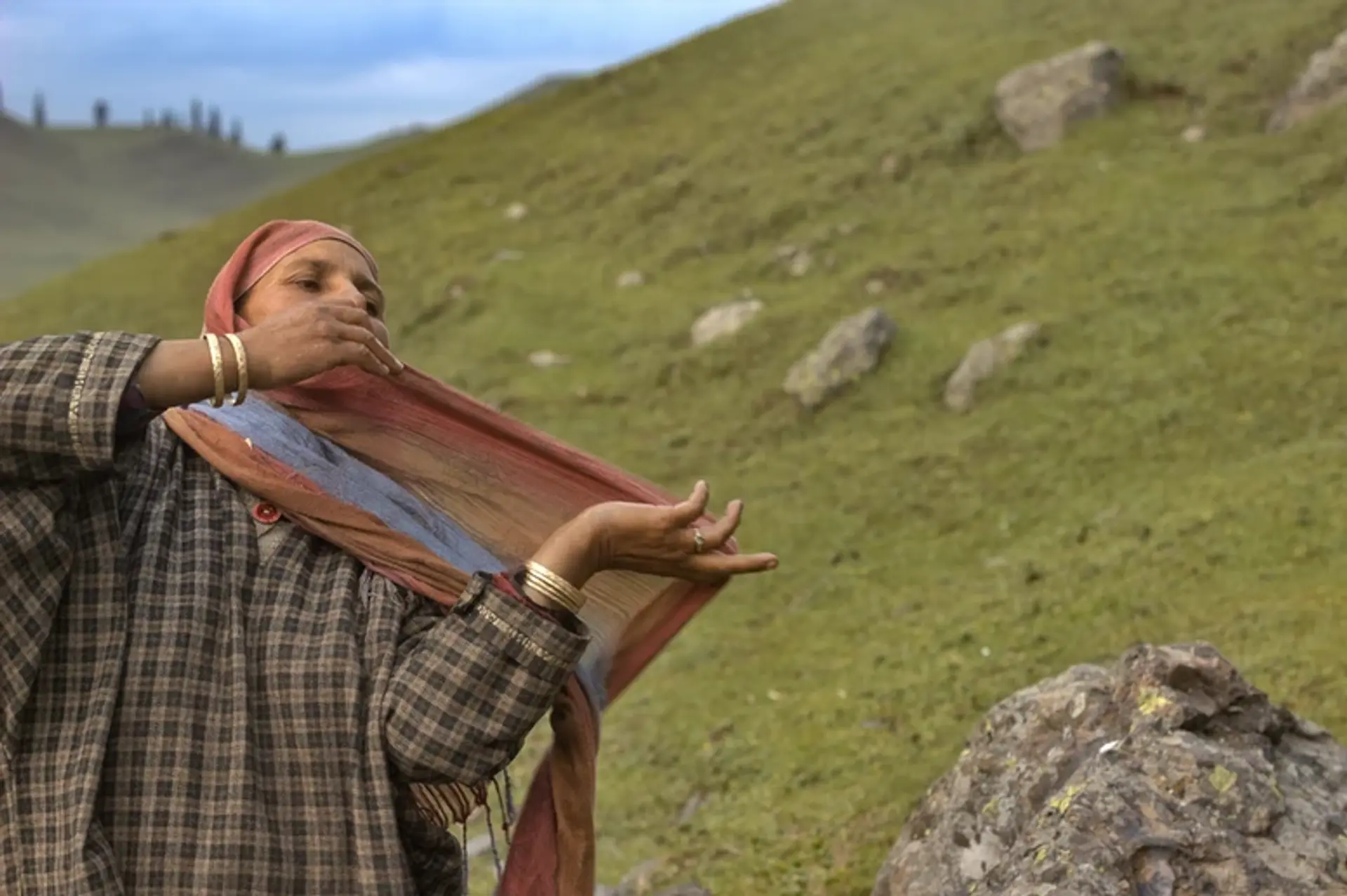
Nawal Ali, The Forbidden Meadow: Tosa Maidan, 2018.
Courtesy of the artist
Images from Kashmir have often relied on the spectacular to stake their claim, to help people from the outside, especially, become cognizant of the violences imposed upon Kashmiri lives. Bloodied pavements and chunks of snow, the uneven clashes between young protestors and the heavily armed military. This visual language has been necessary to invoke the pathos, and the rage, essential in response to the occupation. The occupying force, too, depends on its own forms of spectacle: dip-dyed landscapes of rising suns over sprawling meadows, speckled alpine views. Ali’s visual language is marked by its quietness, and steadfastness. She turns her camera to smaller, more delicate particulars: the curve and marked flair of a woman’s hands as she straightens her hijab, fingers in a soft, dance-like pattern, set against a pitching hill.
This image is from a series entitled The Forbidden Meadow: Tosa Maidan, for which Ali made the journey to Tosa Maidan, a plateau nearly 70 kilometer square, set against a backdrop of white Himalayan peaks, which are blanketed in snow even in the shining heat of the summer. Tosa Maidan is a pasture meadow, used by Indigenous shepherd communities for grazing their animals. Since 1964, the region has also been used as a firing range by the Indian armed forces. Artillery has been stored here for decades, in the villages, and in the steppes of the mountains that surround the plateau. While conducting firing drills—guns pointed toward the icy peaks, or surrounding glaciers—“accidents” have occurred. Reports say that at least 60 people have been killed by stray bullets and mortar. In 2014, two siblings in Lassipora were tossing around a plastic bag filled with soil. A piece of mortar shell had been collected with the dirt. There was an explosion. Seven-year-old Simran Riyaz died, while her brother, Fayaz, lost limbs.
Places like Tosa Maidan are called “playgrounds of death” by some locals, and there are many such playgrounds in Kashmir. Since 2002, a Public Commission on Human Rights report explains, at least 90 minors have been killed by accidentally playing with mortar, or unexploded bombs that have rolled into fields, even backyards. In a note accompanying the series, Nawal Ali writes about Tosa Maidan, “Beauty and tragedy share a plate in Kashmir.”
Nawal Ali is a researcher and a photographer from Indian Administered Kashmir. Ali is the co-founder of Her Pixel Story, a female-led photography collective based in Kashmir. Her practice lies between research and photography focusing on people’s imagination, imageries and reclamation of their spatiality, landscape and identity through ethnography and oral history in regions along the Line of Control (LoC). With a focus on the narratives of the people, Ali has written on issues ranging from gendered resistance to refugee lives to climate change. Her work has been featured in Al Jazeera, The Caravan Magazine, TRT World, Polis Project, The Curator Mag, and The Adi Magazine. In 2023, Ali finished an extensive India Foundation for the arts funded research project on the Shina culture in Gurez-Tuleil, a region along the LoC, mapping its culture as well as the interventions to culture from state and development processes. Currently she is an NBC AHRC funded PhD scholar in Human Geography at Durham University, UK.
Avian D’Souza is a visual artist and designer. He has worked for various design firms in the UK and France, and is now based in India. His recent works include large-scale drawings with Fondazione Elpis in Milan, murals at GSCSK8, a skatepark initiative in Gwalior, India. Album artwork for the Bombay-based music label Incink Records LLP., 3D and VR interfaces for CRI Geneva, a platform for post-human studies and data visualization.