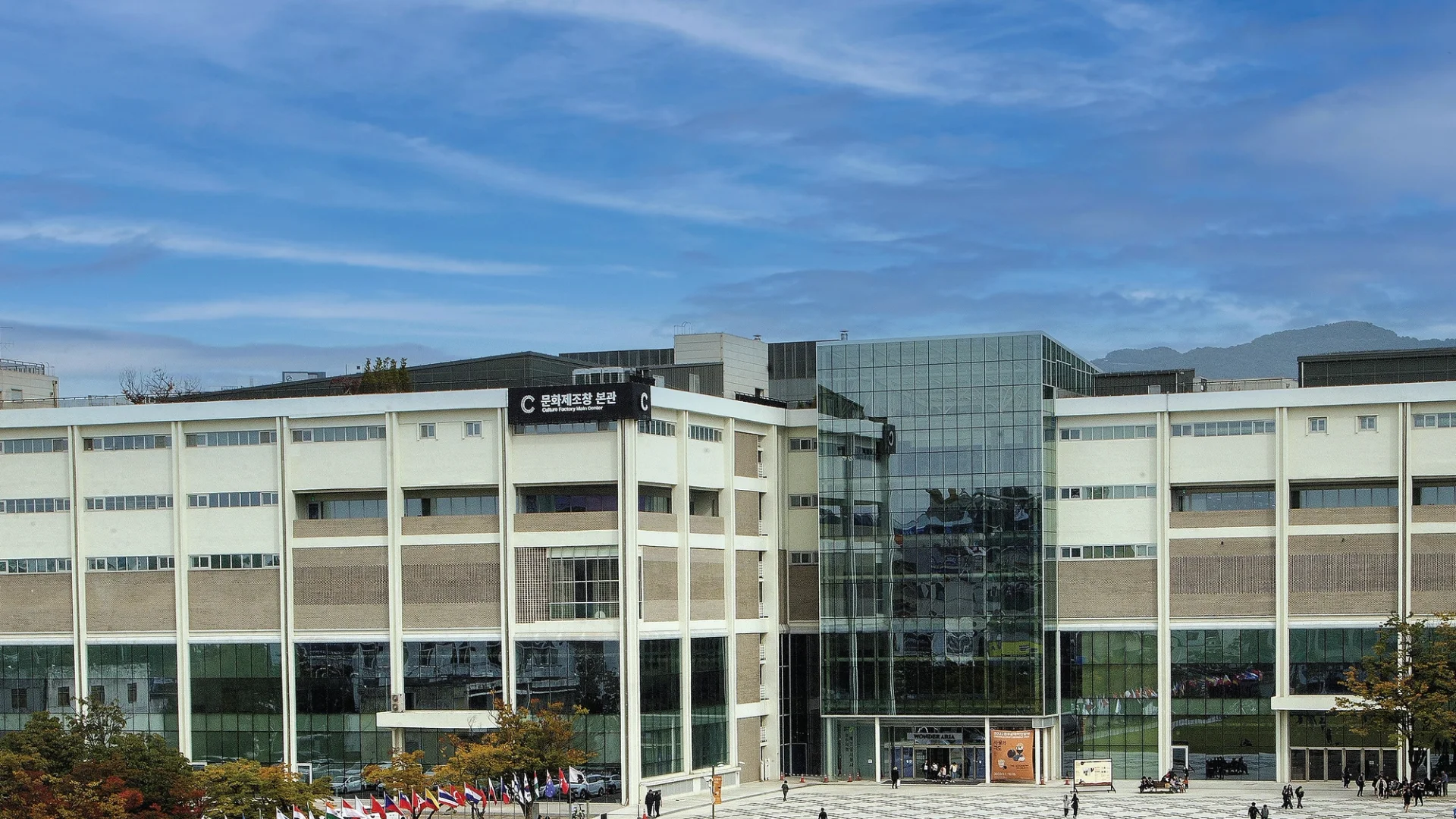
Cheongju Craft Biennale
Photo ⓒ Cheongju Craft Biennale Organizing Committee.
On the occasion of Hyundai Translocal Series: Entangled and Woven—the inaugural exhibition in Hyundai Motor’s new partnership initiative, Hyundai Translocal Series—curators Amy George and Jeeyoung Lee reflect on how reciprocal research, artist exchanges, and co-created works are reshaping global understandings of craft and community.
Artlab Editors: As part of the inaugural Hyundai Translocal Series, the Cheongju Craft Biennale 2025 in Korea collaborated with the Whitworth, The University of Manchester in UK under the theme of “Craft and Community,” delving into the rich histories and contemporary practices surrounding textiles.
A new and innovative cultural initiative designed to foster creative dialogue and cross-regional exchange between leading art institutions and local communities worldwide, Hyundai Translocal Series continues the legacy of Hyundai Motor's art projects through transformative programming that connects the local to the global.
The first of these exhibitions, Hyundai Translocal Series: Entangled and Woven, recently opened in Cheongju and includes eight new commissions alongside a collection of works from the Whitworth.
On the occasion of this exhibition’s opening, we spoke with Amy George, Senior Curator of Collections, Textiles, and Wallpaper at the Whitworth and Jeeyoung Lee, Senior Curator for the 2025 Cheongju Craft Biennale about their collaboration.
Artlab Editors: How do you think the artists and curators from each other's location influenced each other's practices through this partnership? Could you share your observations on how the participating artists’ works have evolved or changed after their research trips?
Amy George: The participating artists demonstrate how textile art today is increasingly hybrid, experimental, and conceptually rigorous. Somi Ko’s transformation of hanji (traditional Korean paper) into thread-like material draws attention to the slowness and intentionality of hand-making. In India, she collaborated with artisans practising bandhani and mirrorwork, allowing these methods to inform new sculptural forms. Similarly, Kaimurai and Yeonsoon Chang’s practices, grounded in indigo-painted khadi and indigo-dyed abacá respectively, both reflect a meditative approach that is deeply personal yet clearly rooted in shared cultural and spiritual practices.
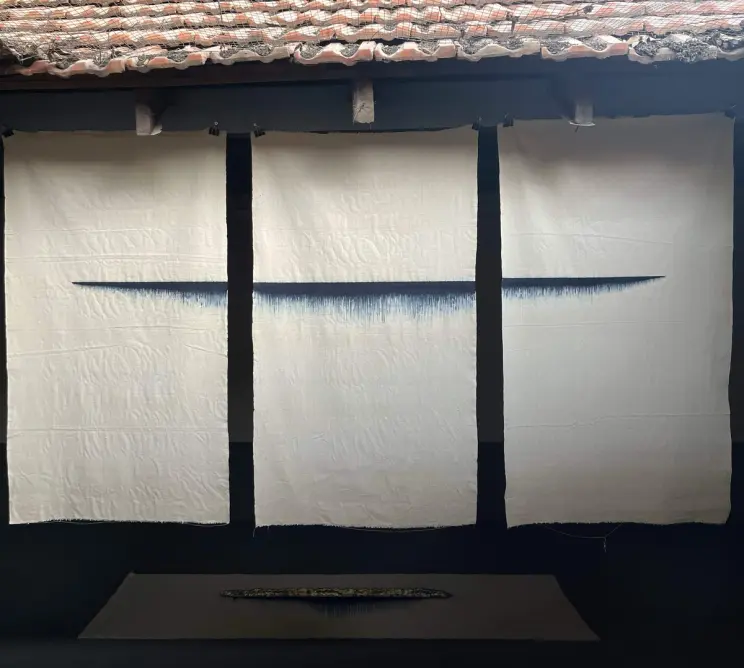
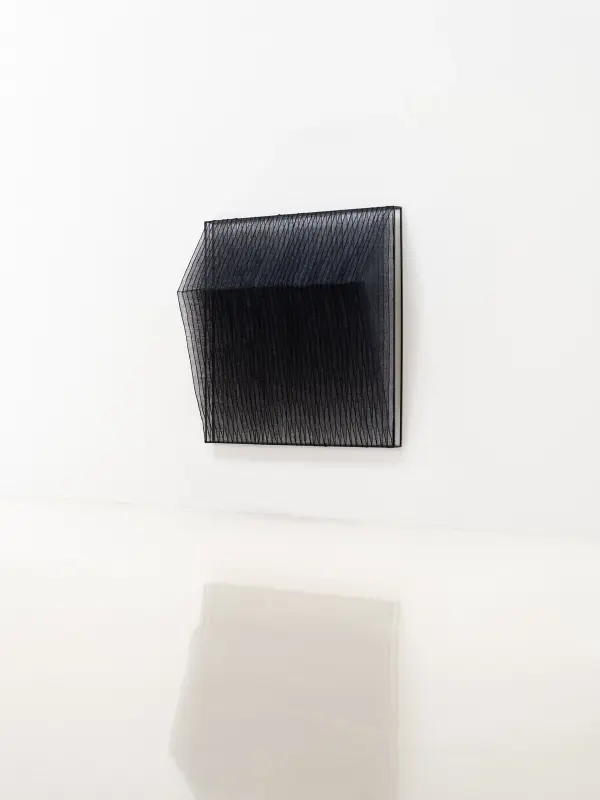
These are not simply reinterpretations of heritage. They are efforts to locate textile practice within broader artistic and political conversations. Whether addressing the legacy of women’s domestic labor, the spiritual symbolism of materials, or the function of ritual in contemporary life, these works show how textile art can be a means of critical inquiry, not just craft preservation.
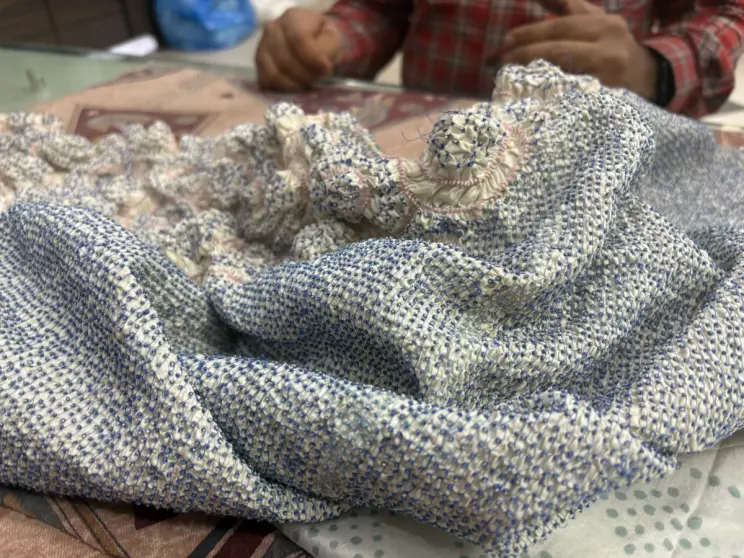
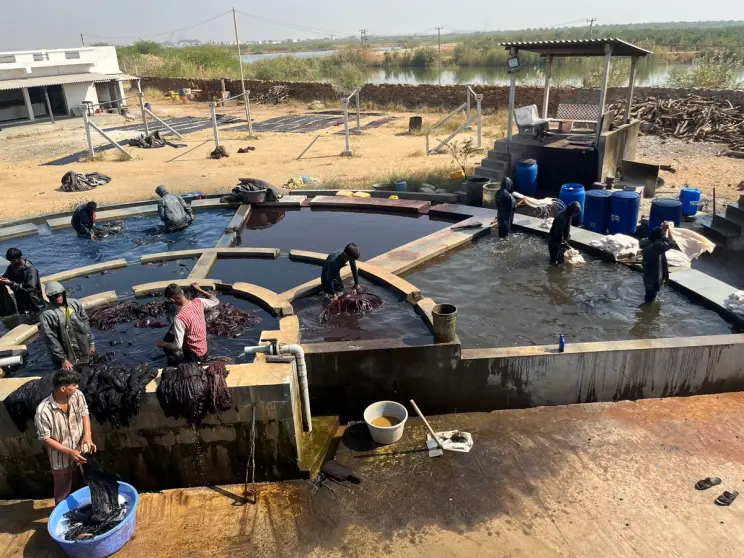
This emphasis on exchange and experimentation has led to outcomes that resist easy categorization. Some pieces take the form of architectural interventions, such as Sumakshi Singh’s thread-based drawings that map imagined and remembered spaces. By conceptualising bridges as symbols of connection, Singh’s work underscores the role of craft in fostering dialogue between cultures and histories. While the techniques may differ, the questions are shared: What does it mean to preserve a tradition? How can materials carry meaning across cultures without losing their specificity?
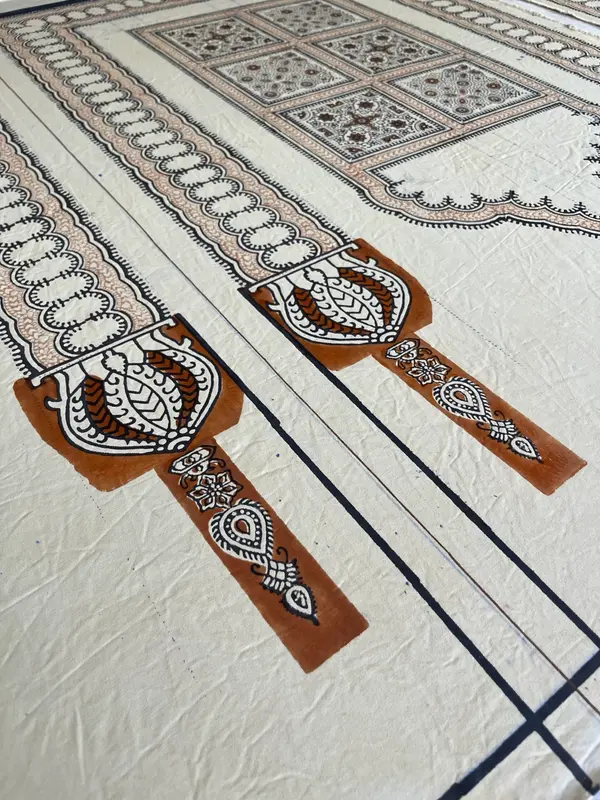
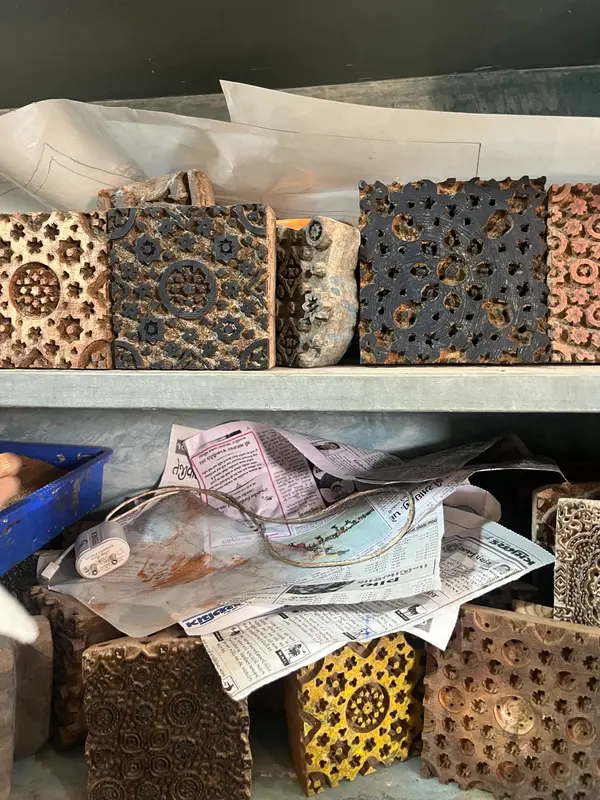
Jeeyoung Lee: Significant transformations emerged through the relational dynamics among the participants. These transformations were not limited solely to the artists from Korea and India, but also extended to the relationships formed between artists and local artisans, as well as the curators and researchers engaged in the process.
The artists approached local artisans not as preservers of cultural legacy, but as contemporaneous creative agents engaged in the co-development of knowledge and practice. While such exchanges may have introduced unfamiliar challenges for artisans working within long-standing traditional frameworks, they also provided opportunities to reconsider how inherited techniques might attain contemporary resonance. This became a platform to explore the evolving role of their expertise. Simultaneously, it offered validation that locally embedded knowledge and practices continue to hold relevance and value within contemporary cultural discourses.
All participating artists have long been engaged in formulating methodologies to reinterpret their respective cultural traditions through contemporary frameworks. For instance, Boito and PÉRO have investigated how traditional textile techniques might be sustained within the structures of the global fashion industry, despite systemic constraints. Their practices are not limited to material appropriation, but rather represent a sustained attempt to position tradition as a core component of cultural identity. These approaches demonstrate how locality and ethical awareness can be expressed through contemporary artistic languages.
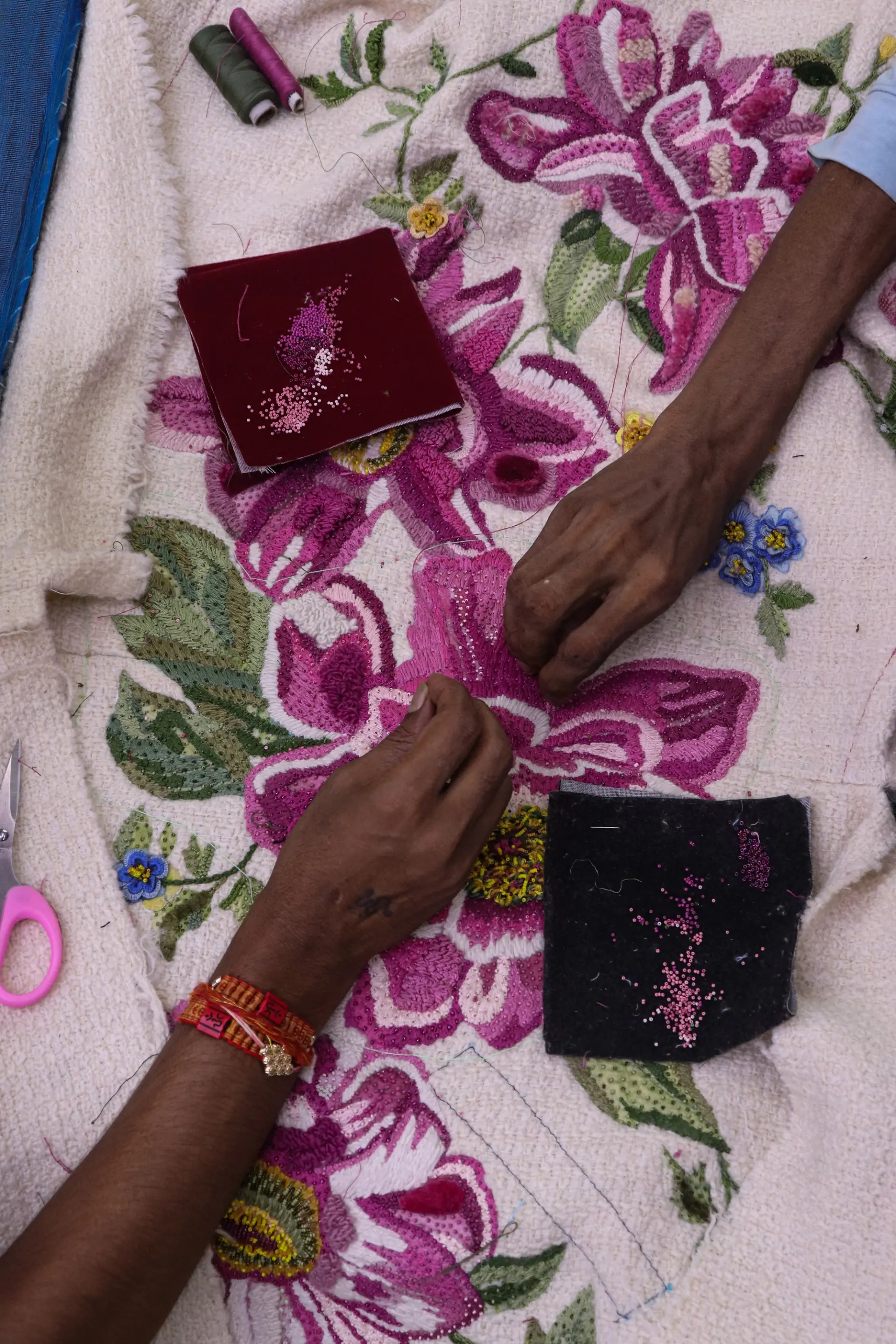
PÉRO, Hullabaloove Collection (fall - winter), 2024. Material: Flowers, flowers, and more flowers scatter on our textiles through multi-techniques and mixed media such as beadwork, hand-embroidered detailing, and 3-dimensional hand painted prints.
A comparable trajectory is evident in the practice of Somi Ko. As both an artist and the founder of a lifestyle studio, Somi integrates critical material inquiry into her work by investigating the potential for locally embedded industries to be sustained through artistic intervention. Her development of a woven textile derived from thread processed from hanji exemplifies this methodology. By collaborating with traditional hanji-making workshops, she actively contributes to sustaining the practice by situating it within broader contemporary cultural and artistic discourses.
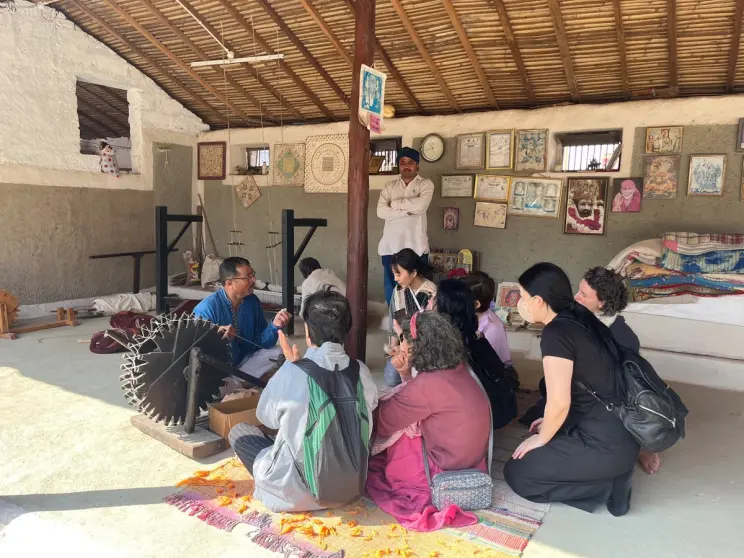
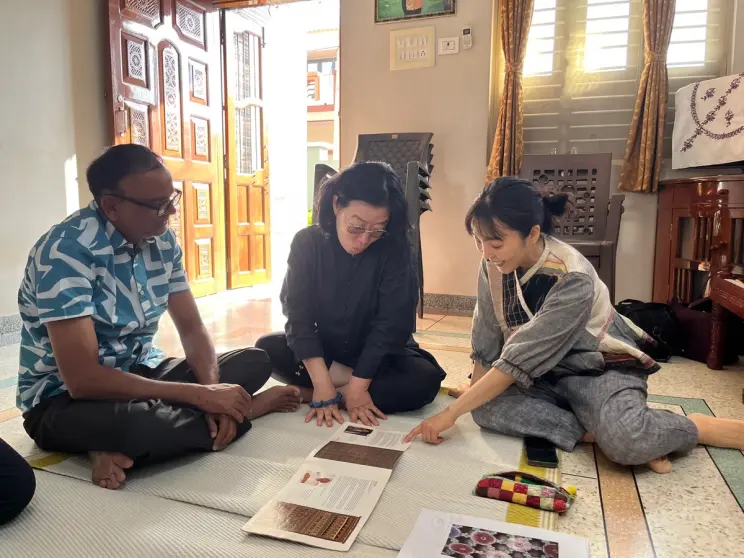
The first research trip, conducted in February, 2025, involved Korean artists undertaking a field study of India’s textile heritage and traditional techniques. Centred around the Bhuj region in Gujarat, the itinerary included visits to Shamji Vishram’s weaving workshop, Dr. Ismail Khatri’s Ajrak block-printing studio, Kala Raksha (a community-based initiative supporting the livelihoods of women from seven minority groups), and a family-run ikat weaving operation. These engagements foregrounded textile practices as dynamic repositories of cultural knowledge.
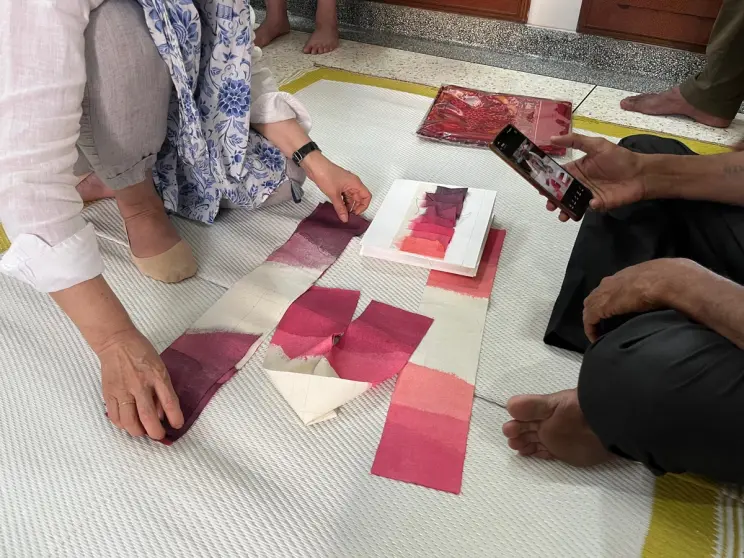
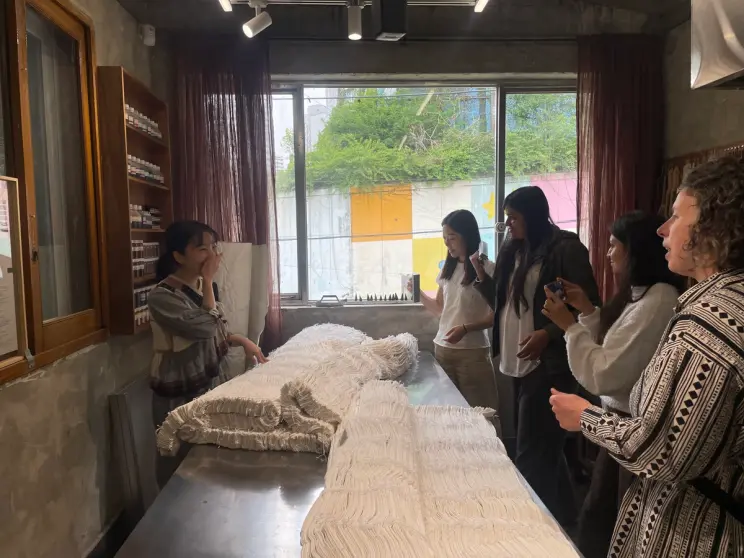
Subsequently, in April, Indian artists visited Korea, engaging with local textile artists and artisans to explore prospects for future collaboration. Under the guidance of Dr. Boyeun Kim, whose research focuses on comparative ramie cultures across Korea, China, and Japan, the group visited key heritage sites, including Hansan Mosi (ramie) in Seocheon, sambe (hemp) production in Andong, and myeongju (silk) weaving in Gyeongju—each recognised as UNESCO or National Intangible Cultural Heritage. These site visits facilitated in-depth exploration of the genealogies and regional specificities of Korean textile traditions.
This reciprocal exchange fostered structural shifts in the participating artists’ approaches to materials and artistic practice. It presented a critical framework for exploring how translocal artistic engagement might give rise to more autonomous and relational models of exchange. For instance, Boito expressed a particular interest in the cultural and technical affinities and distinctions between Korean ramie and Indian kerang fibre. A comparative research project is underway in collaboration with Dr. Boyeun. This development illustrates how individual inquiries can evolve into collective knowledge production, further positioning the project as a platform for sustained creative research.
Given the labor-intensive and time-consuming nature of textile work, the outcomes of this initiative are anticipated to unfold incrementally. The first phase of public presentation is currently taking place at the Cheongju Craft Biennale 2025, followed by exhibitions at the National Crafts Museum & Hastkala Academy in New Delhi, India (February 2026) and the Whitworth in Manchester, UK (July 2026). This trajectory reflects the project’s ambition to develop into a long-term, evolving platform for intercultural artistic collaboration.
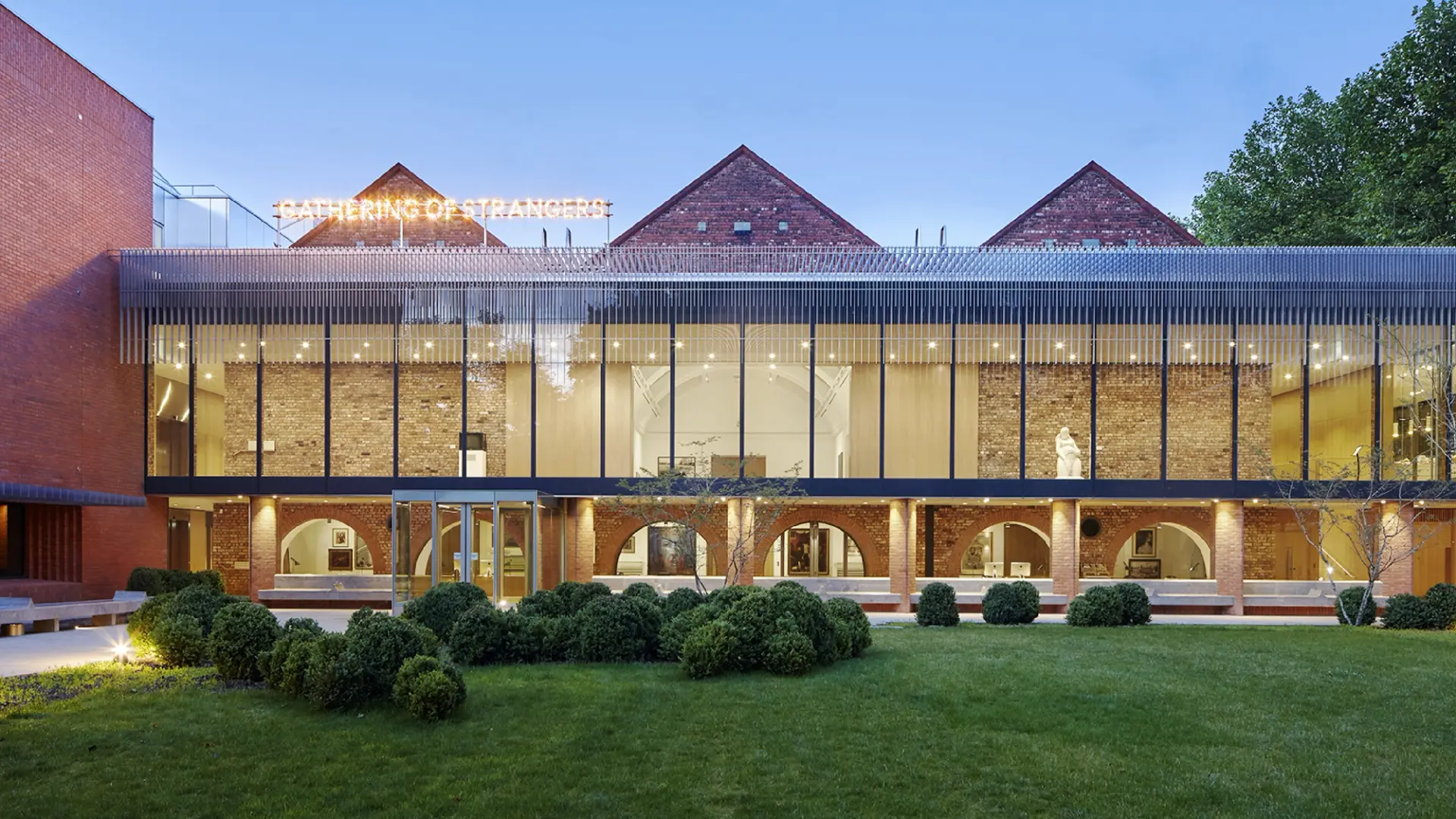
Exterior image of the Whitworth, ‘Gathering of Strangers’ artwork by Nathan Coley (2007).
Photograph by Alan Williams ⓒ the Whitworth, The University of Manchester.
Artlab Editors: In what ways does the collaboration challenge or expand conventional understandings of craft, particularly in a globalized art ecosystem?
Jeeyoung Lee: This collaboration challenges conventional understandings of textile craft by repositioning it as a site of ethical, ecological, and philosophical engagement within the global art ecosystem. Rather than treating craft solely as a repository of traditional techniques or material knowledge, the participating artists collectively pursued a reorientation of their practices toward values rooted in environmental responsibility and respect for life. In doing so, the project shifts the emphasis from technical exchange to a more expansive view of craft as a situated mode of thinking and being—an evolving cultural practice that negotiates global conditions while remaining grounded in local specificity.
In the course of their research into Korean silk production, the participating Indian artists posed critical inquiries into the customary practice of boiling live silkworm cocoons to extract silk fibres. As an alternative, they introduced the concept of Ahimsa silk—a non-violent method that preserves the lives of the silkworms during the extraction process. This approach not only offers an alternative ethical framework through which to reconsider traditional Korean textile practices, but also challenges dominant aesthetic paradigms by necessitating the acceptance of variations in texture and material quality. Such a reorientation foregrounds craft as a site of ethical engagement, where the material processes of making are inextricably linked to broader questions of life, agency, and responsibility.
Beyond ethical considerations, artists from both Korea and India actively engaged in critical dialogue regarding the potential for repurposing by-products within the textile industry, as well as the relevance of traditional techniques within contemporary sustainability discourses. Somi Ko, for example, presented an experimental project undertaken in collaboration with peers, wherein the inner bark waste produced during hanji manufacturing was transformed into drawing charcoal. Building on parallel examples from the Indian context, Kaimurai raised inquiries into the possible reapplication of hemp by-products—generated in the production of sambe—into adjacent industries, thereby posing fundamental questions concerning the long-term sustainability and adaptive capacity of Korea’s traditional textile practices.
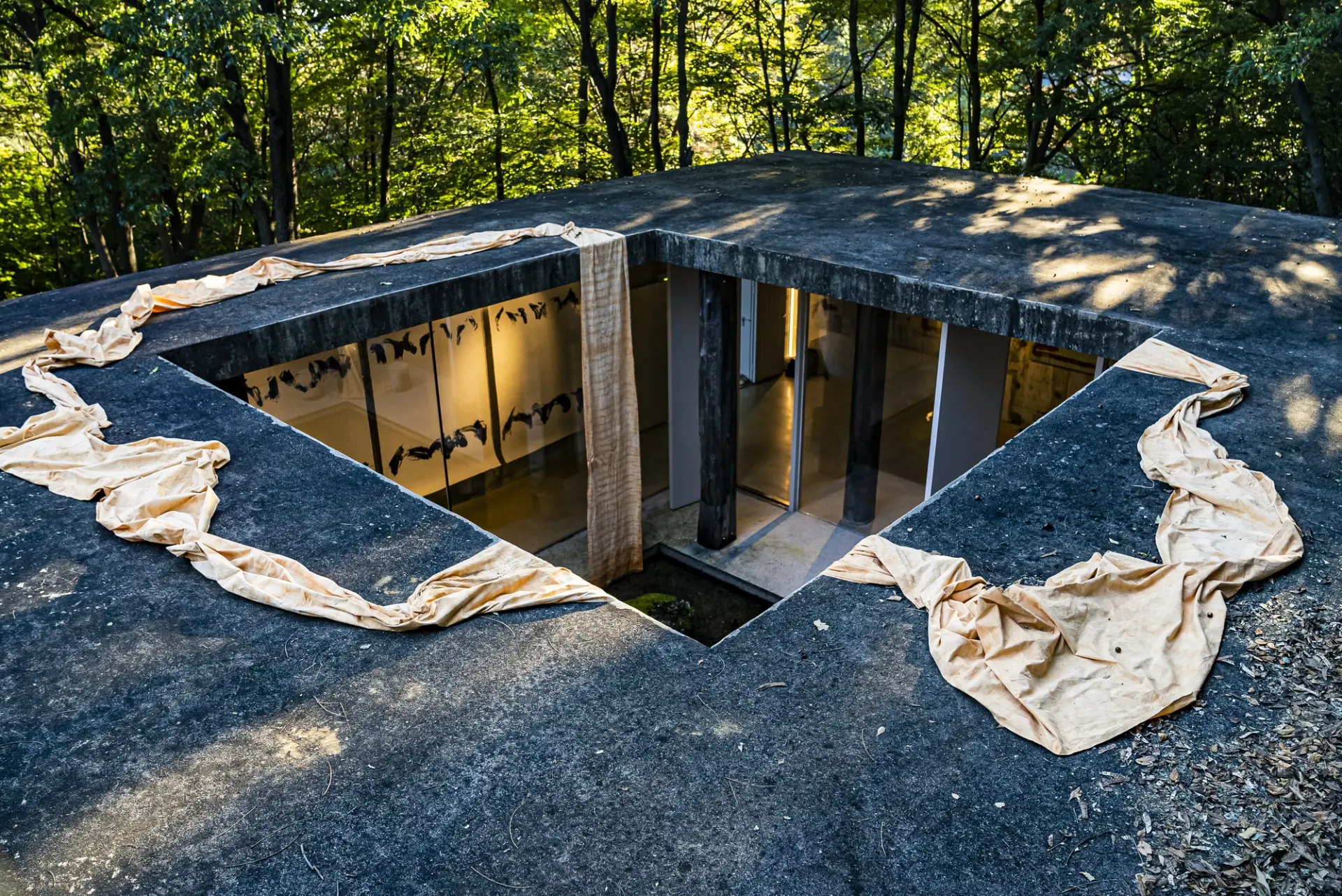
Somi Ko, Arche-trace, 2024. Material: Cotton (unbleached muslin).
Technique: Tie-dye with soil pigment. Photo: Seongmin Hong.
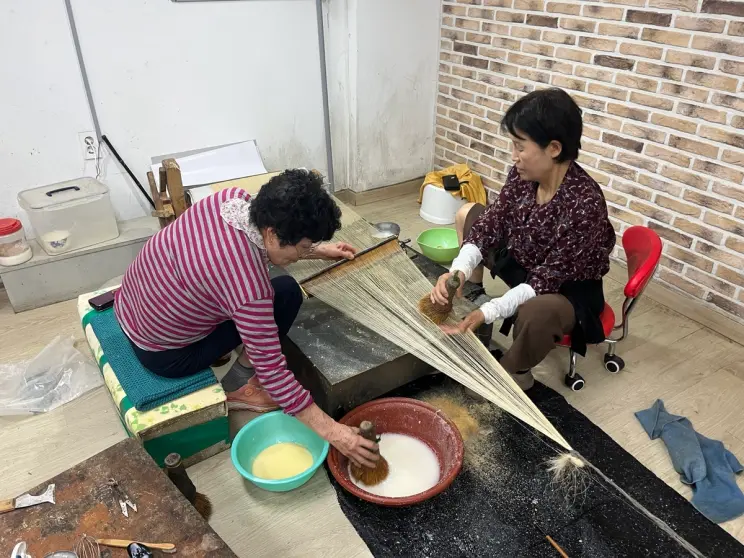
The participants engaged in the reciprocal exchange of specialised knowledge pertaining to environmentally sustainable methodologies for the production of textile materials. Notably, Indian artists were introduced to the utilisation of glutinous rice and rice bran as natural resist agents within traditional Korean dyeing techniques, subsequently expressing a keen interest in integrating these practices within their own creative frameworks. Such methodologies warrant critical attention, as they exemplify efforts to situate craft practices within broader ecological and circular paradigms.
The diverse case studies generated through this project contribute substantively to the expansion of craft’s conceptual boundaries. Craft is progressively being reconceptualised not merely as a repertoire of aesthetic or technical competencies, but as a complex domain where human-environment interactions, philosophical orientations toward life, and ethical considerations surrounding consumption converge. This project constitutes a significant example of such conceptual broadening, providing a tangible illustration of how contemporary craft can operate as an ethical and sustainable modality of cultural praxis.
Artlab Editors: How is community central to this partnership?
Amy George: At the Whitworth, we’ve always understood textiles as more than materials—they are containers of memory, identity, labor, and connection. Our involvement in Hyundai Translocal Series: Entangled and Woven, the inaugural project in the Hyundai Translocal Series, reflects this perspective. Through this collaboration between artists from South Korea, India, and partner institutions like ours, textile practices become both the medium and the message: a way to ask timely questions about community, tradition, and global art discourse.
Community, in this context, is not just a subject—it is an active component of the work. The project has been built on research visits, conversations with makers, and close engagement with textile traditions rooted in place. It allowed artists like Jounghye Yoo to collaborate directly with the Khatri Ajrakh printers in India, combining their hand-printed cotton with embroidered Korean silk to develop an immersive arched walkway. Others, like Youngin Hong, have created works that employ traditional hand embroidery practices from the Kutch region, reframing these inherited forms to address broader themes such as power, identity, and nationhood. These interactions are not superficial exchanges; they have informed new artistic directions and opened pathways for collaboration.
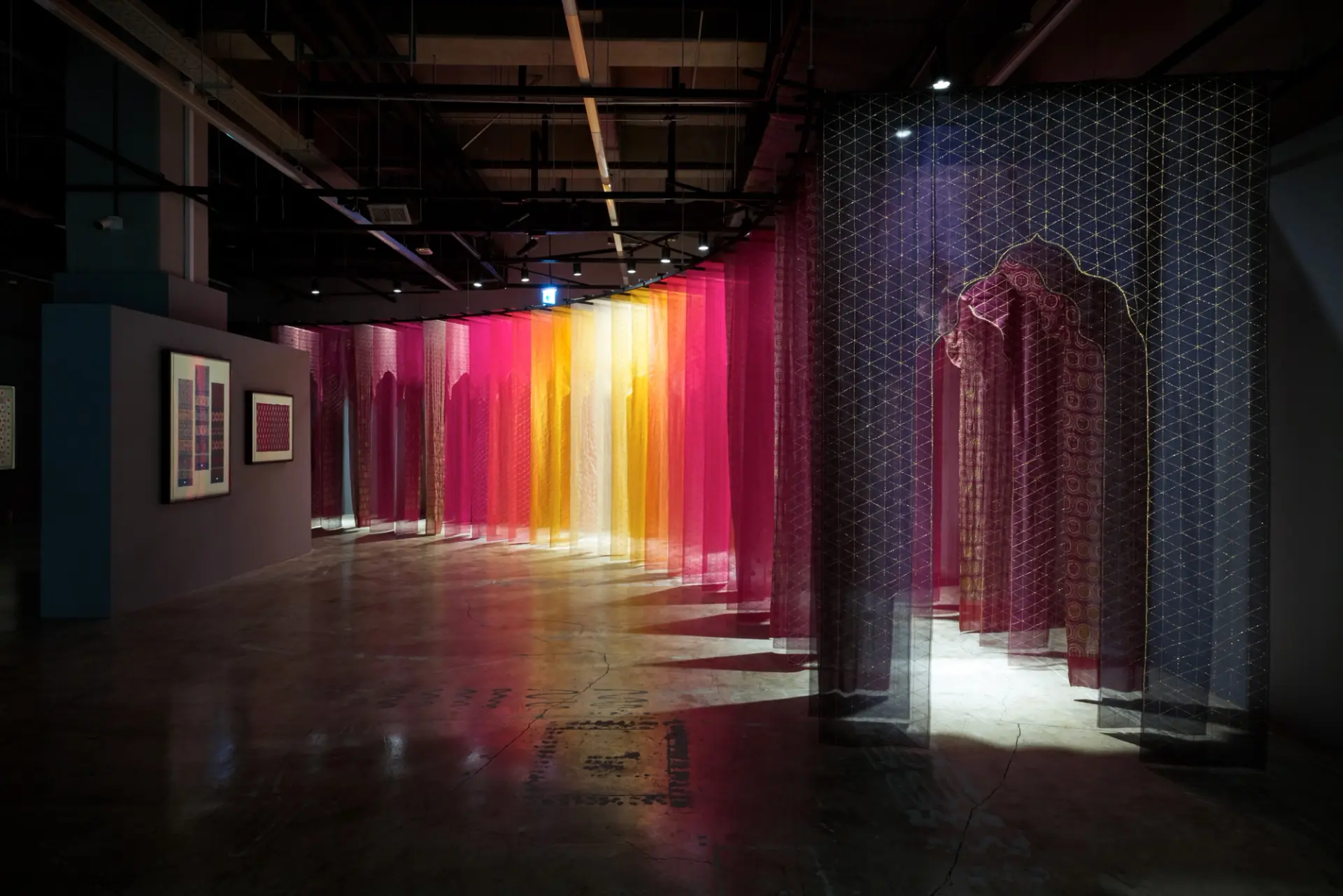
Jounghye Yoo, Gilded Veil_A Mysterious Curtain Lightly Draped in Gold, 2025, installation view in Hyundai Translocal Series: Entangled and Woven, Cheongju Craft Biennale 2025 © Cheongju Craft Biennale Organizing Committee.
Photo by Wooil Kim.
For the Whitworth, this approach resonates deeply. Since our founding in 1889 “for the perpetual gratification of the people of Manchester,” we have held a strong commitment to the social function of art. As part of the University of Manchester, we work at the intersection of research, teaching, and public engagement. Our textiles collection—one of the most significant in the UK—has grown out of this history. It includes everything from early Egyptian fragments to Arts and Crafts designs, from industrial wax prints to contemporary textile art.
Yet, this collection is not without complexity. Much of it reflects Manchester’s industrial past and its entanglement in global trade networks shaped by colonialism. We don’t shy away from this. Instead, we see it as a responsibility—to ask how we can hold, interpret, and present these materials in ways that are transparent, critical, and inclusive. Projects like Hyundai Translocal Series: Entangled and Woven allow us to do that—not by offering easy resolutions, but by creating a space where different practices and perspectives can meet on equal terms.
Artlab Editors: How do the histories of The Whitworth and Cheongju Craft Biennale inform your respective approaches to craft and contemporary art?
Amy George: At the Whitworth, we are increasingly interested in projects that ask these kinds of questions—projects that expand the definition of what a museum can do, and who it is for. Textile art, with its deep social roots and material richness, offers a particularly effective lens through which to explore these concerns.
Importantly, Hyundai Translocal Series: Entangled and Woven does not aim to universalise craft, nor to flatten its cultural contexts. Instead, it highlights the distinctions between practices, the histories that shape them, and the people who sustain them. It suggests that meaningful collaboration requires attention to process as much as product, and to context as much as form. The inclusion of the Whitworth’s historic textiles collection is important here, mapping nearly 400 years of textiles history into these contemporary conversations.
Hyundai Translocal Series: Entangled and Woven does not aim to answer all the questions highlighted here. It’s an ongoing exploration—of technique, identity, history, and collaboration. And while it builds connections between places as geographically distant as Cheongju, Delhi, and Manchester, it also insists on the importance of locality, of specific histories and knowledge systems. This tension—between the local and the global, the traditional and the experimental—is where the most generative conversations often begin.
Jeeyoung Lee: The Cheongju Craft Biennale, inaugurated in 1999, stands as one of the longest-established international biennales dedicated to craft. As such, it has played a pivotal role in advancing contemporary craft discourse on a global scale. The extensive curatorial expertise and discourse accumulated over its history has established a foundation whereby the Biennale today approaches craft not merely as traditional technique or object, but as a critical practice deeply embedded in social and cultural contexts. Accordingly, craft functions here not only as an integration of skill and aesthetics but also as a form of contemporary art that both reflects and interrogates contemporary life.
This framework aligns closely with recent thematic directions, enabling the Cheongju Craft Biennale to reinterpret its legacy through contemporary lenses and to position itself as an experimental platform exploring the future potentials of craft. The 2023 Biennale, themed “The Geography of Objects,” articulated narratives foregrounding harmony with nature, ecological ethics, upcycling, and innovative modes of production.
Following her initial term in 2023, Jaeyoung Kang was reappointed as the artistic director of the Cheongju Craft Biennale. In 2025, she continues to advance a vision of contemporary craft rooted in ecological philosophy, sustainability, and cultural hybridity. Kang notably reconceptualizes craft not merely as material objects but as mediators of relationships, emphasizing its capacity as a social practice that fosters community, memory, and interconnectedness. This perspective informs curatorial initiatives that leverage Cheongju’s distinctive sense of place as a point of departure, experimenting with how craft can generate meaning and forge relationships within diverse regional and cultural contexts.