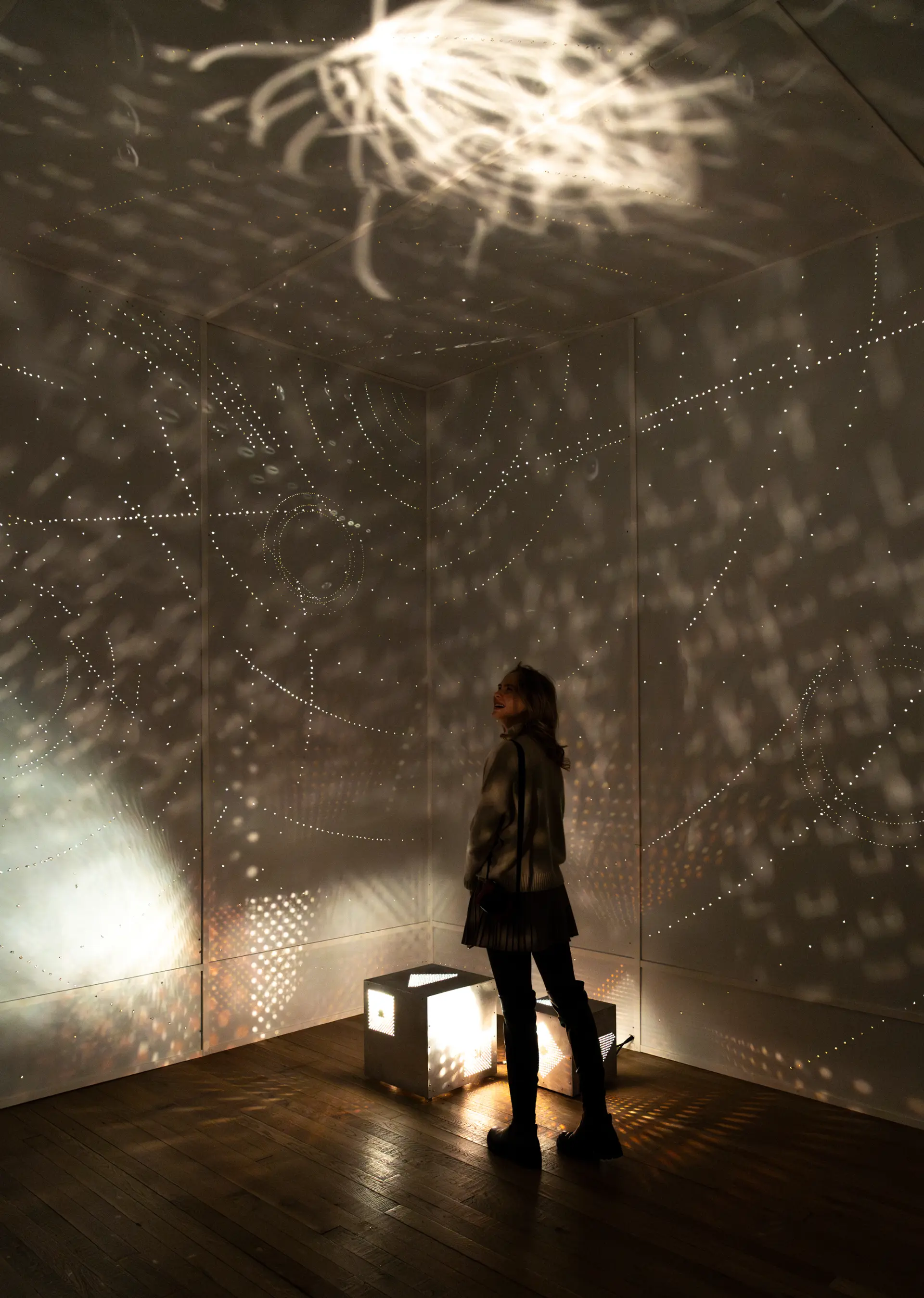
Xin Liu, NOAA: a fall towards home, 2025. Commissioned by Hyundai Artlab, © Xin Liu
For her new Artlab Digital Commission, NOAA: a fall towards home, artist Xin Liu gives voice to three recently decommissioned satellites, lending them agency and reflecting the artist’s own diasporic experience.
Artlab Editors: What would a decommissioned satellite sound like? What would they have to say? Inspired by artist Xin Liu’s digital commission, NOAA: a fall towards home, writer, curator, and educator Anuradha Vikram explores the ways in which satellites may feel akin to people of diasporas, observing their places of origin from afar.
In the skies above Earth float three sibling satellites, NOAA-15, NOAA-18, and NOAA-19, gracefully aging in an era of planned technological obsolescence. These are the last of the United States’ National Oceanic and Atmospheric Administration (NOAA) satellites left still orbiting our planet.
Launched between 1998 and 2009, these satellites provided some of the earliest concrete data proving climatic shifts stemming from human activity. This data also allowed us to understand ourselves and our planet’s climate from a whole-earth perspective for the first time. Once cutting-edge, the NOAA satellites are today treated as “space debris,” decommissioned as their hardware continues to age and fail, destined to orbit endlessly until their mechanical carcasses decay and break apart.
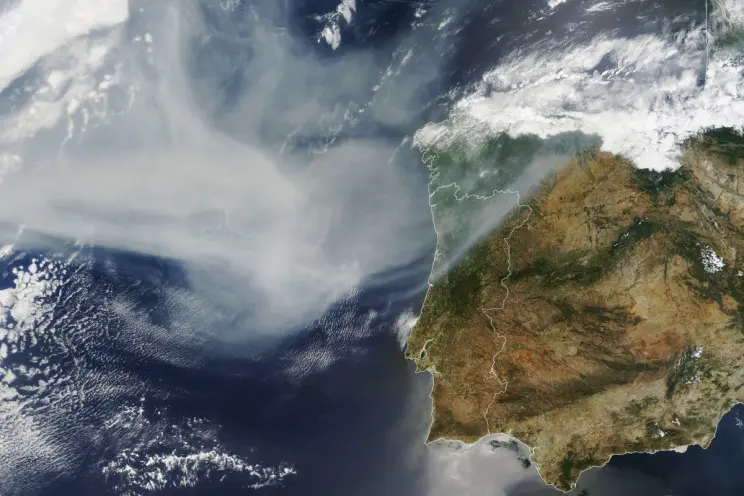
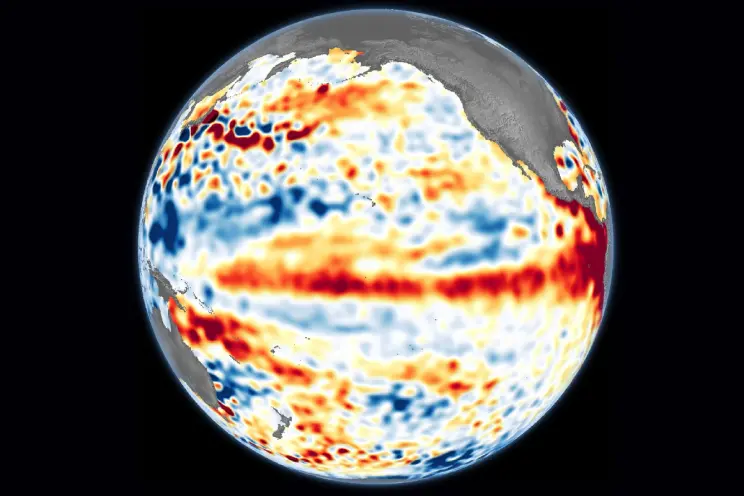
Artist Xin Liu identifies with these satellites. Born and raised in China, Liu has lived between Europe and the US for half her life. As such, her relationship to home is increasingly based in memory. Like the satellite, she has become a distant observer of the place that brought her into being. Liu translates that emotional and physical distance in her Artlab Digital Commission, NOAA: a fall towards home, crafting speculative narratives for each satellite.
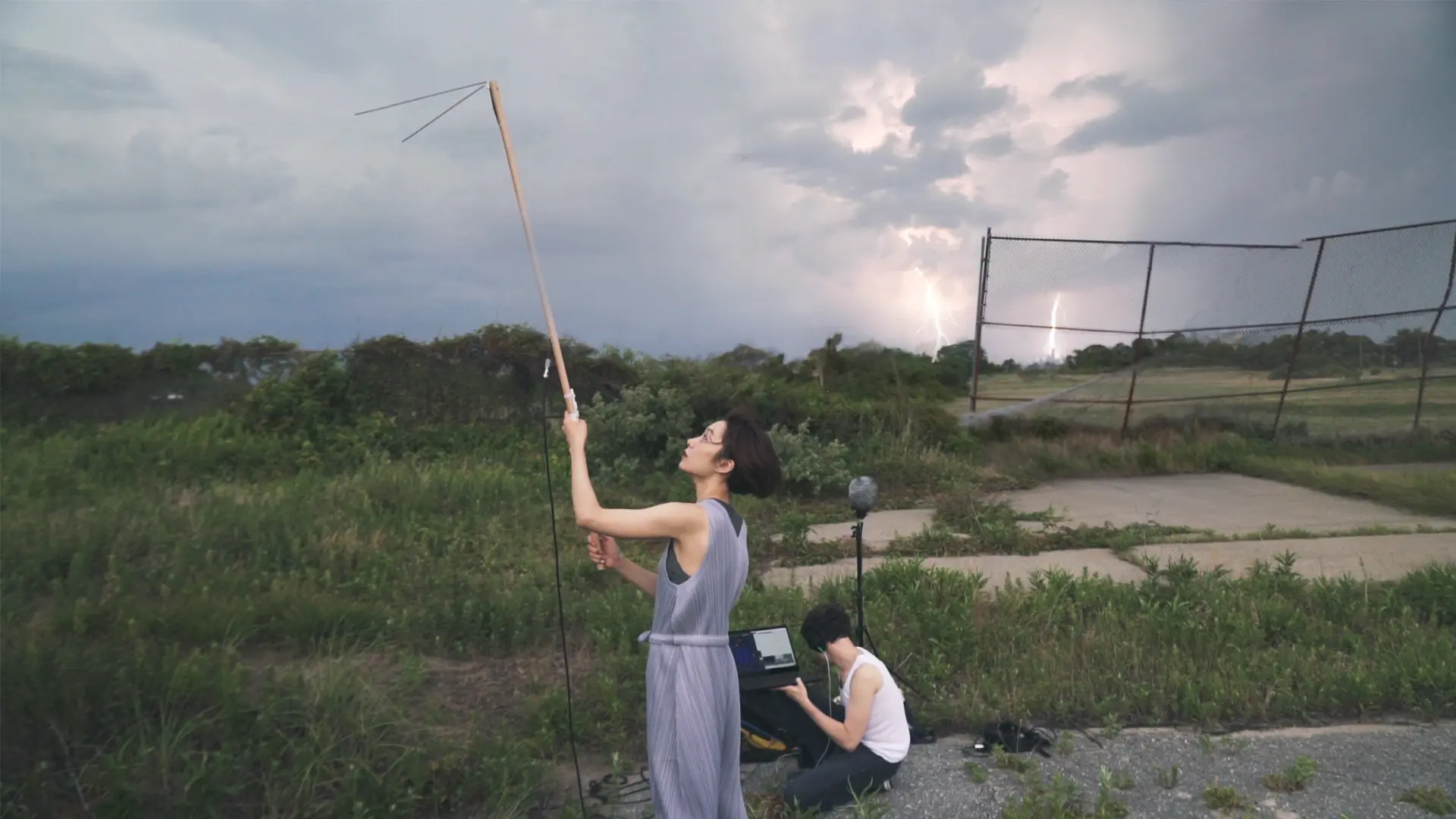
Xin Liu and her partner Gershon Dublon capturing satellite images in Riis Beach, NY. Image Credit: Xin Liu Studio LTD.
Human memory, Liu notes, is imperfect. We misremember, forget, and spin narratives that capture the emotional truth of our experiences while bending the facts. In her digital commission, the artist considers how much we can truly know about a place from so far away.
Unlike our volatile everyday lives, which are complicated and confusing, cultural identity for the diaspora can be framed as comfortably simple and compellingly nostalgic. The longer we live outside our countries of origin, the less we remember about the cultures that shaped us in our youth, what our people represent, even what they do. We construct memory palaces out of distant homes and freeze the past into an eternal, unchanging present. This kind of representation also fits quite comfortably into the West’s existing narrative frameworks and paradigms that often characterize Non-Western cultures of origin as being in and of the past.
The empiricism of much of Western scientific thinking believes that the self is best understood from the outside. Unlike human memory, the computer memory of a satellite is based on data capture and storage—ostensibly infallible, documentary, and faithful to the original experience. As modern people, we define ourselves in external terms such as buying power or Instagram likes. By contrast, in Liu’s work, the NOAA satellites come to understand themselves through their internal experiences of observing the earth from a great distance.
But what do these internalized observations sound like? Liu considered how NOAA-15, as the oldest of the satellites, might feel akin to an eldest sibling—the Quiet Elder. Assigned to observe and record the planet in its totality, faithfully observing weather patterns and atmospheric shifts, NOAA-15 was the first of its kind to emigrate to a new extraterrestrial terrain, setting the template for others to follow. Having left the planet 27 years ago, NOAA-15 also feels the strongest pull toward its earthly home.
“I know I’ve been here for a while.” it says. “NOAA-16 has joined me. It is younger and glassier than I, and has been allocated priority. I was not sure how things were going to be. But now I am enjoying this shift. I spend more time alone, communicating fewer times each day with the ground stations. More of us will come hereafter—the sky is getting populated.”
NOAA-18 is the middle sibling, blessed with clarity of purpose, designed to document the earth’s climate data with precision. It is focused and certain in a way its siblings are not—the Devoted Idealist. NOAA-18 sees how each satellite is shaped and held by the specific capacities and limitations of the technological moment in which it was born.
“The planet turns for me,” it declares. “We are all children of the same planet—scars and all. Looking at the parent planet, I know I’m part of something big. Something that builds and remembers and expands into the void. We are all related.”
Launched in 2009, NOAA-19 is the youngest of its satellite siblings. It also bears the most damage, having been dropped and repaired before launch. As such, it is the most tender of the satellites—the Loving Custodian. NOAA-19 is less confident than the others and more convinced of its own and its creators’ fallibility. The last of the NOAA satellites, it might also be the most existentially burdened, bearing the weight of knowing itself to be the last of its kind.
“My scars tie me to my birth,” it reflects. “Perhaps the past can never be overcome. It is remarkable that anything exists at all. The creators, too, are forged by the places they come from. But it is the same with their elements and my own: Many of them are forged by the diastole of dying stars, such that—down to the very molecule—everything in this cosmos is part of one chemical family tree.”
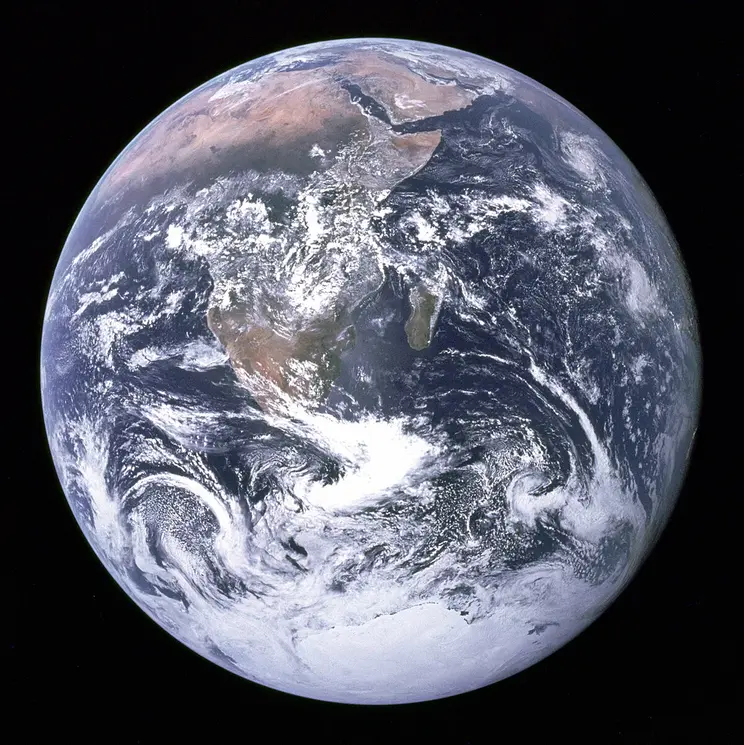
When Liu and I spoke, she referenced French theorist Bruno Latour, who wrote who wrote that the famous Blue Marble image of the Earth photographed from the Apollo 17 spacecraft in 1972 led us to the insufficient conclusion that we all live on the same planet and that we inhabit Earth’s most external surface. Latour argues that we instead live in a “critical zone” inside the planet’s atmospheric envelope, and the way we experience the planet differs wildly depending on not only geography but geopolitics, economics, and our relative proximity to the effects of climate damage.
We whom Latour deems “the Moderns” are ill-equipped, in our limitless expectations of growth and energetic expenditure, to adapt to what he calls the “new climatic regime.” Liu is interested in how Latour’s “critical zones” allow for multiple zones and experiences to overlap and coexist—and how the external points-of-view of the NOAA satellites echo this perspective. Liu’s work beckons us to “disorient” ourselves from the expectations of abstract, infinite extraction in order to understand our existence as being rooted in place, space, and time.
In connecting these satellites to the Chinese diasporic experience, Liu’s work is also in direct conversation with artist Lawrence Lek’s Sinofuturism Sinofuturism (2016). In his influential video essay, Lek offers a new lens through which to view contemporary Chinese society, reclaiming key stereotypes like copying, studying, gaming, labor, and computing as aspects of a new futurist vocabulary. Liu further expands this lens to account for emotion, nostalgia, and longing—an approach we might call Feminist Sinofuturism.
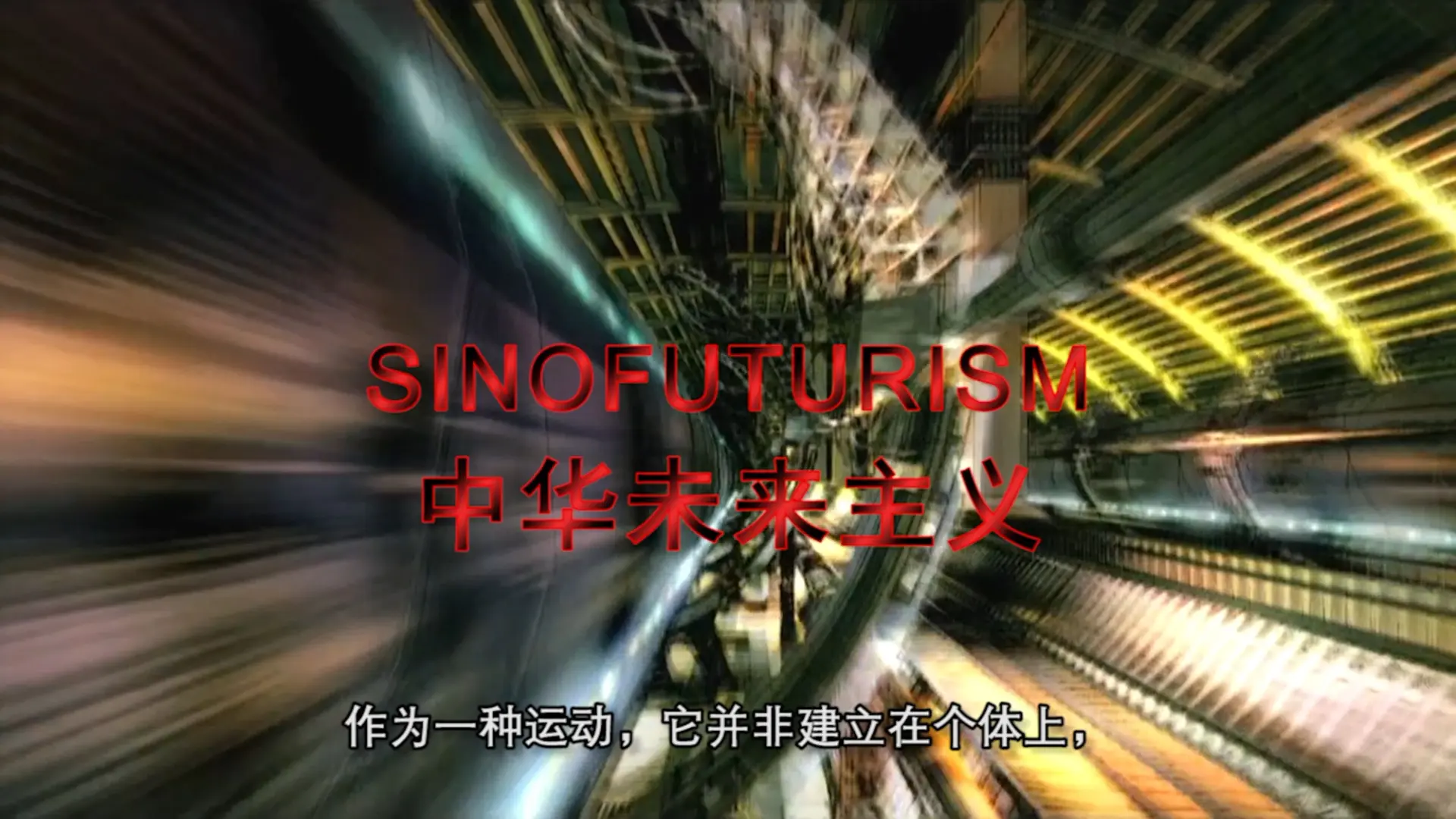
Still: Lawrence Lek, Sinofuturism (1839-2046 AD) (2016), single-channel video.
In contemporary parlance, a person who has spent too much time in virtual social spaces is often admonished to “touch grass.” For NOAA satellites and diasporic subjects, this grounded understanding is harder to come by. We are epistemically adrift in a way that non-diasporics are not.
In the 1980s, my family would receive Aerogram letters from India that would take two weeks to arrive at our home in New York. The distance between these communications was tangible and could be measured in days. Today, I can text my cousin in Bombay in real time. Through social media, communications devices, and online publishing, I can be perceived from multiple locations at once. Sometimes these are locations I have not physically encountered in years or decades, if at all. I experience these gaps from a telescopic distance, shifting from far away to extremely close in an instant with the help of advancing technologies. My feet, my head, and my heart are rarely in the same place at the same time.
It’s uncanny how a life lived in multiple places at once can be perceived as no life at all. Like the satellites, I am never stationary, always orbiting, looking for connection, planning for my own inevitable obsolescence. In the words of NOAA-19, the Loving Custodian, “Perhaps the past can never be overcome. It is remarkable that anything exists at all.”