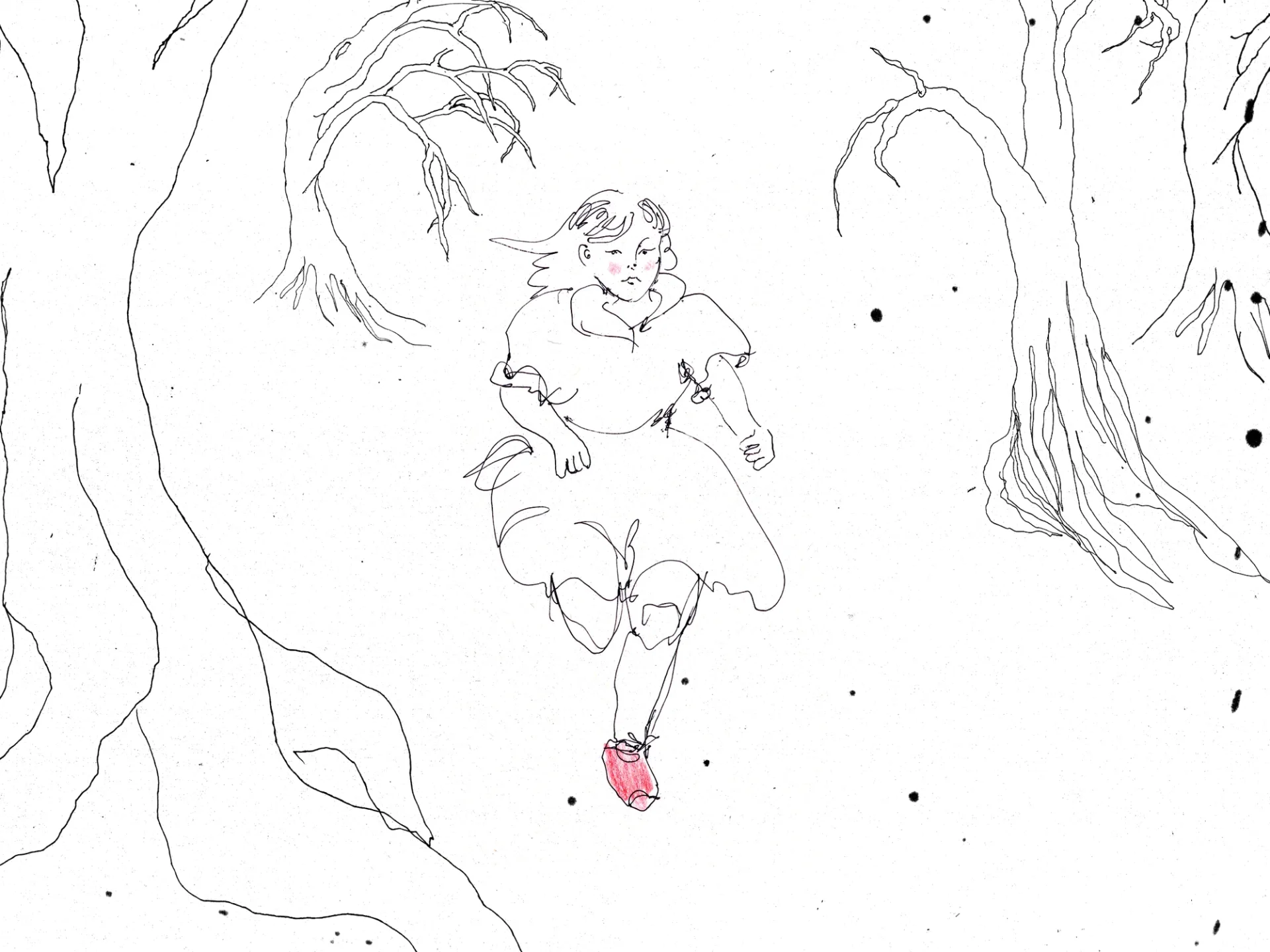
Kyung-Me, The Labyrinth, 2026. Commissioned by Hyundai Artlab © Kyung-Me.
In The Labyrinth, an Artlab Digital Commission by Kyung-Me, the artist expands her recursive practice into the digital realm, where the animation’s frames are structured like a unicursal labyrinth that echoes the artist’s own process.
Artlab Editors: New York-based educator and illustrator Kyung-Me’s ouroboros-like practice manifest in The Labyrinth, a scrollable visual narrative that follows its protagonist through collapsing realities and looping dreams. Exploring the process of creating this work, Artlab Editor Shannon Lee spoke with the artist, who is also a friend. Together, they discuss how The Labyrinth explores autobiography, dreams, spontaneity, and what it takes to escape our own cycles and symbols.
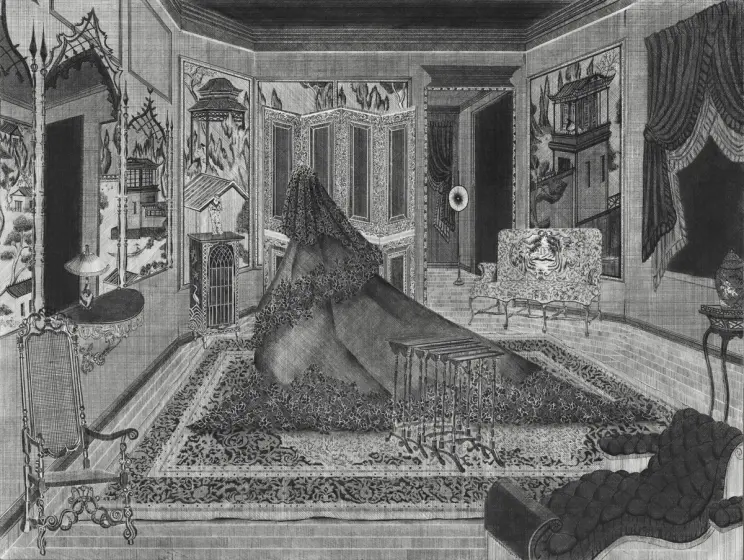
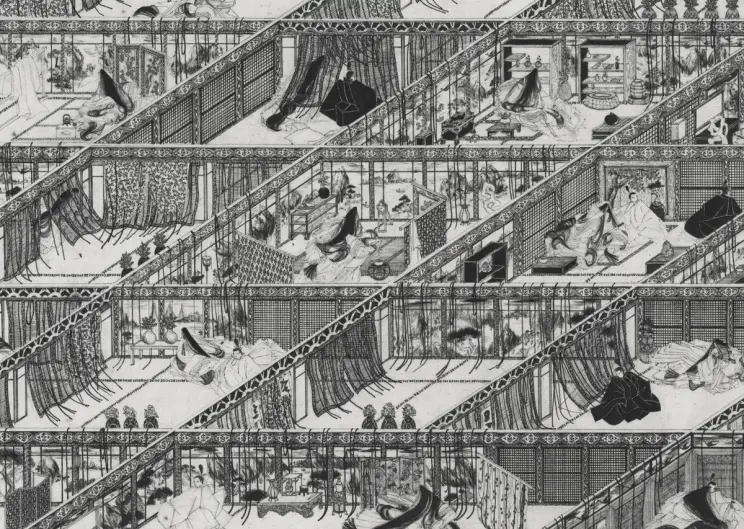
Shannon Lee: I want to learn more about how you arrived at this point in your practice: You’re best known for creating really tight, dense architectural tableaux, usually with a female figure in the center, that are very meticulously rendered. Recently, you’ve broken out of that, creating loose sunflower paintings at larger scales. What’s behind these transitions?
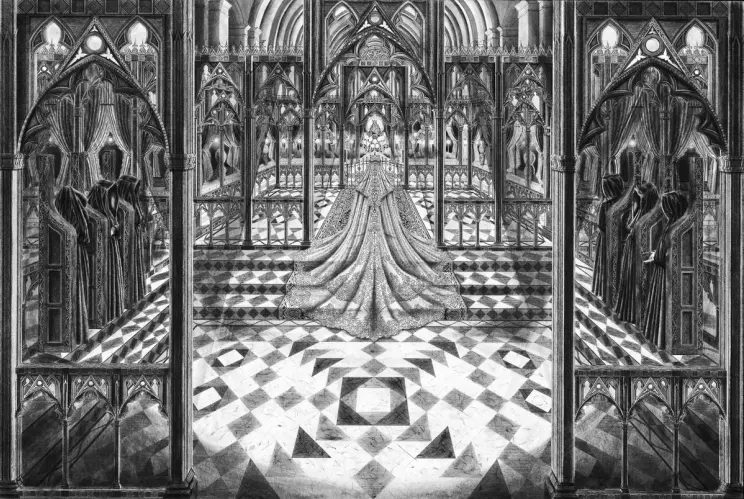
Kyung-Me: For the last decade, I was working primarily on ink drawings in my bedroom. I kept returning to the image of a woman inside a room. From drawing to drawing, she would change form—a Victorian woman in mourning in one, a nun in a cathedral in another. Each scene was a way for me to work through a particular state or complex.
I used a drafting setup for these drawings, so every mark was made with a ruler. Once a drawing was planned with pencil, it would take months to render in pen. Thousands of tiny marks would go into a wooden floor or a patterned rug. Over time, this method became very constraining, both physically and mentally.
About two years ago, I was given a studio outside the home thanks to a couple of residencies. I saw this as an opportunity to try to break out of my fixed habits. I began making more spontaneous ink paintings, starting with a single brush mark and following it without knowing where it would lead. This way of working was immediate and intuitive, the opposite of my previous process.
During those two years, I wasn’t drawing as much. This commission arrived just as my studio residency ended. Returning to my bedroom studio, I wanted to bring this new, more open mindset back into drawing. The starting idea for this project was simply to draw without a plan and see where the process would take me.
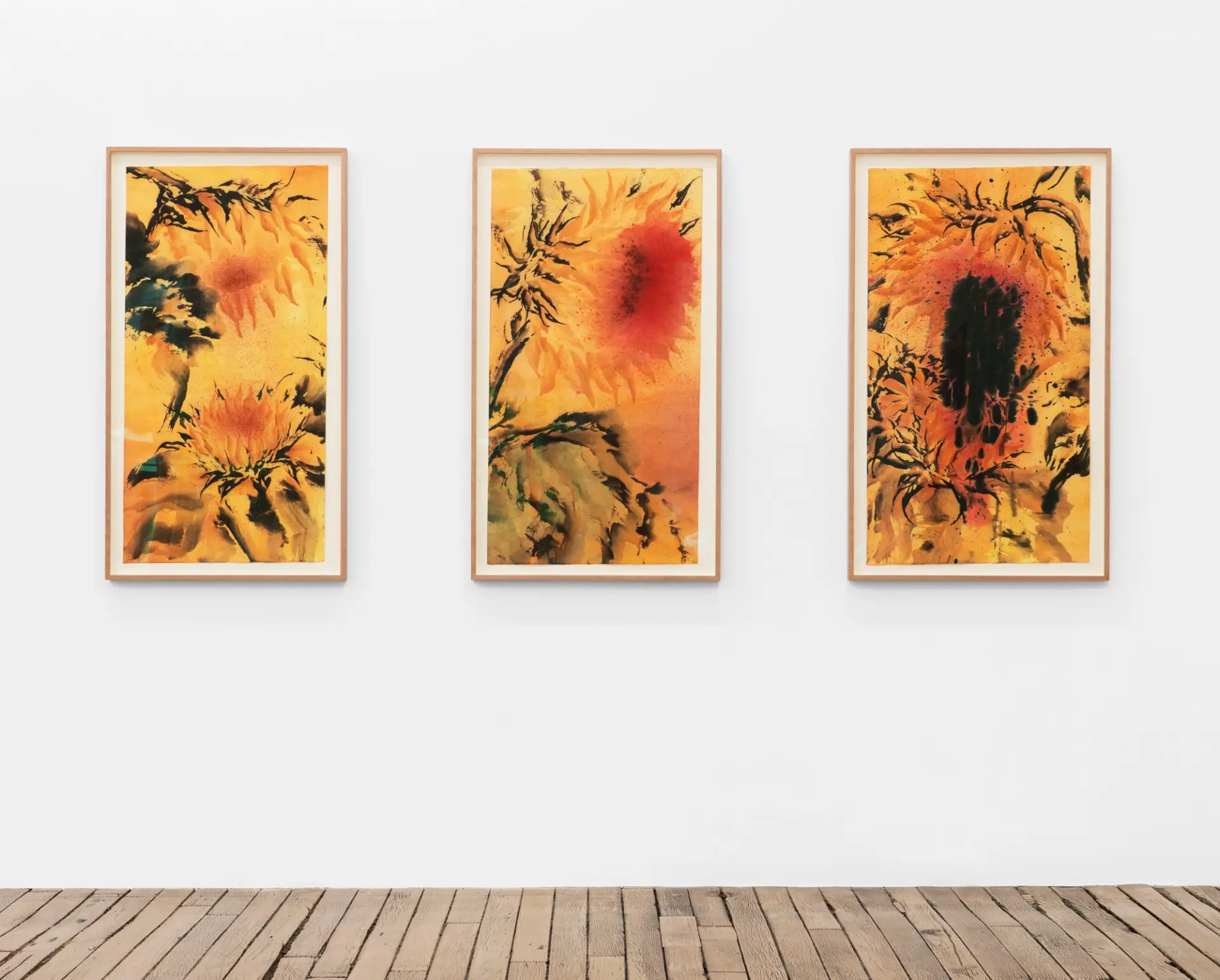
Kyung-Me, Sunflowers, ink and watercolor on paper, 2025. Photo: Kyung-Me
Shannon Lee: You’re also reintroducing the female figure as a central protagonist in this work. Only this time, you’re working faster, and the process is more fluid and spontaneous. How did these changes shape her presence and agency throughout this new body of work?
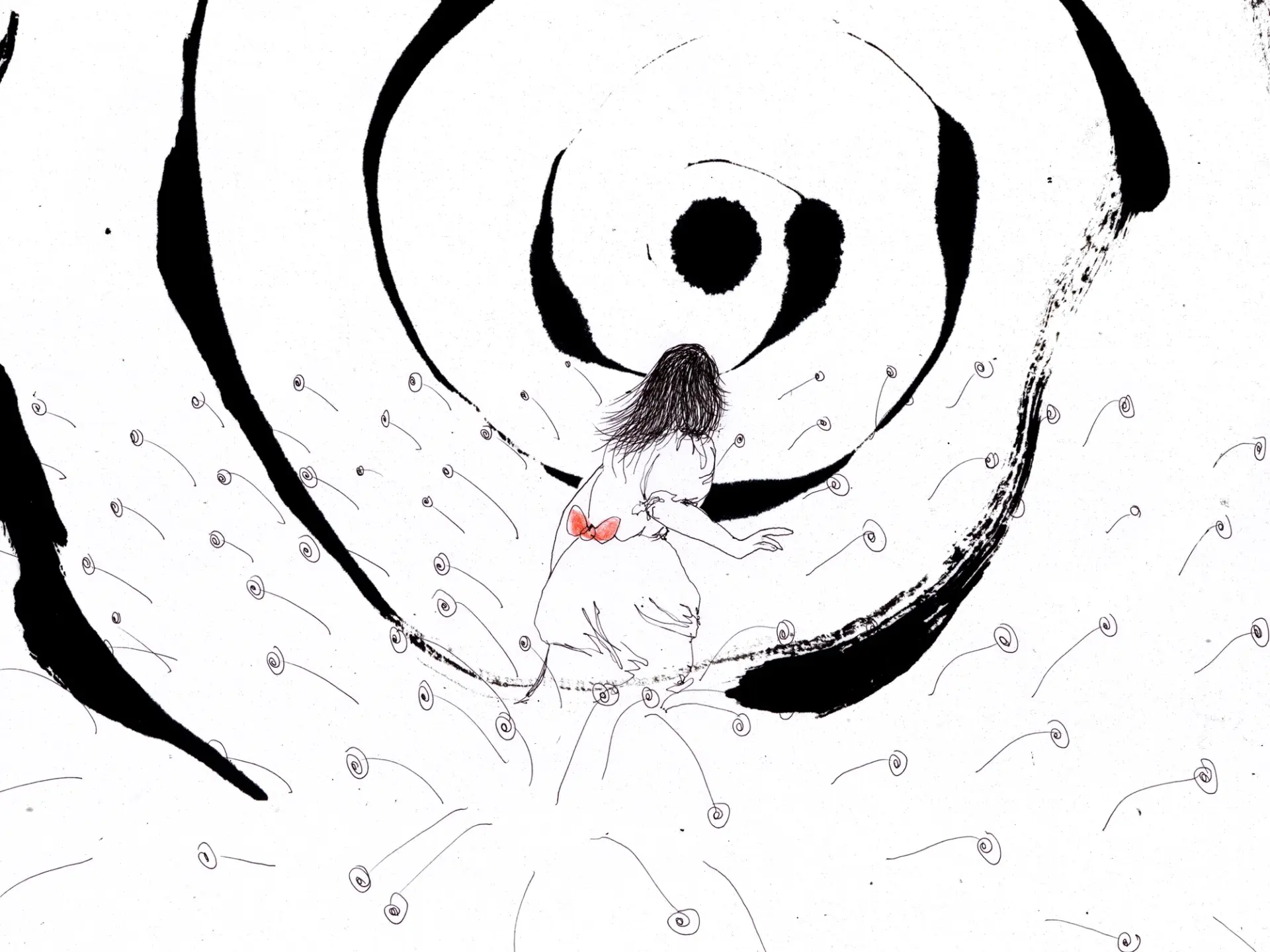
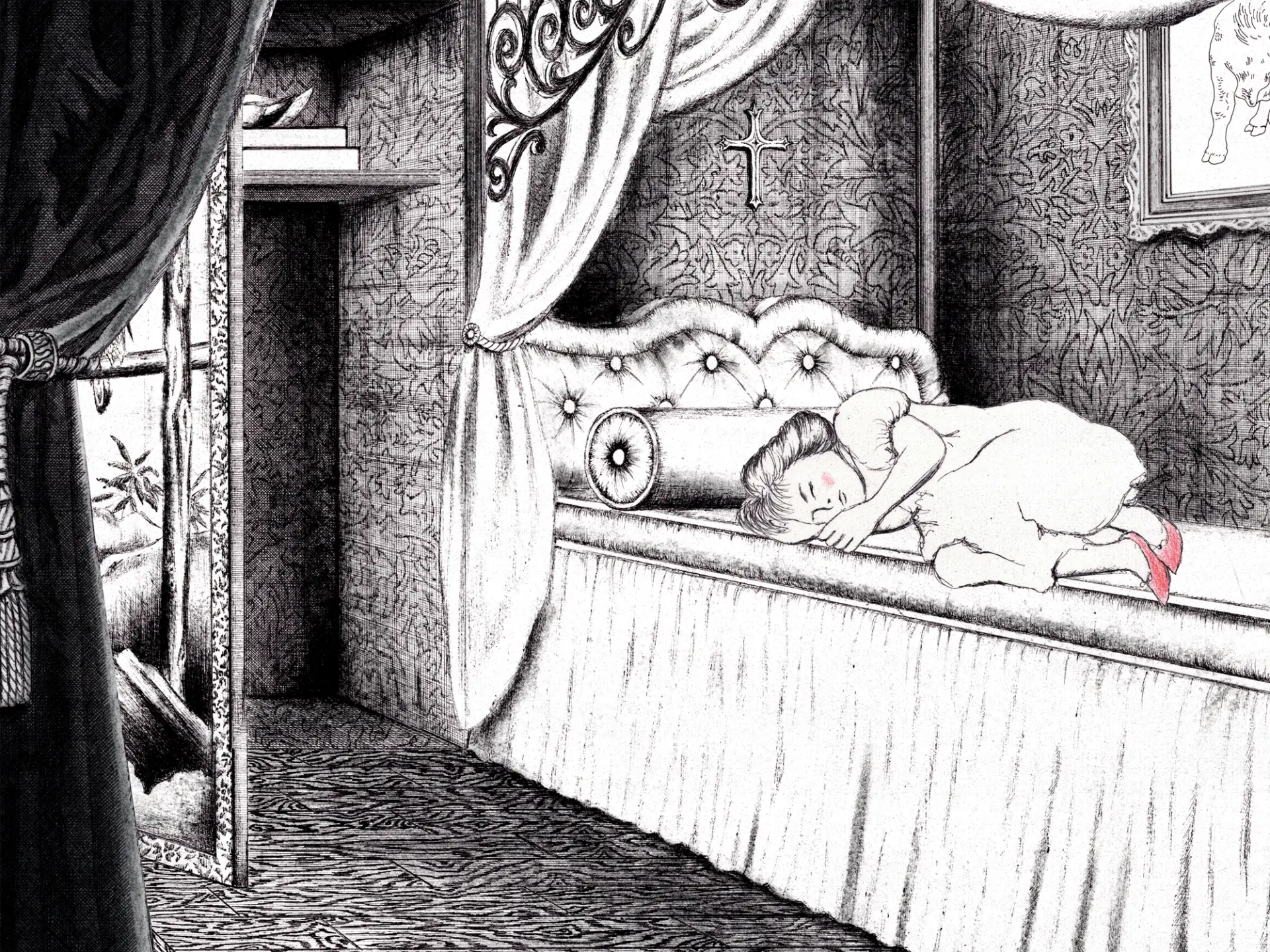
Kyung-Me: When I first began drawing for this project, I was mostly making abstract marks. Over time, those marks began to take the shape of a little girl. I found myself drawing her again and again in different states—running, sleeping, falling. With this commission, I wanted to loosen that mindset and allow her to exist in a more vulnerable, shifting state. There’s a lot of doubt in that process, but also a lot of faith. The girl is evolving here, but she’s doing so in a way that feels awkward, transitional, and very human. I’ve been thinking a lot about the inner journey of a young girl and all the things she has to overcome within herself—the doubt, delusions, envy, self-hatred. The constant feeling of dread but also the moments of hope. I wanted to follow her through those shifting inner states.
As I drew her each day, I began to draw the world around her. During this period, I was making close to a hundred quick drawings a day. This was very new for me. In the past, I would spend months fixated on a single drawing. Here, I was moving rapidly from one image to the next, allowing the journey to unfold at a faster pace. And I think this format gave the girl more agency. In this project, she had to change form constantly. If she stayed the same, the sequence could not move forward. Her movement and transformation became the engine of the work.
Shannon Lee: With this commission, you will be presenting your work in a digital-first format. What’s something you’re looking to express through the specifics of this interface? How do you picture your work coming across to audiences?
Kyung-Me: Working in a digital format was exciting for me because it meant I wasn’t building this experience alone. I was in conversation with a team who were thinking alongside me about how the drawings could move, transition, and be encountered over time. That collaborative back-and-forth changed how I thought about sequencing and pacing the images. Instead of focusing on a single finished drawing, I began thinking about how one image leads into the next, and how that movement itself becomes part of the artwork.
In this format, the drawings unfold in a continuous sequence. Viewers aren’t looking at one isolated image, but moving through a progression where forms shift, dissolve, and reappear. I imagine the work coming across as something you experience gradually, almost like walking through a thought or a dream. The digital space allows the drawings to breathe and to be encountered in time, which feels very aligned with the way this project was made.
Shannon Lee: I’m very excited, too, as someone who’s followed your work for a while and has mostly seen it in the physical two-dimensional plane of a drawing or a book. I think this work in particular also strikes me as feeling very close to, not quite biography, but your practice and your process. I’m thinking of your book Copy Kitty (2020), which also felt semi-autobiographical. Can you expand on the role of yourself and autobiography within your work?
Kyung-Me: Anytime there is chaos or turmoil in my outside life, I have to sort it out on a piece of paper. Drawing is my way to expel manic energy, spiral, sort out my feelings, and hopefully come back with a more expanded view. Each drawing captures some phase of life. In this way, my work is autobiographical.
Shannon Lee: Do you feel like there were moments within the drawing process for this project that surprised you?
Kyung-Me: Yes, definitely. I went into this project wanting to work in a much more open and spontaneous way, but I was surprised by how quickly I started creating new rules for myself. Whenever an image didn’t immediately make sense, I felt this urge to name it, explain it, or to turn it into a story so it felt justified. That’s a habit from my older way of working, where everything needed to be very deliberate and accounted for.
There were real moments where I felt myself loosening up and letting the drawings lead. But there were just as many moments where I slipped back into needing control and clarity. That back-and-forth became part of the process.
Shannon Lee: How would you describe some of those rules that you seem to subconsciously impose on yourself?
Kyung-Me: I think a lot of these rules go back to why I turned to drawing in the first place. I started drawing seriously during a time in my life that felt very chaotic and out of control. Drawing became the place where I could create structure, order, and stability. It felt like I was building a house for myself inside the work.
Over time, that relationship kept changing. At first, the drawings were a place to contain chaos. Then they became a place where I felt I needed to prove something—to be taken seriously, to make work that looked beautiful, impressive. With each new definition of what I wanted the drawings to be, more rules appeared.
Some of them were very literal. For years, I only allowed myself to make marks with a ruler. At one point, I felt every composition needed to be symmetrical. When I started showing work with galleries, I filled the drawing with luxury items so that the drawings looked expensive. But underneath all of that was a deeper rule: The drawing had to compensate for what I lacked. I wanted the image to be more controlled, more composed, more ideal than I felt in my own life.
As these rules stacked up, the structure became so tight that I couldn’t really grow inside it anymore. I had built something that once felt protective but had slowly turned into a kind of enclosure. This project became an opportunity to notice those habits in real time and to try, little by little, to work outside of them.
Kyung-Me, The Labyrinth, 2026. Commissioned by Hyundai Artlab © Kyung-Me.
Shannon Lee: You teach a class on creating personal symbols. I wonder how you see symbols in relation to the self and why they are so good at expressing our inner worlds.
Kyung-Me: Everyone has symbols and images that emerge and recur in their lives. One person might always draw a spider as soon as they pick up a pen. Another person may have recurring dreams about a flooded house.
These symbols often point to something much deeper, something that is hidden. You can either pay no attention to the symbols that emerge in your life or you can take them quite seriously. The more you tap into a symbol, the more you can learn about yourself—your patterns, complexes, and secret desires.
In my own work, there is a recurring cast of symbols that has followed me for years: women, rooms, mirrors, forests. When you continuously work with a symbol, the symbol and its meaning begin to shift and transform. Your whole attitude begins to change. You begin to see things that were invisible to you before. Consider the symbol a guide into your psychic landscape—or labyrinth.
Kyung-Me, The Labyrinth, 2026. Commissioned by Hyundai Artlab © Kyung-Me.
Shannon Lee: That makes sense. It’s a way of processing your internal dialogue, visually and on the page to map things out. I wonder if any kind of spontaneity came from having to repeat these motifs in such quick succession. Can you expand a little bit more about what you discovered through that process?
Kyung-Me: Drawing spontaneously was a very new way of working. I would spend less than a minute on each drawing. From one drawing to the next, I would see forms shift subtly. Each shift would trigger an entire chain of thoughts and associations. I had to respond to the changing forms in real time and try to let them become what they wanted to be. There was a sense of discovery throughout the project.
Shannon Lee: I think that’s a really fascinating process of self-interrogation. Conventional wisdom acknowledges how constraints are often liberating for artists. So it’s interesting that you know there is a threshold for how much restriction is helpful and the point where it feels too boxed-in.
In talking about this work with you, it feels like you’re trying to zoom out of the labyrinth only to discover more labyrinths—but that this is still a worthwhile process of investigating within the self. To that end, I wonder what you hope people take away from navigating through the labyrinths of this work.
Kyung-Me: This project follows a girl who is trying to move through something, but if you zoom out, it’s also me moving through an in-between phase in my own practice. I was trying to change how I worked, hoping it would lead somewhere new, but not knowing if it would. That process came with a lot of doubt, hesitation, and moments where I slipped back into old habits.
Any attempt to grow or change comes with struggle. You progress and regress.
By the end of the sequence, there is a sense of lightness and emergence. What I hope viewers take away isn’t a specific story, but a feeling—that moving through confusion, uncertainty, and repetition is part of the process of becoming something new.