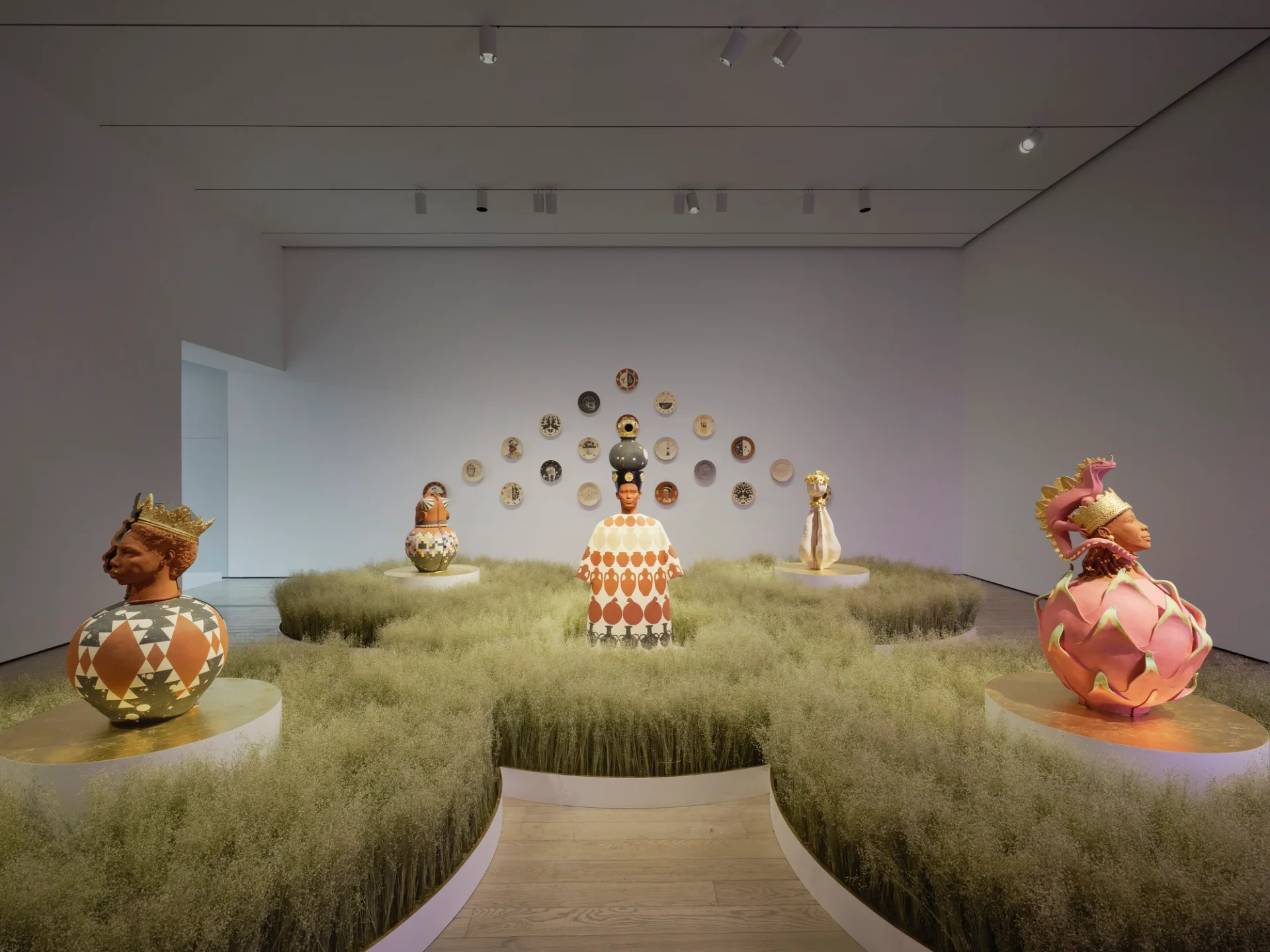
Installation view of Tavares Strachan: The Day Tomorrow Began at LACMA, 2025–26.
Courtesy of the artist and Marian Goodman. Photo: Elon Schoenholz.
Tavares Strachan’s The Day Tomorrow Began presents a series of rooms that repurpose, remix, reinterpret, and refill the vacuums and omissions that exist in our archives.
Artlab Editors: Writer Allison Noelle Conner simmers in the silences echoed by artist Tavares Strachan’s exhibition, The Day Tomorrow Began, part of the Hyundai Project at LACMA.
A gilded leather-bound tome greeted me when I entered the first room of Tavares Strachan’s sprawling exhibition,The Day Tomorrow Began, at Los Angeles County Museum of Art (LACMA). Titled The Encyclopedia of Invisibility (walnut #3) (2018), its stately navy blue cover housed pages whose edges seemed to be dipped into a pool of gold. It was displayed on a table near the center of the room. The book itself was closed, but the table’s drawer extended outwards.
A page stared back at me, its surface mottled with tendrils of grey smoke residue. Its text, an impassioned rebuttal to the Encyclopedia Britannica and its systemic omission of marginalized histories, posed questions that chiseled away at the supposed neutral authority of the Western historian.
At once a sculptural object and a piece of literature, Strachan’s encyclopedia claims to be the first reference book dedicated to lesser-known narratives. It boasts over 17,000 entries. If you want to know more about Nevada’s ghost towns, Soviet cosmonauts, Indian Buddhist monks, and the origins of folk psychology and blissymbols, you’ll find all the information you won’t find elsewhere here. Over the course of eight years, Strachan and his assistants compiled and collated research from libraries and information gathered through everyday conversations. All this information was boiled down into a gush of alphabetized entries that summarized the highlights of people, places, objects, and events usually regarded as inconsequential.
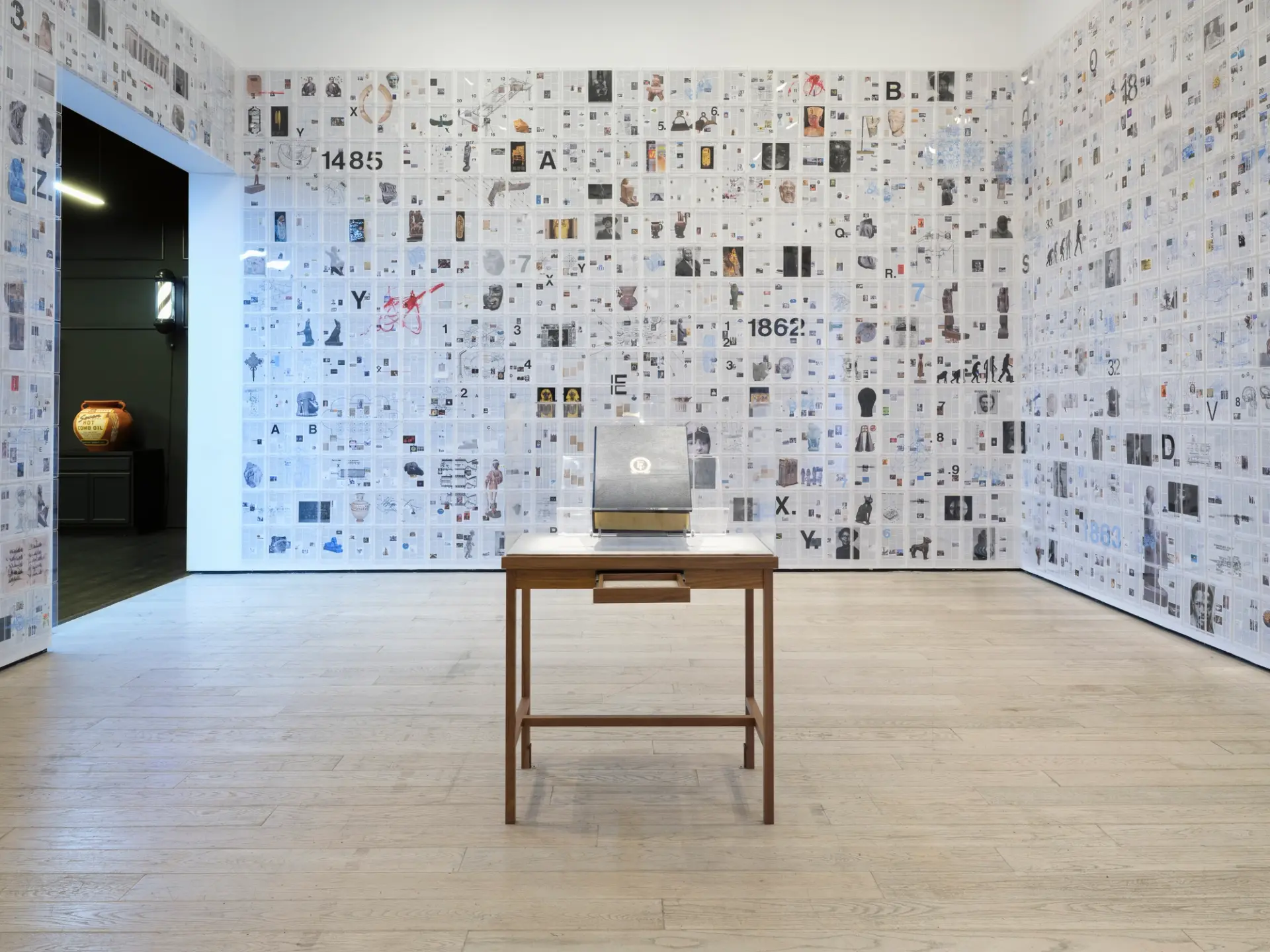
Installation view of Tavares Strachan: The Day Tomorrow Began at LACMA, 2025–26.
Courtesy of the artist and Marian Goodman. Photo: Elon Schoenholz.
Omnivorous in its scope, The Encyclopedia of Invisibility sets the conceptual foundation for the rest of Strachan’s immersive installations: its entries convey what it would feel like to step into a history book and find yourself moving through its text, images, and diagrams. The Day Tomorrow Began turns its compendium of invisibility into a medley of enthralling landscapes, where viewers come in contact with the stories and figures elided from official historical narratives. Strachan renders these silences—the people and events whose very existence fractures the credibility of Western history—in material forms that can no longer be ignored.
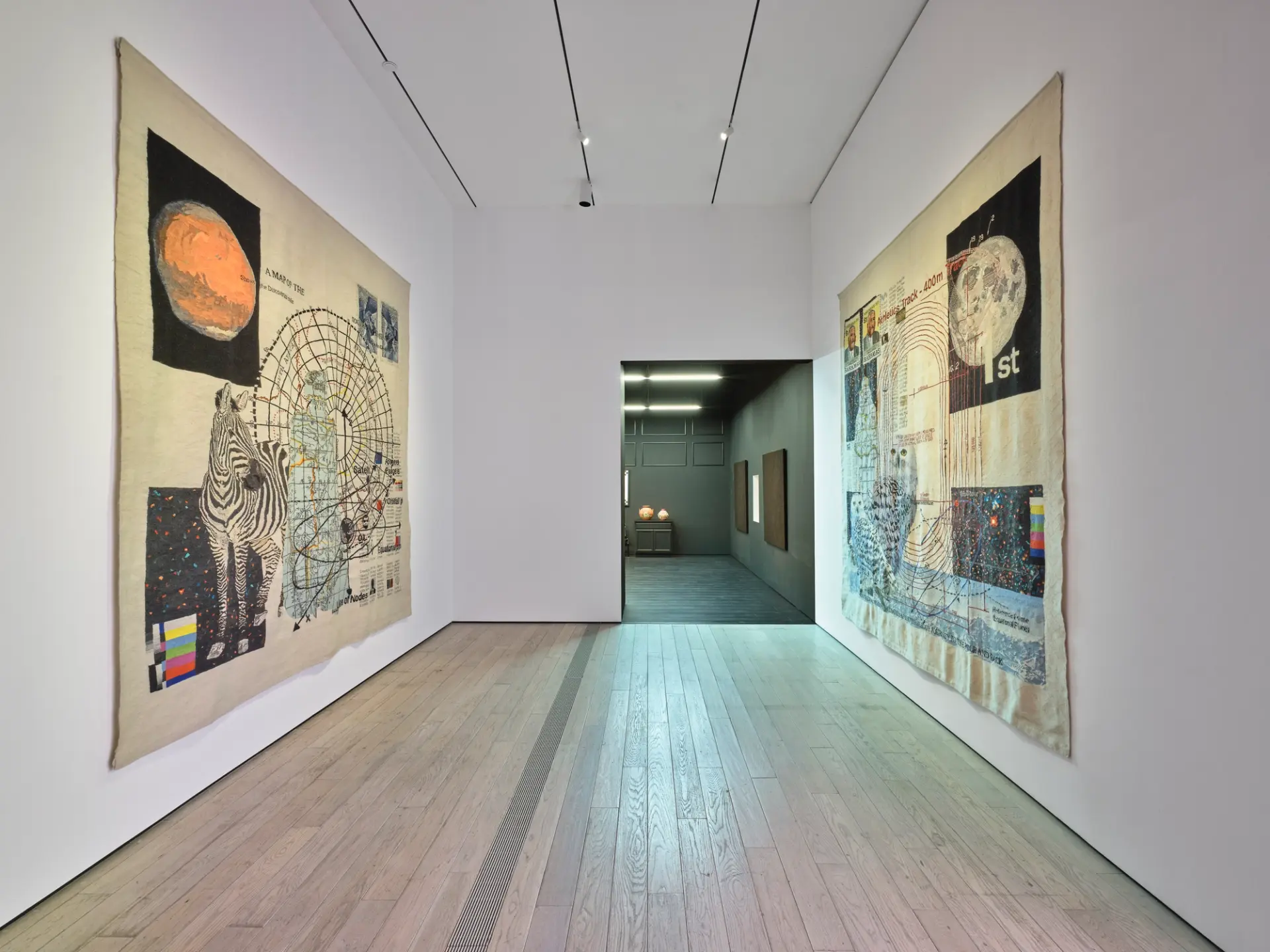
From ceiling to floor, the four walls of The Encyclopedia Room are covered in sheets of A4-sized paper, as if every page had been plucked from the spine of the leather-bounded book at the room’s center. Under the letter “M,” I read about manananggal, a mythical creature from Filipino folklore. The entry for “privacy” took up an entire sheet and ended with a string of paragraphs listing out the citations of sourced texts. The inclusion makes plain the way our definitions are propped up by a network of what has (or hasn’t been) written before. As I moved away, the panels of entries transformed into the backdrop for collaged elements—grainy photographs of figures like civil rights activist Claudette Colson and actor Sidney Poitier, patent illustrations, Egyptian artifacts, and cut-outs of Greek architectural ruins. These obscured large pieces of text from view. It took effort to make sense of the histories surrounding me, and I felt myself shrinking away from the sheer volume of it all, reaching for any kind of graspable, coherent detail.
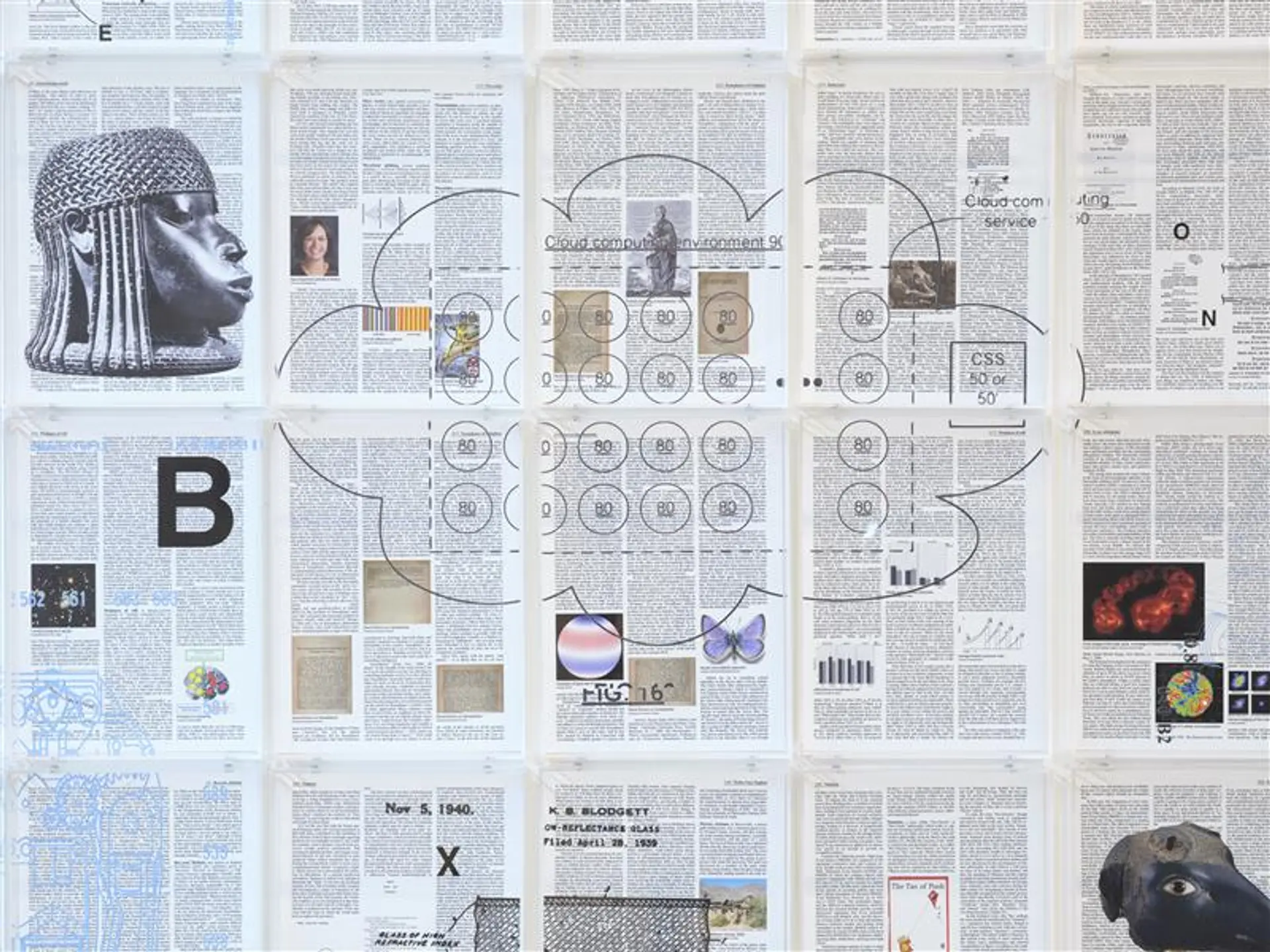
Installation view of Tavares Strachan: The Day Tomorrow Began at LACMA, 2025–26.
Courtesy of the artist and Marian Goodman. Photo: Elon Schoenholz.
In 1995, Haitian scholar Michel-Rolph Trouillot wrote about the various methods used by oppressive power systems to limit the depth of our historical understanding and imagination in his text, Silencing the Past: Power and the Production of History. While Trouillot believed history to be an atmosphere that we move through, he did not fool himself into thinking that these conditions sprung out of thin air. History, Trouillot explains, is created—so are its omissions. “Silences are inherent in history because…[s]omething is always left out while something else is recorded,” he writes. Though it may seem like history precedes us, it is, in fact, produced. The absences tell their own stories. The Day Tomorrow Began contends with this push-and-pull between what we choose to amplify and what we minimize by trying to reimagine history as a participatory action, encouraging visitors to place themselves within this roving and infinitely mutable constellation of disparate phenomena, people, locations, and theories.
Installation view of Tavares Strachan: The Day Tomorrow Began at LACMA, 2025–26.
Courtesy of the artist and Marian Goodman. Photo: Elon Schoenholz.
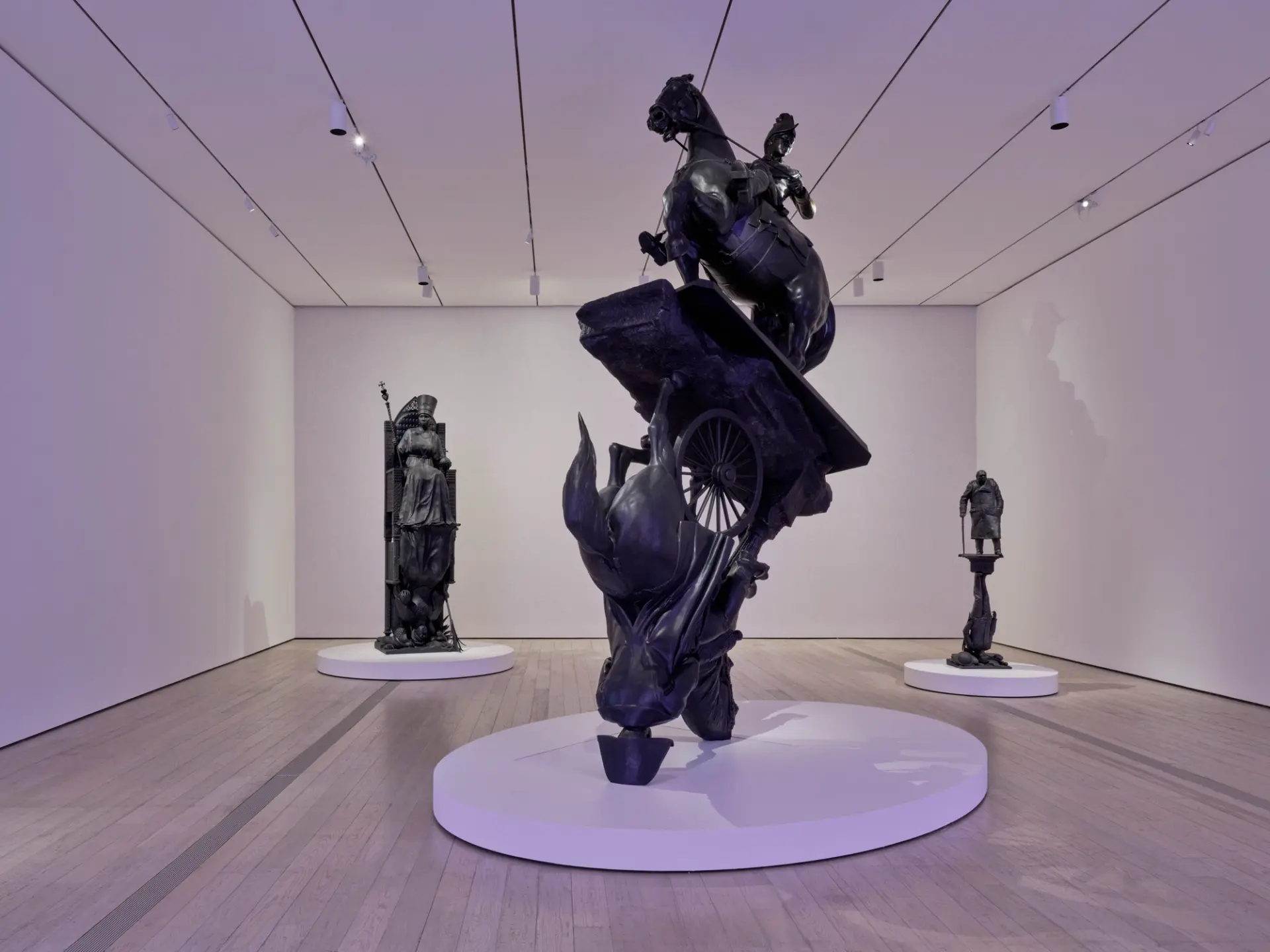
In Monument Hall, seven sculptures turn frequently historicized figures on their heads, while their alternative counterparts usurp their place at the top. The largest one, In Praise of Midnight (Christophe x Napoleon) (2025), fuses two equestrian statues into a hulking amalgamation. Haitian revolutionary leader Henri Christophe rises triumphantly above Napoleon Bonaparte, who has been turned into an upside down visage of colonial pomp and bravado. What stayed with me was Christophe’s face: serene, resolute, all-seeing. Christophe, and the Haitian Revolution in general, is rarely taught in the United States and Europe. When considered alongside other well-known events like the French and American Revolutions, the omission says more about the prevailing interests of Western colonialism than it does about the man or event itself.
Strachan has been shifting through such silences in American history for over a decade, using art, science, and storytelling to recover the undersung contributions of Black people throughout the diaspora. In the past, Strachan has flipped the historical script to center figures like Henrietta Lacks, whose DNA cells were harvested without her consent, leading to research breakthroughs for the medical industry while she died in obscurity. Strachan has also made work about Matthew Hanson, a Black explorer who was one of the first men to reach the North Pole, although his role and presence in the 1909 expedition has been largely overshadowed by his colleague, Robert Peary.
Installation view of Tavares Strachan: The Day Tomorrow Began at LACMA, 2025–26.
Courtesy of the artist and Marian Goodman. Photo: Elon Schoenholz.
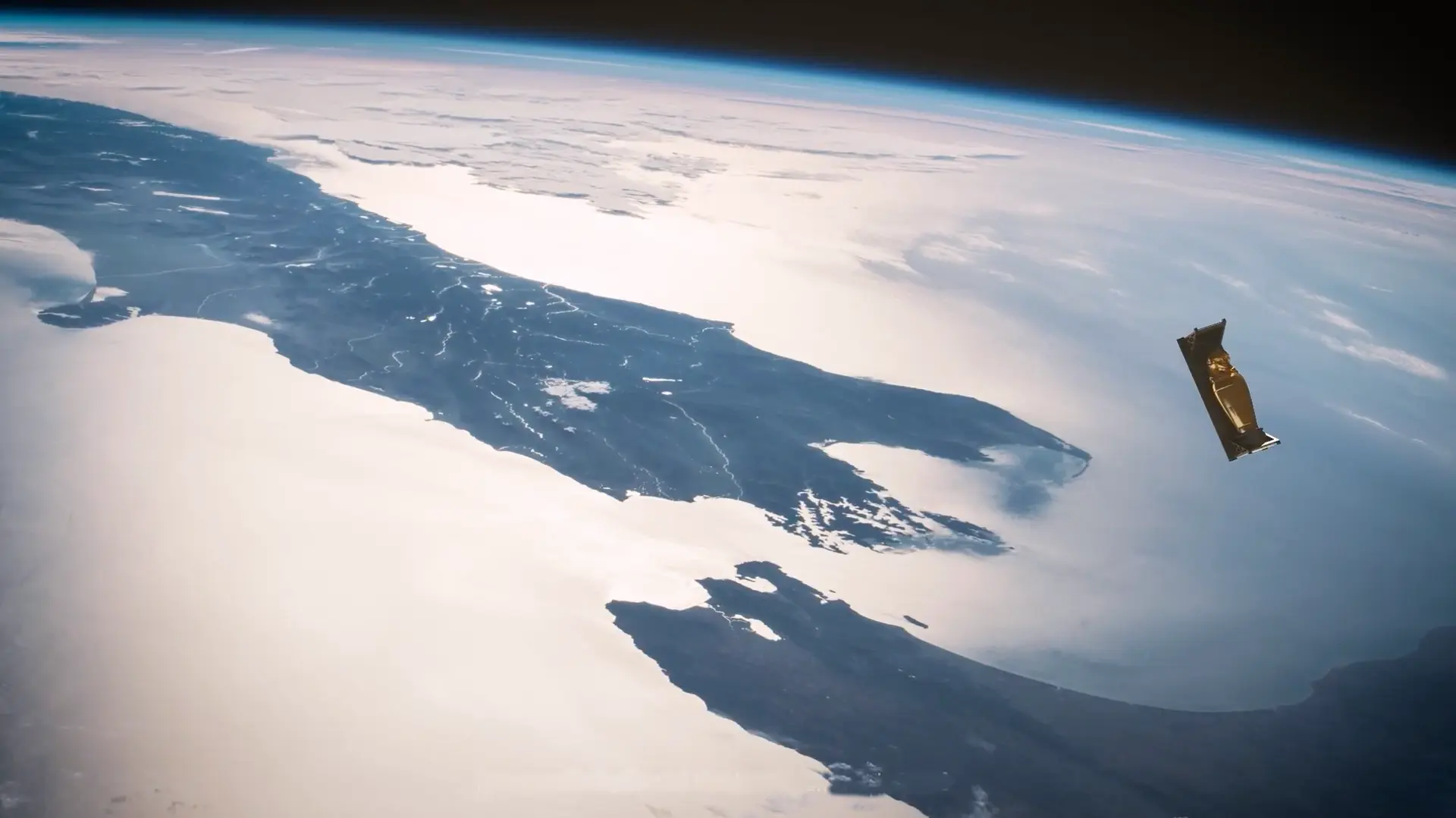
While The Day Tomorrow Began marks Strachan’s first major exhibition in Los Angeles, the show doubles as a homecoming that builds upon the artist’s long relationship with LACMA. In 2014 Strachan received an Art + Technology grant that allowed him to realize ENOCH (2015–17), a tribute to Robert Henry Lawrence Jr. The first Black astronaut selected by a space program, Lawrence was killed in a fighter jet accident before ever making it past earth’s atmosphere. Strachan worked with SpaceX to launch a gold urn bearing Lawrence’s portrait into space, where it remained in orbit for three years. The urn now stands on a plinth in The Day Tomorrow Began, in a small room dedicated to the astronaut. Through ENOCH, Strachan creates a new timeline through which the astronaut has achieved his dreams.
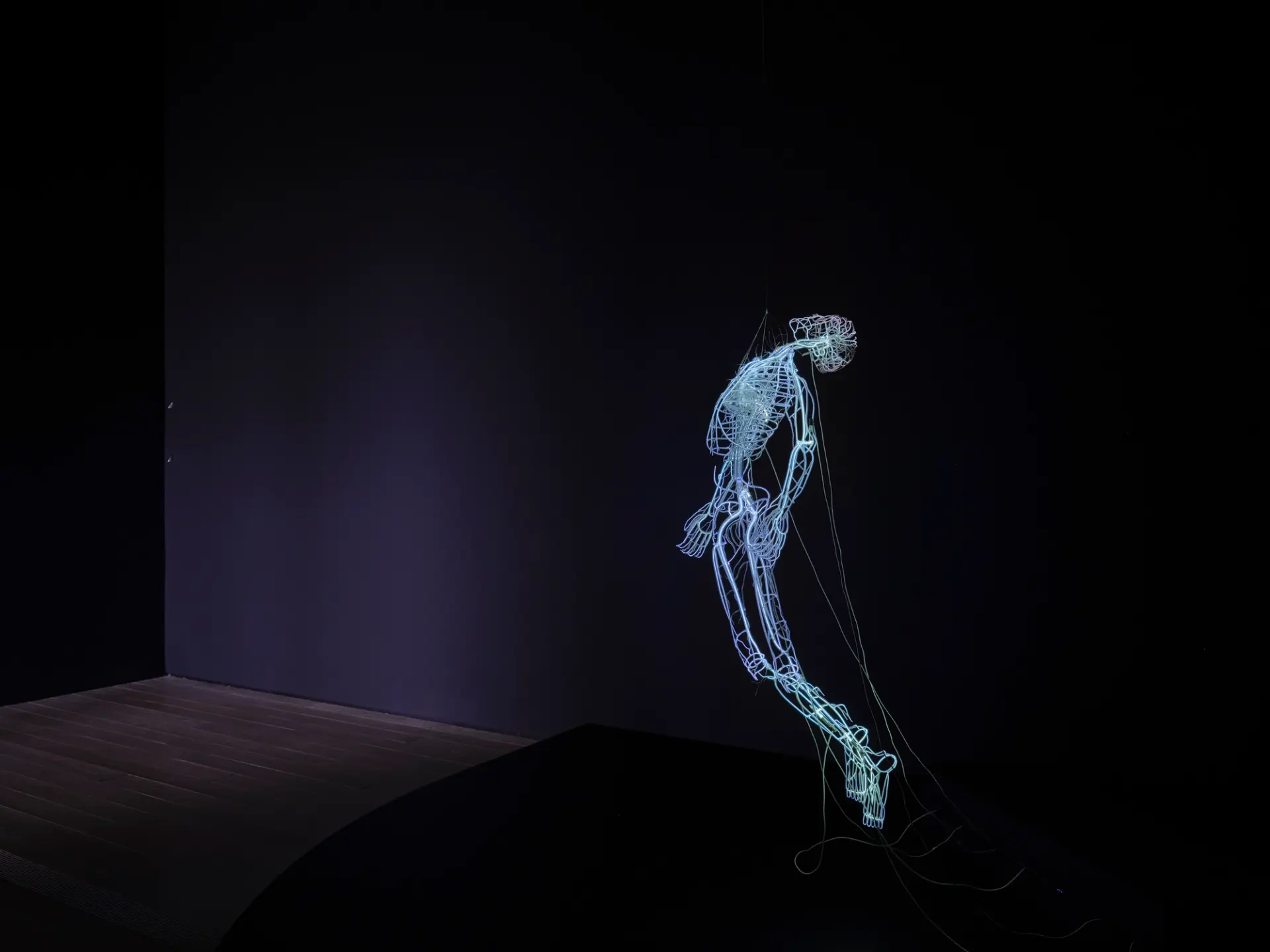
A postscript to ENOCH’s gesture of reclamation, in a darkened room, Robert (2018) blinks with eerie intensity. The neon sculpture depicts a skeletal figure with his feet lifted off the ground, his spine curled backwards, his head lifted towards the heavens. Is he lost in space or moving into another plane of existence?
Installation view of Tavares Strachan: The Day Tomorrow Began at LACMA, 2025–26.
Courtesy of the artist and Marian Goodman. Photo: Elon Schoenholz.
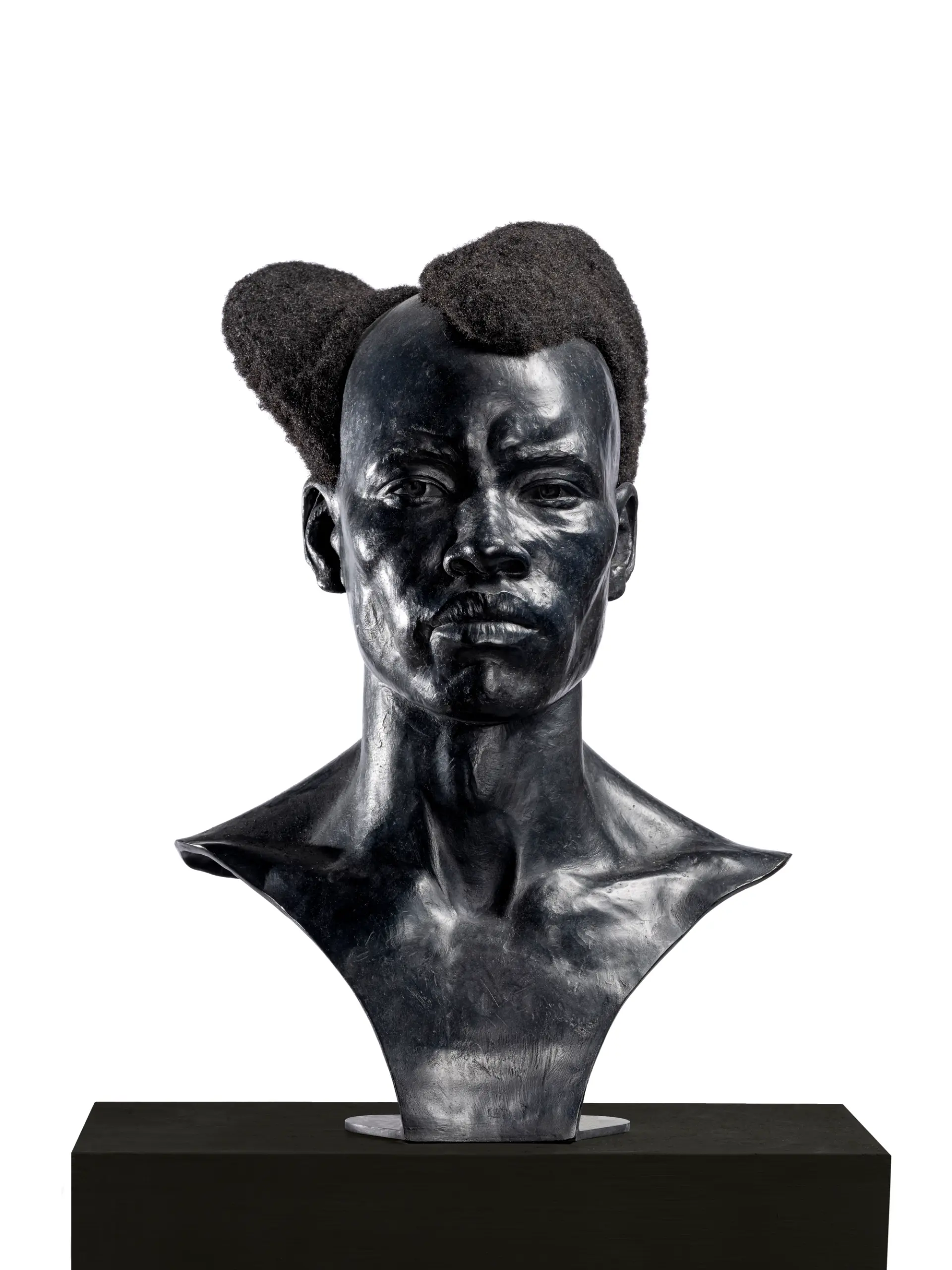
In The Barbershop (2025), silkscreen posters on burlap, framed and hung on the black walls, extol the braiding techniques of the Shilluk communities in South Sudan as well as imagined hairstyles like the regal knot worn by the Yoruban folk heroine Moremi Ajasoro. In another room, ceramic vessels sprout from the fragrant rice grass, and transform into portraits of Andrea Crabtree, Mary Seacole, Nina Simone, and other trailblazing women. Bedsheets tumble in the grey-toned Wash Room (2025), as nearby disinfecting wipes promise to “scrub away nuance, erase context, and sterilize memory.” At intervals, performers walked in through nondescript doors to sing songs and deliver monologues.
Tavares Strachan, A Map of the Crown (Amasunzu Black), 2023, © Tavares Strachan, courtesy of the artist, photo by Jonty Wilde]
Sensory cues, from the faint smell of dried grass to the rhythmic murmurs of an electric dryer, subliminally guide visitors through this series of distinctive settings: jaw-dropping replicas of a neighborhood barbershop, a spartan laundromat, a field of rice grass in the shape of a West African adinkra symbol. Meticulously designed, it’s as if each room has been waiting for us to enter in order to activate its hidden meanings. The Day Tomorrow Began comes alive during these moments of ambiguity, leaving us to consider the role we play in producing and maintaining, disrupting, or augmenting a historical narrative. These are not just stories of reclamation and recovery—they are also an inquiry into the processes that calcify a person, event, or object into fact. While our questions might linger like the smell of rice grass, The Day Tomorrow Began insists on this process of remembering and honoring these silences as the source of our true power.