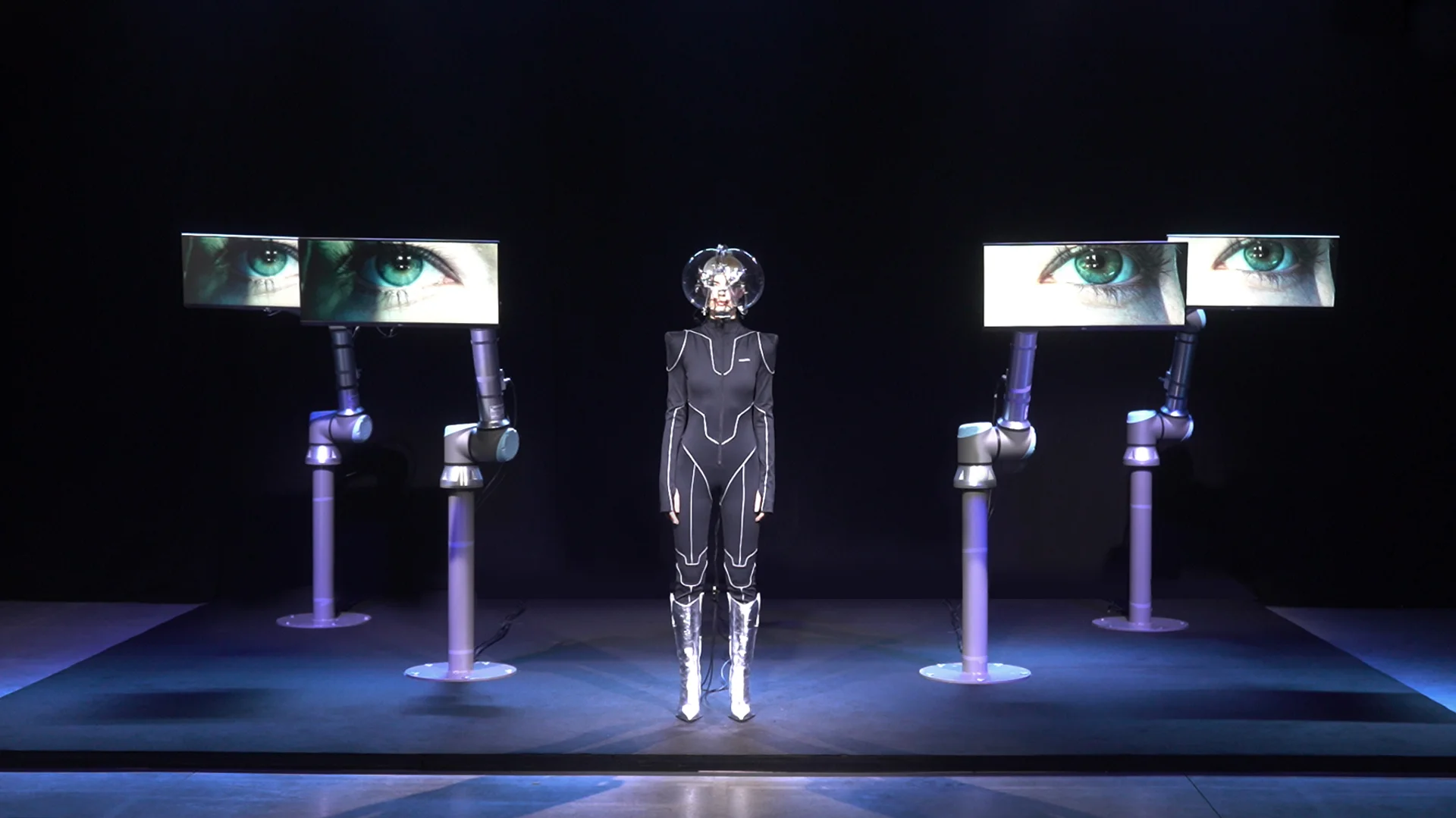
Behnaz Farahi, Returning the Gaze, 2022.
Photography by Nick Henry Soland. Courtesy of the artist.
2024 Artlab Editorial Fellow Kira Xonorika explores how artist Behnaz Farahi’s work uses feminist and postcolonial frameworks to challenge surveillance and reclaim bodily autonomy.
Artlab Editors: For her second essay of the 2024 Artlab Editorial Fellowship, Kira Xonorika spoke to artist Behnaz Farahi about her practice merging visually arresting fashion and cutting-edge robotics. Through her in-depth exploration of Farahi’s practice, Xonorika assesses the ways in which the artist’s work functions to subvert dominant methods of subjugation—particularly in the act of looking.
In Iranian American artist Behnaz Farahi’s 2020 piece, “Can the subaltern speak?,” a mask of black draped fabric is bejeweled with 18 green micro-electromagnetic actuators adorned with false eyelashes. These small robotic features function as blinking and “seeing” eyes, which transmit messages to another mask wearer through Morse code, encoded with GPT-3.
“Two masks begin to develop their own language to communicate with each other, blinking their eyelashes in rapid succession, using AI-generated Morse code,” Farahi explained to me in a recent conversation.
She went on to describe how the project is, in part, informed by an incident in which an American soldier used his eyes to blink the word "TORTURE" using Morse Code during his captivity in Vietnam, as well as stories of women using code to report domestic abuse during COVID-19 lockdowns. “Here the ‘wink’ of the sexual predator is subverted into a language to protect women from their advances,” she said of the latter.
Farahi’s masks also take inspiration from those worn by the Bandari women of southern Iran. Thought to have originated from Portuguese colonial influence in the Persian Gulf from 1507 to 1622, the Bandari masks were worn to shield from the heat of sun—and, more crucially, from the gaze of slave masters seeking women for sexual exploitation. As such, these masks have functioned for centuries as a technology of protection.
As millennia of patriarchal regimes have ruled lifeworlds, women have often shared the experience of subalternized difference. At the root of such othering is the intrusive violence of the gaze, where cognition is systemically crystallized into perception.
The impact of the gaze is, at its core, an issue of bodily autonomy, as it involves the power to inspect, control, and regulate another’s physical presence in the world through objectification. It is an historical, gendered, and racialized taxonomization. By exploring the intersections of fashion, AI, surveillance, and postcolonial feminism, Farahi’s work seeks to counteract pervasive phenomenological effects of the gaze.
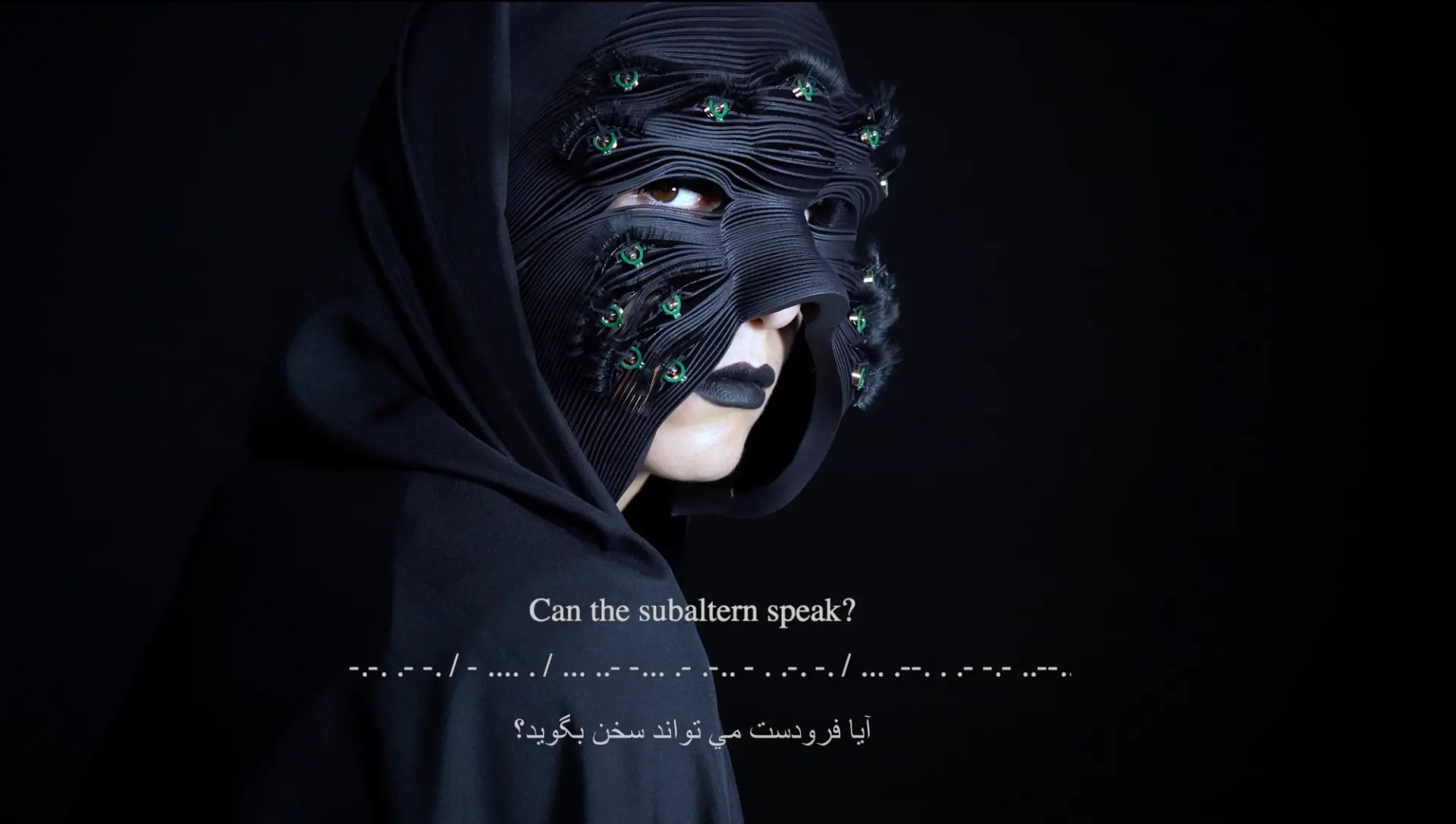
Behnaz Farahi, Can the subaltern speak?, 2020.
Courtesy of the artist.
“Can the subaltern speak?” is titled after a 1983 essay by Indian scholar Gayatri Spivak of the same name. A foundational text of postcolonial studies, Spivak’s work introduces the idea of "strategic essentialisms," where the adoption of simplified collective identities serve as a tactical tool in advocating for collective needs within systems of oppression.
Spivak belongs to the first generation of global majority theorists engaging with postcoloniality to address the absence and consequent othering of brown women in Western academia. In a similar vein, Farahi’s work is also deeply immersed in Palestinian American literary theorist Edward Said’s identification and critique of Orientalism, which seeks to challenge Western-centric worldviews while moving beyond the actionable limitations of East-West binaries.
Farahi’s approach to wearable technology examines how design can act as both a tool for conformity as well as a means of resistance. As a response to that duality, camouflage emerges often in her work.
While camouflage is often linked to warfare, its origins lie in evolutionary, biological adaptations—in the natural world, insects such as moths and butterflies exhibit eye-like markings on their wings that can startle and confuse larger predators. “It represents both a strategy for survival and an opportunity for subversion, challenging the gaze that seeks to control,” said Farahi.
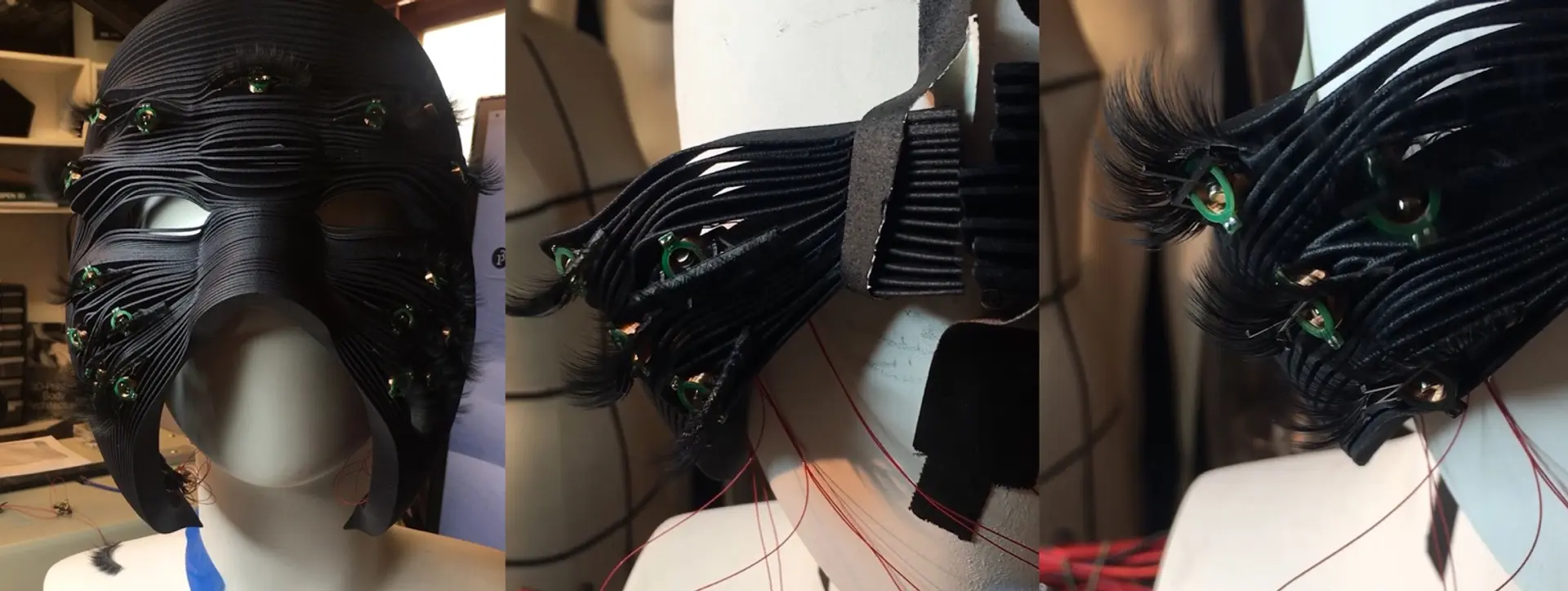
Behnaz Farahi, Can the subaltern speak?, 2020.
Photo: ACM Digital Library
Finnish new media theorist Jussi Parikka's research in robotics has shown that the behaviors of insects and robots are closely related, a connection that is clearly reflected in Farahi’s approach. “Can the subaltern speak?” suggests a potential co-evolution between human and more-than-human intelligences, serving as a means to understand and address the complexities of sociopolitical issues and collective harm. “By integrating non-human intelligence, we can challenge the divide between nature, culture, and machines,” she stated. Here, the artist emphasizes that interconnectivity arises within complex evolutionary contexts.
Another approach to challenging the effects of the [Western patriarchal] gaze involves exposing the observer. Farahi’s 2022 work, “Returning the Gaze,” which was showcased at Milan Fashion Week as part of ANИAKIKI’s FW22/23 runway show, amplifies this act of looking.
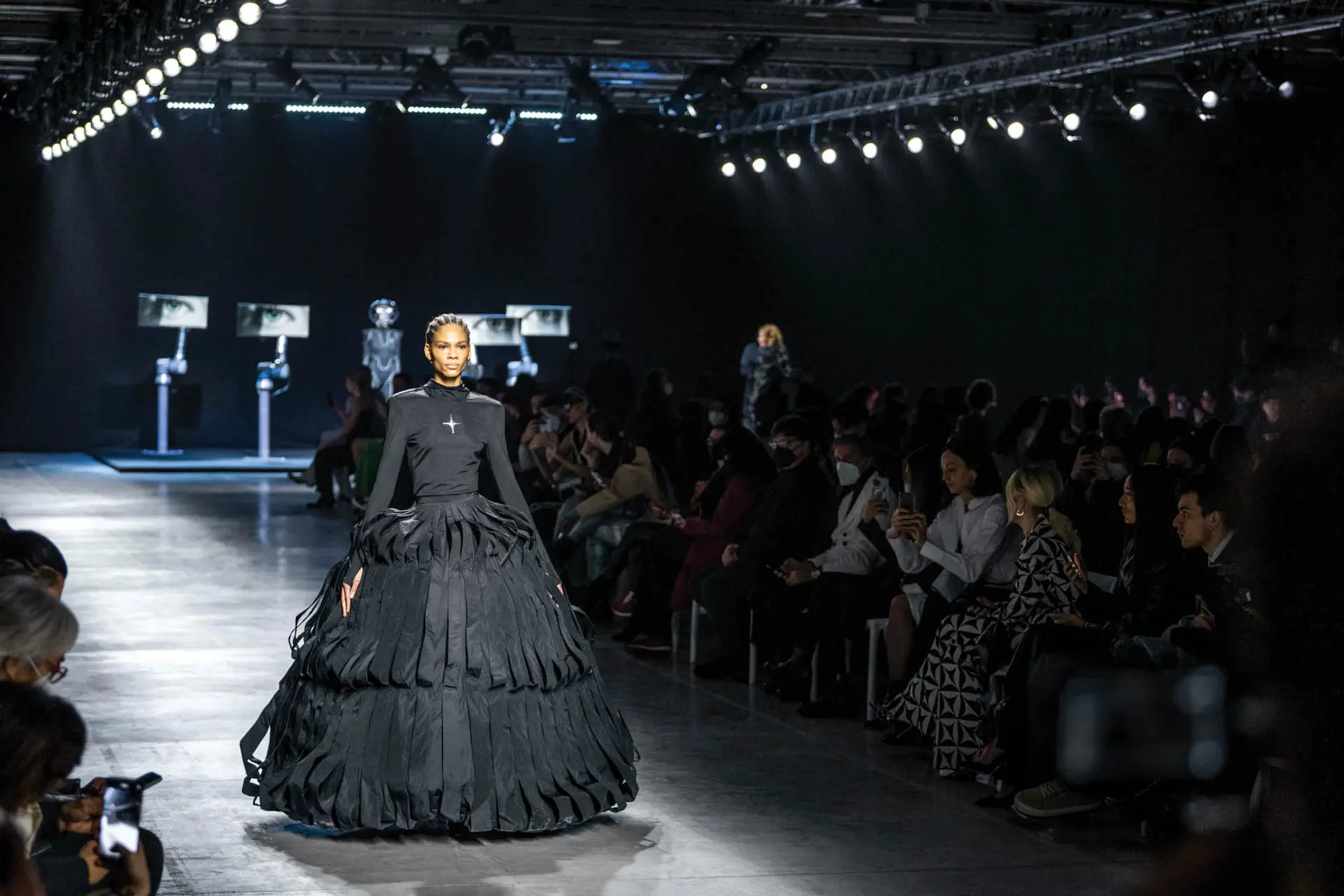
ANNAKIKI during Milan Fashion Week.
Photography by Nick Henry Soland. Courtesy of the artist.
Scale, profusion, and architectural sensibility are crucial elements in the work. At the center of the runway, a model wore an ANИAKIKI futuristic, spacesuit-like outfit with white lines defining contours, paired with metallic boots, and completed with a transparent helmet made by Farahi, which houses dual miniature cameras. These cameras meticulously track and record the wearer’s eye movements, projecting them onto four monitors mounted on robotic arms that swivel to intensely focus on the audience.


In this setup, the model’s gaze is both mirrored and magnified, creating a dramatic, hyperbolic dialogue between observer and observed. In our conversation, Farahi noted that, at the end of the show, many attendees approached the piece, causing the monitors to move erratically in response to the multitude of eyes.
Drawing on the theoretical frameworks of Laura Mulvey, John Berger, and Barbara Kruger, Farahi’s “Returning the Gaze” explores how the act of looking can both empower and oppress. Mulvey’s theory of the male gaze, Berger’s analysis of visual culture and objectification, and Kruger’s critique of the power dynamics in image consumption all address the complexities of looking, perception, and positionality.
“Fashion is a powerful semiotic device because it communicates identity, culture, and politics in a unique, non-verbal language,” said Farahi. In the context of a runway show, “Returning the Gaze” highlights how the fashion industry perpetuates serialized, gendered scrutiny of the body. The monitors exaggerate the gaze, turning it into a real-time architectural forensics of women's bodies.
Who, what, and how we perceive is foundational to our mechanisms for classification. What are we observing, and how does the experience of being observed change us? Today, such biases in seeing are what inform the development of surveillance technologies. Facial recognition technology, for example, assumes an objective ability to distinguish normalcy from deviancy through racialization and gendering—bioessentialist and deterministic markers from obsolete cultural wars.
Farahi’s work exposes the scope of such surveillance technologies, particularly when the object of the gaze turns the tables in the game of biopolitics. This reveals a state of crossed boundaries through hypervigilance. ”It is about reclaiming power by actively engaging with, confronting, or subverting the act of being watched,” she said.
Farahi’s work is cyborgian in concept, entangling human biology with machines to ask how such technologies might be coded to subvert the dominant systems of surveillance and violence enacted against subalternized bodies. This incorporation of multiregional-multisectorial feminist and coalitional postcolonial-anticolonial frameworks into sociotechnical design is both urgent and essential.
Farahi joins a growing chorus of such artistic interventions by women artists, including Stephanie Dinkins’s “Conversations with Bina48” (2014-present), Violeta Ayala’s “Las Awichas” (2024), and the literary work of Mashinka Firunts Hakopian “The Institute of Other Intelligences” (2023). These frameworks are crucial for creating systemic epistemic justice that dismantles and transcends existing biased conditions across the fields of machine learning, algorithms, and robotics while also developing and strengthening alternative and equitable ecologies.
‘‘I aim to envision alternative futures that can disrupt and transform current power dynamics,” notes Farahi. “This forward-looking approach allows me to explore how emerging technologies might reshape our understanding of identity, agency, and social justice.’’