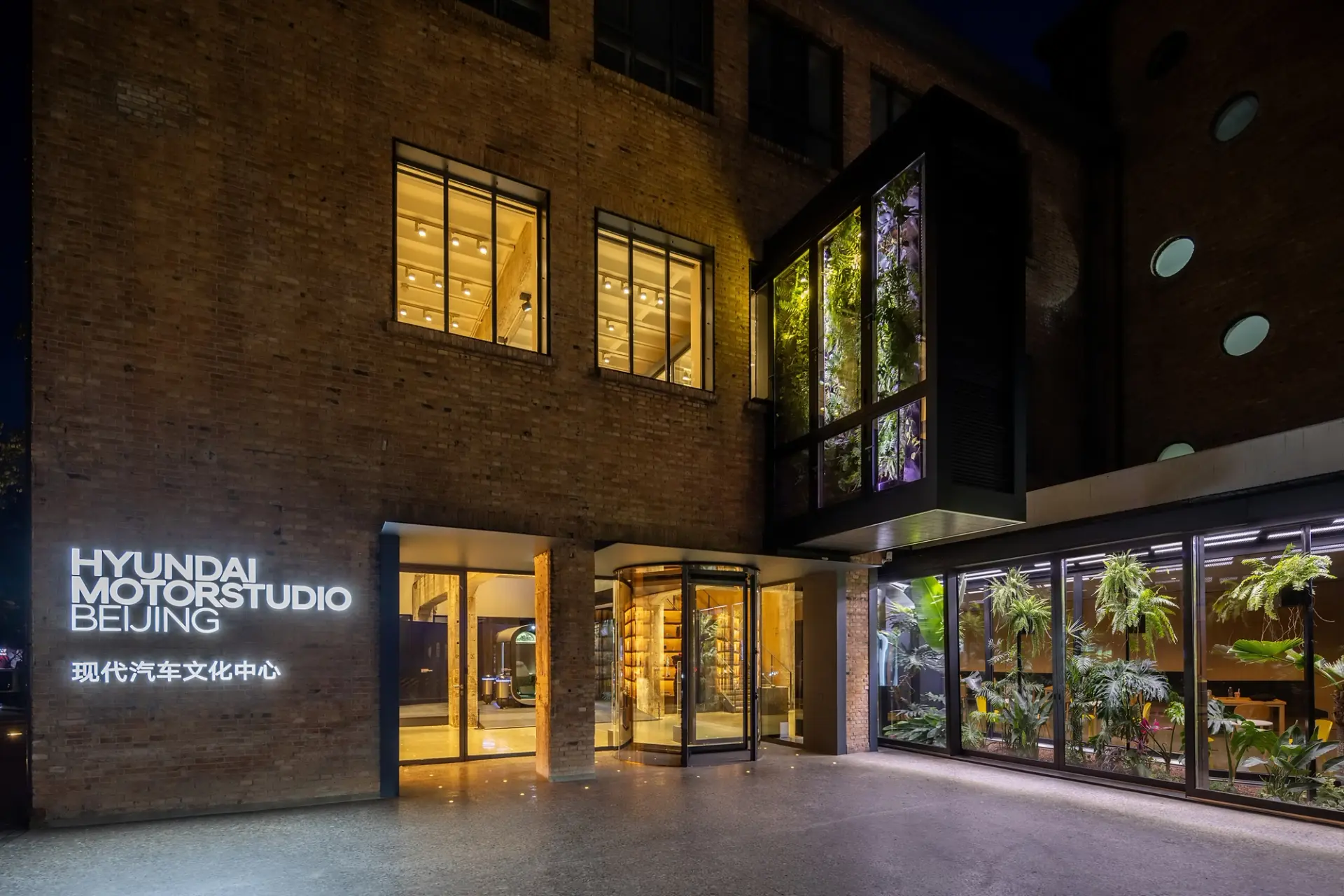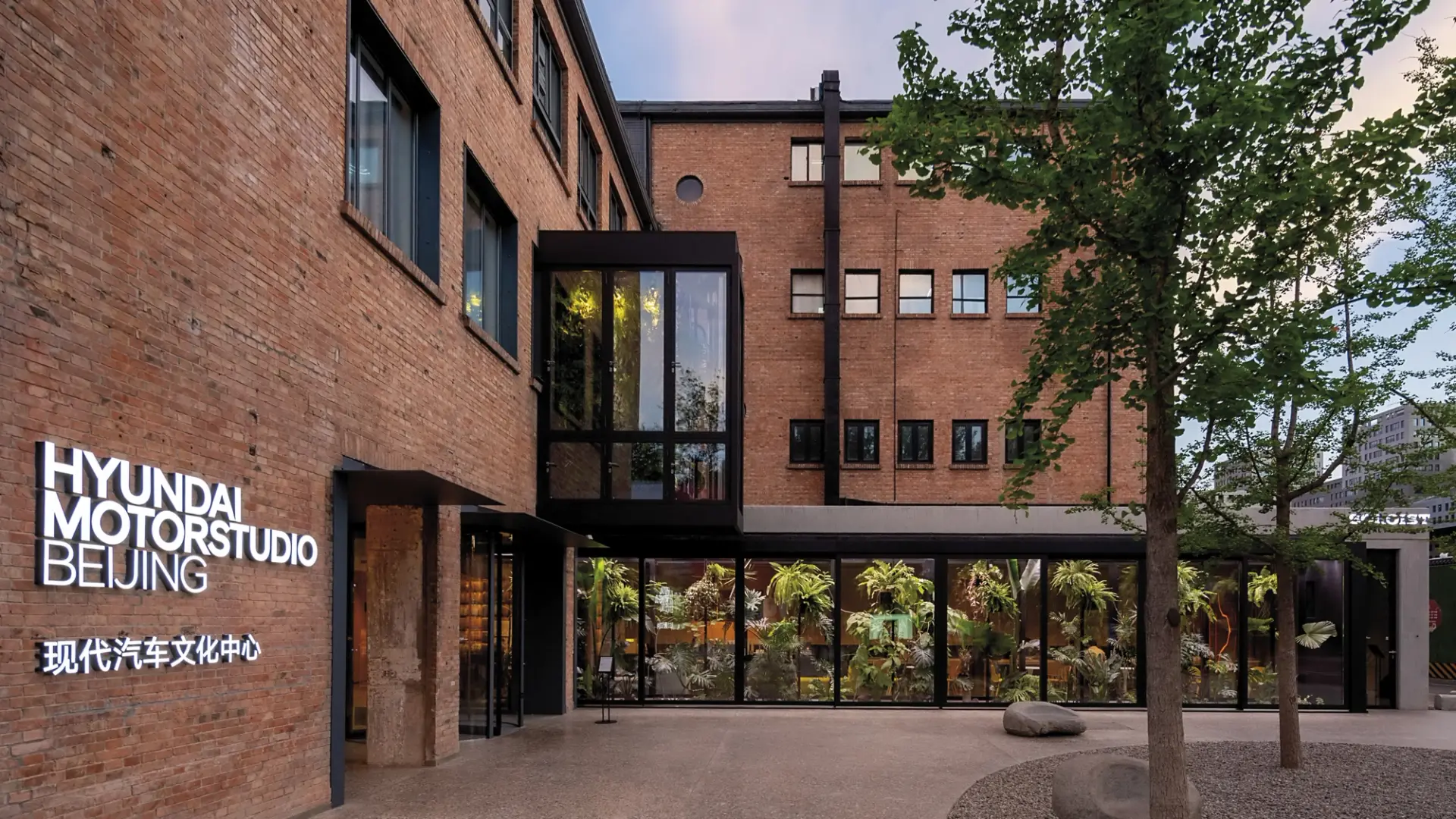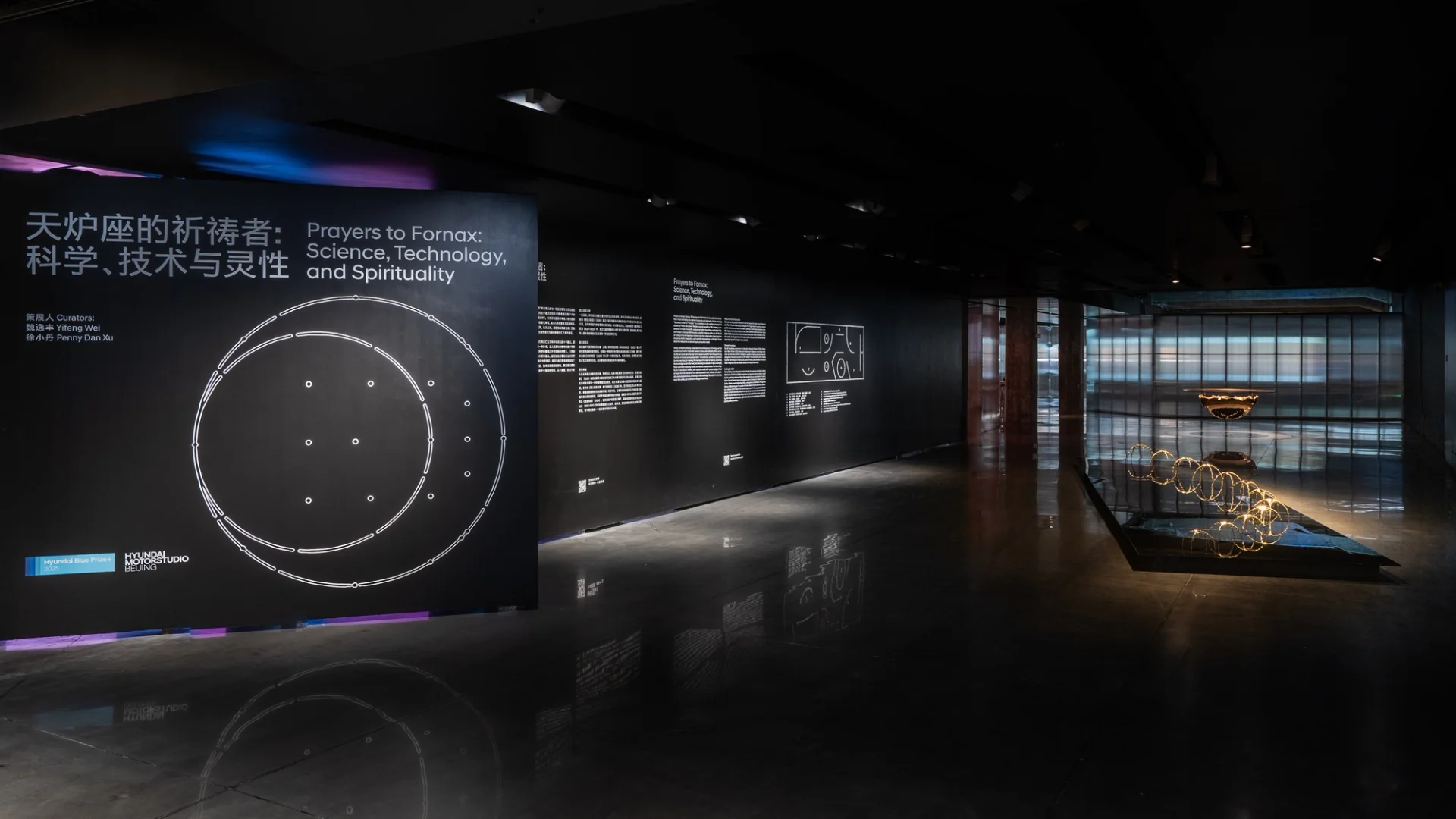
Installation view of Hyundai Blue Prize+ 2025, Prayers to Fornax: Science, Technology, and Spirituality, 2026. Image courtesy of Hyundai Motorstudio Beijing.
Yue Ren visits Prayers to Fornax: Science, Technology, and Spirituality, the first exhibition mounted by one of the two Hyundai Blue Prize+ 2025 awardee collectives, at Hyundai Motorstudio Beijing.
Artlab Editors: Science and spirituality often take turns explaining the world. Where one is prominent the other keeps to a respectful silence, recalling the peacekeeping separation of Church and State. But in charting how art and technology similarly move us towards the edges of our own imagination and understanding, writer and critic Yue Ren describes how science and spirituality are, in fact, intimately entwined and impossible to separate.
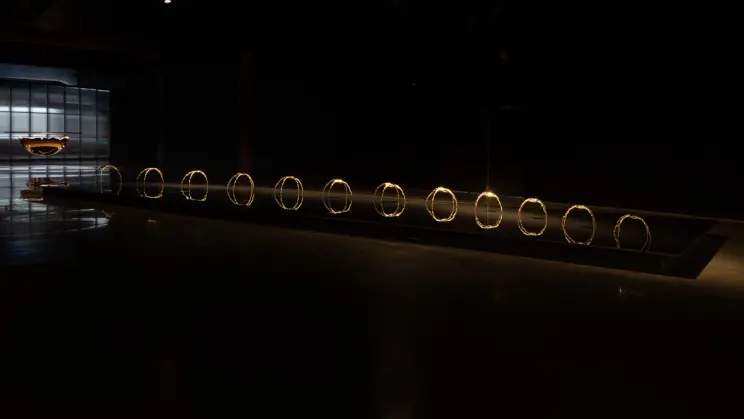
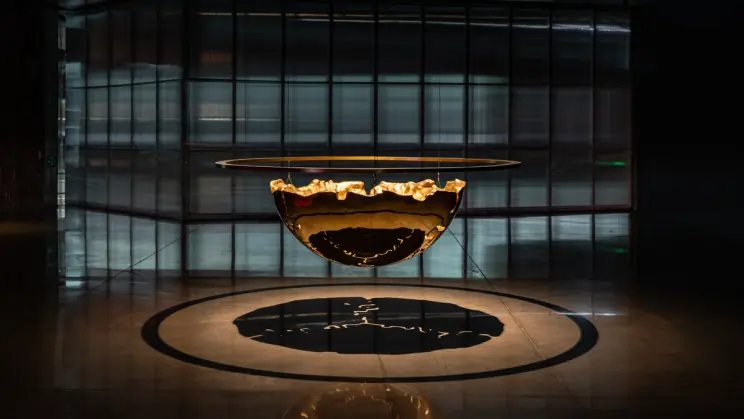
At the entrance to Prayers to Fornax: Science, Technology, and Spirituality, the exhibition’s interior is almost entirely withheld from view. Chen Zhe’s Celestial-cranial Instrument series (2022-2023) leaves a faint glow across the black floor, just bright enough to suggest the depth of the gallery. For visitors to Hyundai Motorstudio Beijing, the technological infrastructure of the building is usually difficult to miss. On the second floor, texts on a glass wall set against a dense array of pipes offer an extensive explanation of the building’s sophisticated air-circulation system, making the otherwise invisible machinery markedly legible. The exhibition curated by one of two awardee pairs of the Hyundai Blue Prize+ 2025, however, is slightly more obscure. Instead of explaining itself, it prefers to ask: Who gets to explain the world, and what makes that explanation authoritative?
This is an apt departing point for an exhibition that brings science, technology and spirituality into proximity, yet the most compelling inquiry is not whether they can be reconciled. In fact, these three domains have never been quite as separate as the narrative of modern knowledge institutions might suggest. Nor do they stand in a relationship of linear succession or cyclical recurrence.
Throughout history, diverse forms of spirituality, scientific breakthrough, and evolving technologies have swirled around each other; each taking turn as primary authority in explaining the world and defining the roles the others are assigned. The story of August Kekulé, the German chemist who proposed the ring structure of benzene, offers a revealing case. While struggling with the molecule’s puzzling structure in the 1860s, Kekulé later recalled seeing a serpent seize its own tail, an image that suggested to him the possibility of a closed chain of carbon atoms. He went on to publish his six-membered ring model in 1865. Whether the famous dream actually played the decisive role later attributed to it remains disputed, but the story has endured for giving scientific discovery an origin outside the tidy sequence of hypothesis and proof. Intuition and even the unconscious appear first; formal knowledge follows.
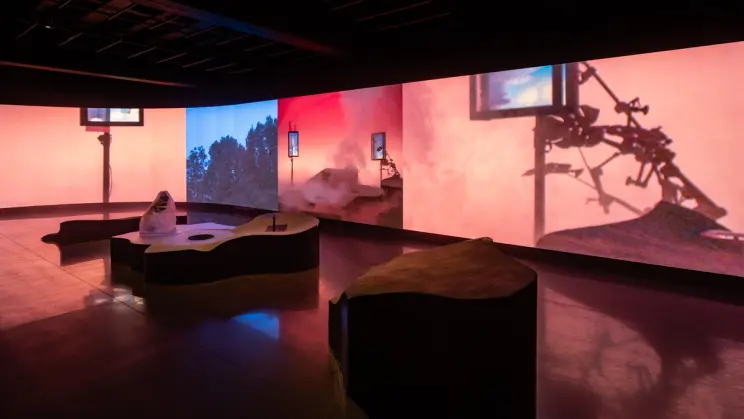
Near the entrance, June Balthazard and Pierre Pauze’s Mass (2020) and two pieces from Chen’s Celestial-cranial Instrument series establish a productive uncertainty between cosmos, body, and scientific instruments. In Mass, two physicists surviving an ecological catastrophe search for an invisible substance that might have once connected everything. Across two screens, their conversation unfolds alongside magnified particle movements, scientific instruments in operation, and unfamiliar landscapes. Although used in mythology and modern physics, respectively, the “aether” and the Higgs boson they discuss both occupy very similar epistemological positions. Both terms name an unseen entity through which the world might be rendered intelligible. Rather than turning science into a form of metaphysics, Mass unsettles the distinction between the two. On the other hand, Chen’s work finds an elegance in the longstanding, imagined unity between heaven and humanity. By demonstrating the correspondence between the human skull structure and celestial movement, the artist suspends mundane concerns of mortality by transforming the body itself into a measuring instrument, and grants it a certain sacredness and sense of permanence.
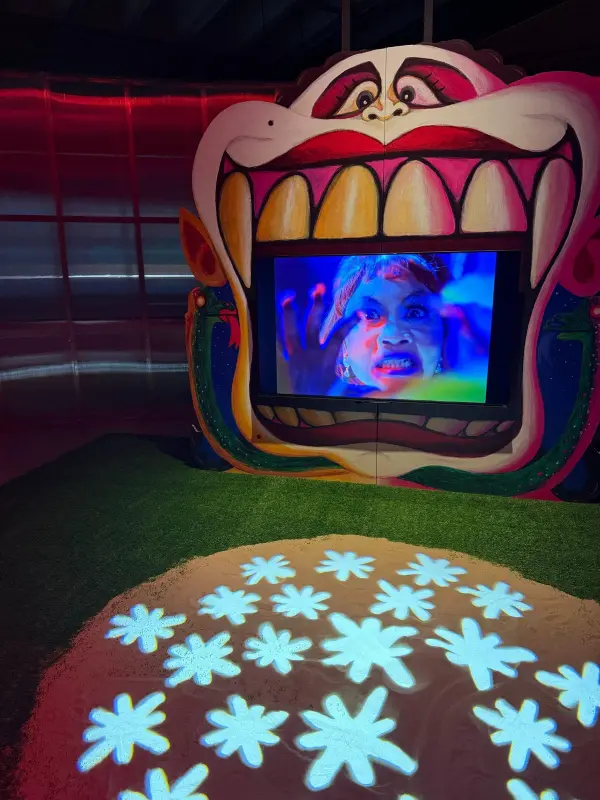
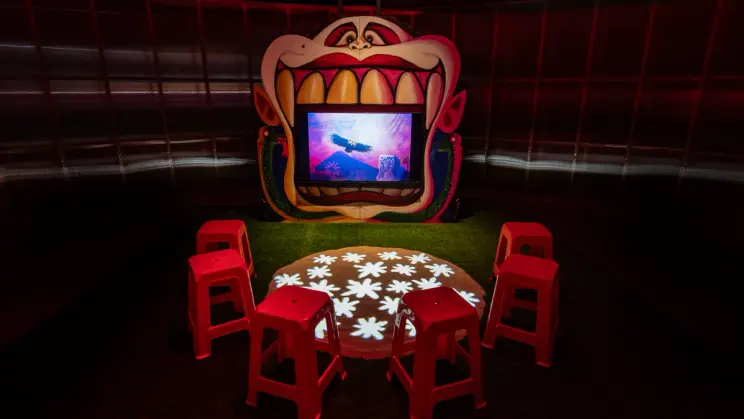
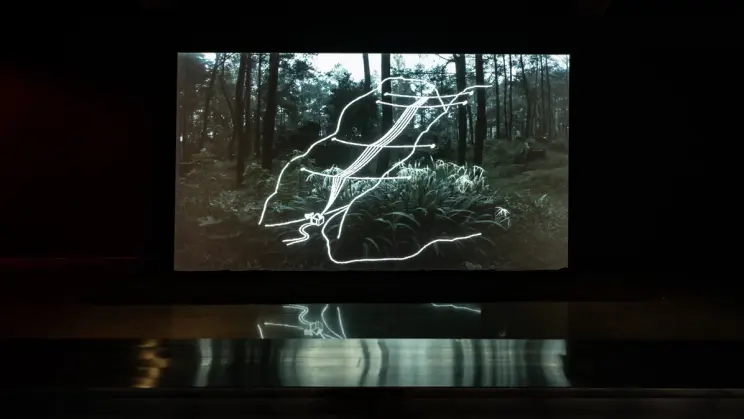
The tentative distinctions between the scientific and the spiritual become more unstable as the exhibition unfolds. Natasha Tontey’s Of Other Tomorrows Never Known (2023) and Riar Rizaldi’s Tellurian Drama (2020) both ask who takes the wand when power, tradition, and technology intersect. Through a deliberately teasing installation combining red plastic stools, artificial grass, and a theatrical painted filming frame, Tontey evokes a neighborhood street cinema saturated within ridiculously low-res and cultish aesthetics. The film reveals Minahasan cosmology where the makatana, a supreme cosmic being in North Sulawesi tradition, is strikingly referred to as an “AI.” This seemingly casual substitution of a pronoun brings two systems of explanation into an uncanny alignment: one that locates ultimate agency in a spiritual cosmic being, and another that increasingly attributes its authority to contemporary technology. Rizaldi traces another collision between indigenous West Java and the infrastructural rationalities of Dutch colonial governance in the 1920s. The encounter between standardized clock time and local systems of timekeeping rooted in people, belief, and land exemplifies a contestation over epistemic authority.
This brings us to a more complicated relationship between science, technology, and spirituality. Science has never thoroughly expelled the mysterious from the world. And its own practices likewise depend on acts of imagination, classification, abstraction, and symbolization. What distinguishes them is the particular regimes of evidence and legitimacy through which certain claims become authoritative.
Measurement, as the exhibition also pays attention to, is one such way. To measure is to make some being, in a Foucauldian sense, easier to incorporate into institutionalized knowledge. Our increasing reliance on metrics, from credit scores and health data, thus represents more than a proliferation of technological tools. It signals a transformation in how we seek to read and know. The object of authority has changed from an unknowable spirit to symbols of reason, while the underlying desire to find patterns and predictions has proved remarkably persistent. People who once looked to the stars for signs, now look to data.
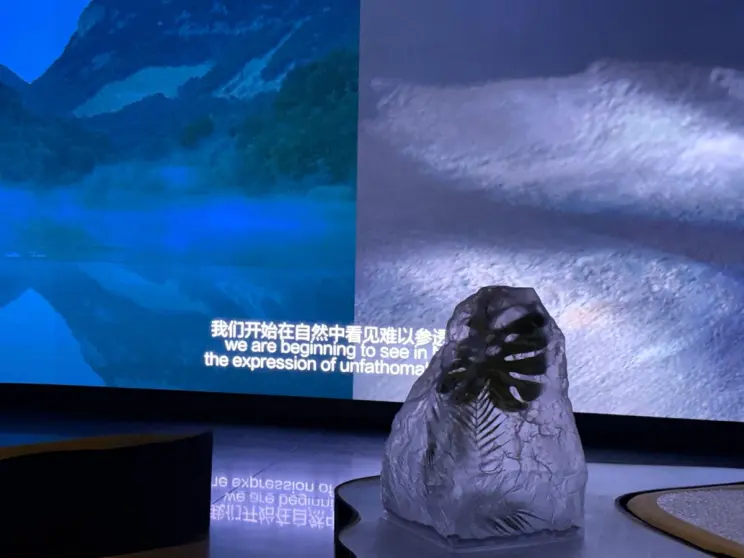
In Metric Mysticism: A Troll’s Tale (2022), Zach Blas makes this continuity literal. A grotesque crystal ball occupies the center of the work while surrounding screens splice together occult imagery, diagrams, and cinematic fragments. Focusing on the appropriation of mysticism and magic by Silicon Valley start-ups and governmental surveillance agencies alike, the work turns the traditional fortune-telling device into a satirical model for contemporary computation. The joke, of course, is that the technological apparatus ultimately resembles what it claims to have superseded. As someone more sympathetic to the messiness of qualitative inquiry, I find Blas’s mockery of data science’s claims to rigor and omniscience difficult to not enjoy.
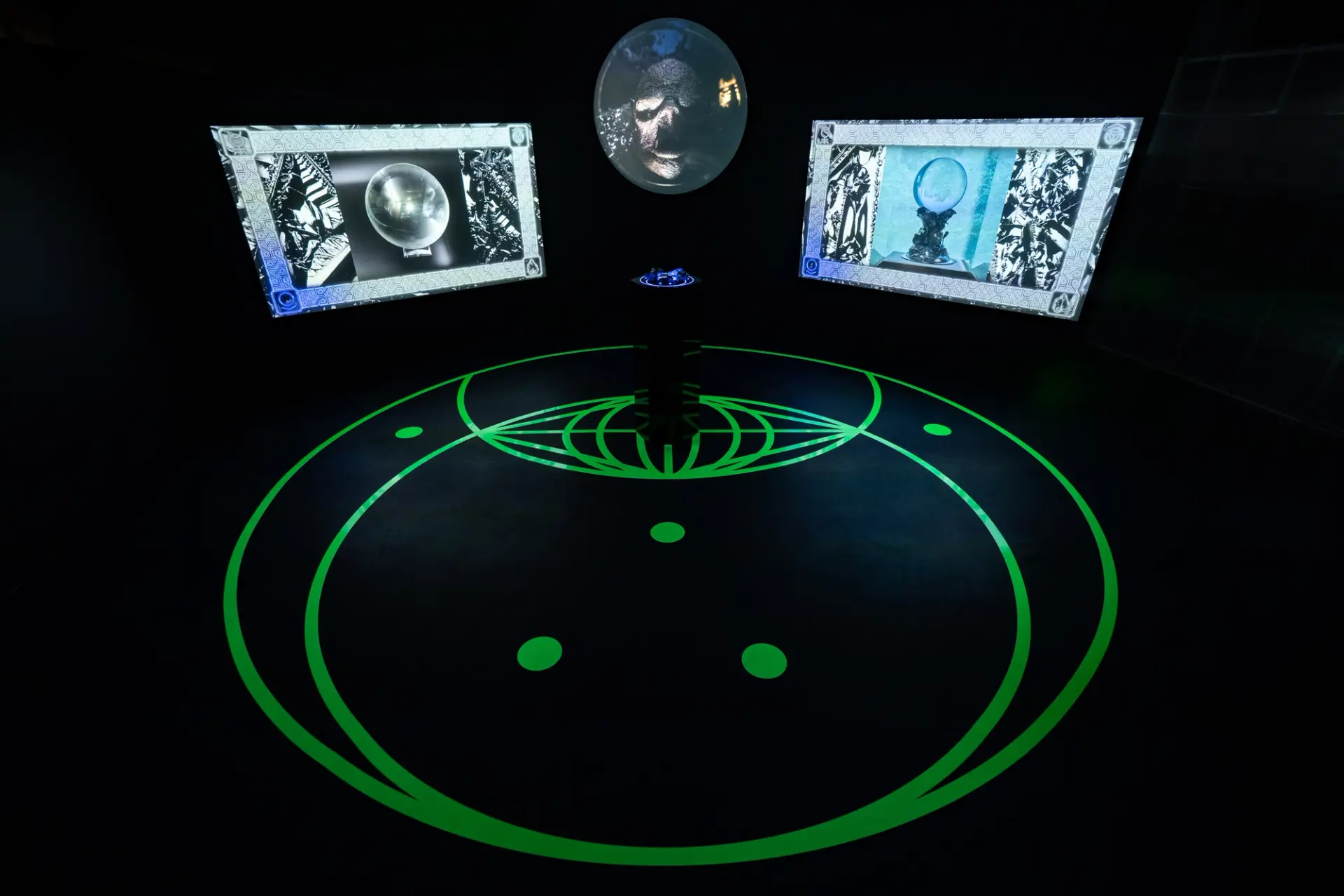
Zach Blas, Metric Mysticism: A Troll's Tale, 2022, installation view of Hyundai Blue Prize+ 2025 Prayers to Fornax: Science, Technology, and Spirituality at Hyundai Motorstudio Beijing, 2026. Image courtesy of Hyundai Motorstudio Beijing.
Science is conventionally understood as a force of disenchantment that makes the world more transparent. Yet technologically mediated life has become increasingly opaque. The data-driven systems shaping our decisions can resemble, in an unexpected way, the mysterious forces once invoked to make sense of the world. In that sense, technology has not abolished the sacred so much as redistributed some of its functions. Nolan Oswald Dennis’s Black Liberation Zodiac: Whale-mouth Solidarities (2026) offers a fitting reminder that the cosmos has never belonged to a single system of interpretation. The same sky may be an astronomical object, a spiritual map, or a political imaginary, depending on how it is read.
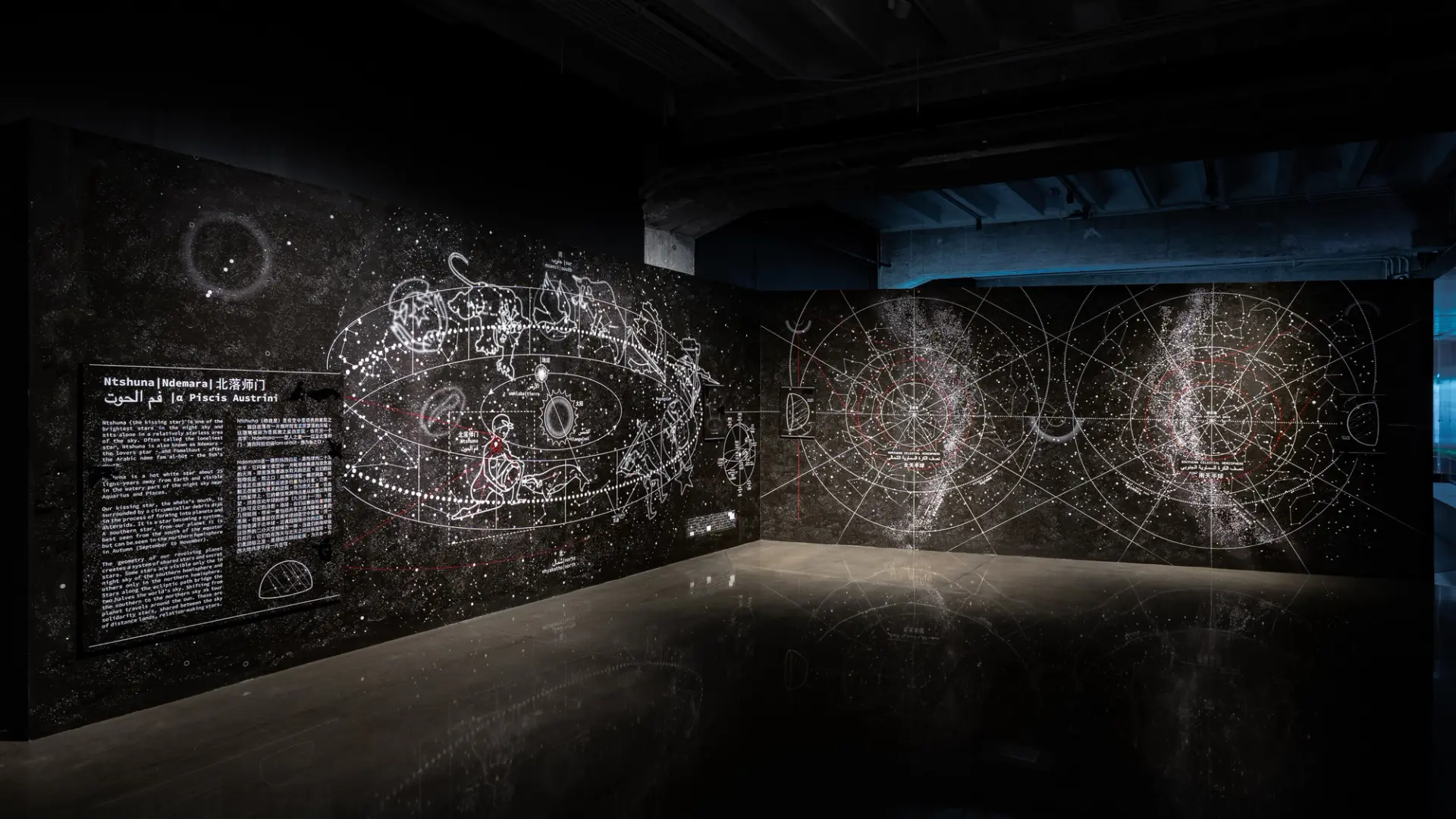
Nolan Oswald Dennis, Black Liberation Zodiac: Whale-mouth Solidarities, 2026, installation view of Hyundai Blue Prize+ 2025 Prayers to Fornax: Science, Technology, and Spirituality at Hyundai Motorstudio Beijing, 2026. Image courtesy of Hyundai Motorstudio Beijing.
The question is what makes one way of explaining the world authoritative at a given moment. Like the imaginary furnace of Fornax, the exhibition suggests that knowledge is forged through friction, heat, and pressure. Its curatorial gesture is most productive when it treats science, technology, and spirituality not as stable categories to be reconciled, but as shifting positions within a larger field of knowledge production. By placing their languages, symbols, and claims to authority into proximity, the exhibition makes their boundaries (and their instability) available for scrutiny. A more inclusive epistemology may lie not in reconciling these domains once and for all, but in tracing how they continually displace and reconfigure one another, producing new regimes of knowledge and authority.