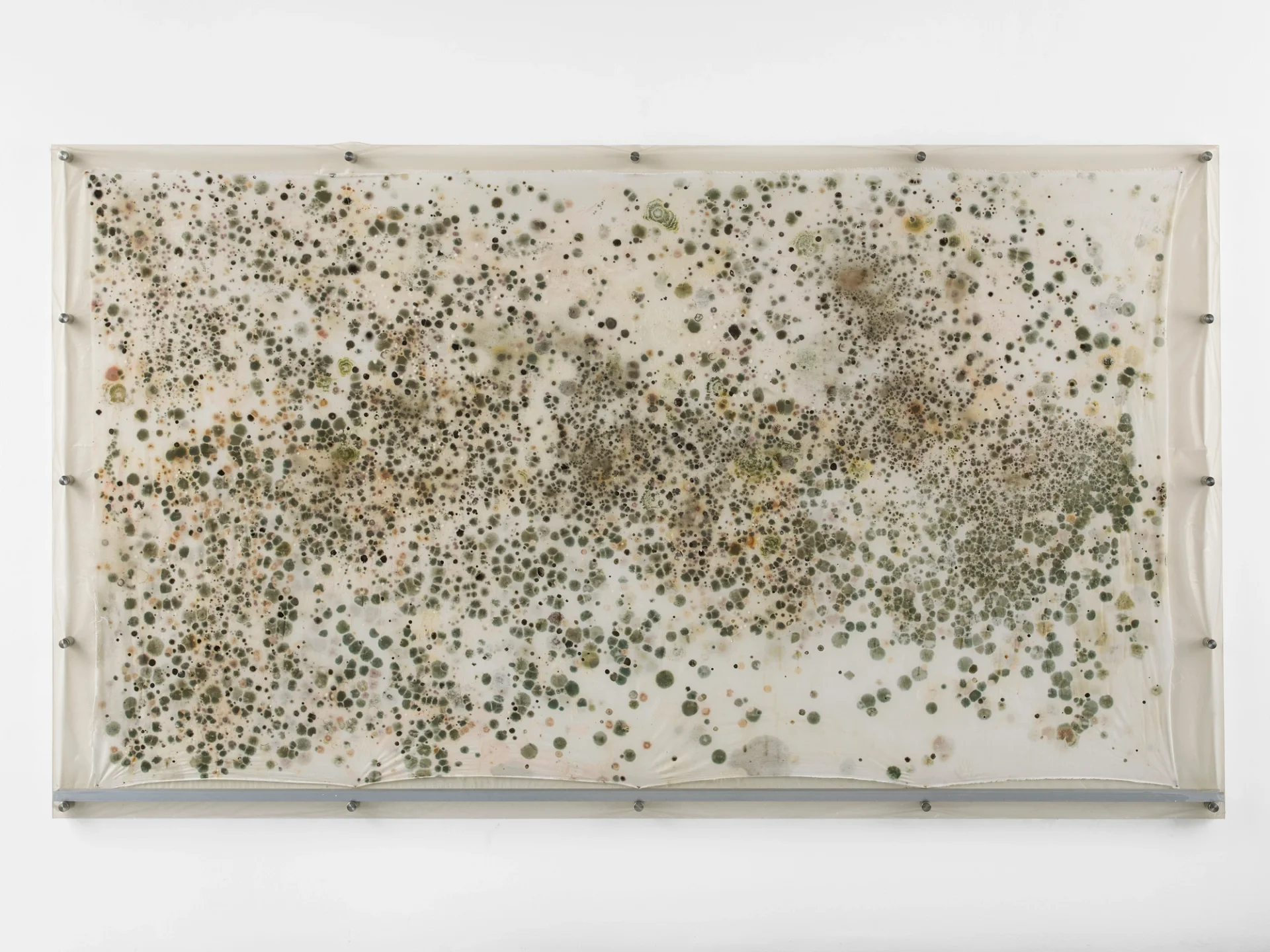
Gala Porras-Kim, Out of an instance of expiration comes a perennial showing, 2022-ongoing.
Join Mira Dayal as she uncovers how Gala Porras-Kim reimagines museum collections in works ranging from climate-controlled vitrines to institutional databases, proposing expansive new systems that honor the past, present, and potential futures of the artifacts they hold.
Artlab Editors: How do museums affect the ways in which we see art and artifacts? In Expansive Data Fields, Gala Porras-Kim’s current project with the LACMA Art + Technology Lab, the artist is collaborating with information scientists and open data specialists to further her ongoing investigations into this query. Writer Mira Dayal brings us behind the scenes to learn about how Porras-Kim is dismantling and reshuffling the ways in which institutions catalog, understand, and display their collections.
During a recent talk recent talk at Asia Art Archive in America, an audience member asked a panel of artists what anchors them in their work. “Trying to be unanchored is the anchor,” responded Gala Porras-Kim. “The challenge is to become unanchored from the things that you think you know already.” She proceeded to explain that in many cases, the system or set of rules that we take to be a default—whether an institution or a set of laws—is a form of insurance, or assurance, to quell some anxiety. But if we loosen our attachment to that default, we can see other possibilities.
For the past decade, Porras-Kim, who is based in London and Los Angeles, has sought to unmoor institutions and their visitors from how they typically understand and work with specific objects in a collection. In her current project for the LACMA Art + Technology Lab, Expansive Data Fields, the artist is tackling the wider cataloging system itself by working closely with information science and linked open data specialists to reshape how works are categorized and labeled in a collection database. Through this process, she aims to expand the functions and responsibilities of institutions.
Her concept represents a shift away from the typical top-down collection model, in which a database includes categories and attributes that are used to sort objects and fill out their descriptions. Porras-Kim notes that in this current model, information that is not or cannot be noted in a preexisting data field is often lost or made secondary to other, more commonly emphasized attributes: the object’s date, region, or function as a cultural representative of a particular society. For example, if many objects in museums were created to fulfill ritual functions that were never supposed to end—and are, in theory, still happening today—why do institutions rarely prioritize that aspect of their taxonomy?
Through Expansive Date Fields, Porras-Kim envisions a bottom-up model, where the many possible attributes of an object—for example, physical material (e.g., wood, stone), ritual function (e.g., offering to a rain god), or post-human function (“a feast for bugs,” she jokes)—are accounted for. These categorizations should then collectively determine what the museum needs, who it needs to employ, what spaces it should occupy, and how it operates to fulfill those functions.
Working with the LACMA Art + Technology Lab has enabled Porras-Kim to partner with experts who will be able to develop a prototype for new software and systems that others will ideally continue iterating on for years. For now, she still has many questions: How much data should this system contain? Will it be an add-on to an existing database or a separate program entirely? Will it be open-source? How can its interface be friendlier than that of a typical database? How can she “relax the categories” that she thought would be needed based on her previous projects?
These questions will largely play out on the back end. Porras-Kim notes that this artwork’s primary audience is the registrar and museum staff; its effects are intended to trickle down to the regular art-goer. A future visitor will not see the database itself, but might see changes in the way the museum operates that are representative of what the database has illuminated. Porras-Kim proposed that even this text may itself be an early exposition of the project, a possible equivalent to the typed letters to museum directors that she often includes in exhibitions to summarize the questions behind her often enigmatic physical works.
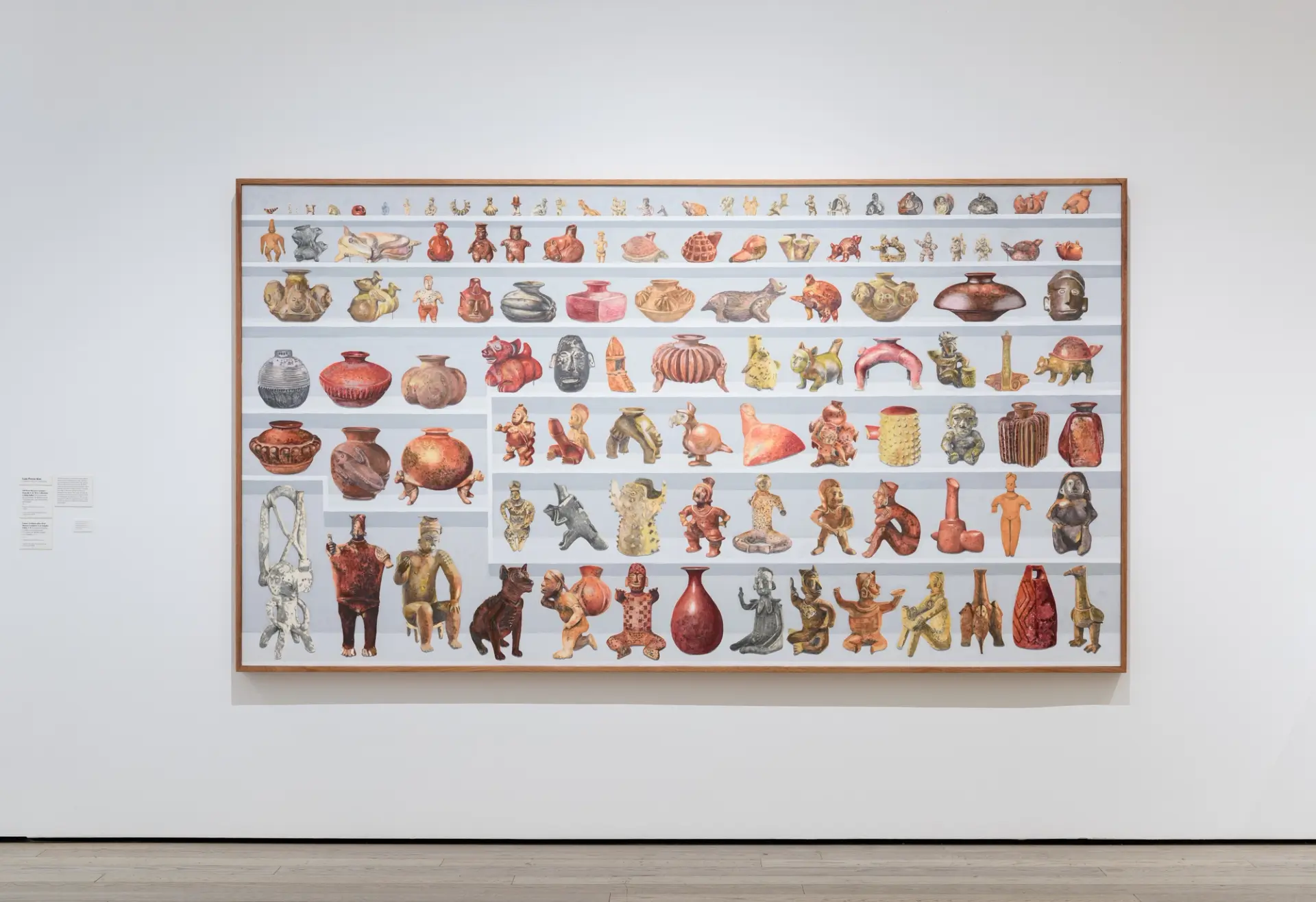
Gala Porras-Kim, 109 West Mexico Ceramics from LACMA Collection: Colima Index, 2017.
Whereas Expansive Data Fields reconsiders the taxonomical infrastructure of museums, the artist’s past works have largely examined how the technicalities of standard museum protocols—including temperature and humidity control, artwork insurance, display conventions, and deaccession policies—can lead to interesting quandaries when applied generally across many different types of objects. One 2021 work title describes this succinctly: “Leaving the institution through cremation is easier than as a result of a deaccession policy.”
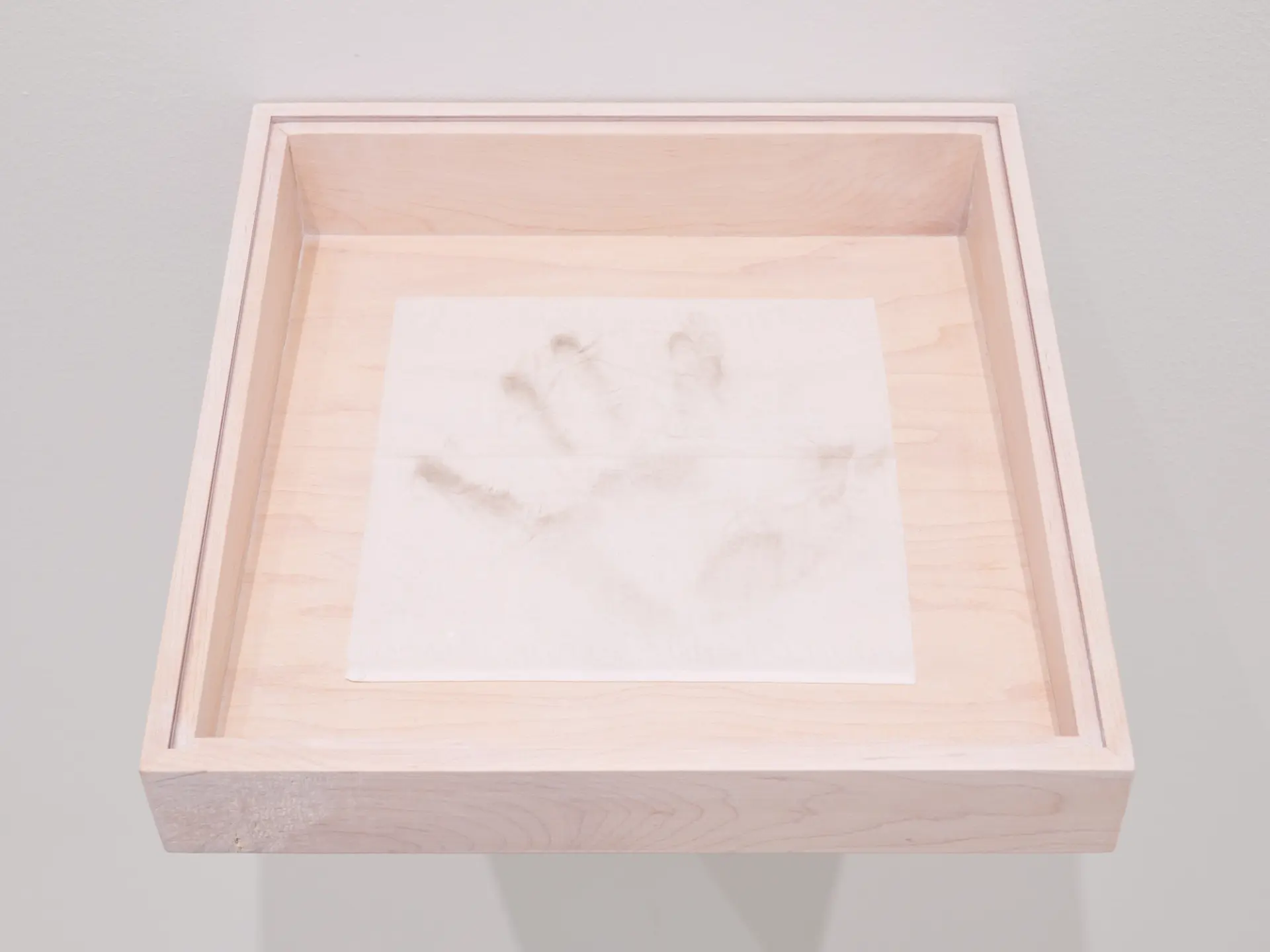
Gala Porras-Kim, Leaving the institution through cremation is easier than as a result of a deaccession policy, 2021.
That work, comprising a printed letter and the imprint of a hand in ash on a napkin, is a response to a 2018 incident at the National Museum of Brazil in Rio de Janeiro. A fire harmed much of the collection, including the bones of one of the oldest known human ancestors, who was calculated to have lived more than 11,000 years ago. As part of its restoration efforts, the museum reassembled fragments of the skeleton which were formerly held together with now-melted glue.
In the letter, addressed to the museum director, Porras-Kim interrogates that intervention, asking whether this restoration might counter the original wishes of this deceased person. Should this charred skeleton instead be released back into the material world, cremated and left to decompose in the earth? Through this line of inquiry, Porras-Kim suggests that, if the museum had treated the bones not primarily as a historical artifact or object of study but as a body of its own time, or even simply as a material composed of collagen and calcium, its fate might have been different.
Porras-Kim’s ideas often emerge in relation to specific institutional collections. Her exhibition Precipitation for an arid landscape (2021–22) at Amant in New York, for example, examined the hundreds of objects that an archaeologist, indirectly financed by Harvard University’s Peabody Museum, dredged from a sacred Mayan cenote (sinkhole) in Mexico. These objects are thought to have been deposited into the cenote as ritual offerings to a Mayan god of rain and thunder, and they remained there, underwater, until the 1900s. So what happens when an institution like the Peabody Museum showcases them in a temperature-controlled vitrine within a dry, darkened room, following conservation practices?
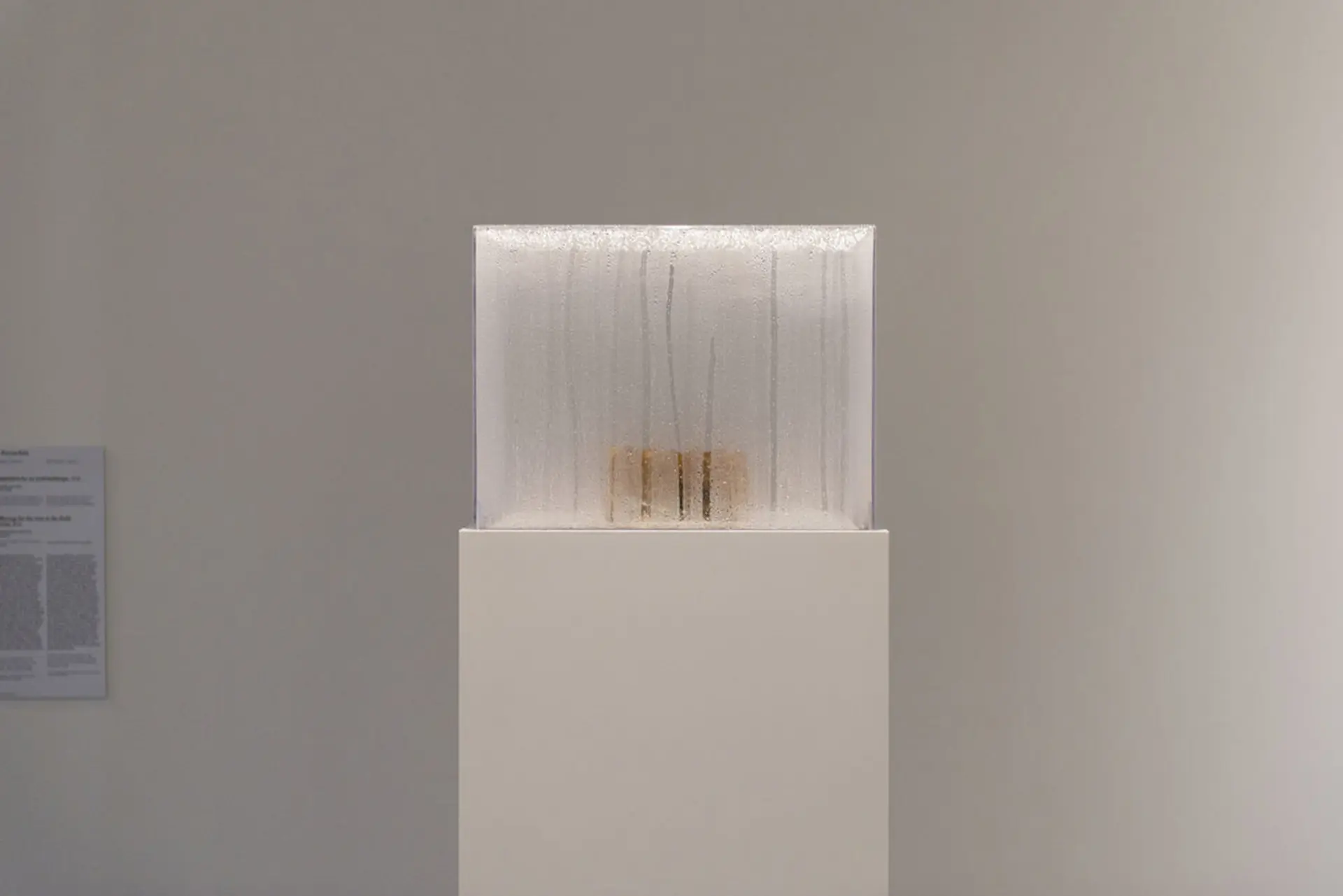
Gala Porras-Kim, Precipitation for an arid landscape, 2021-ongoing.
Rather than focus on binaries of preserving exported objects in a collection versus returning them to their home country, or replicating a former environment versus acclimating an object to new conditions, Porras-Kim opens up the field of possibilities for how such objects could be handled and contextualized. In Precipitation for an arid landscape, for example, she rendered the Mayan artifacts in colored pencil and flashe paint in several large-scale photorealistic drawings depicting objects arranged according to the Peabody cataloging system. This imagery was accompanied at Amant by a slab-shaped sculpture made of copal—a clear resin also found in the sinkhole—and dust collected from the objects (the sculpture is designed and remade by each institution that shows the work).
As a stand-in for the collection, this object is routinely moistened with rainwater collected by the institution where it is displayed, thus suggesting how the artifacts might otherwise be “conserved” or displayed in a fashion more consistent with their initial ritual context. Through this indirect execution of an alternative conservation method, Porras-Kim provides a sensory experience that museum-goers might not access by merely looking at the dry and decontextualized necklaces, figurines, and vessels.
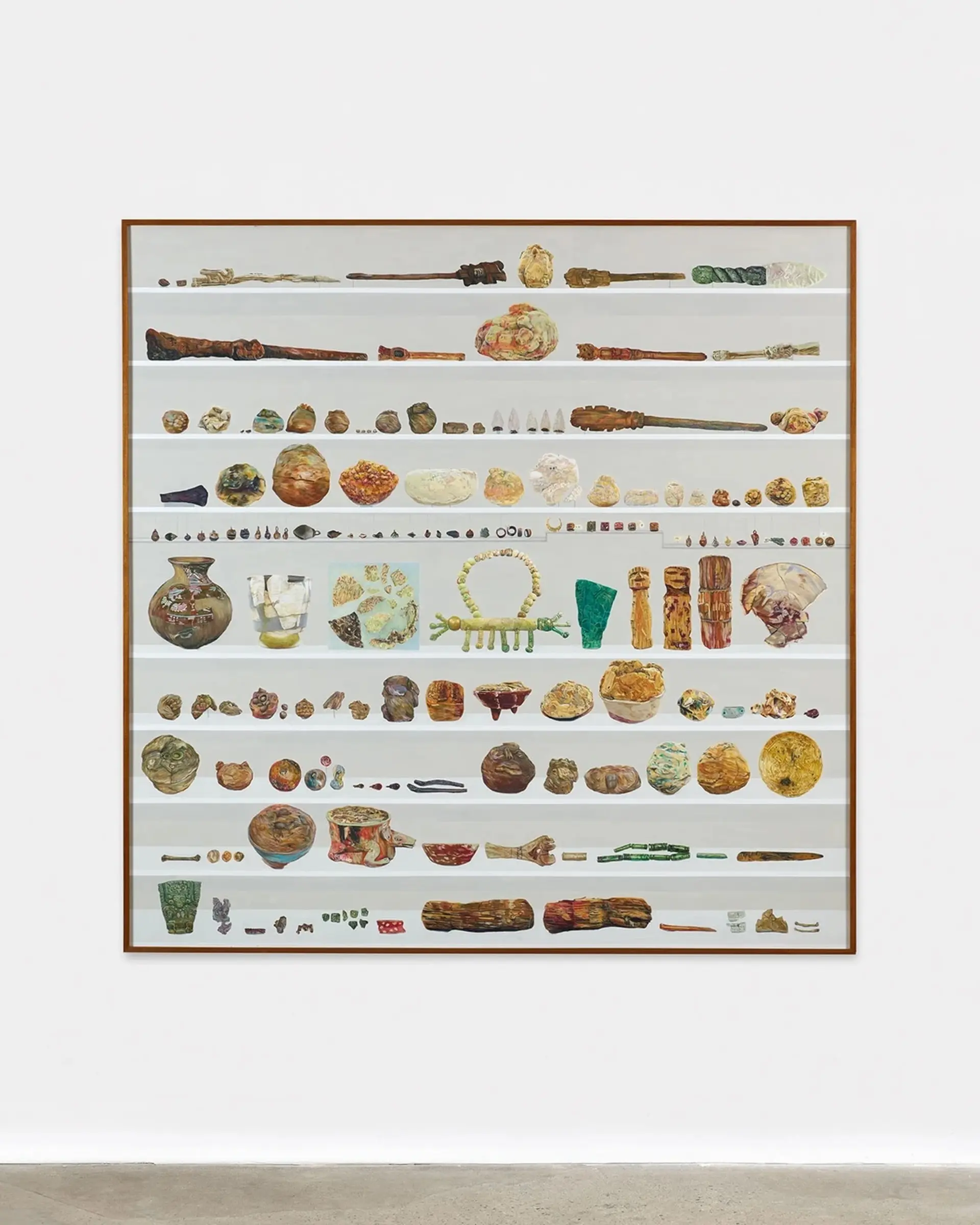
Gala Porras-Kim, 228 offerings for the Rain at the Peabody Museum, 2021.
Photo credit: Paul Salveson.
Much of this thinking, Porras-Kim is quick to point out, happens in conversation with museum staff—especially registrars and conservators, who understand and respond to the collection in ways an average museumgoer or even curator might not. The artist also recognizes that conservation methods do not necessarily counter an object’s prior or intended treatment. For example, if a mummified body is brought into an institution, its preservation there might seem to align with the person’s desire to be preserved. But in many cases, we may not, and may never, fully understand the original intentions and nuances of a burial or an object. Through her work, Porras-Kim does not expect to arrive at answers, but does intend to untether all of the things held in museums from their default contemporary positions.
Through these projects, Porras-Kim has posited that imagining the perspective of an object, material, or deceased person might be more illuminating than maintaining the traditional perspective of the institution. Consider, for example, one of those Mayan ritual objects that was later excavated, exported, and brought to the Peabody Museum: “It has been ‘historical’ for so little compared to the time it was submerged in the cenote,” the artist told me.
Similarly, Porras-Kim is drawing attention to the lives of institutions; she emphasizes that museums were built and restructured over time, their collections formed through long and often violent or exploitative accumulations. Such efforts cannot be undone overnight: You have to exert the same amount of labor involved in constructing institutions in order to recognize those other functions the objects still have, she emphasizes.
So while efforts to decolonize museums or repatriate stolen objects may seem stalled or slow-moving, by centering the object’s lifetime over the museum’s, the artist sees that ancient objects are “just moonlighting as this historical thing.” Within this timeline, “the museum is moving”—and its white walls may no longer be standing 200 years from now, a mere fraction of the thousands of years that the items from the cenote have survived. Like the charred skeleton in Brazil, in time, such artifacts might eventually return to the ground, resembling the earth as much as anything “historical” or “cultural.”
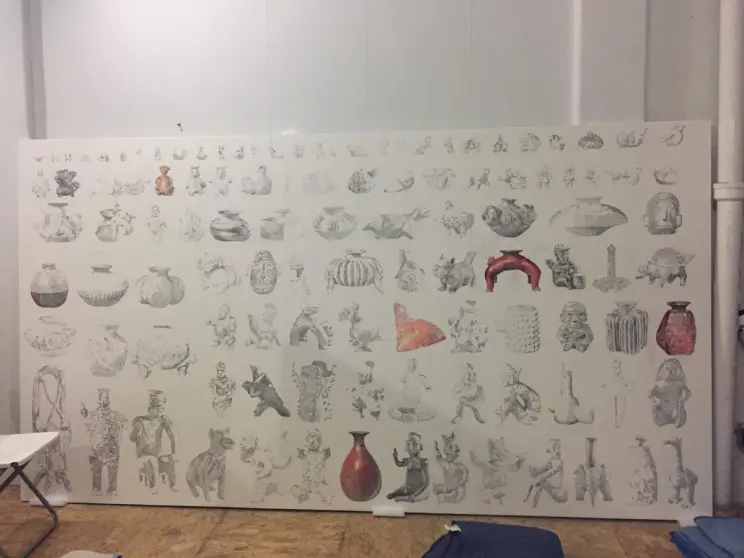
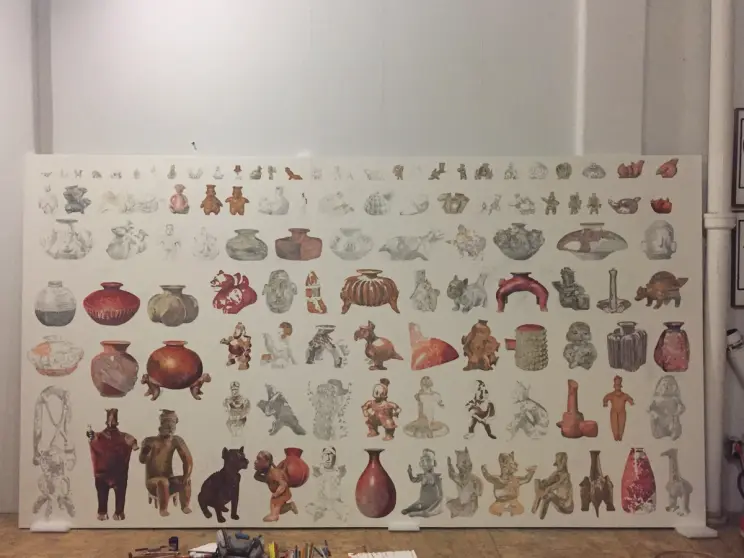
Concurrent to Expansive Data Fields, Porras-Kim is developing several exhibitions that function as additional test cases for alternative archival taxonomies. At the Storefront for Art and Architecture in New York, in an exhibition that opened this past September and is on view through early December, the artist built on her prior explorations of how an object’s original environment might inform how a collecting institution later cares for that object. In this case, the material on display in a long vitrine was mud that the artist sourced from the wetlands of the Yucatán Peninsula, a substance described in the exhibition text as “a tangible record of both geological and human histories.” While the Storefront is not usually climate-controlled, Porras-Kim’s installation—an interior space framed in wood and lined with plastic sheeting—was insulated and over-heated to create a miniature climate for the mud closer to that of its native wetlands. Relating this exhibition back to Porras-Kim’s Expansive Data Fields, if the “original climate” of an object were a data field, that attribute might help determine how the institution displays that object.
Meanwhile, for a forthcoming exhibition at the Carnegie Museum of Art in Pennsylvania, Porras-Kim is exploring how changes in institutional structures influence the attributes and contents of collections. The Carnegie Museum of Art is one of several institutions (also including a library and natural history museum) that all began as the Carnegie Institute, founded in 1895. But as one institution became many, Porras wondered what determined which objects went into which collection. Many similar objects now exist in both the library and the art museum, or the art museum and the natural history museum, and are cataloged differently depending on where they are held. For the exhibition, Porras-Kim will produce “index drawings” similar to those at Amant—diptychs of these similar but differently labeled objects, again underscoring how the categories we might see as default are in fact multiple and malleable.
What many of Porras-Kim’s projects have in common is an interest in how what is whole becomes fractured, and how what is fragmented comes to appear whole. If a collection is often meant to represent a historical narrative, the implications of Porras-Kim’s project are far-reaching; Expansive Data Fields could lead not only to alternative museums and hybrid conservation practices, but also to more diffuse and tentacular understandings of history. While Porras-Kim’s vivid drawings invite us to attend to the forms, shapes, and attributes of things, her proposed database edges toward the formless.
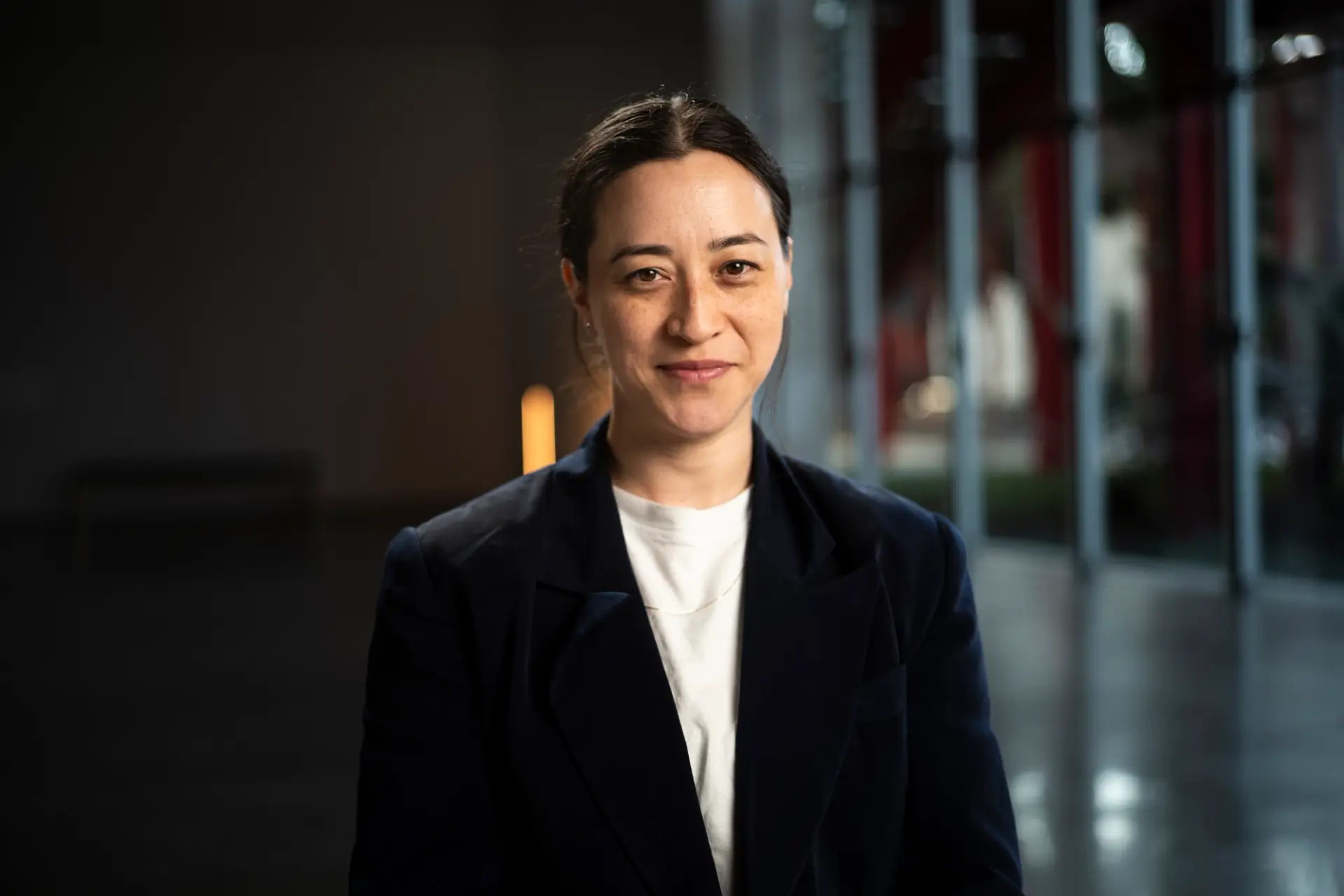
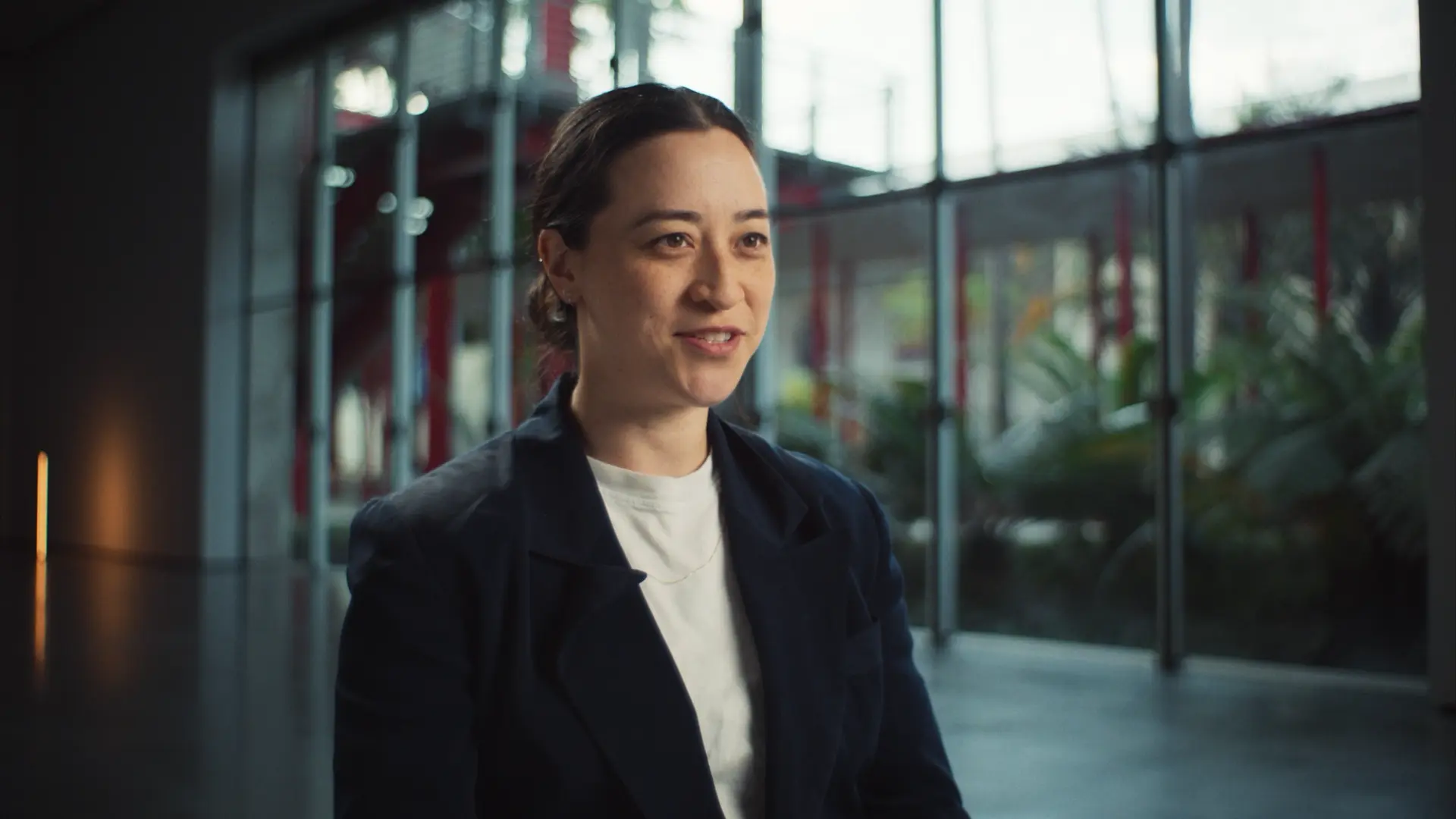
Gala-Porras Kim, Portrait of the Artist.
Photo: Mike Vitelli.