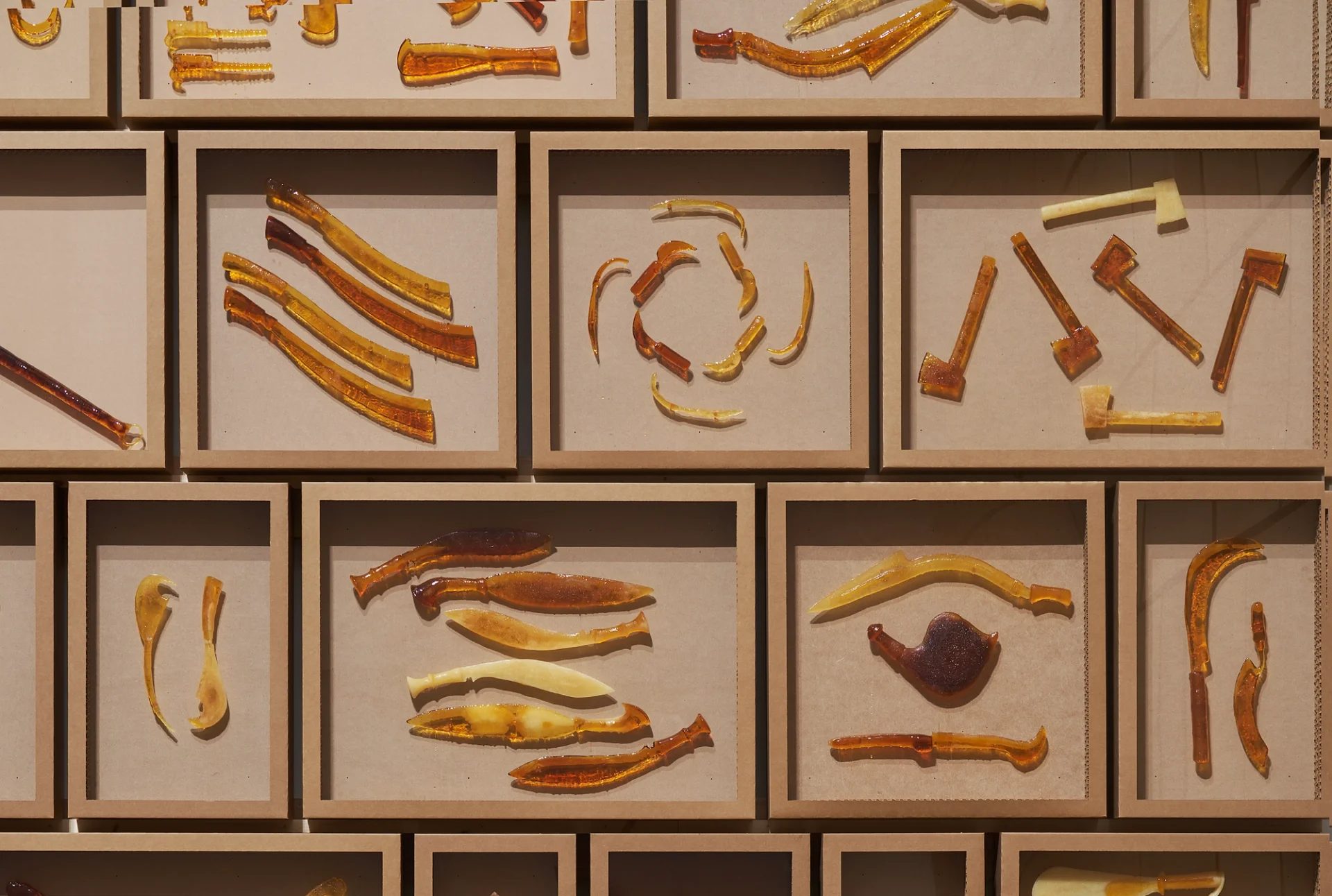
Jung Yeondoo, Wall of Blades (details), 2023, sugar, honeycomb board, sound-absorbing material, 75×36×18.5 cm (25), 75×49×18.5 cm (25), 75×75×18.5 cm (58), 75×101×18.5 cm (28), 75×114×18.5 cm (22), 75×153×18.5 cm (5), display dimension variable.
Courtesy of artist. Photograph by sonongji.
In her review of MMCA Hyundai Motor Series 2023: Jung Yeondoo – One Hundred Years of Travels, Minji Chun explores how Jung’s work addresses the overlooked history of Korea’s diaspora in Mexico to reveal a web of global interconnectedness.
Around the turn of the 20th century, over 1,000 Korean immigrants embarked from the port city of Incheon toward Mérida, the capital of Mexico’s Yucatán region. Leaving behind an impoverished homeland, these migrants were hired as contracted laborers, lured by the prospects of work, education, and refuge from Japan’s impending annexation of their homeland.
Upon their arrival, the group was dispersed across various “henequen,” or agave, plantations, where their dreams of a better life were met with oppressive working conditions. By the end of their contract, inhibited by the cost of re-migration and wary of returning to a colonized Korea, the migrants settled in Mexico.
Around this time, so the fable goes, the nopal or “prickly pear” cactus, originally native to Mexico, embarked on a journey in the opposite direction, ultimately finding its way to the shores of Jeju Island off the Southern coast of the Korean peninsula. On a trip to Jeju Island, Seoul-based artist Jung Yeondoo encountered colonies of these cacti, locally referred to as “baengnyeoncho,” which translates to “hundred-year plant,” in Korean.
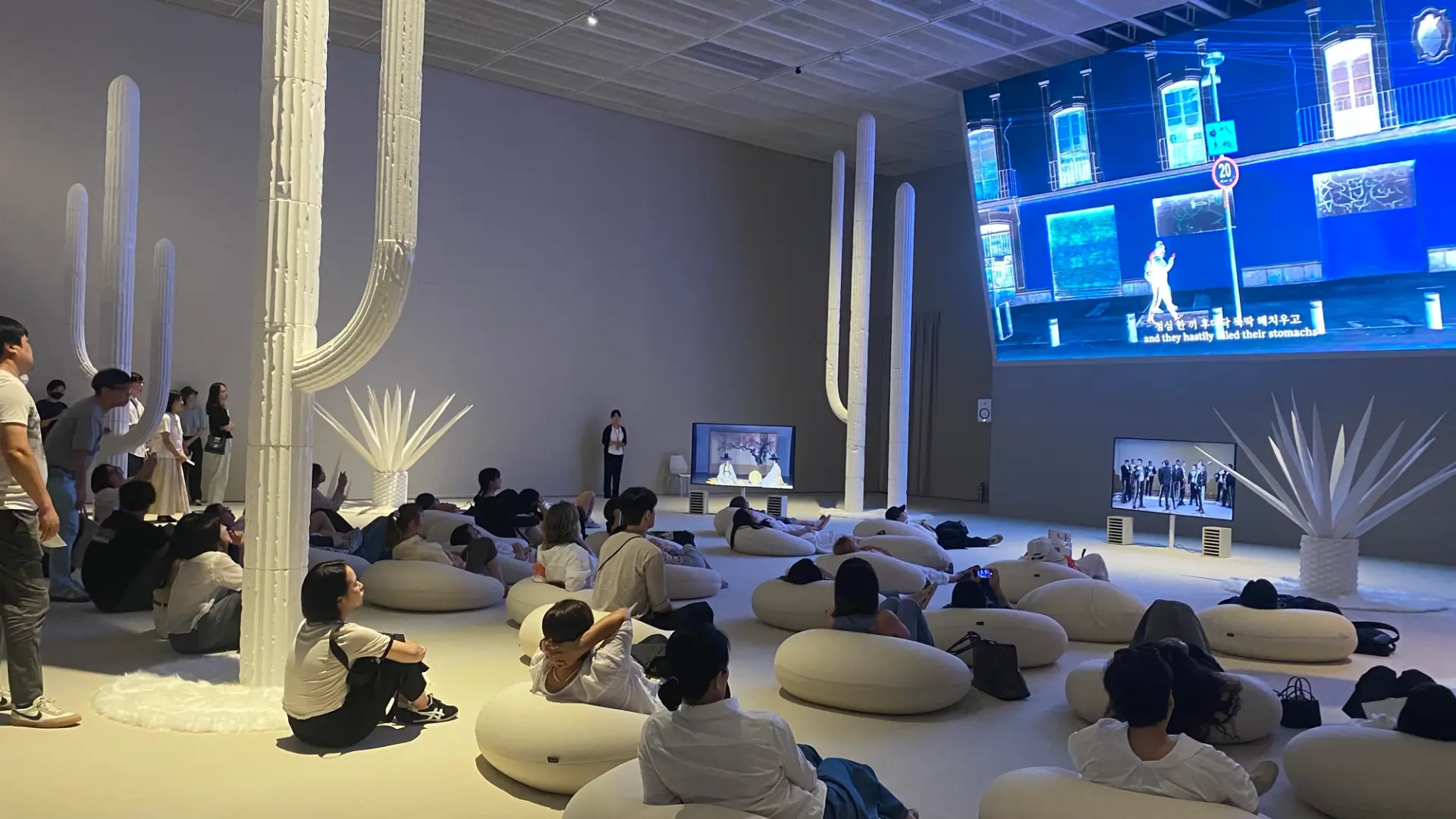
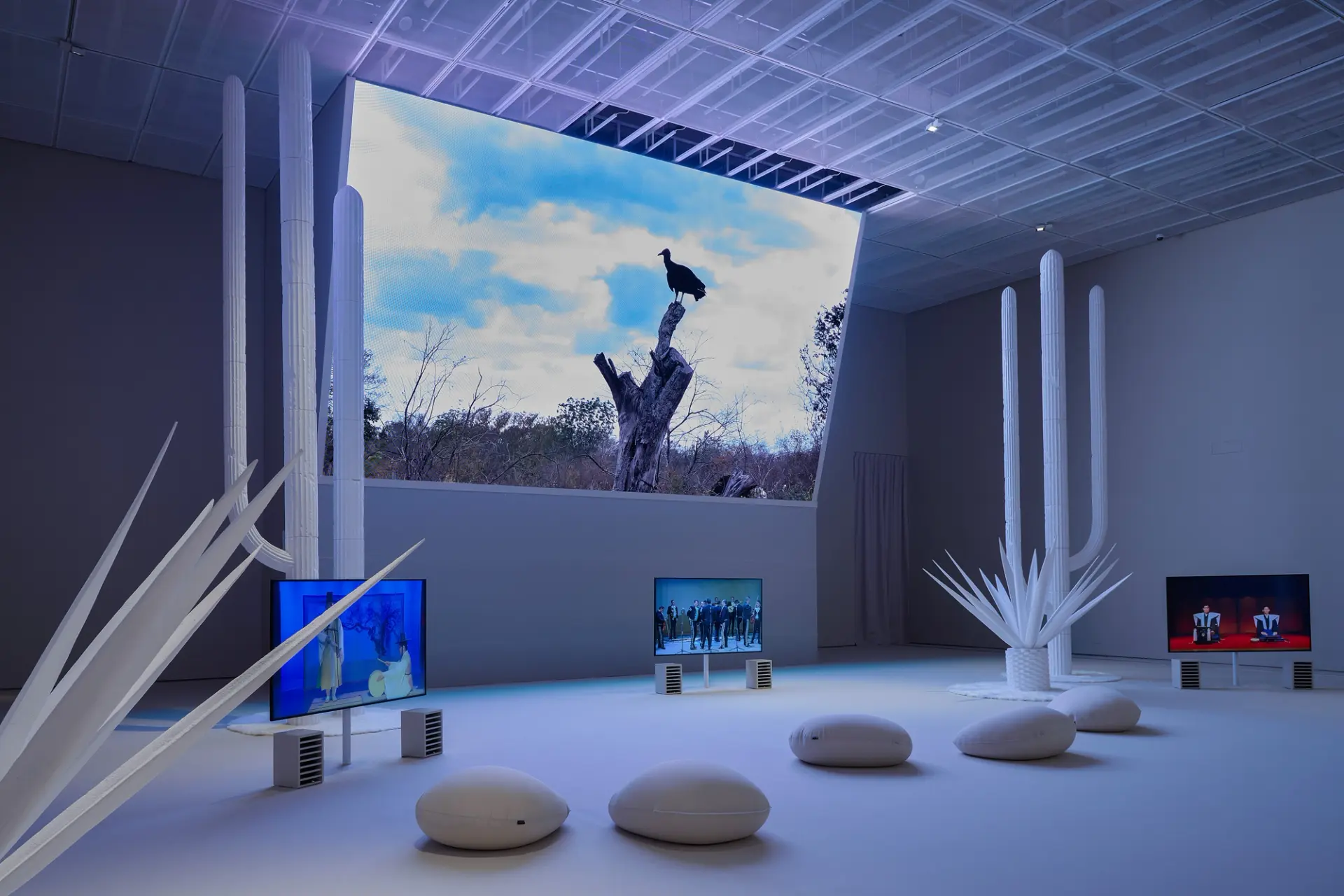
Jung Yeondoo, One Hundred Years of Travels, 2022, stage installation, mixed media, lights, single-channel HD digital video, color, sound, video, inkjet print, tufting, ink on paper, dimension variable, 35 min. 14 sec., 45×60 cm, 53×70 cm, 40×42 cm, 27x27 cm, 15.7x22.8 cm (6). Installation view.
Image provided by Hyundai Artlab.
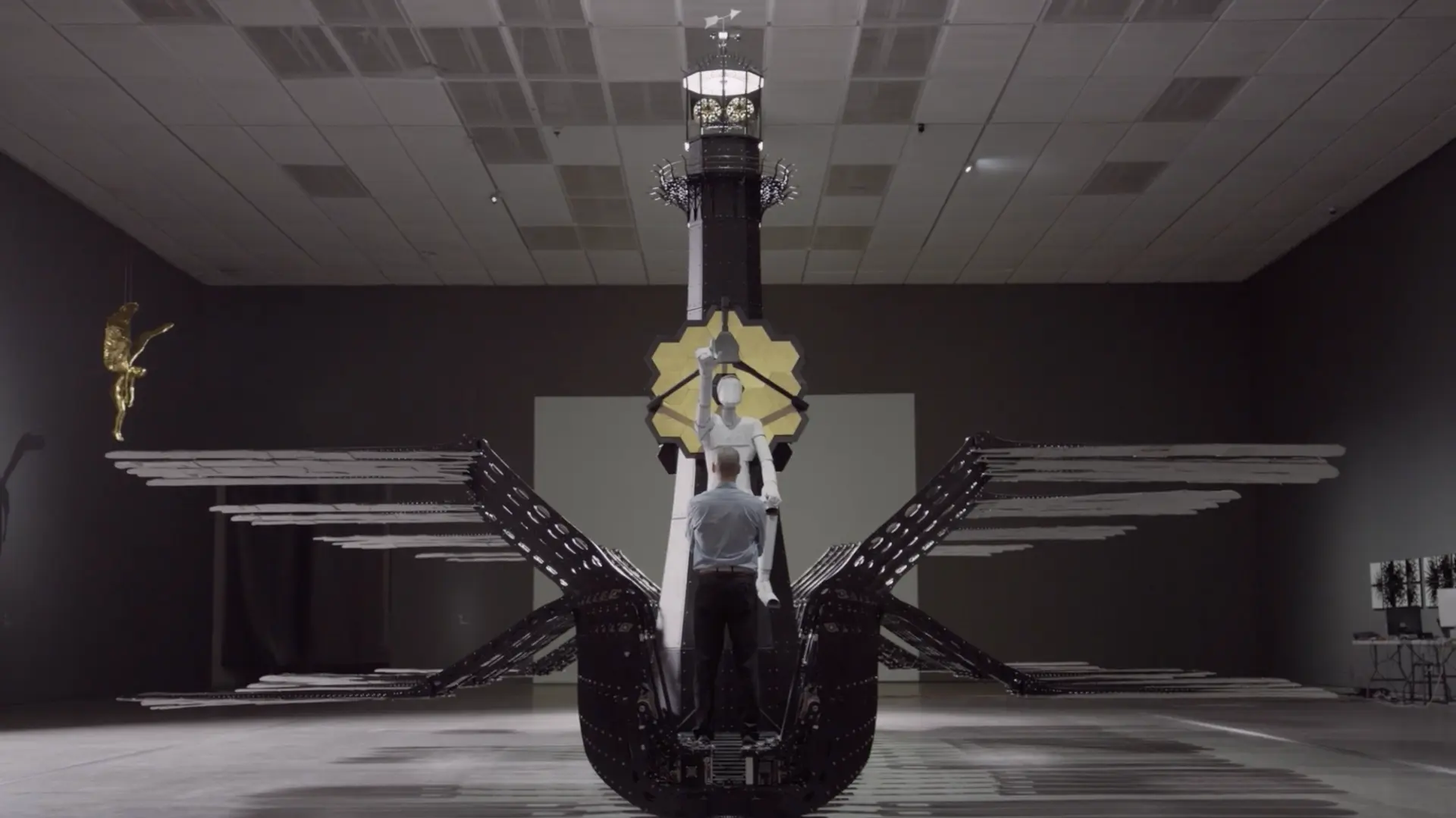
In September—more than a century after these journeys took place—Jung’s exhibition, MMCA Hyundai Motor Series: Jung Yeondoo - One Hundred Years of Travels, held its busy opening at MMCA, Seoul. In works which reflect themes of migration, colonization, and cultural hybridity, the fables making up the historical context of Jung’s work took on a kind of physical reality. One encounters a feeling of home coupled with a persistent sense of the unfamiliar: a wall of bladed farming tools are revealed as being made out of candied sugar-syrup; sculptures dangling from the ceiling, seemingly abstract, are actually physical metaphors for lyrics to an imagined song about the history of Korean diaspora. Throughout, Jung’s work evokes the perception of time as an unbroken flow of experiences and orientations, connecting disparate peoples across various histories, geographies, and cultures.
Nowhere is this idea more apparent than in One Hundred Years of Travels, a new eponymously titled video-based installation which leads the exhibition. Focusing on the little-known history of Mexico’s enduring Korean diaspora and interlacing that history with contemporary reflections and perspectives, Jung offers a thought-provoking exploration of the notion of cultural hybridity, intergenerational understandings of diaspora, and the non-linear notion of time in the migrant experience. Throughout the film, the words, stories, and records of Korean migrant workers are intertwined with Korean pansori, Japanese gidayū, and Mexican mariachi music. This symphony of melodies and cultures transcends physical borders, uniting seemingly disparate cultural expressions in a manner which feels evocative of the experience of diaspora as it is felt globally.
Jung’s Wall of Blades presents a similar kind of cultural variety. A 12-meter-high barricade of candied sugar machetes, the use of a seemingly benign sculptural material weaves together an intricate story about the Korean diaspora with that of other farm-based diaspora communities around the world, and speaks to the complex interplay between migration and imperialism in the process. Made of a substance from the same crop they were built to harvest, these golden-colored tools serve as metaphors for the historical and systemic injustices of cash crop industries of the past, and reveal the ways these industrial histories continue to implicate the marginalized communities they originally exploited.
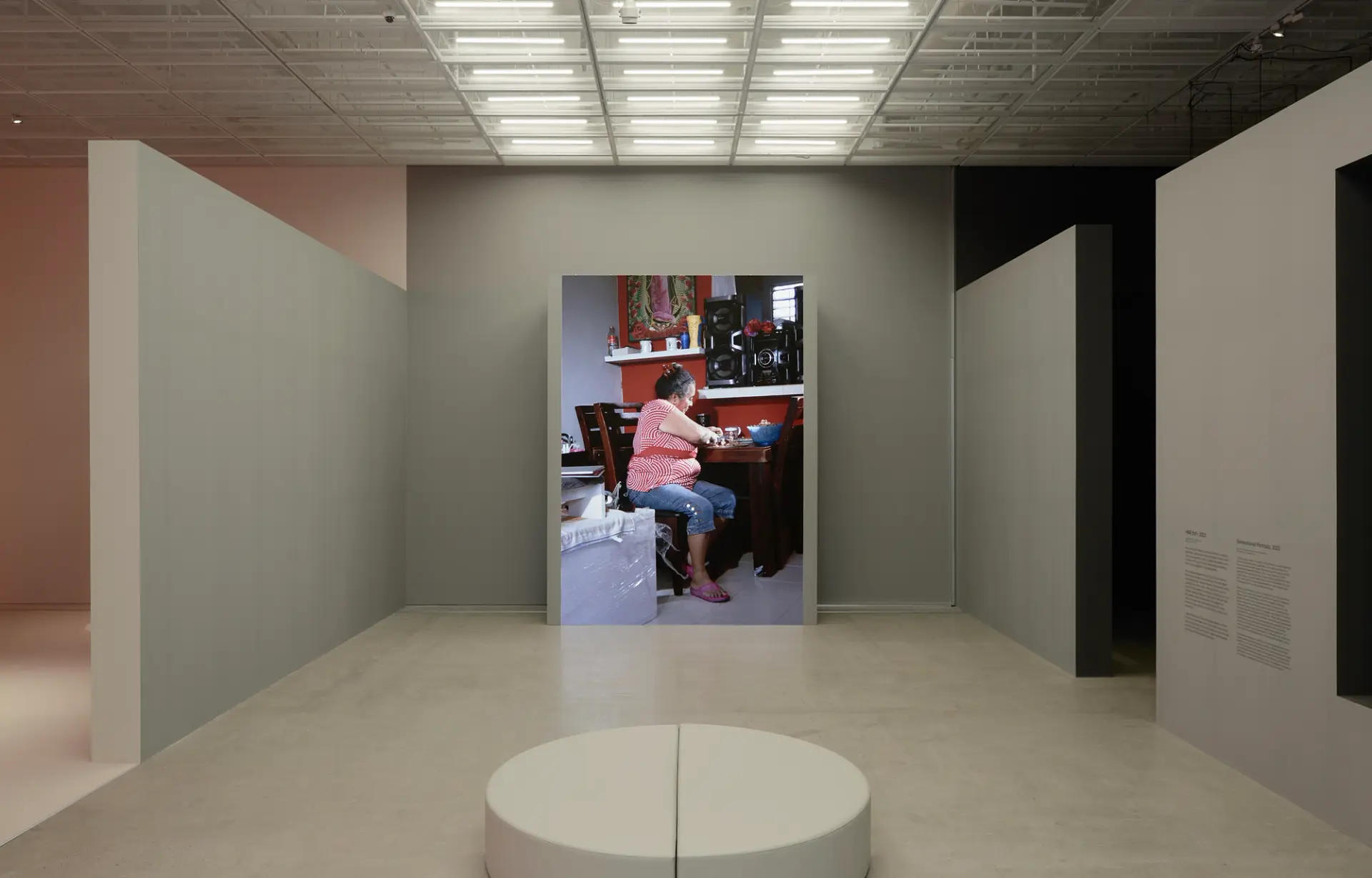
Jung Yeondoo, Generational Portraits, 2023, two-channel HD digital video, LED screen, color, 22 min., 500 x 350 cm (2). Installation view.
Courtesy of artist. Photograph by sonongji.
The sense of irony in these histories isn’t lost on Jung. In Generation Portrait, a slow-motion video work which captures the lives of twelve descendents of Korean immigrants living in Mexico, one sees how members of different generations navigate their relationship with the idea of homeland in contrasting ways. The artist brings to light the disparity of experience between parents and their children, as both groups continue to negotiate their place in a land which some call foreign and others home. In these thoughtfully framed moments, Jung captures the subtle nuances of these dynamics, inviting viewers to reflect on the passage of time and its impact on one's cultural heritage. In Jung’s sound installation Imaginary Song, visitors find themselves immersed in the voices of immigrants currently living in Korea. Their stories unfold against a backdrop of tropical plant-shaped structures, each fitted with directional speakers. As present-day immigrants from around the world—speaking languages which include Japanese, Spanish, Arabic, Hungarian, Telugu, and Indonesian—share their dreams and struggles, one is reminded of the sense of isolation experienced by Korean laborers a century ago.
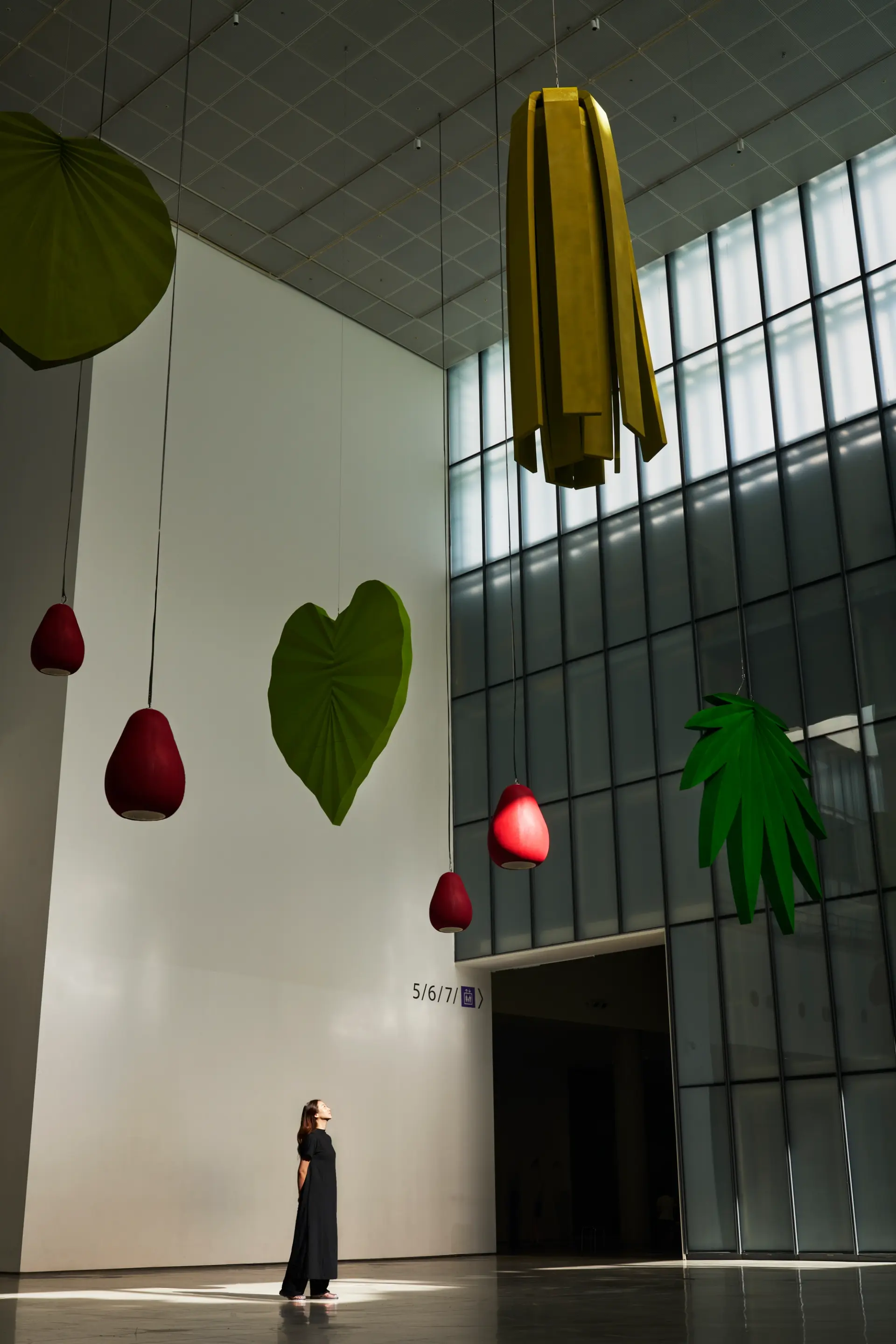
Jung Yeondoo, Imaginary Song, 2023, sound installation, super-directional speakers, sub-woofer, amplifiers, audio interface, sound absorbing material sculptures, wires, 251.4×306.2×20 cm, 300.5×227.8×20 cm, 287.5×158.6×20 cm, 250×230.3×20 cm, 250×73×73 cm, 72.2×54.2×54.2 cm (6), display dimension variable. Installation view.
Photograph by sonongji.
What emerges from the experience of witnessing so many tales of movement—all expressed in close proximity and often in closely interacting ways—is a prevailing sense not of universality but of multiplicity. Jung isn’t interested in weaving various legacies of diaspora together into a comprehensive narrative of the human condition. Rather, his work speaks with sensitivity and nuance towards a broader understanding of the histories and legacies of migration, with particular and focused attention on the lived experience of the people whose lives and labors were—and continue to be—shaped by over a century of travels.
In times of emergent environmental and economic crises, which are driving the mass movement of peoples across continents just as colonialism did a century ago, Jung’s fables take on a particular thematic urgency. Serving to remind us that the legacy of diaspora is not of the past but of the present, MMCA Hyundai Motor Series 2023: Jung Yeondoo – One Hundred Years of Travels offers a resounding recognition of the enduring interconnectedness of our global community.