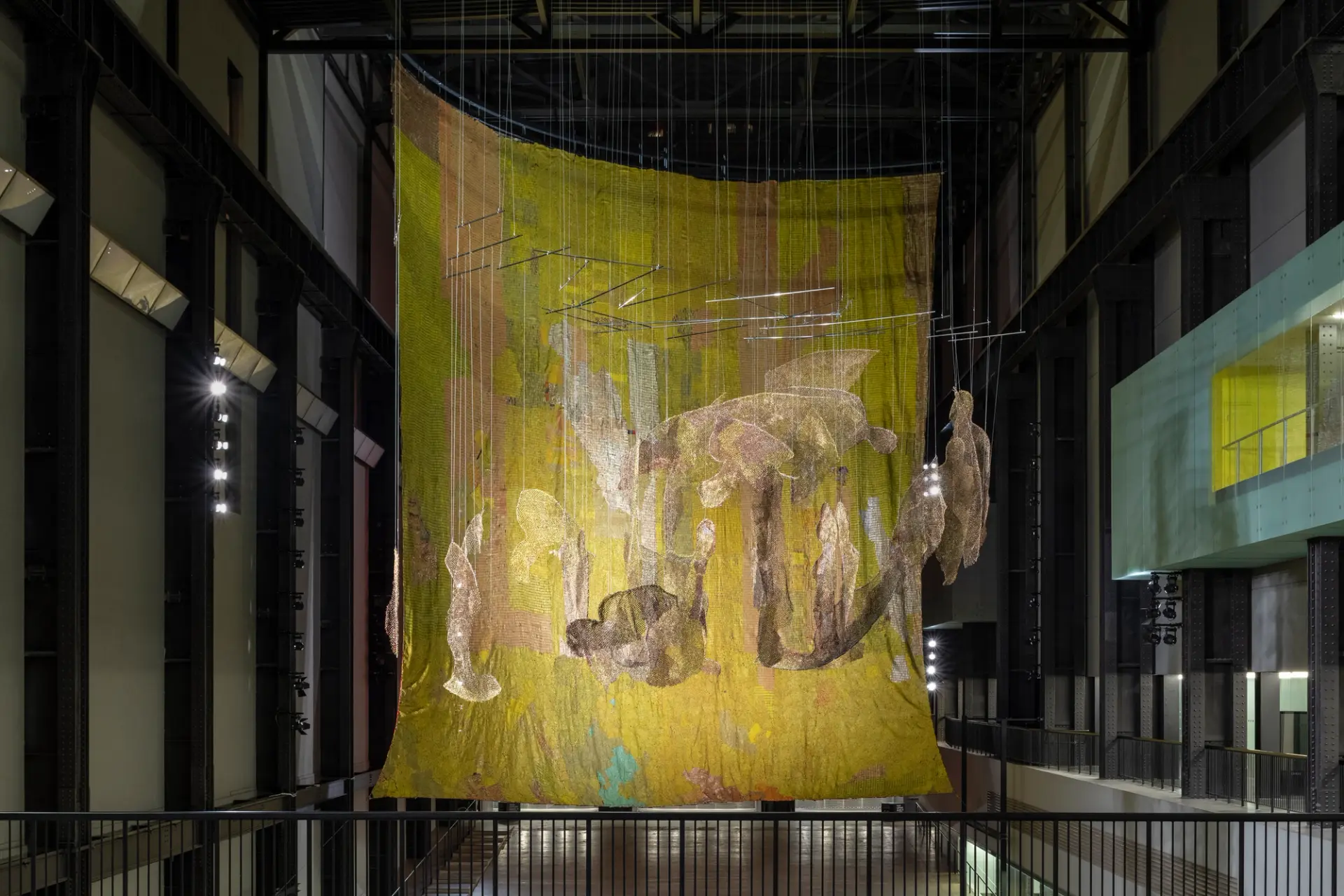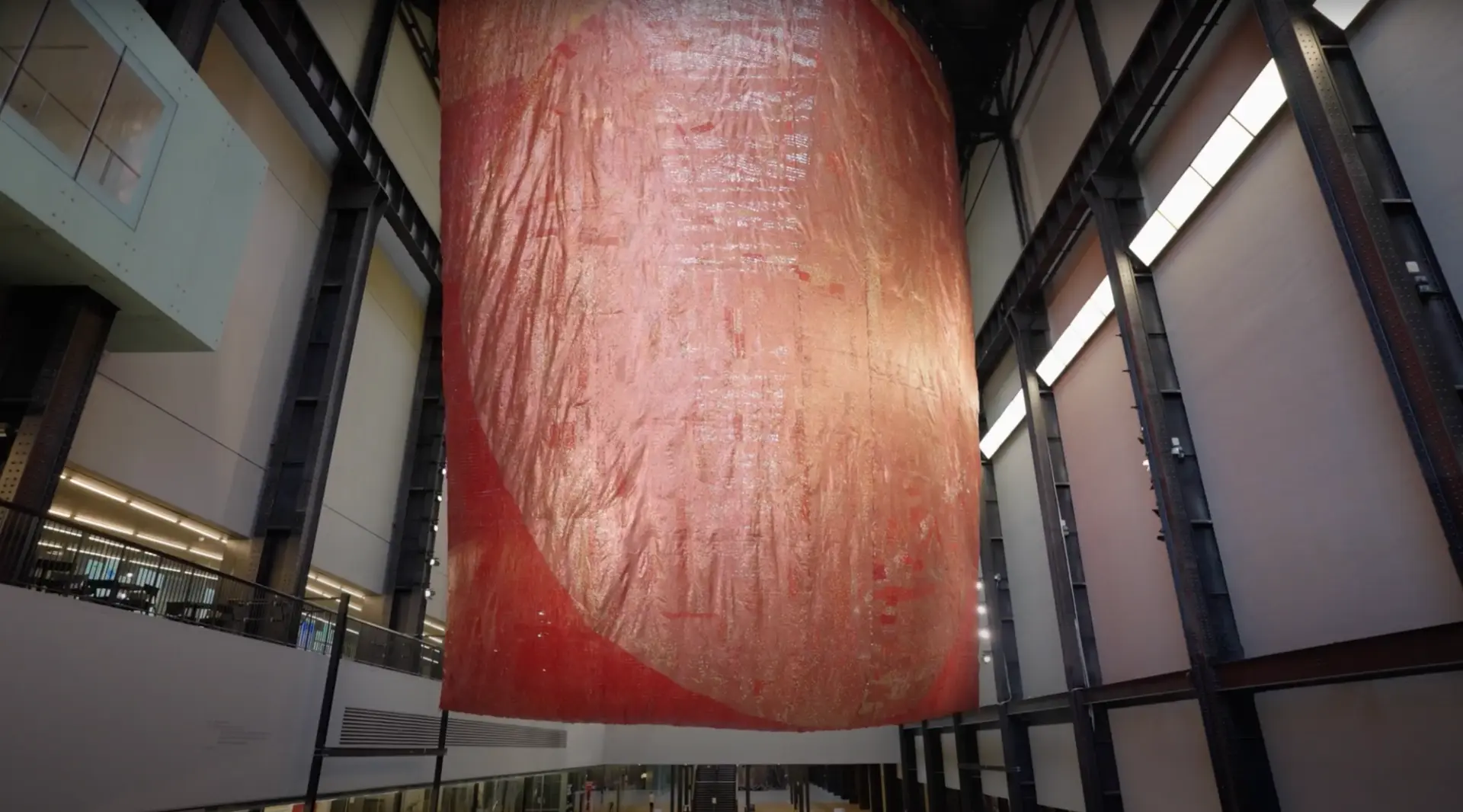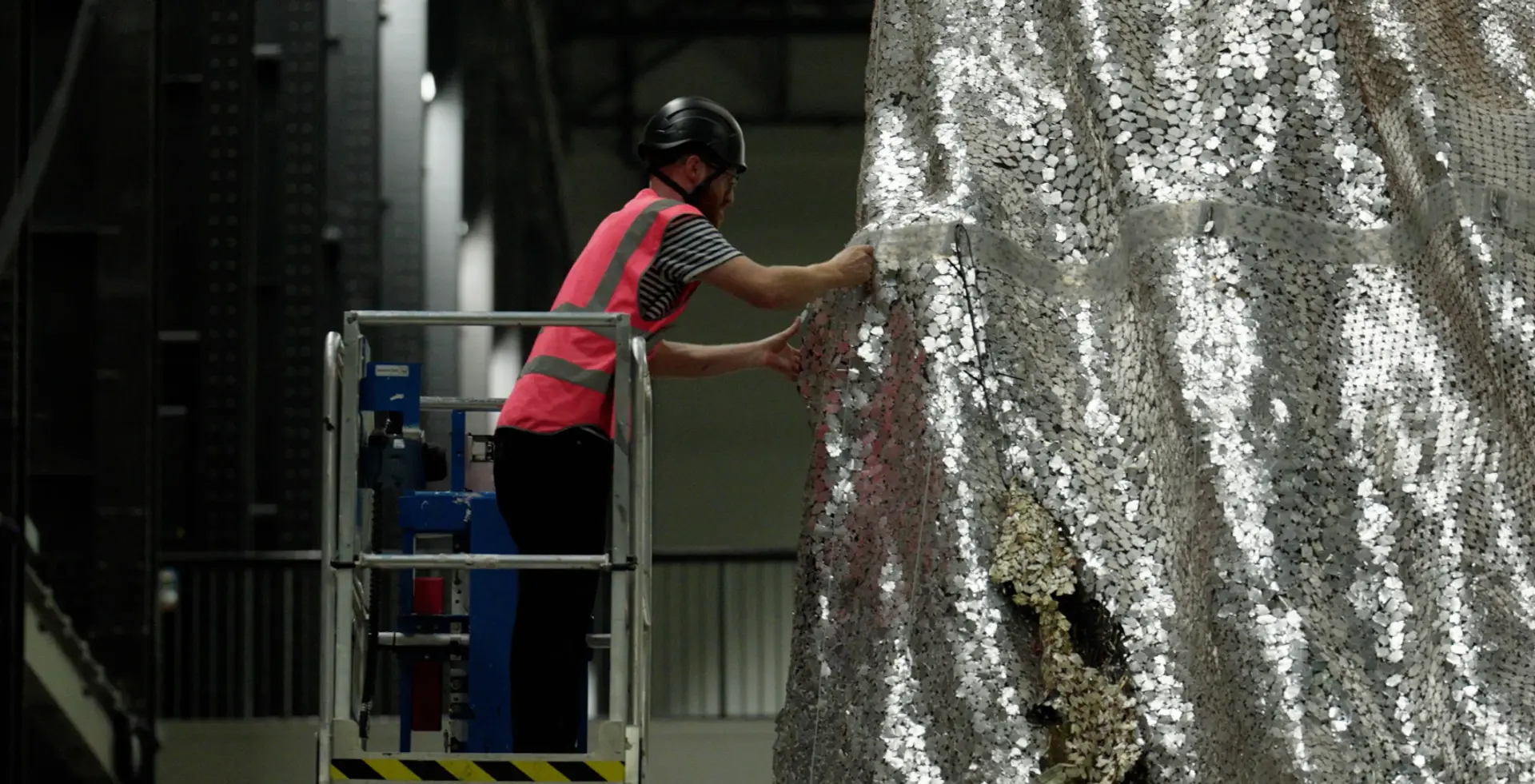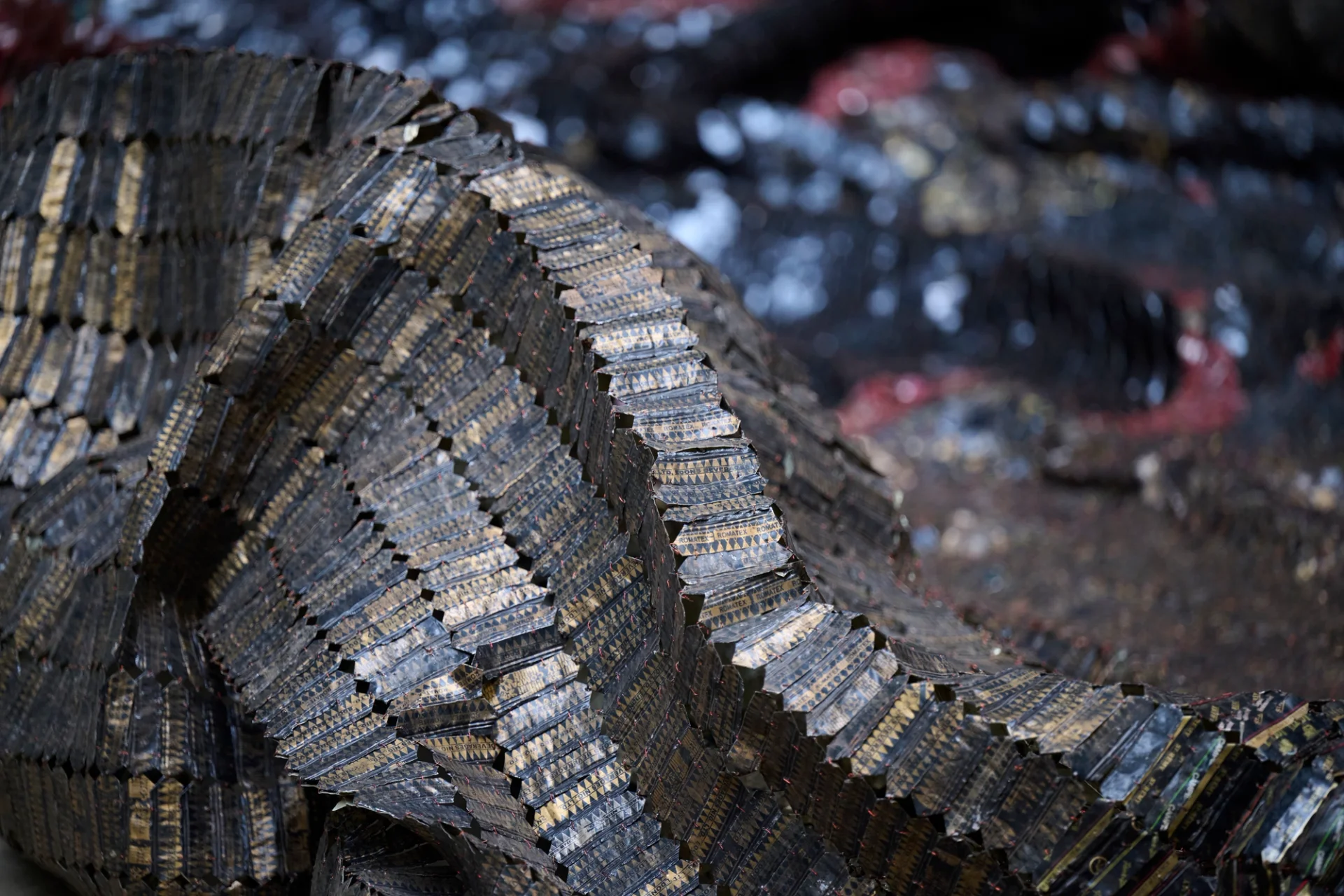
Hyundai Commission: El Anatsui: Behind the Red Moon, Installation View
Photo ©Tate (Ben Fisher Photography)
Aindrea Emelife on how the works in Hyundai Commission: El Anatsui: Behind the Red Moon are charged by the lives and communities of the people it took to build them.
Nigerian-British art historian, critic, and curator Aindrea Emelife is interested in questions surrounding colonial and decolonial histories in Africa, with a focus on transnational exchange and the politics of representation. She is the curator of the second ever Nigerian Pavilion at the forthcoming 2024 Venice Biennale. Emelife has been instrumental in bringing Nigerian art to international platforms, including her widely acclaimed 2022 exhibition "BLACK VENUS" at Somerset House, which surveyed the history of Black women and their identities within the art world, and her ongoing work as curator of The Museum of West African Art (MOWAA) in Benin City.
When El was studying at the University of Science and Technology in Kumasi, Ghana, the curriculum was skewed towards Western Art, in part due to an affiliation with Goldsmiths, University of London at the time. It is probable then that El was thinking about, and imagining, so to conjure forth, an art history that belonged to him, an artistic heirloom that belongs to us as Africans. Anatsui has brought many such heirlooms into the world and now, in bombastic, shimmering, and historically potent delight, in Hyundai Commission: El Anatsui: Behind the Red Moon, the newly commissioned pieces in the Turbine Hall at Tate Modern.
As Africans, we have always found places to gather to think on matters like this. The Mbari Clubs of Nigeria, founded in 1961, and for Anatsui, the Kumasi Cultural Centre, where he and his circle would listen to music, watch artists painting, witness fabric being woven and printed upon…culture is always a living culture in Africa.
The use of everyday materials is grounded in the pursuit of finding an “Indigenous” language of one’s own. It can be seen in his early work, such as “No Child is born with all his teeth” (1973), currently in the collection of the University of Nsukka Nigeria, and it can be seen in the bold new commission at Tate.
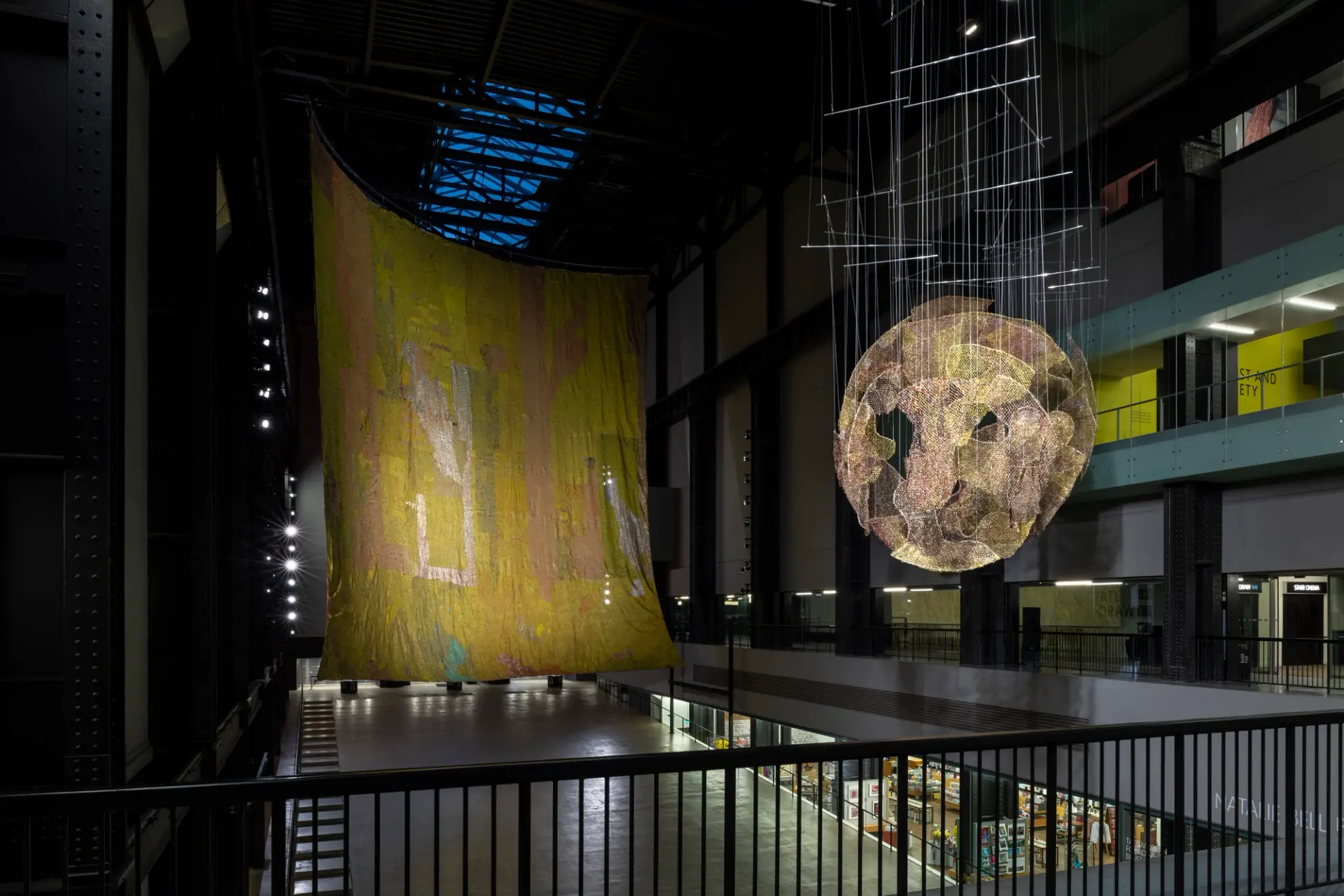
Hyundai Commission: El Anatsui: Behind the Red Moon, Installation View.
Photo ©Tate (Joe Humphrys)
In early Fall, as the unveiling of his new commission approached, there was a sense of serendipity. To recognize this moment is to recognize El Anatsui and all that he represents, and to think of his work in relation to those who surround him. In many ways, this is a crystallization of a moment that was vibrant then, in Nsukka, Nigeria, and vibrant now, as the world narrows focus on Nigeria.
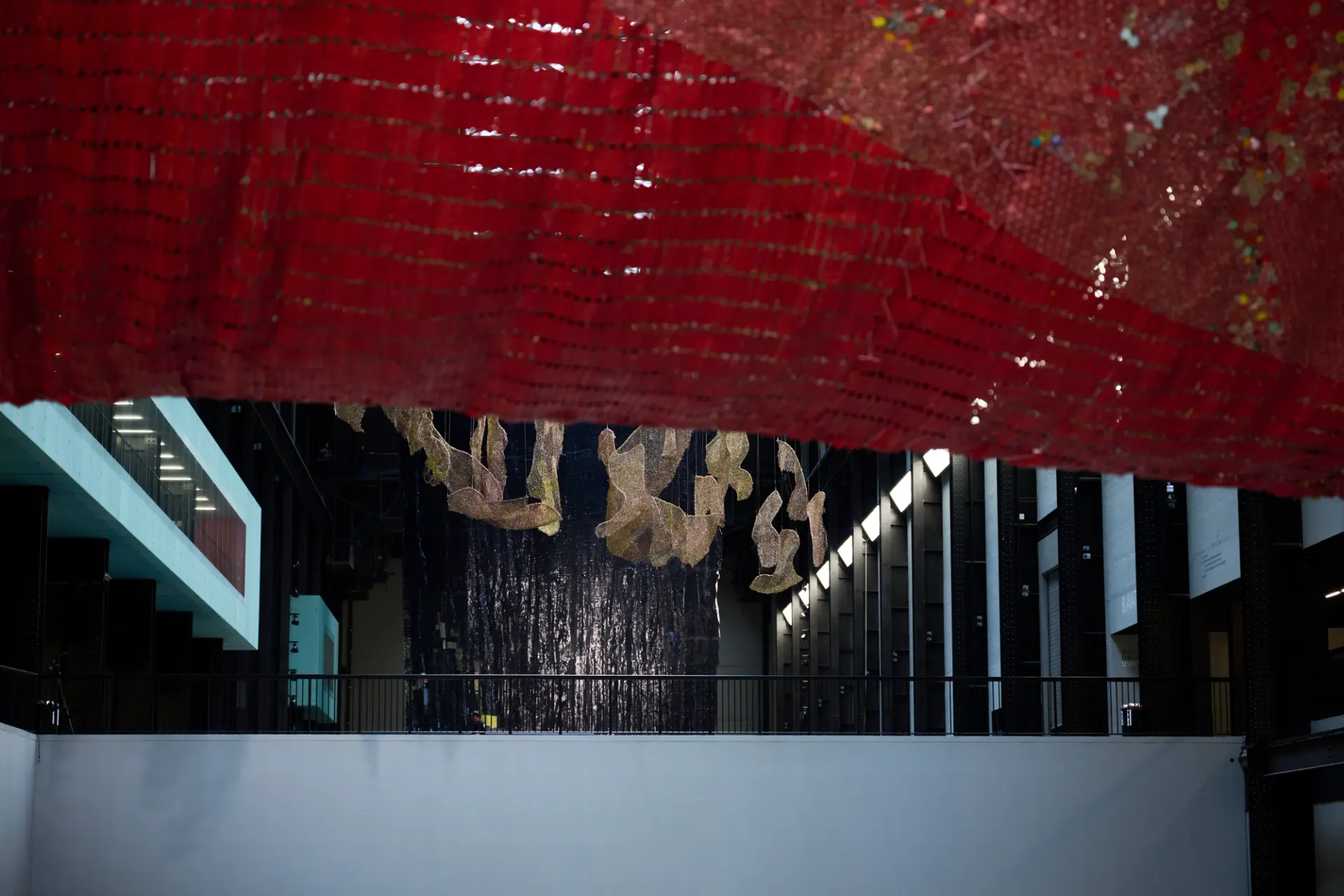
Hyundai Commission: El Anatsui: Behind the Red Moon, Installation View.
Photo ©Tate (Ben Fisher Photography)
It is interesting to consider when we became aware of El Anatsui’s work. For many, he seemingly came out of nowhere in 2007 with the Venice Biennale, with a powerful bottle cap aesthetic that stuck in international minds and piqued interest. This novelty, of course, is just one moment in a, then, forty-year span of artistic production. In many ways, however tempting as I, similarly, embark on a similar journey to the Venice Biennale, it is more interesting to consider his work in relation to his generation of artists. By doing so, we can consider the historical and socio-political ideological contexts of his practice; understand the kinds of questions that artists were asking of themselves, of their nation and of their context, dive deep into the thinking at tipping edge independence of these students at Nsukka, and understand a significance of his work and this moment in new ways. Proving legacy is an accidental advantage of looking back, but moving to understand how the difference of time and location shapes and involves these ideas puts us at the center of the work.
After a British-style education, Anatsui underwent a period of “reschooling” before immersing himself, in 1975, in the vibrancy of the University of Nigeria, Nsukka, which was, at the time, fizzing with possibility and a central hub of intellectual production and the arts (literature, music, theater) with Chinua Achebe at the center. Witnessing Anatsui’s work now is going back in time and looking to the future in tandem. This spirit is in the nature of the sculptural object Anatsui developed.
What does it mean to create a metamorphic form? How do the many El Anatsui’s we have seen across venues create an amalgamated work? His work allows us to think about how form “meta-morphs” in physicality, and in our minds. El has spoken about his sculptures having the quality of living things. And like humans, their identities shift and grow over time. If we look for evolution in sculpture, we embrace the potential of living history and can reposition our consideration of Anatsui not just as a sculptor, but as a true conceptual artist. This animation of form is not by chance, and it is present in the many evocations in his practice.
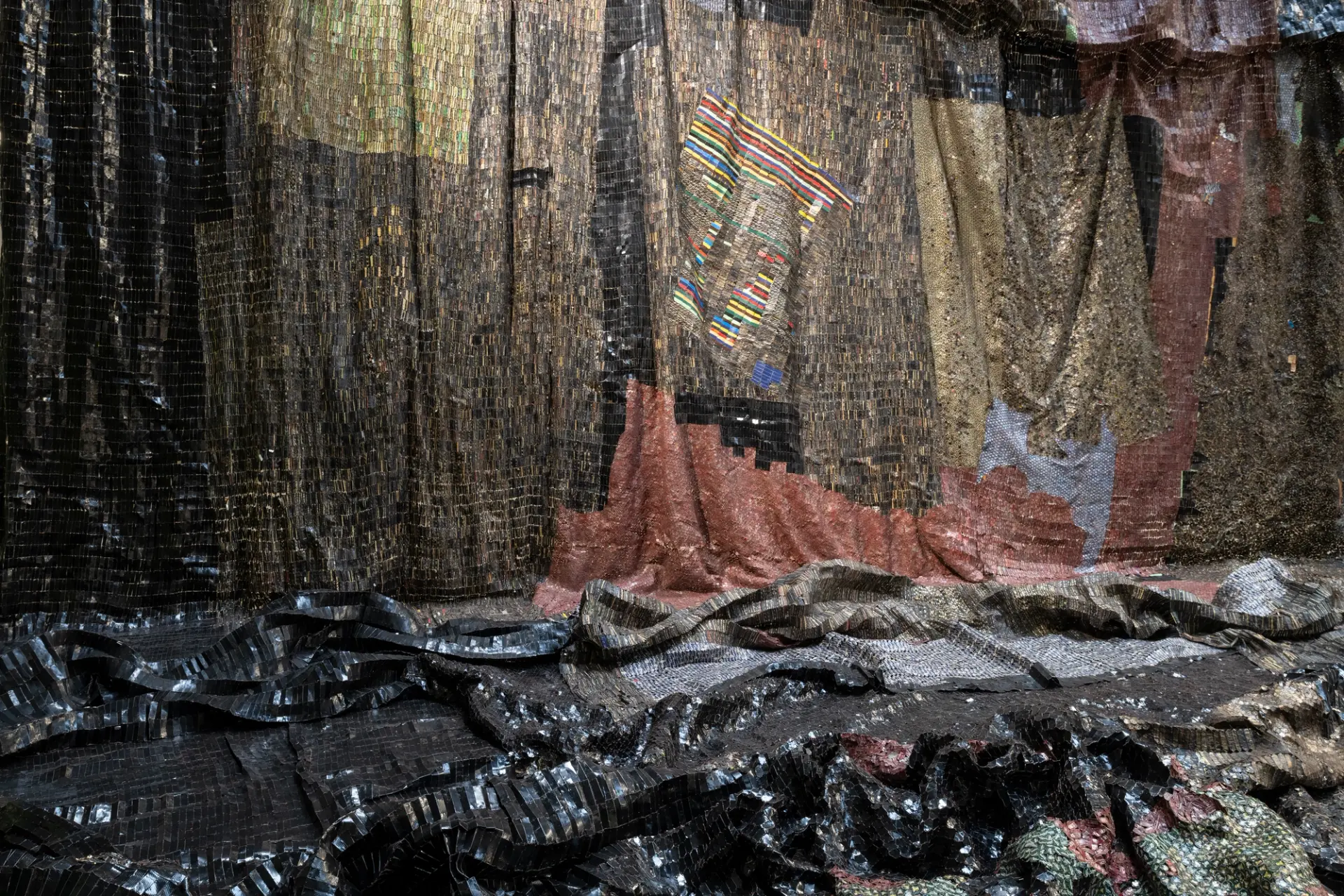
Hyundai Commission: El Anatsui: Behind the Red Moon, Installation View.
Photo ©Tate (Joe Humphrys)
Walking up to the Turbine Hall, we can ponder: is the form standing upright, or approaching us from the side? How do we read an object that resists, and how do we, too, resist the historical dogmas of art and behold El Anatsui’s work in new ways? By allowing work to be reconfigured in different ways, he disrupts the static ideas of art historical knowledge.
In conversation, Anatsui has used the metaphor, regarding his work, of “raising a child.” Aligned with the African proverb, that it “takes a village to raise a child,” this sentiment further encourages our own gesture to understand the work; for a curator to embed their own perspective in its configuration, for the viewer to read in personal manner and to call for a constant reinvention of the object.
How do we bear witness to the work, aware of the ethnographic gaze that is often assigned? How do we eschew the ready-made comparisons to kente cloth and other convenient fallacies, and look, with fervor, with the deserved sophistication and consider the nuance of his deliverance?
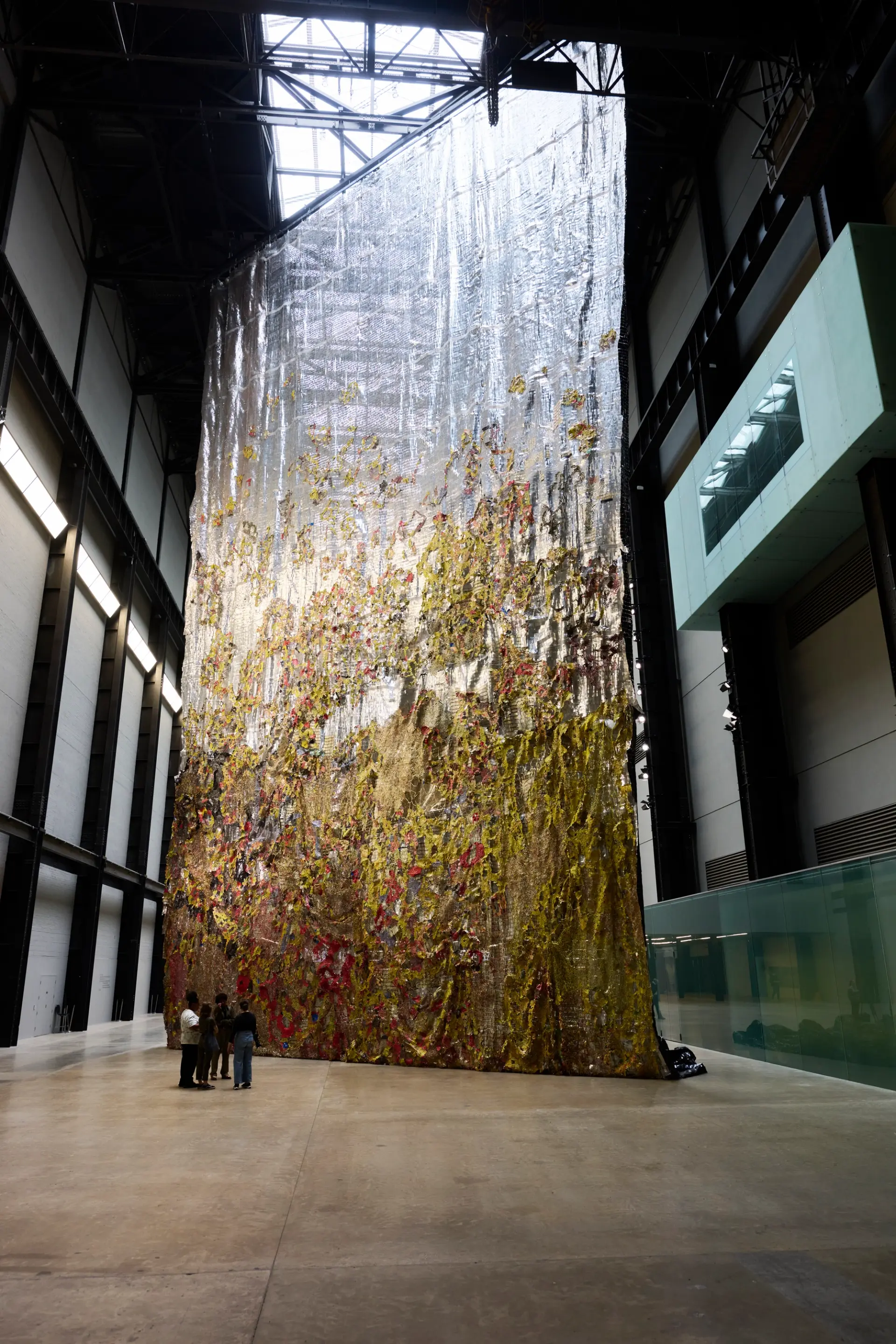
Hyundai Commission: El Anatsui: Behind the Red Moon, Installation View.
Photo ©Tate (Ben Fisher Photography)
There is cultural and historical reasoning for this game. The idea that no condition is permanent is central to West African philosophy; it reckons with the unpredictable. Truly, no condition is permanent, and this is evoked in a deep-rooted cultural feeling that contextualizes the inventiveness of his material marvels we must push past the material. And so, as we are dwarfed by this commission, one can only wonder— where shall we meet again? Will I recognize you? We are always strangers and friends with Anatsui’s majesty. As the work, as much of his does, metamorphoses, we question the sacredness of finality in art. Like humans, the work endures.
An element of change is lurking in his work—in the gathering of oil slick Act III: The Wall in the way Act II: The World catches and is activated by the natural movement of the wind. Pieces of things come together to form and be reformed. This freedom is present in his older carved works; slats put together to form a composition. These slats are numbered, but these configuration serves as an initial proposition—the future reconfigurations are up to the unpredictable swings of life. Like fabric’s infinite possibilities of draping, of folds—sharp or soft—the fluidity too is like material. The precarity comes with the interconnectedness.
There is a balance and tension between finished product and creative process. The doing is in the work. Community life imbues materially in Hyundai Commission: El Anatsui: Behind the Red Moon. In truth, one can consider human life and the communities we form as his found material.